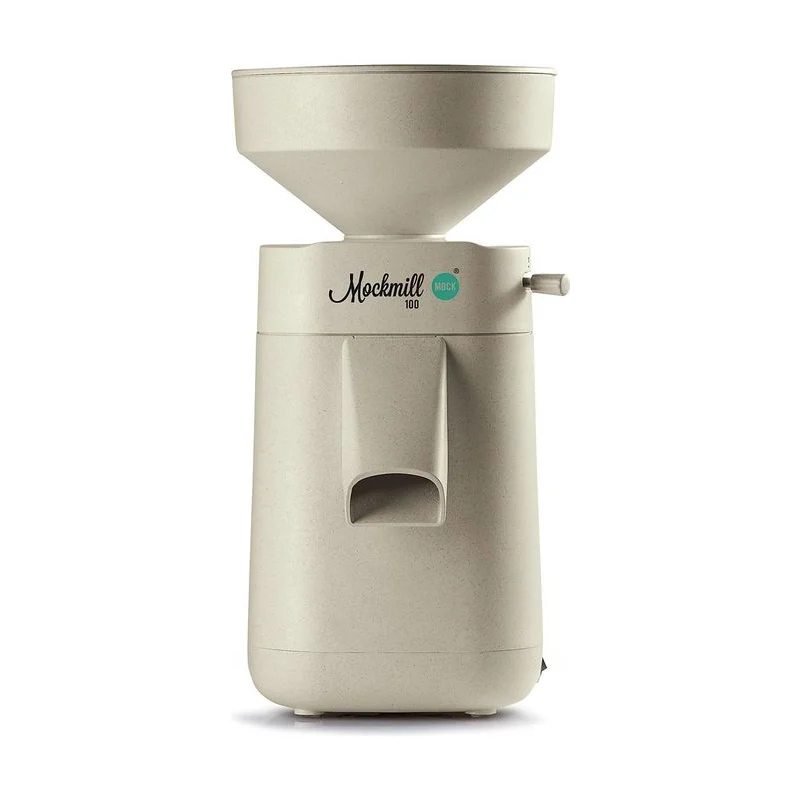
The Mockmill 100 is a stone grain mill, and the lower-specified of the two the manual covers
What this section establishes
- The Mockmill 100 is a stone mill: the owner’s manual cover describes the unit as a stone mill for milling grains, pulses and spices, and both grinding surfaces are stated as corundum ceramic.
- One owner’s manual covers the Mockmill 100 and the Mockmill 200 and prints the differing figures as pairs; the Mockmill 100 takes the first of each, at 360 W, approximately 100 g of wheat per minute and 6.6 kg, though the mockmill.us listing states 6 kg for the weight instead.
- Wolfgang Mock GmbH publishes dimensions of 380 x 220 x 190 mm, or 15 by 8.7 by 7.5 inches, a cable of approximately 150 cm, protection class 1, and a box holding the mill with its hopper cover plus the owner’s manual.
Stone milling and impact milling are two different machines doing the same job, and the Mockmill 100 is squarely the first kind. A stone mill grinds grain between two abrasive burr surfaces that turn against one another, so the texture is set by how far apart those surfaces sit. An impact mill instead flings grain into a chamber where spinning fins shatter it, so the texture is set by how long the grain stays in the chamber. The Mockmill 100 carries corundum ceramic stones, and the cover of its owner’s manual describes the unit as a stone mill for milling grains, pulses and spices.
The Mockmill 100 is the lower-specified of the two models its owner’s manual covers. The same manual serves the Mockmill 100 and the Mockmill 200, and where a figure differs between them it is printed as a pair: 360 W and 600 W for power, approximately 100 g and 200 g of wheat per minute for milling rate, 6.6 kg and 8 kg for weight. The Mockmill 100 takes the first figure in each pair. What the step between the two models buys, and what it does not, is worked through at Mockmill 100 vs Mockmill 200.
The published frame around the machine is compact. Wolfgang Mock GmbH lists dimensions of 380 x 220 x 190 mm, or 15 by 8.7 by 7.5 inches, a cable of approximately 150 cm or 6 feet, protection class 1, and a box containing the mill with its hopper cover plus the owner’s manual. The manufacturer’s own webshop describes the same contents as the Mockmill with cone-lid and instruction manual. Both the US listing and the webshop state Made in Germany, and the manual’s back cover names Wolfgang Mock GmbH, Marie-Curie-Str. 5, 64823 Gross-Umstadt.
Readers arriving at this model are usually choosing between it and one other machine rather than shopping a whole category. The head-to-head against the NutriMill Harvest, the other stone mill most often set against it at this end of the market, is at NutriMill Harvest vs Mockmill 100.

Corundum ceramic stones in the Mockmill 100, and the stone diameter no document states
Corundum ceramic is the stated material of both grinding surfaces. The mockmill.us specification table gives the grinding mechanism as corundum ceramic grinding stones; the current owner’s manual gives the milling mechanism as corundum ceramic milling stones. Those are the same description in two wordings, and no source fetched offers a different material, a grit rating or a hardness figure for them.
The arrangement is described in the manual’s disassembly instructions rather than in any specification table, which is the only place the internal layout appears. The manual walks the owner through lifting off the top stone, which it calls the stator, at which point the bottom stone, the rotor, becomes visible and is attached to the motor shaft. It also warns the owner not to lose the two small springs that support the upper stone. So the Mockmill 100 turns one stone against a sprung, stationary partner, and the stones are user-accessible without tools being named as a barrier.
The manufacturer does not state a stone diameter. That absence matters more on a stone mill than on most specifications, because burr diameter is the figure a buyer would normally use to reason about surface area, heat and throughput. None of the five sources fetched publishes it, so any diameter quoted elsewhere for the Mockmill 100 is not coming from Wolfgang Mock GmbH’s own documentation. No stone lifespan, replacement interval or resurfacing guidance appears either.
One care rule attaches directly to the stones and is stated in absolute terms. The manual instructs that the millstones should never be cleaned with water or a wet cloth, and separately that the Mockmill must never be submerged in water or any other liquid. The full handling and cleaning rules are set out further down this page.
Now you can lift off the top stone (stator). The bottom stone (rotor) is then visible; it is attached to the motor shaft.
Stepless fineness adjustment and the 1 to 10 lever scale
What this section establishes
- Stepless adjustment leaves the Mockmill 100 with no detents to count, and the two published descriptions of its range differ at the coarse end: both product pages state stepless adjustment of the settings from very fine to coarse, while the current owner’s manual states variable from very fine to very coarse.
- The screw-in lever runs across a numbered 1 to 10 scale on which position 1 is the finest setting, and the mill leaves the factory pre-adjusted so that a quiet sound of the stones touching is audible at position 1 when it idles without grain.
- The lever can be loosened and re-indexed at position 10 or position 1, shifting the whole 1 to 10 range, so a setting number on the Mockmill 100 is a relative index and not a particle size; no source publishes a micron figure for any position.
The Mockmill 100 adjusts steplessly, which is the single mechanical fact that most shapes how it is used. Both product pages state stepless adjustment of the settings from very fine to coarse, meaning the control is continuously variable rather than clicking between fixed detents. The mockmill.us specification table records the milling grades as variable from very fine to coarse; the current manual records them as variable from very fine to very coarse. The two documents describe the same control with different endpoint wording, which is covered in the conflicts section below.
The control itself is a screw-in adjustment lever that moves across a numbered scale running from 1 to 10. The manual states that position 1 is the finest setting and that the mill leaves the factory pre-adjusted so that a quiet sound of the stones touching is audible at lever position 1 when the mill idles without grain. Higher lever numbers give coarser results. That calibration note is the closest thing the documentation provides to a reference point a new owner can verify by ear before any grain goes in.
The scale can be moved. The manual describes loosening the lever and re-indexing it at position 10 or position 1, which shifts the whole 1 to 10 range coarser or finer. The consequence for a buyer is that the numbers on the Mockmill 100 are a relative index, not absolute particle sizes: setting 4 on one owner’s mill and setting 4 on another’s need not be the same texture if either lever has been re-indexed, and neither corresponds to a published micron figure. Anyone following a setting recommended in a recipe or a forum post is following a relative position on a re-indexable scale.
The manual’s food tables put a Mockmill 100 lever setting against each permitted ingredient, so the scale is calibrated by the manufacturer per ingredient rather than left to the owner to discover. The spread of those settings shows how much of the range the machine is expected to use in practice.
No source states how many discrete settings the Mockmill 100 has, and given a stepless control the question is arguably malformed. A figure of 30 settings circulates online; on the sources fetched it appears in customer-review text on the retailer page, not in any manufacturer specification, and it is not recorded here as a specification. Nor does any source publish a micron output, a particle-size distribution or a flour-temperature figure for any setting.
- Finest published anchor: lever position 1, described as the finest setting, with a quiet sound of the stones touching audible at idle
- Amaranth, quinoa, teff, milo and buckwheat: 0 to 1, at the fine end of the scale
- Wheat, spelt, einkorn, kamut, rye and hulled barley: 1
- Oats: 3
- Cumin and aniseed: 4; caraway seeds and chickpeas: 4 to 5
- Chia seeds: 6 to 7
- Tonka beans: 9 to 10, the only entry using the coarse end of the published scale
Mockmill 100 hopper capacity, milling rate and 360 W motor
What this section establishes
- The Mockmill 100 motor is stated at 360 W by all three specification sources: the mockmill.us table, the manufacturer’s webshop table, and the current manual, which prints 360 W and 600 W as the Mockmill 100 and Mockmill 200 pair.
- The hopper holds 1,100 g of wheat, or 2 lbs 7 oz, and the published milling rate is approximately 100 g per minute, which puts a full wheat hopper at roughly eleven minutes on the manufacturer’s own two figures rather than on any observed run.
- No flour container is supplied with the Mockmill 100 and no container capacity is published; the manual’s own getting-started step is to place a bowl beneath the chute.
The hopper holds 1,100 g of wheat, which the mockmill.us specification table also gives as 2 lbs 7 oz. The manufacturer’s webshop states the same 1,100 g filling capacity for wheat, and the current manual states 1,100 g and 2 lbs 7 oz. The mockmill.us comparison table rounds the same figure to 2.4 lbs. Every source qualifies the number with wheat, and that qualifier is load-bearing on a mill that also takes chickpeas, cloves and cinnamon: the hopper is a fixed volume, so the mass it holds moves with the density of what goes in it.
The published milling rate is approximately 100 g per minute, or approximately 3.5 oz per minute. The mockmill.us listing qualifies that as soft wheat; the manual qualifies it only as wheat, printing approximately 100 g and 200 g per minute as the pair covering the Mockmill 100 and Mockmill 200. Taken with the hopper figure, the published numbers put a full wheat hopper at roughly eleven minutes of continuous milling. That is arithmetic on two manufacturer figures rather than an observed run time, and no source states a duty cycle that would tell an owner whether repeating it back to back is within specification.
The motor draws 360 W. All three specification sources agree: the mockmill.us table, the manufacturer webshop table, and the manual’s technical details, which print 360 W and 600 W as the Mockmill 100 and Mockmill 200 pair. Beyond that single wattage, the documentation is thin. Both product pages state a sturdy industrial motor, which is a manufacturer description rather than a specification, and no source states a motor class, an amperage, a thermal-protection rating or a continuous-duty limit.
Electrical figures split by region. The mockmill.us listing states 110 V; the manufacturer’s international webshop states 220 V / 230 V. Both manuals pair 230 V at 50 Hz with approximately 1,100 rpm and 110 V at 60 Hz with approximately 1,300 rpm. The rpm figures do not line up cleanly across sources, and that disagreement is set out in the conflicts section. Protection class 1 is stated on the US listing and agreed by the manual.
No flour container is supplied and no flour container capacity is published anywhere. Both product pages and both manual editions list the contents as the mill, the hopper cover or cone-lid, and the manual. The manual’s own getting-started sequence tells the owner to place a bowl beneath the chute, which confirms the omission is by design rather than an oversight in the contents list.
| Attribute | Published value | Document | Read from |
|---|---|---|---|
| Hopper capacity (wheat) | 1,100 g | 2 lbs 7 oz | mockmill.us specification table | mockmill.us product page |
| Hopper capacity (wheat) | 1,100 g | Manufacturer webshop specification table | grainlovers.shop product page |
| Hopper capacity (wheat) | 2.4 lbs | mockmill.us model comparison table | mockmill.us product page |
| Milling rate | Approx. 100 g/min | approx. 3.5 oz/min, qualified as soft wheat | mockmill.us specification table | mockmill.us product page |
| Milling rate | Approx. 100 g per minute, the first of the 100 g / 200 g pair, qualified as wheat | Current owner’s manual | Owner manual (PDF) |
| Motor power | 360 W | mockmill.us specification table | mockmill.us product page |
| Motor power | 360 W | Manufacturer webshop specification table | grainlovers.shop product page |
| Motor power | 360 W, the first of the 360 W / 600 W pair | Current owner’s manual | Owner manual (PDF) |
| Voltage | 110 V | mockmill.us specification table | mockmill.us product page |
| Voltage | 220V / 230V | Manufacturer webshop specification table | grainlovers.shop product page |
| Milling speed | Approx. 1,100 RPM, printed against 110 V | mockmill.us specification table | mockmill.us product page |
| Milling speed | 230 V (50 Hz) approx. 1,100 rpm; 110 V (60 Hz) approx. 1,300 rpm | Current owner’s manual | Owner manual (PDF) |
| Rotation speed | ca. 1,300 rpm at 50 Hz, printed against 220V / 230V | Manufacturer webshop specification table | grainlovers.shop product page |
| Protection class | 1 | mockmill.us specification table | mockmill.us product page |
| Cable length | Approx. 150 cm | approx. 6 ft | mockmill.us specification table | mockmill.us product page |
| Motor duty cycle, amperage or thermal rating | Not stated in any document read | None of the five sources | Not stated in any document read for this page. |
| Flour container capacity | Not stated in any document read; no container is listed among the contents | None of the five sources | Not stated in any document read for this page. |
Every hopper figure is qualified as wheat. The hopper is a fixed volume, so the mass it holds moves with the density of what goes into it, and no source publishes a capacity for any other grain. The milling-speed rows disagree with one another; that disagreement is set out further down this page rather than resolved here.
Terluran GP-35 and the renewable-casing claim
The housing material is the one specification on which the manufacturer’s current documents and its own live sales copy do not agree. Three current sources give the same answer: the mockmill.us specification table states Terluran GP-35 for the casing, the manufacturer webshop’s specification table states Terluran GP-35 for the housing, and the current owner’s manual states Terluran under casing, without the GP-35 grade designation the two specification tables carry. The mockmill.us comparison table repeats Terluran GP-35 in the Mockmill 100 row, so four current documents name the same material and only the manual drops the grade.
What none of those four documents does is say what Terluran is. No source fetched states a material class, a supplier, a food-contact approval, a heat or impact rating, or a recycled content figure for it, and the manual’s technical details print the casing line with no qualifier at all. A buyer weighing the housing therefore has a product name and a grade code and no published property standing behind either, which is also why the specification table on this page reproduces the manufacturer’s string rather than translating it.
The older manual edition tells a different story, and it is not an archived document. The 2019-dated manual hosted on mockmill.us, which is the file the live US product page links as the owner’s manual, states the casing as Arboblend made from renewable raw materials. A buyer who downloads the manual from the product page therefore receives a different housing material from the one the specification table on that same page states.
The manufacturer’s own webshop reproduced the contradiction inside a single page. On 12 September 2026 its bullet list advertised an innovative casing made from renewable materials, sitting directly above a specification row reading Housing: Terluran GP-35; by 22 October 2026 that bullet read Innovative robust casing. No source fetched states whether the housing material changed at some point in the model’s life or whether one of the two descriptions is simply stale, and Wolfgang Mock GmbH does not publish a revision history that would settle it.
Nothing else in the specification set is disturbed by this. Dimensions of 380 x 220 x 190 mm are stated identically by the mockmill.us table and the manual, and the manual prints one dimension set covering both the Mockmill 100 and Mockmill 200 with no per-model split. Housing material is, however, one of the axes on which Mockmill 100 vs KoMo Fidibus Classic separates the two machines, so the unresolved wording is worth carrying into that comparison rather than assuming the current spec table is the final word.
The 41 foods the Mockmill 100 manual permits, with the lever setting for each
What this section establishes
- The Mockmill 100 manual tabulates forty-one foods and prints a lever setting against each one, spanning cereal grains, pseudocereals, pulses, rice and a separate herbs-and-spices block.
- Most of the tabulated list sits at 0 to 1 or 1, so a buyer whose intended use is bread flour will stay inside the first two positions of the Mockmill 100's scale.
- The extremes of the published scale are tonka beans at 9 to 10 and chia seeds at 6 to 7; every other tabulated food is printed at 5 or below.
The manual permits forty-one named foods and prints a Mockmill 100 lever setting against each one, which is an unusually specific ingredient list for a domestic mill. The table spans cereal grains, pseudocereals, pulses, rice, and a separate herbs-and-spices block. Both the 2019 edition and the current edition carry the same table; the current edition adds one note, on buckwheat, that the older edition does not have.
The permitted list, with the lever setting the manual gives for each on the Mockmill 100, is as follows.
Beyond the tabulated foods, the manual permits dried spices and seasonings generally, naming pepper, coriander, cardamom and cinnamon in its prose on milling spices. Two entries carry a preparation instruction rather than a setting caveat: star anise and cinnamon sticks are both to be cut into small pieces before they go into the hopper. Corn carries the note No Popcorn, natural long grain rice carries No parboiled rice, and buckwheat carries Only hulled and not pre-toasted.
The settings themselves are informative about the machine. Twenty-plus entries sit at 0 to 1 or 1, which is to say most of what the Mockmill 100 is expected to mill is milled at or near the finest end of its scale. Oats at 3, cumin and aniseed at 4, chickpeas and caraway at 4 to 5, chia at 6 to 7 and tonka beans at 9 to 10 are the exceptions that use the middle and top of the range. The scale is not evenly populated, and a buyer whose intended use is bread flour will spend nearly all of it within the first two positions.
- Wheat: 1
- Spelt: 1
- Einkorn wheat: 1
- Emmer wheat: 0 to 1
- Green spelt: 1
- Kamut: 1
- Rye: 1
- Hulled barley: 1
- Oats: 3
- Corn or maize: 1 to 2, with the note No Popcorn
- Milo, grain sorghum: 0 to 1
- Millet: 1
- Natural long grain rice: 0 to 1, with the note No parboiled rice
- Teff: 0 to 1
- Buckwheat: 0 to 1, with the current manual’s note Only hulled and not pre-toasted
- Amaranth: 0 to 1
- Quinoa: 0 to 1
- Chia seeds: 6 to 7
- Lupin seeds: 2
- Dried peas: 1
- Chickpeas: 4 to 5
- Kidney beans: 1
- Lentils: 1
- Pinto beans: 2
- Soya beans: 1 to 2
- White beans: 0 to 1
- Aniseed, whole: 4
- Fenugreek seeds: 1
- Fennel seeds: 2
- Rosemary, dried: 2
- Cardamom pods: 0 to 1
- Coriander seeds: 1
- Cumin: 4
- Caraway seeds: 4 to 5
- Cloves: 3
- Allspice: 1
- Star anise: 2 to 3, cut into small pieces
- Pepper: 2
- Tonka beans: 9 to 10
- Cinnamon flowers: 0 to 1
- Cinnamon sticks: 1, cut into small pieces
| Food | Mockmill 100 lever setting | Note the manual attaches | Read from |
|---|---|---|---|
| Wheat | 1 | None | Owner manual (PDF) |
| Spelt | 1 | None | Owner manual (PDF) |
| Einkorn wheat | 1 | None | Owner manual (PDF) |
| Emmer wheat | 0 to 1 | None | Owner manual (PDF) |
| Green spelt | 1 | None | Owner manual (PDF) |
| Kamut | 1 | None | Owner manual (PDF) |
| Rye | 1 | None | Owner manual (PDF) |
| Hulled barley | 1 | None | Owner manual (PDF) |
| Oats | 3 | None | Owner manual (PDF) |
| Corn or maize | 1 to 2 | No Popcorn | Owner manual (PDF) |
| Milo, grain sorghum | 0 to 1 | None | Owner manual (PDF) |
| Millet | 1 | None | Owner manual (PDF) |
| Natural long grain rice | 0 to 1 | No parboiled rice | Owner manual (PDF) |
| Teff | 0 to 1 | None | Owner manual (PDF) |
| Buckwheat | 0 to 1 | Only hulled and not pre-toasted, a note the current edition adds and the 2019 edition does not carry | Owner manual (PDF) |
| Amaranth | 0 to 1 | None | Owner manual (PDF) |
| Quinoa | 0 to 1 | None | Owner manual (PDF) |
| Chia seeds | 6 to 7 | No note in the table; the same manual separately asks owners to refrain from milling oily foods | Owner manual (PDF) |
| Lupin seeds | 2 | None | Owner manual (PDF) |
| Dried peas | 1 | None | Owner manual (PDF) |
| Chickpeas | 4 to 5 | None | Owner manual (PDF) |
| Kidney beans | 1 | None | Owner manual (PDF) |
| Lentils | 1 | None | Owner manual (PDF) |
| Pinto beans | 2 | None | Owner manual (PDF) |
| Soya beans | 1 to 2 | None | Owner manual (PDF) |
| White beans | 0 to 1 | None | Owner manual (PDF) |
| Aniseed, whole | 4 | None | Owner manual (PDF) |
| Fenugreek seeds | 1 | None | Owner manual (PDF) |
| Fennel seeds | 2 | None | Owner manual (PDF) |
| Rosemary, dried | 2 | None | Owner manual (PDF) |
| Cardamom pods | 0 to 1 | None | Owner manual (PDF) |
| Coriander seeds | 1 | None | Owner manual (PDF) |
| Cumin | 4 | None | Owner manual (PDF) |
| Caraway seeds | 4 to 5 | None | Owner manual (PDF) |
| Cloves | 3 | None | Owner manual (PDF) |
| Allspice | 1 | None | Owner manual (PDF) |
| Star anise | 2 to 3 | Cut into small pieces | Owner manual (PDF) |
| Pepper | 2 | None | Owner manual (PDF) |
| Tonka beans | 9 to 10 | None | Owner manual (PDF) |
| Cinnamon flowers | 0 to 1 | None | Owner manual (PDF) |
| Cinnamon sticks | 1 | Cut into small pieces | Owner manual (PDF) |
The manual’s prose separately permits dried spices and seasonings generally, naming pepper, coriander, cardamom and cinnamon, but prints no lever setting for anything the table does not already list. Outside the table the manual adds one storage instruction, that rye should be stored for at least six months following harvesting before milling. No micron figure or particle size stands behind any number in the settings column, and the same table appears in the 2019 edition without the buckwheat note.
What the Mockmill 100 manual excludes: nuts, coffee, flax, and the chia exception
The Mockmill 100 excludes oil-bearing foods, and the manual gives a mechanical reason rather than a warranty formality. Its oily and fatty foods section asks the owner to refrain from milling nuts or oily foods such as sesame, flax or poppy seeds, and states that even coffee beans contain a great deal of oil, which leaves a film on the milling stones, rendering them incabable of processing the grain properly. The misspelling of incapable is the manual’s own. The stated failure mode is therefore a progressive loss of grinding performance from residue on the corundum surfaces, not an immediate breakage.
The excluded list, drawn together from the manual’s warnings and its table notes, is as follows.
A genuine tension sits inside the manufacturer’s own document, and it is worth naming plainly because the manual does not reconcile it. Chia seeds appear in the permitted table at lever setting 6 to 7. Chia is an oilseed. The same manual asks the owner to refrain from milling oily foods and singles out sesame, flax and poppy by name. The manual never explains why chia is admitted where flax is refused. The nearest thing to a bridge is the cleaning section, which instructs the owner to run the cleaning procedure right away when oilseeds have been included in the milling. Reading those two passages together suggests the table’s permission is conditional on immediate cleaning, but that reading is ours; the manual does not state it.
A second unresolved boundary sits between the manual’s table and its prose, and it decides how far the permitted list actually reaches. The tabulated list is finite: forty-one named foods, each carrying a Mockmill 100 lever setting. The manual’s prose on milling spices is not finite, permitting dried spices and seasonings generally and naming pepper, coriander, cardamom and cinnamon. All four of those already appear as tabulated rows with settings of their own, so the prose adds no ingredient the table lacks; what it adds is an open category. Set against it is the manual’s own closing rule, that milling foods or substances other than those listed can damage your mill and void the warranty. A dried spice the table does not name is therefore admitted by one sentence and excluded by another, and the manual does not state which governs. The conservative reading, and the one this page uses, is the narrow one: the tabulated rows at the settings printed against them, with anything else treated as unlisted.
Moisture is handled as a requirement rather than a prohibition, and the distinction matters. The manual states that only dry grain should be used, explains that moist grain leads to the build-up of a film on the milling stones, and gives a remedy rather than a ban. It also states that rye should be stored for at least six months following harvesting before milling. On cleanliness the language hardens again: only cleaned grains should be used, because unclean grain may contain small stones that can damage the milling stones. And on anything outside the list, the manual states that milling foods or substances other than those listed can damage your mill and void the warranty.
- Nuts
- Oily foods such as sesame, flax or poppy seeds
- Coffee beans, which the manual states contain a great deal of oil
- Popcorn, listed against corn and maize as No Popcorn
- Parboiled rice, listed against natural long grain rice as No parboiled rice
- Un-hulled or pre-toasted buckwheat, per the current manual’s note Only hulled and not pre-toasted
- Grain that is not dry, which the manual states will build a film on the milling stones
- Unclean grain, which the manual states may contain small stones that can damage the milling stones
- Anything not listed in the manual’s tables or on the manufacturer’s website, which the manual states can damage your mill and void the warranty
How to start, lift and clean the Mockmill 100, in the manual's own order
The Mockmill 100 requires being switched on before grain goes into the hopper, and the manual states it in bold: always switch the Mockmill on prior to loading the hopper. The same page instructs the owner not to switch the Mockmill off while it is milling. The numbered quick-start sequence reinforces the order, placing switch-on at step three and loading at step five, and the troubleshooting section returns to it. The 2019 manual edition carries the same order, so this is a stable instruction across revisions rather than a recent change.
The transport-lock instruction is model-specific in a way that is easy to misread. The manual’s removal step is headed with an attention notice reading Only for Mockmill 200, and states that the transport lock must be removed before starting a Mockmill 200 for the first time. Elsewhere the manual repeats that the step applies only to the Mockmill 200. What the manual does not do is state that the Mockmill 100 has no transport lock; it states that the removal step is not for this model. That is a meaningful distinction for a buyer following a first-run checklist.
Cleaning is bounded by two absolute instructions and one conditional one. The manual states that the Mockmill must never be submerged in water or any other liquid, that the casing is to be wiped with a slightly damp cloth, that it is important that no water enter the mill, and that the millstones should never be cleaned with water or a wet cloth. The conditional instruction is the oilseed rule: clean the mill right away when oilseeds have been included in the milling. General maintenance practice across stone mills is covered at Cleaning and maintaining a grain mill.
Lifting has its own rule, and it appears only in the current manual edition. The manual states that the spout cover, which it calls the mill’s nose, must never be used as a handle because it is not made to resist the unit’s weight and may well break off; the adjacent sentence directs the owner to lift by the base or by cradling the hopper instead. The 2019 edition hosted on mockmill.us contains no lifting section at all, so an owner working from the older PDF linked on the product page will not encounter this warning.
Don’t switch the Mockmill off while it is milling. ALWAYS switch the Mockmill on prior to loading the hopper!
The order the current owner’s manual puts these in
- The transport-lock step is for the Mockmill 200 onlyThe removal instruction is headed with an attention notice reading Only for Mockmill 200, and the manual repeats elsewhere that the step applies only to that model. What the manual never states is that the Mockmill 100 has no transport lock; it states that this step is not for this model.
- Place a bowl beneath the chuteNo flour container is supplied and none is listed among the contents, so the manual’s own getting-started sequence names a bowl as the receiving vessel.
- Switch the mill on before any grain goes inThis is step three of the manual’s numbered quick guide, and the manual states it again in bold: always switch the Mockmill on prior to loading the hopper.
- Load the hopperStep five of the same numbered sequence. The hopper holds 1,100 g of wheat, and the manual instructs that only cleaned, dry grain goes into it.
- Leave it running until the hopper emptiesThe manual instructs owners not to switch the Mockmill off while it is milling. The troubleshooting section returns to the same order, and the 2019 edition carries it unchanged.
- Clean without waterThe Mockmill is never to be submerged in water or any other liquid; the casing is wiped with a slightly damp cloth; the millstones are never cleaned with water or a wet cloth. The manual adds one conditional instruction: clean the mill right away when oilseeds have been included in the milling.
- Lift by the base, never by the spout coverThe current manual states that the spout cover, which it calls the mill’s nose, is not made to resist the unit’s weight and may well break off, and directs owners to lift by the base or by cradling the hopper. The 2019 edition hosted on mockmill.us has no lifting section at all.
The Mockmill 100 warranty: 6 years home use, and a commercial term only the webshop states
Six years is the warranty term every source agrees on, with the scope attached to home use. The mockmill.us listing states a 6-year warranty for non-commercial use. The current manual states that the Mockmill is guaranteed by Wolfgang Mock GmbH for home use against material and manufacturing defects for a period of 6 years from the date of purchase, and excludes fragile parts in the paragraph that follows. The manufacturer webshop’s bullet list states a 6-year warranty.
Registration is requested rather than demanded, and the wording is worth reproducing because the difference is legally live. The manual states: please register your device online under www.grainlovers.shop to ensure that your warranty is valid. That is a request phrased around validity, not a stated precondition with consequences spelled out. A buyer should treat registration as something to do, and should not assume from this wording alone that skipping it voids the term.
The manufacturer webshop introduces a commercial-use term that no other source carries. Its specification row reads: 2-year warranty for commercial use, 6 years, truncated exactly as printed on the page. Neither the US listing nor either manual edition states any commercial warranty at all.
That commercial term sits awkwardly against the manufacturer’s own intended-use statement. The mockmill.us page states that the Mockmill is intended for home use and milling quantities appropriate for normal family needs, and that it is not designed for commercial use in which large quantities of grains are to be ground. A machine described as not designed for commercial use is nonetheless offered a two-year commercial warranty on the manufacturer’s own shop. Both statements are recorded here as published; no source reconciles them, and a buyer intending commercial use should get the position in writing from the seller before relying on either.
The manufacturer webshop also carries a supply claim absent from the US listing: the Mockmill 100 is delivered gluten-free. That is a statement about the condition of a new unit as shipped, made by the manufacturer, and it is not repeated on mockmill.us. Anyone buying for a gluten-free household should note that no source states anything about maintaining that condition after the first non-gluten-free grain has passed through the stones.
For home use: The Mockmill is intended for home use and milling quantities appropriate for normal family needs. It is not designed for commercial use in which large quantities of grains are to be ground.
Five Mockmill 100 specifications where the manufacturer's documents and its US listing disagree
What this section establishes
- Five published Mockmill 100 attributes carry different values across Wolfgang Mock GmbH’s own documents and its US listing: weight, rotation speed, casing material, warranty scope and the coarse endpoint of the milling-grade range.
- The weight split is three sources against one: 6.6 kg in both manual editions and on the manufacturer’s webshop, against 6 kg on the mockmill.us product page that most US buyers read.
- The rotation-speed disagreement is three-way, and the manufacturer’s own webshop contradicts the manual it hosts: ca. 1,300 rpm at 50 Hz on the shop against approximately 1,100 rpm at 50 Hz in the manual.
Five published attributes carry conflicting values across the manufacturer’s own documents and its authorized US listing. These are reported, not resolved: the site has not weighed, measured or run the machine, so there is no basis on which to declare one figure correct and retire the other.
The rotation-speed conflict is the most consequential of the five, because it is three-way and it involves the manufacturer contradicting its own manual on its own shop. The mockmill.us listing pairs 110 V with approximately 1,100 rpm. Both manual editions pair 110 V at 60 Hz with approximately 1,300 rpm and 230 V at 50 Hz with approximately 1,100 rpm, which would make the correct US figure 1,300 rpm rather than 1,100 rpm. The manufacturer webshop then states rotation at 50 Hz of approximately 1,300 rpm alongside a voltage of 220 V / 230 V, which contradicts its own manual’s 50 Hz figure in the opposite direction. Three sources, three pairings, and no source acknowledges the disagreement.
One apparent discrepancy is not a conflict and is flagged here so it is not mistaken for one. The mockmill.us comparison table gives the hopper as 2.4 lbs where the product page gives 2 lbs 7 oz. Two pounds seven ounces is 2.44 lbs, so the comparison table is rounding the same 1,100 g figure, not reporting a different one.
- Weight: the mockmill.us product page states 6 kg, 13 lbs 3.5 oz. The current manual states 6.6 kg, 14 lbs 9 oz as the first figure of its Mockmill 100 and 200 pair, the 2019 manual gives the same 6.6 kg, and the manufacturer webshop states 6.6 kg. Three sources against one, but the outlier is the page most US buyers read.
- Rotation speed: 1,100 rpm on the US listing at 110 V, approximately 1,300 rpm at 110 V and 60 Hz in both manuals, approximately 1,300 rpm at 50 Hz on the manufacturer webshop where the manual says approximately 1,100 rpm at 50 Hz.
- Casing material: Terluran GP-35 on both current specification tables and Terluran in the current manual, against Arboblend made from renewable raw materials in the 2019 manual that the live US product page still links, and, until a revision between 12 September and 22 October 2026, an innovative casing made from renewable materials in the webshop’s own bullet list directly above its Terluran specification row.
- Warranty scope: 6 years for home or non-commercial use on all four documents, plus a 2-year commercial term that appears only in the manufacturer webshop’s specification row and sits against the manual’s statement that the mill is not designed for commercial use.
- Milling-grade endpoints: the mockmill.us specification table states variable from very fine to coarse; the current manual states variable from very fine to very coarse. A wording difference at the coarse end of the same stepless control, with no numeric scale on either side to settle what the endpoint is.
| Attribute | Value as published | Document | Read from |
|---|---|---|---|
| Weight | 6 kg | 13 lbs 3.5 oz | mockmill.us product page | mockmill.us product page |
| Weight | 6.6 kg | 14 lbs 9 oz, the first of the 100 / 200 pair | Current owner’s manual | Owner manual (PDF) |
| Weight | 6.6 kg | Manufacturer webshop | grainlovers.shop product page |
| Rotation speed | Approx. 1,100 RPM, printed against 110 V | mockmill.us product page | mockmill.us product page |
| Rotation speed | 230 V (50 Hz) approx. 1,100 rpm; 110 V (60 Hz) approx. 1,300 rpm | Current owner’s manual | Owner manual (PDF) |
| Rotation speed | ca. 1,300 rpm at 50 Hz, printed against 220V / 230V | Manufacturer webshop | grainlovers.shop product page |
| Casing material | Terluran GP-35 | mockmill.us product page | mockmill.us product page |
| Casing material | Terluran, without the grade designation | Current owner’s manual | Owner manual (PDF) |
| Casing material | Arboblend made from renewable raw materials | 2019 owner’s manual, still linked from the US product page | Owner manual (PDF) |
| Casing material | Housing: Terluran GP-35 in the specification table, innovative casing made from renewable materials in the bullet list above it | Manufacturer webshop | grainlovers.shop product page |
| Warranty scope | 6-year warranty for non-commercial use | mockmill.us product page | mockmill.us product page |
| Warranty scope | 6 years, home use, against material and manufacturing defects | Current owner’s manual | Owner manual (PDF) |
| Warranty scope | 2-year warranty for commercial use, 6 years | Manufacturer webshop | grainlovers.shop product page |
| Milling-grade endpoints | Variable from very fine to coarse | mockmill.us product page | mockmill.us product page |
| Milling-grade endpoints | Variable from very fine to very coarse | Current owner’s manual | Owner manual (PDF) |
None of these rows is resolved here. This page is built from published documents alone, so it has no basis on which to retire one manufacturer figure in favour of another. The hopper reading of 2.4 lbs on the mockmill.us comparison table is not in this table because it is not a conflict: 2 lbs 7 oz is 2.44 lbs, so the comparison table is rounding the same 1,100 g.
What no Mockmill 100 document states, and what this page therefore does not establish
This page is built from published specifications and owner’s manuals only. Nothing here rests on possession of a Mockmill 100, and no sentence above should be read as an observation of one running. The five sources fetched were the mockmill.us product page, the mockmill.us model comparison table, the Mockmill 100 page on the manufacturer’s own webshop, the current owner’s manual and the 2019 owner’s manual edition still linked from the US product page.
Several attributes a buyer would reasonably want are simply not published by Wolfgang Mock GmbH or its US partner on any of those sources, and are listed below rather than estimated. Where a figure for one of these appears elsewhere on the web, it is not coming from the manufacturer’s documentation.
One further limit is regional. The mockmill.us listing at 110 V and the manufacturer’s international listing at 220 V / 230 V describe variants of the same model number, and no source states whether anything other than the motor and plug differs between them. Specifications on this page that come from one regional listing should not be assumed to transfer to the other.
- Noise: no decibel figure or noise rating appears on any of the five sources
- Stone diameter: not published anywhere, on either product page or in either manual
- Motor specifics: beyond 360 W and the phrase sturdy industrial motor, no motor type, amperage, duty cycle or thermal-protection rating is stated
- Flour temperature: no figure is published for any setting or any grain
- Particle size: no micron output or particle-size distribution is published, so the fine and coarse endpoints have no numeric definition
- Nutrient retention: no manufacturer figures were found
- Stone lifespan: no service interval, replacement interval or expected life is stated
- Number of discrete settings: the manual describes a re-indexable 1 to 10 lever scale and no source states a count
- Durability and failure rates: no reliability data is published, and none is inferred here from the 6-year warranty term
Can the Mockmill 100 mill nuts, coffee beans or flax seed?
No. The owner’s manual asks the owner to refrain from milling nuts or oily foods such as sesame, flax or poppy seeds, and states that even coffee beans contain a great deal of oil, which leaves a film on the milling stones and renders them unable to process grain properly. The manual also states that milling foods other than those listed can damage the mill and void the warranty.
The one apparent exception is chia, which appears in the permitted table at lever setting 6 to 7 despite being an oilseed. The manual does not explain the exception. It does instruct owners to clean the mill right away when oilseeds have been included in the milling, which is the only handling instruction attached to the question.
How fine does the Mockmill 100 mill?
The manufacturer states the milling grades as variable from very fine to coarse on the mockmill.us specification table and as variable from very fine to very coarse in the current manual, with lever position 1 described as the finest setting. Both product pages state that the adjustment is stepless, so the fine end is a continuous approach rather than a fixed step.
No micron figure, particle-size distribution or sieve equivalent is published for the fine setting or any other setting. The manual’s only physical reference point is that at lever position 1, running empty, a quiet sound of the stones touching should be audible. Anyone needing a defined particle size for a specific flour will not find it in this manufacturer’s documentation.
How many texture settings does the Mockmill 100 have?
No source states a count. The manual describes a screw-in adjustment lever moving across a numbered scale of 1 to 10, and describes loosening and re-indexing that lever at position 10 or 1 to shift the whole range coarser or finer. With a stepless control and a movable index, a fixed count is not a figure the manufacturer publishes.
A figure of 30 settings circulates. On the sources checked it appears in customer-review text on the retailer page rather than in any manufacturer specification, and it is not recorded on this page as a specification. A reader who wants the manufacturer’s own account should read the adjustment section of the current owner’s manual hosted on grainlovers.shop.
How loud is the Mockmill 100?
Wolfgang Mock GmbH does not state a noise figure. No decibel rating, sound-pressure figure or comparative noise claim appears on the mockmill.us product page, the mockmill.us comparison table, the manufacturer webshop page, or either edition of the owner’s manual.
The only sound reference anywhere in the documentation is a calibration instruction rather than a rating: the manual states that a quiet sound of the stones touching should be audible at lever position 1 when the mill idles without grain. Any decibel figure quoted for this model elsewhere did not come from these sources.
Does the Mockmill 100 come with a flour container?
No, and no flour container capacity is published. Both product pages and both manual editions list the contents as the mill with its hopper cover or cone-lid plus the owner’s manual, and nothing else. The manual’s getting-started sequence instructs the owner to place a bowl beneath the chute, which is the manufacturer’s own answer to where the flour goes.
The consequence for the counter is that the only published capacity figure for this mill is the hopper: 1,100 g of wheat, or 2 lbs 7 oz. The container on the receiving end is whatever the owner supplies, and the published milling rate of approximately 100 g per minute is the figure to size it against.
Every published figure, with the document it came from
Every row this maker publishes for this mill, printed as its own document prints it, with the document named beside it.
| Attribute | As published | Read from |
|---|---|---|
| Milling mechanism | Corundum ceramic grinding stones | mockmill.us product page |
| Texture adjustment | Stepless, variable from very fine to coarse | mockmill.us product page |
| Motor | 360 W | mockmill.us product page |
| Voltage | 110 V (US listing) | mockmill.us product page |
| Hopper capacity | 1,100 g | 2 lbs 7 oz (wheat) | mockmill.us product page |
| Flour container capacity | No container supplied; stated contents are the mill with hopper cover and the owner's manual | mockmill.us product page |
| Milling speed | Approx. 1,100 RPM (owner manual states approx. 1,300 rpm at 110 V, 60 Hz) — the manufacturer’s own documents disagree on this figure. | mockmill.us product page |
| Milling rate | Approx. 100 g/min | approx. 3.5 oz/min (soft wheat) | mockmill.us product page |
| Dimensions | 380 x 220 x 190 mm | 15 x 8.7 x 7.5 in | mockmill.us product page |
| Weight | 6 kg | 13 lbs 3.5 oz | mockmill.us product page |
| Housing | Terluran GP-35 | mockmill.us product page |
| Warranty | 6 years, non-commercial use | mockmill.us product page |
| Country of manufacture | Germany | mockmill.us product page |
This mill against the other eight
The catalogue reduced to five columns and grouped by the mechanism each maker's own documents describe. This mill keeps its place in the order.
| Mill | Mechanism | Motor | Hopper | Warranty |
|---|---|---|---|---|
| Impact — the grain is shattered against steel heads, there is no gap to setTwo mills · 1,200 to 1,250 W | ||||
| NutriMill Classic Grain MillRead from NutriMill product page · Owner manual (PDF)View NutriMill Classic on Amazon | High-speed impact chamber with stainless steel Microburst milling heads | 1200 W, 10 amps | 12 cups 13 cups | 5 years parts and plastics; limited lifetime on motor and milling heads; original noncommercial purchaser only |
| WonderMill Electric Grain MillRead from Pleasant Hill Grain dealer specifications · WonderMill product page · Owner manual (PDF)View WonderMill Electric at Unsifted | Impact; two fin-studded stainless steel plates, one rotating | 1250 W LG Electronics motor (manufacturer states) | 8 cups (wheat) | Lifetime on milling heads to the original owner; six years on all other parts |
| Stone burr — the grain is ground between two corundum discs you can moveFour mills · 360 to 600 W | ||||
| Mockmill 100 Stone Grain Mill — this pageRead from Mockmill product pageView Mockmill 100 at Mockmill USA | Corundum ceramic grinding stones | 360 W | 1,100 g | 2 lbs 7 oz (wheat) | 6 years, non-commercial use |
| KoMo Fidibus Classic Grain MillRead from KoMo product pageView KoMo Fidibus Classic at Pleasant Hill Grain | Stone burr; infinitely adjustable, self-sharpening, made of premium corundum ceramic | 360 watts | Approx. 1,000 g of wheat | 12 years on household grain mills |
| Mockmill 200 Stone Grain MillRead from Mockmill product pageView Mockmill 200 at Mockmill USA | Corundum ceramic grinding stones | 600 W | 1,100 g | 2 lbs 7 oz (wheat) | 6-year warranty for non-commercial use |
| NutriMill Harvest Grain MillRead from NutriMill product page · NutriMill technical illustrationView NutriMill Harvest on Amazon | Corundum stone burrs, upper and lower | 450 watts | 5 cups | 5 years against manufacturing defects in materials and workmanship |
| Steel burr — the grain is ground between steel platesThree mills · one at 1,500 W, two with no motor of their own | ||||
| Country Living Grain MillRead from Country Living product pageView Country Living Grain Mill on Amazon | Opposed burr plates — one fixed plate held by three screws, one rotating plate on the drive shaft, fed by an auger | — | 4 1/2 cups standard; nearly 11 cups with the optional hopper extension | Lifetime of the original owner on all parts excluding the finish; grinding plates one year |
| KitchenAid All Metal Grain Mill AttachmentRead from Owner manual (PDF)View KitchenAid grain mill attachment on Amazon | Metal burr: a grind worm drives the grinding action and a movable burr grinds whole grains into flour | — | — | One-year full warranty from date of purchase with hassle-free replacement, for the 50 United States and the District of Columbia; limited one-year warranty in Puerto Rico |
| VEVOR Electric Grain Mill Grinder MFS-140Read from Owner manual (PDF) · VEVOR product listingView VEVOR MFS-140 at VEVOR | One stationary and one moving grinding plate, supplied as a dry-grinding pair and a wet-grinding pair | 1500 W | — | 12-month standard manufacturer's warranty, from VEVOR's site-wide policy rather than the product listing |
Impact — the grain is shattered against steel heads, there is no gap to set
Two mills · 1,200 to 1,250 W
NutriMill Classic Grain Mill
Read from NutriMill product page · Owner manual (PDF)
View NutriMill Classic on Amazon- Mechanism
- High-speed impact chamber with stainless steel Microburst milling heads
- Motor
- 1200 W, 10 amps
- Hopper
- 12 cups 13 cups
- Warranty
- 5 years parts and plastics; limited lifetime on motor and milling heads; original noncommercial purchaser only
WonderMill Electric Grain Mill
Read from Pleasant Hill Grain dealer specifications · WonderMill product page · Owner manual (PDF)
View WonderMill Electric at Unsifted- Mechanism
- Impact; two fin-studded stainless steel plates, one rotating
- Motor
- 1250 W LG Electronics motor (manufacturer states)
- Hopper
- 8 cups (wheat)
- Warranty
- Lifetime on milling heads to the original owner; six years on all other parts
Stone burr — the grain is ground between two corundum discs you can move
Four mills · 360 to 600 W
Mockmill 100 Stone Grain Mill — this page
Read from Mockmill product page
View Mockmill 100 at Mockmill USA- Mechanism
- Corundum ceramic grinding stones
- Motor
- 360 W
- Hopper
- 1,100 g | 2 lbs 7 oz (wheat)
- Warranty
- 6 years, non-commercial use
KoMo Fidibus Classic Grain Mill
Read from KoMo product page
View KoMo Fidibus Classic at Pleasant Hill Grain- Mechanism
- Stone burr; infinitely adjustable, self-sharpening, made of premium corundum ceramic
- Motor
- 360 watts
- Hopper
- Approx. 1,000 g of wheat
- Warranty
- 12 years on household grain mills
Mockmill 200 Stone Grain Mill
Read from Mockmill product page
View Mockmill 200 at Mockmill USA- Mechanism
- Corundum ceramic grinding stones
- Motor
- 600 W
- Hopper
- 1,100 g | 2 lbs 7 oz (wheat)
- Warranty
- 6-year warranty for non-commercial use
NutriMill Harvest Grain Mill
Read from NutriMill product page · NutriMill technical illustration
View NutriMill Harvest on Amazon- Mechanism
- Corundum stone burrs, upper and lower
- Motor
- 450 watts
- Hopper
- 5 cups
- Warranty
- 5 years against manufacturing defects in materials and workmanship
Steel burr — the grain is ground between steel plates
Three mills · one at 1,500 W, two with no motor of their own
Country Living Grain Mill
Read from Country Living product page
View Country Living Grain Mill on Amazon- Mechanism
- Opposed burr plates — one fixed plate held by three screws, one rotating plate on the drive shaft, fed by an auger
- Motor
- —
- Hopper
- 4 1/2 cups standard; nearly 11 cups with the optional hopper extension
- Warranty
- Lifetime of the original owner on all parts excluding the finish; grinding plates one year
KitchenAid All Metal Grain Mill Attachment
Read from Owner manual (PDF)
View KitchenAid grain mill attachment on Amazon- Mechanism
- Metal burr: a grind worm drives the grinding action and a movable burr grinds whole grains into flour
- Motor
- —
- Hopper
- —
- Warranty
- One-year full warranty from date of purchase with hassle-free replacement, for the 50 United States and the District of Columbia; limited one-year warranty in Puerto Rico
VEVOR Electric Grain Mill Grinder MFS-140
Read from Owner manual (PDF) · VEVOR product listing
View VEVOR MFS-140 at VEVOR- Mechanism
- One stationary and one moving grinding plate, supplied as a dry-grinding pair and a wet-grinding pair
- Motor
- 1500 W
- Hopper
- —
- Warranty
- 12-month standard manufacturer's warranty, from VEVOR's site-wide policy rather than the product listing
If this is not the mill
Three mills to read next, each with the first catalogue figure it prints differently from this one.
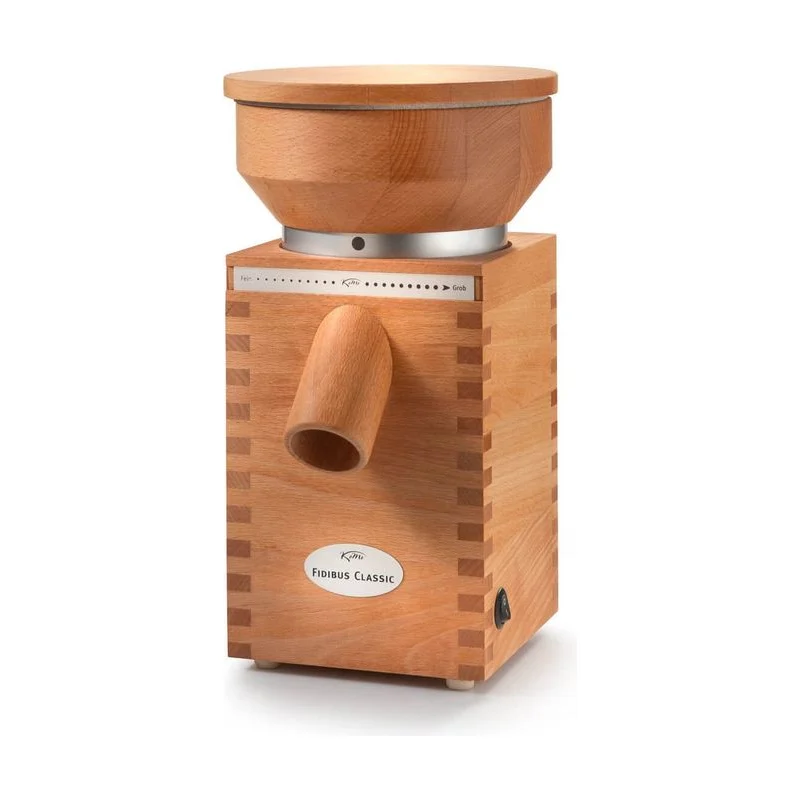
KoMo Fidibus Classic Grain Mill
- Hopper capacity, Mockmill 100
- 1,100 g | 2 lbs 7 oz (wheat)
- Hopper capacity, KoMo Fidibus Classic
- Approx. 1,000 g of wheat
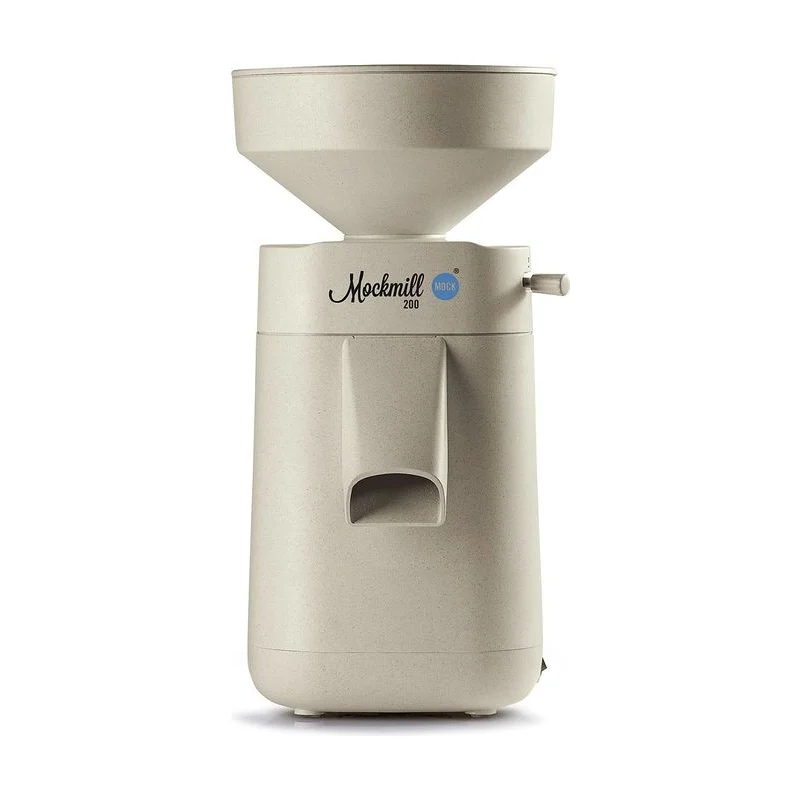
- Motor, Mockmill 100
- 360 W
- Motor, Mockmill 200
- 600 W
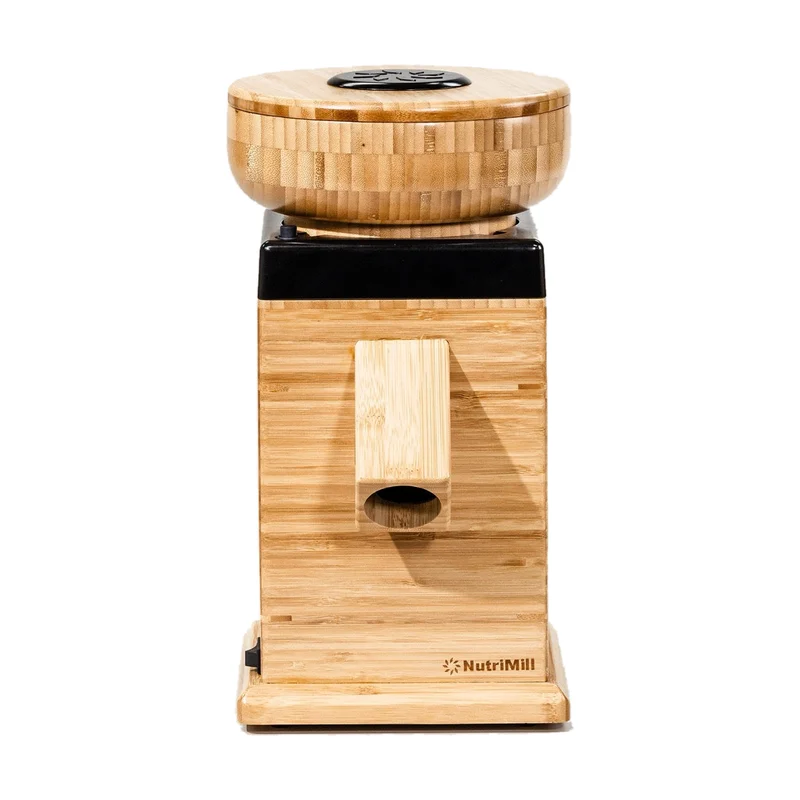
- Motor, Mockmill 100
- 360 W
- Motor, NutriMill Harvest
- 450 watts
The comparisons this mill appears in
Each of these decides this mill against one other model, on the rows both makers publish.
- Impact vs stone burr grain millsThe NutriMill Classic's impact chamber and the Mockmill 100's ceramic stones, compared on what each mechanism permits, adjusts, excludes and requires.
- NutriMill Harvest vs Mockmill 100Two corundum stone mills compared on stone material, texture adjustment, hopper capacity, housing and how much each manufacturer documents.
- Mockmill 100 vs KoMo Fidibus ClassicBoth mill on corundum ceramic stones at 360 watts. The split is the case: Terluran GP-35 against oiled beech, six years of warranty against twelve.
- Mockmill 100 vs Mockmill 200Mockmill 100 vs 200: Mockmill rates the 200 at 600 W and about 200 g of wheat a minute, the 100 at 360 W and 100 g. Hopper and warranty match.
The documents this page was read from
- Mockmill 100 Stone Grain Mill product page, mockmill.us (Wolfgang Mock GmbH's listed USA partner; reproduces the manufacturer specification table)
- Mockmill 100 product page on the manufacturer's own webshop, grainlovers.shop (Wolfgang Mock GmbH)
- Operating Instructions Mockmill 100 / Mockmill 200 (English), current edition hosted by the manufacturer
- Operating Instructions Mockmill 100 / Mockmill 200 (English), 2019 edition hosted on mockmill.us and linked from the product page as Owner's Manual (PDF)
- Compare Mockmills model comparison table, mockmill.us
Prices and availability are on the seller’s site. Amazon links are affiliate links; we may earn a commission at no extra cost to you. Other seller links are unpaid.
- Publication
- By Millwright
- Source
- Manufacturer documentation
- Reviewed
- Documented
- 10 of 10 attributespublished by the makerCounts published attributes, not quality.