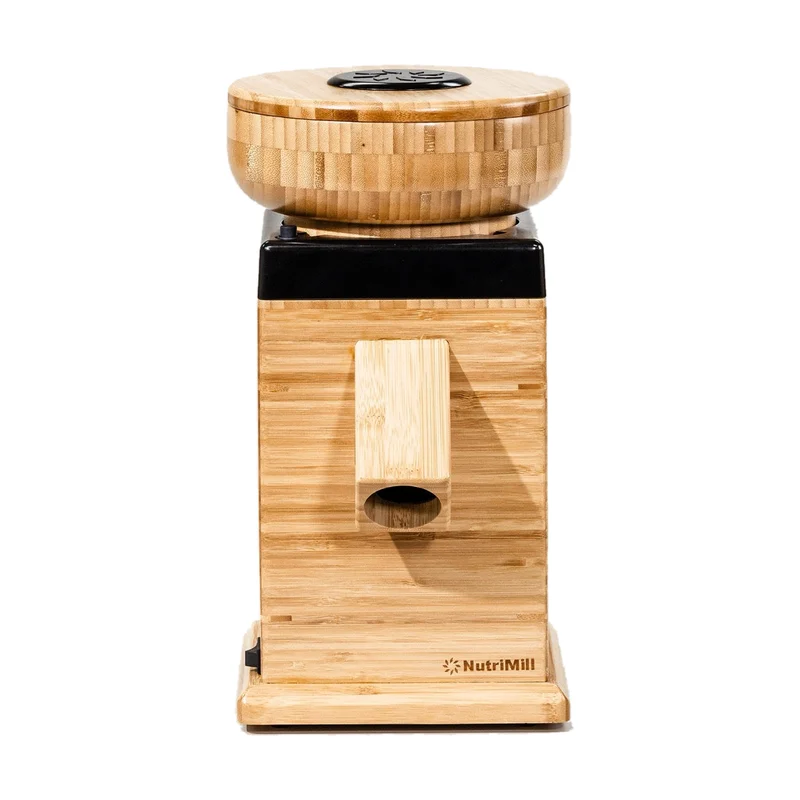
The NutriMill Harvest grain mill grinds between two corundum stones
What this section establishes
- The NutriMill Harvest is a stone mill: the product-page specification list prints “Near Diamond Hard Corundum Grainmaster Milling Stones”, and the user guide’s cutaway labels an upper stone and a lower stone that the grain is pressed between.
- NutriMill’s claim that the stones “efficiently preserve the flavor and nutrients of the grains during grinding” is published with no measurement, no comparison and no method: nothing on the product page, in the four-page user guide or in the help centre article quantifies it.
- NutriMill states no stone diameter and no stone service life on any document read, so no published figure says how much grain a set of corundum stones is expected to mill before replacement.
The Harvest mills between two corundum stones. The product page lists “Near Diamond Hard Corundum Grainmaster Milling Stones” among its specifications, and the user guide’s cutaway diagram labels an upper stone and a lower stone, states that “Grains flow down through the center of the milling unit”, and then that “The grain is pressed through the stones creating flour.” Stone here means a burr grinding surface that the kernel is squeezed against, as distinct from impact, which is a chamber that shatters grain. That single distinction decides most of what follows on this page.
The manufacturer states, in the marketing copy on the same product page, that “The grinding mechanism uses natural corundum stones to efficiently preserve the flavor and nutrients of the grains during grinding.” That is a manufacturer claim about flavor and nutrient retention. It is published with no measurement, no comparison and no method behind it, nothing on the product page, in the user guide or in the help center article quantifies it, and we have not tested it.
The general argument about which mechanism suits which baker does not belong on a product page and is not restated here. It is set out at Impact vs stone burr grain mills. What this page covers is narrower: what changes in ordinary ownership because NutriMill sold you stones rather than a chamber, and where NutriMill’s own documents disagree with each other about the machine.
The grain is pressed through the stones creating flour. The space between the stones determines the texture of your flour.
| What is described | As published | Document it is printed in | Read from |
|---|---|---|---|
| Milling surfaces | “Near Diamond Hard Corundum Grainmaster Milling Stones” | Product-page specification list | nutrimill.com product page |
| Milling surfaces | “The grinding mechanism uses natural corundum stones to efficiently preserve the flavor and nutrients of the grains during grinding.” | Feature block on the same product page | nutrimill.com product page |
| Grinding action | “The grain is pressed through the stones creating flour.” | User guide, milling-unit cutaway on page 1 | Owner manual (PDF) |
| Stone arrangement | Diagram callouts labelling an upper stone and a lower stone, with grain flowing down through the centre of the milling unit | User guide, milling-unit cutaway on page 1 | Owner manual (PDF) |
| Lower stone fixing | “The lower stone is secured with a reverse-threaded screw, which must be turned clockwise to loosen.” | Help centre FAQ | help.nutrimill.com product page |
| Stone diameter and stone service life | Not stated in any document read | — | Not stated in any document read for this page. |
Two NutriMill documents describe the stones independently and a third names the screw that holds the lower one. None of them states a stone diameter, a stone service life or a replacement interval.

How to start and stop the NutriMill Harvest, and why the stones set the order
What this section establishes
- The NutriMill Harvest user guide requires the mill to be running before grain is added — “ALWAYS TURN ON MILL BEFORE ADDING GRAIN” — and the stones to be loosened before it is switched off.
- Fine flour carries a published duty cycle of “Mill for 5 min, rest for 10 min”, a one-to-two ratio of work to rest that a buyer should price into a baking session before ordering.
- The duty cycle is printed under the heading “To avoid Glazing Stones”, so NutriMill’s stated reason for it is stone glazing rather than motor heat, and it is written for fine flour specifically.
The Harvest requires an order of operations that no specification table communicates. The user guide prints it in capitals: “ALWAYS TURN ON MILL BEFORE ADDING GRAIN.” It then instructs the owner to “Adjust texture control knob until you hear the stones begin to grind”, and at the end of a run to “ALLOW THE GRAIN TO EMPTY FROM THE HOPPER AND LOOSEN STONES BEFORE TURNING OFF YOUR MILL.” Grain sitting between closed stones with the motor stopped is the state the guide is written to prevent, and both halves of the sequence exist to avoid it.
Fine flour carries a duty cycle. The user guide states: “When milling fine flour, mill grains in 5 minute increments. Mill for 5 min, rest for 10 min.” That guidance is conditional. It is printed under the heading “To avoid Glazing Stones”, and it attaches to fine flour rather than to every setting. It is also a one-to-two work-to-rest ratio, which is worth working out before buying: three five-minute runs separated by two ten-minute rests occupy thirty-five minutes of counter time for fifteen minutes of milling.
Over-tightening is the failure mode NutriMill names outright: “Over tightening results in low flour flow, causing burned flour and glazed stones.” The mill has no numbered detents and no micron scale on any fetched source, so there is no setting to write down and return to next week. The knob is set by ear, and the guide’s own reference point is the moment the stones are heard to begin grinding.
- Turn the mill on before adding grain; the user guide capitalizes this instruction.
- Adjust the texture control knob until the stones are heard to begin grinding.
- Add grain to the hopper, which holds 5 cups.
- Place a bowl under the spout; the guide’s milling step reads “Place bowl under flour spout.”
- For fine flour, mill for 5 minutes and rest for 10.
- Let the hopper empty and loosen the stones before switching the mill off.
What NutriMill publishes for a Harvest run, from the user guide and the technical illustration
- Turn the mill on before adding grainThe user guide prints the instruction in capitals: “ALWAYS TURN ON MILL BEFORE ADDING GRAIN.” Grain sitting between closed stones with the motor stopped is the state the whole sequence exists to prevent.
- Adjust the knob until the stones begin to grindThe guide’s reference point is auditory rather than numeric: “Adjust texture control knob until you hear the stones begin to grind.” No numbered detent or scale is published to return to.
- Fill the hopper, which holds 5 cupsThe technical illustration NutriMill serves on the product page prints “5 CUP HOPPER CAPACITY” on the line below “CONTINUOUS FLOUR SPOUT.”
- Place a bowl under the spoutThe guide’s second milling step reads “Place bowl under flour spout.” No flour container appears in the What’s Included list, so the bowl belongs to the owner.
- For fine flour, mill 5 minutes and rest 10Printed under the heading “To avoid Glazing Stones”: “When milling fine flour, mill grains in 5 minute increments. Mill for 5 min, rest for 10 min.” The guidance is stated for fine flour, not for every setting.
- Let the hopper empty and loosen the stones before switching offThe guide’s closing instruction, also in capitals: “ALLOW THE GRAIN TO EMPTY FROM THE HOPPER AND LOOSEN STONES BEFORE TURNING OFF YOUR MILL.”
Cleaning the Harvest's stones: never water, and one cup of white rice for glazing
What this section establishes
- The Harvest’s stones must never be washed: the user guide gives “NEVER USE WATER TO CLEAN MILL STONES” a heading of its own, and the product page repeats the rule as “DO NOT get the stones wet.”
- Glazed stones are cleared by milling rather than washing — 1 cup of white rice on a coarse setting, with “or more if needed” being the whole of NutriMill’s dosing guidance.
- A separate break-in instruction calls for 2 cups of white rice to be milled and discarded before any flour is eaten, so the two published rice doses are different instructions and are easy to conflate.
- NutriMill does not recommend removing the lower stone, and its one published sentence on the subject is the whole of the Harvest’s stone-service guidance.
The user guide gives one instruction a heading of its own: “NEVER USE WATER TO CLEAN MILL STONES.” The product page repeats the same rule in its own words as “DO NOT get the stones wet.” Neither document explains the reason, and neither publishes a recovery procedure for a stone that has already been wetted, which leaves an owner who makes the mistake once with no stated remedy.
The manufacturer’s remedy for a fouled stone is not washing but re-milling. The guide states: “If stones become glazed mill 1 cup of white rice or more if needed on a COARSE setting to remove glaze.” The phrase “or more if needed” is the whole of the dosing guidance. NutriMill does not state how an owner recognizes a glazed stone, how often glazing should be expected, or how many rice passes a badly glazed stone needs.
Glazing is also the reason the duty cycle exists, which means the two maintenance rules on this page are one rule seen from two sides. The 5-minute increments are printed under a glaze-avoidance heading, and the rice pass is the cure once avoidance has failed. A separate break-in instruction sits alongside them: the guide states “Before consuming flour, mill 2 cups of white rice & discard.” Two cups is the break-in dose and one cup on a coarse setting is the de-glazing dose, and the two are easy to conflate because both involve white rice.
The lower stone is the one part owners are told to leave alone. NutriMill’s help center states that “The lower stone is secured with a reverse-threaded screw, which must be turned clockwise to loosen. However, we do not recommend removing the lower stone.” A reverse thread turned the familiar direction tightens instead of releasing, which is precisely the mistake a confident owner makes with a screwdriver in hand.
That single help center answer is also the whole of NutriMill’s published stone-service guidance. It names the fastener, names the direction that loosens it, and advises against the removal in the same breath, without stating why removal is discouraged or what an owner should do instead. Nothing on the product page, in the four-page user guide or in the help center article states a stone diameter or a stone service life either, so there is no published figure for how much grain a set of corundum stones is expected to mill before it needs replacing, and no interval an owner can budget for. Every piece of stone maintenance NutriMill does publish, the rice pass for glazing and the prohibition on water, is carried out with the stones in place and the mill running, which is consistent with an assembly the manufacturer would rather owners left closed.
The gap that leaves is diagnostic rather than mechanical. Glazing has a published cure, so an owner whose flour has gone poor can run the rice pass and see whether it recovers. Wear has no published test at all: NutriMill states no expected output before replacement, no way to tell a worn stone from a glazed one, and no replacement procedure beyond the one sentence about the screw. A buyer who wants to know what a set of stones costs to renew, or how often renewal is expected, will not find either figure in this documentation and should ask NutriMill before treating the Harvest as a mill with serviceable consumables. The maintenance routine that is published in full is the routine set out at Cleaning and maintaining a grain mill, and on this mill it stops at the surface of the stones.
NEVER USE WATER TO CLEAN MILL STONES.
The Harvest's texture knob sets a stone gap, not a numbered setting
What this section establishes
- The NutriMill Harvest’s texture control knob changes the gap between two stones: the user guide states “The space between the stones determines the texture of your flour.”
- Clockwise tightens the stones for finer flour and counterclockwise loosens them for coarse, and the four-page guide prints that direction of travel twice.
- No micron figure, numbered detent or scale appears on the product page, in the user guide or in the help centre article, so a Harvest texture setting cannot be written down or exchanged between bakers.
- The fine end is bounded by a failure state rather than a stop: “Over tightening results in low flour flow, causing burned flour and glazed stones.”
The Harvest adjusts texture with what the product page calls a “Patented Texture Control Knob”, and the user guide states what that knob physically does: “The space between the stones determines the texture of your flour.” Clockwise tightens and refines, per the guide’s sentence “Turn the control knob clockwise to tighten the stones, creating finer flour.” Counterclockwise loosens and coarsens. The guide’s second page repeats the two directions on dial graphics reading “COARSE - COUNTERCLOCKWISE” and “FINE - CLOCKWISE”, so the direction of travel is stated twice in the same four-page document.
The published range is qualitative throughout. The product page states: “Choose from coarse, medium, or fine textures with a quick turn of the texture control knob. Perfect for flour, cereals, cracked grains, baby food, and more”, and elsewhere describes the span as running from cracked grain to ultra-fine flour. No micron figure, no numbered position and no detent count appears on the product page, in the user guide, or in the help center article fetched for this page.
The practical consequence of a gap rather than a setting is that a texture is not portable. Two bakers cannot exchange a Harvest fine setting the way they could exchange a numbered click, and one baker cannot reliably reproduce last month’s setting from memory. The reference points NutriMill supplies are sensory: the sound of the stones engaging, and the flour arriving at the spout. Anyone weighing that adjustment scheme against another stone mill’s should read the head-to-head at NutriMill Harvest vs Mockmill 100, because the adjustment method, not the stone material, is where two stone mills usually part company.
One boundary is published rather than left to feel. The guide’s over-tightening warning defines the far end of the fine range as a failure state rather than a maximum: past a certain point the stones stop passing flour, and the guide names burned flour and glazed stones as the result. Fine on this mill is bounded by flour flow, not by a stop.
| Texture | What the stones do | Which way the knob turns | Read from |
|---|---|---|---|
| Coarse flour | Loosen stones | Counterclockwise | Owner manual (PDF) |
| Fine flour | Tighten stones | Clockwise | Owner manual (PDF) |
The guide publishes directions, not positions. There is no micron figure, no numbered detent and no scale on any document read, so this table is the whole of the Harvest’s published texture calibration.
The Harvest's 450-watt motor, its thermal cutoff, and the electrical ratings NutriMill omits
The Harvest draws 450 watts. The specification accordion on the product page prints “450 Watt Heavy-Duty Motor”, and the marketing copy on the same page states the mill “is equipped with an industry-leading 450-watt motor ready for anything from soft rice to the hardest ancient grains.” The first of those is a rating and the second is a manufacturer claim; NutriMill publishes no comparison behind the phrase “industry-leading”, and the range from soft rice to hard ancient grains is a marketing summary rather than a tested envelope.
The mill carries “Auto-Shutoff Thermal Protection” per the same specification list, and the product page states the mill is “Tested and Listed by CSA” and “Meets all US Safety Standards.” NutriMill does not state the temperature or the elapsed running time at which the thermal cutoff trips. It is tempting to assume the 5-minute fine-flour duty cycle exists to stay clear of that cutoff, but the guide gives the duty cycle a different stated reason, glazing, so the two should be read as separate rules rather than one rule restated.
Wattage is the only electrical figure published anywhere in this evidence. Voltage, amperage, frequency and stone RPM are not stated on the product page, in the user guide or in the help center article. A buyer outside North America has no published basis here for judging supply compatibility, and a buyer comparing motors across brands has one number to compare and no load rating, no service factor and no duty rating to go with it.
A 5-cup hopper, a continuous spout, and no bowl in the box
The hopper holds 5 cups. That figure appears on the technical illustration NutriMill serves on the product page, printed as “5 CUP HOPPER CAPACITY” directly beside “CONTINUOUS FLOUR SPOUT.” The hopper is removable and ships with a lid, both listed as separate line items in what the box contains.
There is no flour container. The What’s Included list has exactly five entries: “Harvest Grain Mill”, “Near Diamond Hard Corundum Milling Stones”, “Removable Hopper”, “Lid” and “Cleaning Brush.” No bowl, canister or bin appears among them. The user guide’s second milling step confirms the arrangement from the other direction: “Place bowl under flour spout.” The bowl belongs to the owner.
This matters more on a comparison table than it does at the counter. Flour container capacity is a standard row on grain-mill specification tables, and the Harvest has no value for that row, not a small figure but none at all. Anyone building a like-for-like table should record it as not applicable rather than leaving it blank, because blank reads as unresearched while not applicable is the actual finding. The same-brand comparison at NutriMill Classic vs NutriMill Harvest is where the difference in flour handling between NutriMill’s two mills is worked through row by row.
The 5-cup hopper also sets the practical batch size, and it interacts with the duty cycle. Under the guide’s fine-flour pattern of five minutes on and ten minutes off, a full hopper may well span more than one work interval. NutriMill does not state how long 5 cups of hard wheat takes to clear the stones at any setting, so the number of intervals a full hopper needs is not derivable from published evidence.
Three footprints, two countries of origin and two warrantors: where the Harvest's documents disagree
What this section establishes
- NutriMill publishes three different footprints for one Harvest: “h13" x w6" x d9"” and “7" W x 7" D x 13" H” in the same product-page specification list, and 6 3/4" square on the technical illustration served beside it.
- Only the 13" overall height survives all three sources; the three published depths are 9", 7" and 6 3/4".
- The same product page states both “Designed and Assembled in the USA” and “a product of precise German craftsmanship”, and neither statement is reconciled anywhere in NutriMill’s documentation.
- The 5-year warranty term is consistent in four places, but the product page grants it as NutriMill and the user guide grants it as L’Chef, LLC.
Three different footprints for one mill are published, and two of them sit in the same accordion on the same page. The specification list gives “Dimensions: h13" x w6" x d9".” Four lines further down that same list it gives “Overall Dimensions: 7" W x 7" D x 13" H.” The technical illustration served on that page labels both base edges 6 3/4", with 13" overall height split into a 10" body and a 3" hopper-and-lid section. Only the 13" height survives all three sources.
The disagreement is not cosmetic for anyone measuring a cabinet. A 6" by 9" rectangle, a 7" by 7" square and a 6 3/4" by 6 3/4" square are three different objects on a countertop, and the deepest published figure of 9" is exactly a third larger than the shallowest of 6 3/4". We report all three rather than picking a winner. The specification table on this page carries the product-page specification-list figure, because that is the value a buyer is most likely to be shown first, not because it is the one we believe.
Country of manufacture contradicts itself inside a single page as well. The specification list states “Designed and Assembled in the USA.” A feature block on the same page states: “German Quality - The Harvest Grain Mill is a product of precise German craftsmanship, ensuring excellent durability and performance.” The German sentence sits inside the block describing the mill stones, so it may be intended as a claim about the stones rather than about final assembly. As printed, though, it names “The Harvest Grain Mill” and not the stones, and NutriMill does not reconcile the two statements anywhere in this evidence.
The warranty names two different warrantors for the same term. The product page states that “NutriMill warrants the Harvest grain mill to be free of manufacturing defects in materials and workmanship for 5 years.” The user guide states that “L’Chef, LLC warrants the NutriMill Harvest grain mill” for the same 5 years. The help center states a “5-year limited warranty, covering defects in materials and workmanship”, naming no entity. The technical illustration adds a “5 YEAR WARRANTY” badge, also naming no entity. The length is consistent in four places; the legal entity behind it is stated twice and differently.
- Footprint, source one: h13" x w6" x d9", product-page specification list.
- Footprint, source two: 7" W x 7" D x 13" H, same specification list, four lines below the first.
- Footprint, source three: 6 3/4" wide by 6 3/4" deep, 13" tall, technical illustration on the same page.
- Origin, source one: “Designed and Assembled in the USA”, product-page specification list.
- Origin, source two: “a product of precise German craftsmanship”, feature block on the same page.
- Warrantor, source one: NutriMill, product-page warranty text.
- Warrantor, source two: L’Chef, LLC, user guide warranty text.
| Figure | As published | Document it is printed in | Read from |
|---|---|---|---|
| Dimensions | h13" x w6" x d9" | Product-page specification list | nutrimill.com product page |
| Dimensions | 7" W x 7" D x 13" H | Same specification list, four lines below the first | nutrimill.com product page |
| Dimensions | 6 3/4" W x 6 3/4" D x 13" H overall, split into a 10" body and a 3" hopper and lid | Technical illustration served on the product page | nutrimill.com product page |
| Country of manufacture | “Designed and Assembled in the USA” | Product-page specification list | nutrimill.com product page |
| Country of manufacture | “The Harvest Grain Mill is a product of precise German craftsmanship” | Feature block on the same product page | nutrimill.com product page |
| Warrantor | “NutriMill warrants the Harvest grain mill” | Product-page warranty text | nutrimill.com product page |
| Warrantor | L’Chef, LLC — “warrants the NutriMill Harvest grain mill” | User guide warranty text, page 4 | Owner manual (PDF) |

Every row is a manufacturer document; none of these are retailer figures. This page prints both sides of each disagreement rather than choosing one. The warranty length is not in dispute anywhere, only the entity granting it.
Two errors printed inside the guide's own grain chart
The user guide’s grain chart prints einkorn as “Eikhorn.” It appears that way on the guide’s fourth page, in the last bullet of the gluten-grain column, and it sits in the document’s text layer rather than being an artifact of reading the file. The product page spells the same grain “Einkorn.” The practical effect is small but real: an owner searching the guide for einkorn finds nothing and may conclude the mill excludes a grain it in fact permits.
The chart also files two grains under the wrong heading. Teff and kaniwa are listed under the guide’s “GRAINS (W/GLUTEN)” column. Both are gluten-free. A household milling for a gluten-free diet that takes the guide’s columns at face value would draw the wrong conclusion straight from the manufacturer’s own document. The error at least runs in the cautious direction by accident: it wrongly warns off two permitted grains rather than wrongly admitting one that is prohibited.
Not every entry in the chart is mis-filed, which is the point worth carrying forward. Popcorn, blue corn and dent corn are correctly placed under the gluten-free heading in the same chart. The columns are therefore selectively wrong rather than systematically shifted, and there is no rule an owner can apply to correct them. Read the guide’s permitted and prohibited split, which is the part that governs the warranty, and treat its column headings as unreliable.
What the user guide permits: twenty-four grains and nine legumes
The user guide lists twenty-four grains and nine legumes under “Grains that can be milled.” The product page frames the same scope loosely, as “non-oily grains, beans, and legumes”, and heads its own grain block “Mill any non-oily grains or legumes.” Where the two differ in specificity, the guide’s explicit list is the better instrument, because the guide is also the document the warranty exclusions are printed in.
Two entries carry conditions rather than a simple yes. Large legumes require two passes: the help center states the rule and the guide repeats it, with a very coarse grind first and a second pass at the wanted texture. The guide does not define which legumes count as large, so the threshold is left to the owner’s judgment. Buckwheat carries a recommendation rather than a restriction, layered on top of a chart entry that lists plain buckwheat with no hull qualifier.
- Grains, as the guide lists them: Kamut, hard wheat, soft wheat, spelt, barley, farro, rye, bulgur wheat, teff, kaniwa, emmer, einkorn (printed “Eikhorn”), popcorn, blue corn, oat groats, white rice, brown rice, wild rice, sorghum, millet, buckwheat, quinoa, amaranth and dent corn.
- Legumes, as the guide lists them: lentils, soybeans, anasazi beans, mung beans, navy beans, black beans, kidney beans, split peas and pinto beans.
- Large legumes: mill a very coarse pass first, then mill again at the texture you want. NutriMill states the two-stage rule in both the help center and the user guide.
- Buckwheat: a NutriMill staff answer in the product-page question thread, dated 11 September 2025, states “We don’t recommend grinding whole buckwheat with the hull in the Harvest Grain Mill, as the hulls can affect performance and texture. It’s best to use dehulled buckwheat for milling.”
- Popcorn: the same product-page thread states “Yes, you can mill popcorn. Just make sure it is completely dry before milling.”
The fifteen things the Harvest user guide says not to mill, and why the warranty depends on it
The user guide excludes fifteen things under “Do not mill”, listed below. The list is not advisory garnish attached to the end of a manual, because the warranty’s exclusion clause names the same category of damage and declines to cover it. Reading the two documents together turns a list of suggestions into a list of conditions.
Sprouted grain is the only conditional entry on that list. The guide excludes “sprouted grains or beans” with the qualifier “if not thoroughly dried” attached. The exclusion therefore attaches to moisture rather than to sprouting itself, and thoroughly dried sprouted grain is not placed on the prohibited side of the line as printed. Anyone milling sprouted wheat should read that conditional as written rather than treating it as a flat ban, and should note that the guide does not define thoroughly dried or give a moisture test for it.
The warranty is what makes the rest of the list expensive to ignore. The user guide’s warranty text excludes “damage caused by any foreign objects, oily grains, or seeds getting into the mill.” Nuts, sesame, flax, sunflower, hemp, chia, coffee and chocolate all appear on the do-not-mill list, and all of them would fall inside that clause on any ordinary reading of it. A stone gap fouled with oil is the failure mode the entire user guide is organized around, and it is the failure mode the warranty specifically declines to cover.
The product page’s framing of scope as “non-oily grains, beans, and legumes” is consistent with the warranty clause, so the two documents point the same way here even where they disagree elsewhere. Oil is the boundary, not hardness. The 450-watt motor is described by the manufacturer as ready for the hardest ancient grains, and nothing in this evidence suggests hard grain is the constraint; oily and moist material is.
- Dried fruit or vegetables
- Sprouted grains or beans, if not thoroughly dried
- Spices
- Nuts
- Goji beans
- Sesame seeds
- Flax seeds
- Herbs
- Sunflower seeds
- Coffee beans
- Hemp
- Sugar
- Chia seeds
- Tapioca
- Chocolate
The Harvest's 5-year warranty: original purchaser only, and no commercial use
The Harvest carries a 5-year warranty against manufacturing defects in materials and workmanship, and every NutriMill source agrees on the length. The product page states it, the user guide states it, the help center states a “5-year limited warranty, covering defects in materials and workmanship”, and the technical illustration carries a “5 YEAR WARRANTY” badge.
The user guide is the only one of those documents that publishes the conditions. It states that the warranty “applies to the original noncommercial purchaser”, and that it “does not cover damage resulting from an accident, misuse, shipping, normal wear, commercial use, neglect, incidental or consequential damages, or damage caused by any foreign objects, oily grains, or seeds getting into the mill.” The warrantor named in that text is L’Chef, LLC rather than NutriMill.
Two consequences follow that a buyer will not see on a product listing. A mill bought secondhand falls outside the warranty as written, because the term runs to the original purchaser and nothing in the evidence provides for transfer. And a mill used in a bakery, a farm stand, a co-op or any other commercial kitchen is excluded by the commercial-use clause regardless of how carefully it was run. Both exclusions are printed in the four-page guide, which means an owner who never downloads the guide may never encounter them.
The remedy is discretionary rather than fixed. The product page’s warranty question states that defective products “will be repaired or replaced with a comparable model at our sole discretion.” Replacement is therefore not guaranteed to be the same model, and the choice between repair and replacement is the manufacturer’s.
What this analysis does not establish about the NutriMill Harvest
We have not milled anything on a Harvest. Every figure on this page comes from NutriMill’s published product page, the technical illustration served on it, the four-page user guide and the help center article, each one re-checked against the source document rather than carried over from a summary. No performance claim on this page is ours, and the gaps below are gaps in NutriMill’s publication, not in our access.
One further limit is about the documents rather than the machine. The guide’s grain chart contains a printed spelling error and two grains filed under the wrong heading, which is reason enough to read the chart closely rather than skim it, and reason to check any Harvest grain list republished on another site against the guide and the product page before relying on it.
- Noise: no decibel figure is published. The product page uses the marketing phrase “whisper-quiet operation”, which carries no measurement.
- Throughput: NutriMill does not state how long the mill takes to clear a hopper of any grain at any texture setting.
- Flour temperature: not stated on any fetched source, at any setting, even though the duty-cycle guidance implies heat is a factor.
- Particle size: no micron figure is published for the fine setting or for any other position of the knob.
- Texture positions: no numbered detents and no scale are published, so settings cannot be recorded numerically or exchanged between owners.
- Stone diameter and stone service life: not stated. Nothing published says how much grain a set of corundum stones is expected to mill before replacement.
- Electrical ratings beyond wattage: voltage, amperage, frequency and stone RPM are not stated on the product page, in the user guide or in the help center article.
- Flour container capacity: not applicable, because no flour container is included.
- Model number: no engineering model number is published on any fetched source.
- Nutrient and flavor retention: the manufacturer’s claim that corundum stones “efficiently preserve the flavor and nutrients of the grains” is published with no method and no comparison, and we do not repeat it as fact.
Does the NutriMill Harvest come with a flour container?
No. The What’s Included list on the product page has five entries, the mill itself, the corundum milling stones, a removable hopper, a lid and a cleaning brush, and none of them is a bowl, canister or bin. Flour leaves through a continuous spout, and the user guide’s milling instructions tell the owner to “Place bowl under flour spout.” The bowl is supplied by the owner, so no flour container capacity figure exists for this mill; there is nothing to rate. On a comparison table, record the row as not applicable rather than unknown.
How fine can the NutriMill Harvest mill flour?
NutriMill does not publish a particle size. The product page states the knob selects “coarse, medium, or fine textures” and describes the span as reaching from cracked grain to ultra-fine flour, but no micron figure appears on the product page, in the user guide or in the help center article. Fineness is produced by turning the knob clockwise to tighten the stones, judged by ear and by the flour at the spout, and bounded at the fine end by the guide’s warning that “Over tightening results in low flour flow, causing burned flour and glazed stones.” A reader who needs a numeric fineness specification will not find one in NutriMill’s documentation and should ask the manufacturer directly before buying on that basis.
Can the NutriMill Harvest mill nuts, seeds or coffee beans?
No. The user guide’s “Do not mill” list names nuts, sesame seeds, flax seeds, sunflower seeds, hemp, chia seeds and coffee beans, alongside spices, herbs, sugar, tapioca, chocolate, goji beans, dried fruit or vegetables, and sprouted grains or beans that are not thoroughly dried. The warranty reinforces the list rather than merely restating it: the guide’s warranty text excludes damage caused by “any foreign objects, oily grains, or seeds getting into the mill.” Milling any of those items is both contrary to the instructions and outside the warranty as written, and the product page’s own framing of the mill’s scope as “non-oily grains, beans, and legumes” agrees.
Who warrants the NutriMill Harvest, NutriMill or L'Chef?
The documents name both, and NutriMill does not explain the relationship. The product page states that “NutriMill warrants the Harvest grain mill to be free of manufacturing defects in materials and workmanship for 5 years.” The user guide states that “L’Chef, LLC warrants the NutriMill Harvest grain mill” for the same 5 years, and adds that the warranty “applies to the original noncommercial purchaser.” The help center states a 5-year limited warranty without naming an entity at all. The term is consistent everywhere; the warrantor is not. A buyer should keep the user guide with the mill, because it is the only document in this evidence that carries both the warrantor’s name and the exclusions, and NutriMill publishes it for download on its Harvest resources page.
Every published figure, with the document it came from
Every row this maker publishes for this mill, printed as its own document prints it, with the document named beside it.
| Attribute | As published | Read from |
|---|---|---|
| Milling mechanism | Corundum stone burrs, upper and lower | nutrimill.com product page |
| Motor | 450 watts | nutrimill.com product page |
| Hopper capacity | 5 cups | nutrimill.com product page |
| Flour container capacity | None included; flour leaves through a continuous spout into a bowl the owner supplies | nutrimill.com product page |
| Texture adjustment | Patented texture control knob; coarse, medium or fine | nutrimill.com product page |
| Dimensions | h13" x w6" x d9" as printed in the product-page specification list; two other figures are published, see the documentation conflicts section | nutrimill.com product page |
| Weight | 16 lbs | nutrimill.com product page |
| Housing | Bamboo | nutrimill.com product page |
| Thermal protection | Auto-shutoff thermal protection | nutrimill.com product page |
| Safety certification | Tested and listed by CSA; stated to meet all US safety standards | nutrimill.com product page |
| Warranty | 5 years against manufacturing defects in materials and workmanship | nutrimill.com product page |
| Country of manufacture | Designed and assembled in the USA | nutrimill.com product page |
This mill against the other eight
The catalogue reduced to five columns and grouped by the mechanism each maker's own documents describe. This mill keeps its place in the order.
| Mill | Mechanism | Motor | Hopper | Warranty |
|---|---|---|---|---|
| Impact — the grain is shattered against steel heads, there is no gap to setTwo mills · 1,200 to 1,250 W | ||||
| NutriMill Classic Grain MillRead from NutriMill product page · Owner manual (PDF)View NutriMill Classic on Amazon | High-speed impact chamber with stainless steel Microburst milling heads | 1200 W, 10 amps | 12 cups 13 cups | 5 years parts and plastics; limited lifetime on motor and milling heads; original noncommercial purchaser only |
| WonderMill Electric Grain MillRead from Pleasant Hill Grain dealer specifications · WonderMill product page · Owner manual (PDF)View WonderMill Electric at Unsifted | Impact; two fin-studded stainless steel plates, one rotating | 1250 W LG Electronics motor (manufacturer states) | 8 cups (wheat) | Lifetime on milling heads to the original owner; six years on all other parts |
| Stone burr — the grain is ground between two corundum discs you can moveFour mills · 360 to 600 W | ||||
| Mockmill 100 Stone Grain MillRead from Mockmill product pageView Mockmill 100 at Mockmill USA | Corundum ceramic grinding stones | 360 W | 1,100 g | 2 lbs 7 oz (wheat) | 6 years, non-commercial use |
| KoMo Fidibus Classic Grain MillRead from KoMo product pageView KoMo Fidibus Classic at Pleasant Hill Grain | Stone burr; infinitely adjustable, self-sharpening, made of premium corundum ceramic | 360 watts | Approx. 1,000 g of wheat | 12 years on household grain mills |
| Mockmill 200 Stone Grain MillRead from Mockmill product pageView Mockmill 200 at Mockmill USA | Corundum ceramic grinding stones | 600 W | 1,100 g | 2 lbs 7 oz (wheat) | 6-year warranty for non-commercial use |
| NutriMill Harvest Grain Mill — this pageRead from NutriMill product page · NutriMill technical illustrationView NutriMill Harvest on Amazon | Corundum stone burrs, upper and lower | 450 watts | 5 cups | 5 years against manufacturing defects in materials and workmanship |
| Steel burr — the grain is ground between steel platesThree mills · one at 1,500 W, two with no motor of their own | ||||
| Country Living Grain MillRead from Country Living product pageView Country Living Grain Mill on Amazon | Opposed burr plates — one fixed plate held by three screws, one rotating plate on the drive shaft, fed by an auger | — | 4 1/2 cups standard; nearly 11 cups with the optional hopper extension | Lifetime of the original owner on all parts excluding the finish; grinding plates one year |
| KitchenAid All Metal Grain Mill AttachmentRead from Owner manual (PDF)View KitchenAid grain mill attachment on Amazon | Metal burr: a grind worm drives the grinding action and a movable burr grinds whole grains into flour | — | — | One-year full warranty from date of purchase with hassle-free replacement, for the 50 United States and the District of Columbia; limited one-year warranty in Puerto Rico |
| VEVOR Electric Grain Mill Grinder MFS-140Read from Owner manual (PDF) · VEVOR product listingView VEVOR MFS-140 at VEVOR | One stationary and one moving grinding plate, supplied as a dry-grinding pair and a wet-grinding pair | 1500 W | — | 12-month standard manufacturer's warranty, from VEVOR's site-wide policy rather than the product listing |
Impact — the grain is shattered against steel heads, there is no gap to set
Two mills · 1,200 to 1,250 W
NutriMill Classic Grain Mill
Read from NutriMill product page · Owner manual (PDF)
View NutriMill Classic on Amazon- Mechanism
- High-speed impact chamber with stainless steel Microburst milling heads
- Motor
- 1200 W, 10 amps
- Hopper
- 12 cups 13 cups
- Warranty
- 5 years parts and plastics; limited lifetime on motor and milling heads; original noncommercial purchaser only
WonderMill Electric Grain Mill
Read from Pleasant Hill Grain dealer specifications · WonderMill product page · Owner manual (PDF)
View WonderMill Electric at Unsifted- Mechanism
- Impact; two fin-studded stainless steel plates, one rotating
- Motor
- 1250 W LG Electronics motor (manufacturer states)
- Hopper
- 8 cups (wheat)
- Warranty
- Lifetime on milling heads to the original owner; six years on all other parts
Stone burr — the grain is ground between two corundum discs you can move
Four mills · 360 to 600 W
Mockmill 100 Stone Grain Mill
Read from Mockmill product page
View Mockmill 100 at Mockmill USA- Mechanism
- Corundum ceramic grinding stones
- Motor
- 360 W
- Hopper
- 1,100 g | 2 lbs 7 oz (wheat)
- Warranty
- 6 years, non-commercial use
KoMo Fidibus Classic Grain Mill
Read from KoMo product page
View KoMo Fidibus Classic at Pleasant Hill Grain- Mechanism
- Stone burr; infinitely adjustable, self-sharpening, made of premium corundum ceramic
- Motor
- 360 watts
- Hopper
- Approx. 1,000 g of wheat
- Warranty
- 12 years on household grain mills
Mockmill 200 Stone Grain Mill
Read from Mockmill product page
View Mockmill 200 at Mockmill USA- Mechanism
- Corundum ceramic grinding stones
- Motor
- 600 W
- Hopper
- 1,100 g | 2 lbs 7 oz (wheat)
- Warranty
- 6-year warranty for non-commercial use
NutriMill Harvest Grain Mill — this page
Read from NutriMill product page · NutriMill technical illustration
View NutriMill Harvest on Amazon- Mechanism
- Corundum stone burrs, upper and lower
- Motor
- 450 watts
- Hopper
- 5 cups
- Warranty
- 5 years against manufacturing defects in materials and workmanship
Steel burr — the grain is ground between steel plates
Three mills · one at 1,500 W, two with no motor of their own
Country Living Grain Mill
Read from Country Living product page
View Country Living Grain Mill on Amazon- Mechanism
- Opposed burr plates — one fixed plate held by three screws, one rotating plate on the drive shaft, fed by an auger
- Motor
- —
- Hopper
- 4 1/2 cups standard; nearly 11 cups with the optional hopper extension
- Warranty
- Lifetime of the original owner on all parts excluding the finish; grinding plates one year
KitchenAid All Metal Grain Mill Attachment
Read from Owner manual (PDF)
View KitchenAid grain mill attachment on Amazon- Mechanism
- Metal burr: a grind worm drives the grinding action and a movable burr grinds whole grains into flour
- Motor
- —
- Hopper
- —
- Warranty
- One-year full warranty from date of purchase with hassle-free replacement, for the 50 United States and the District of Columbia; limited one-year warranty in Puerto Rico
VEVOR Electric Grain Mill Grinder MFS-140
Read from Owner manual (PDF) · VEVOR product listing
View VEVOR MFS-140 at VEVOR- Mechanism
- One stationary and one moving grinding plate, supplied as a dry-grinding pair and a wet-grinding pair
- Motor
- 1500 W
- Hopper
- —
- Warranty
- 12-month standard manufacturer's warranty, from VEVOR's site-wide policy rather than the product listing
If this is not the mill
Three mills to read next, each with the first catalogue figure it prints differently from this one.
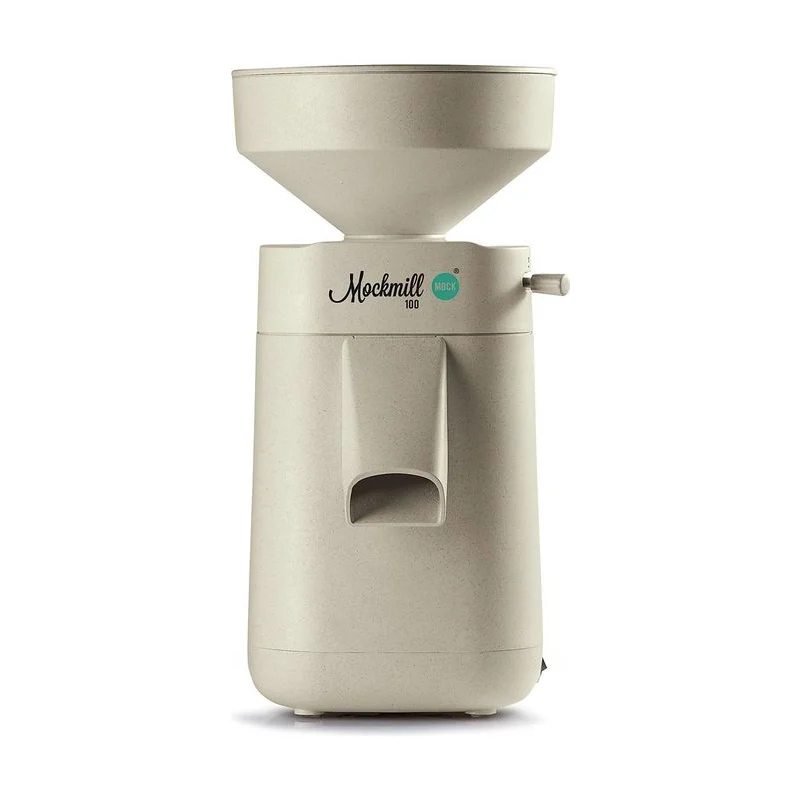
- Motor, NutriMill Harvest
- 450 watts
- Motor, Mockmill 100
- 360 W
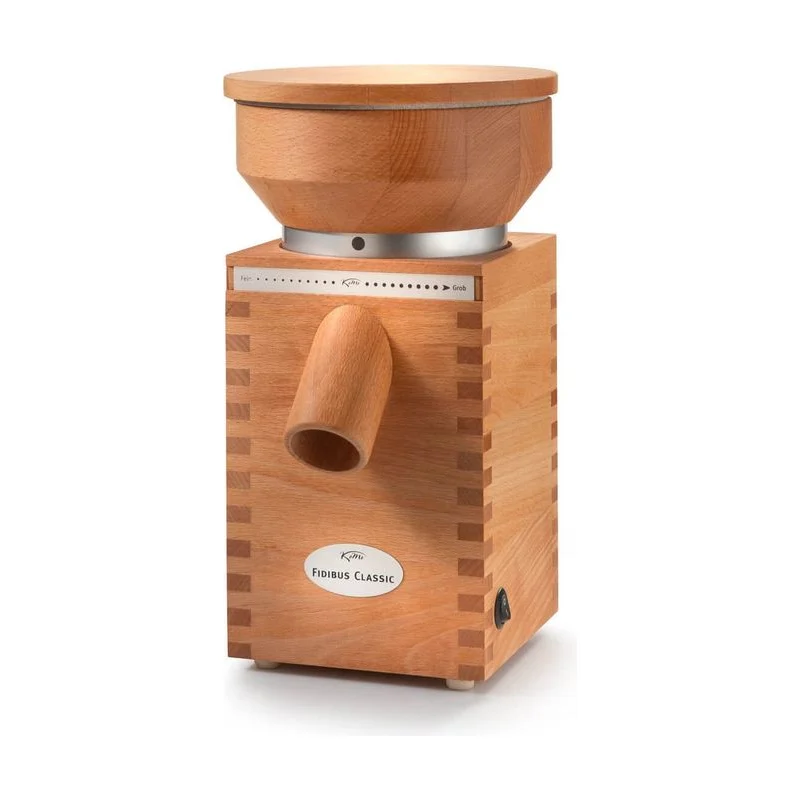
KoMo Fidibus Classic Grain Mill
- Motor, NutriMill Harvest
- 450 watts
- Motor, KoMo Fidibus Classic
- 360 watts
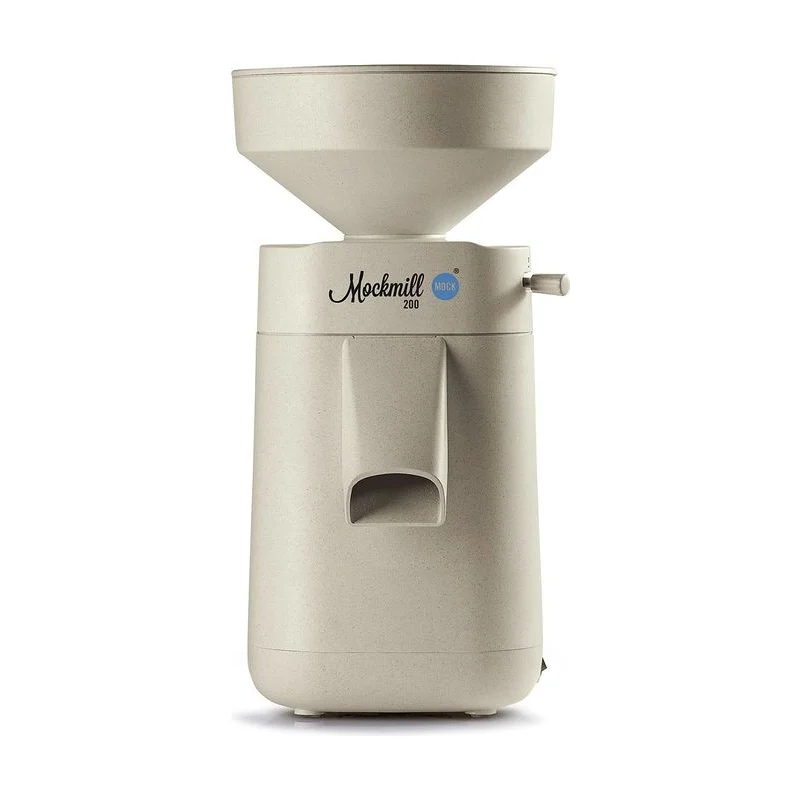
- Motor, NutriMill Harvest
- 450 watts
- Motor, Mockmill 200
- 600 W
The comparisons this mill appears in
Each of these decides this mill against one other model, on the rows both makers publish.
- NutriMill Classic vs NutriMill HarvestNutriMill Classic vs Harvest: the Classic's 12- or 13-cup hopper and 20-cup bowl (21 to 22 in its manual) against the Harvest's 5-cup hopper and spout.
- NutriMill Harvest vs Mockmill 100Two corundum stone mills compared on stone material, texture adjustment, hopper capacity, housing and how much each manufacturer documents.
The documents this page was read from
- NutriMill Harvest Grain Mill (manufacturer product page)
- NutriMill Harvest technical illustration (dimension and capacity diagram served on the product page)
- NutriMill Harvest user guide (4-page PDF)
- Harvest Grain Mill FAQs (NutriMill help center)
- NutriMill Harvest Grain Mill Resources (user guide download page)
Prices and availability are on the seller’s site. Amazon links are affiliate links; we may earn a commission at no extra cost to you. Other seller links are unpaid.
- Publication
- By Millwright
- Source
- Manufacturer documentation
- Reviewed
- Documented
- 9 of 10 attributespublished by the makerCounts published attributes, not quality.