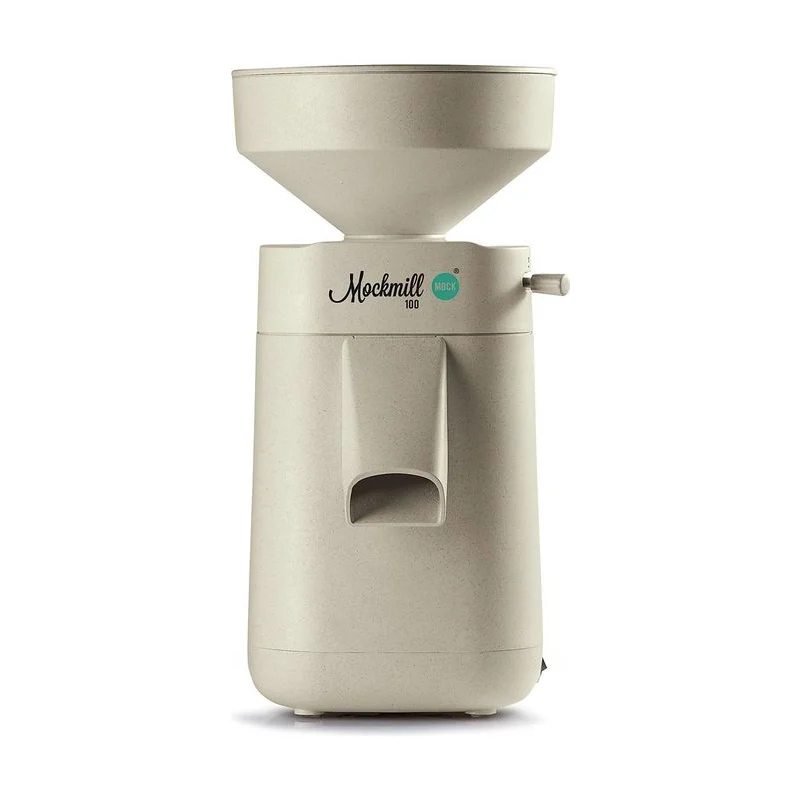
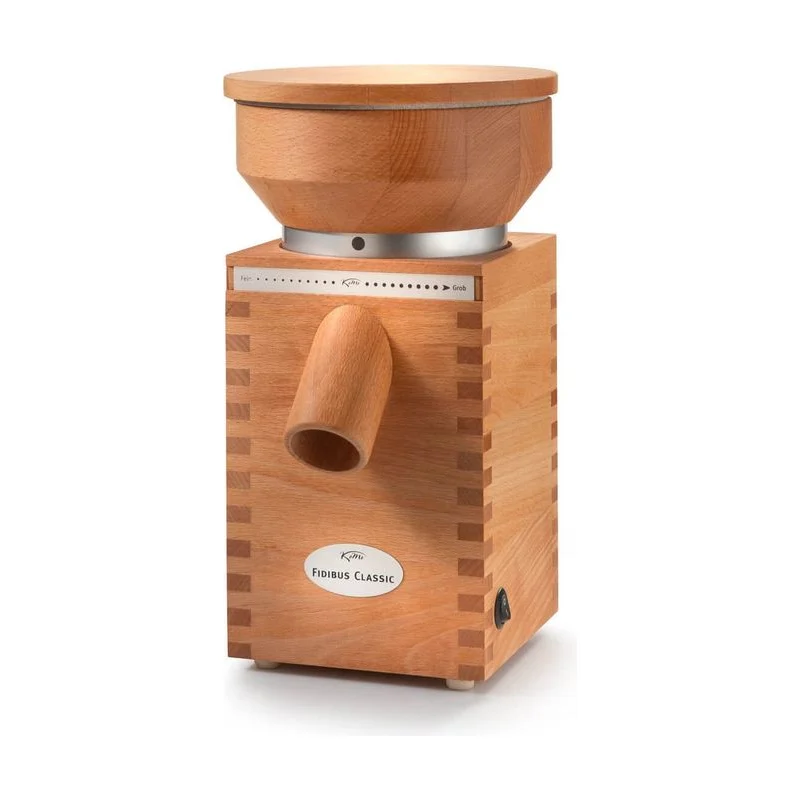
Two weight units, and the two figures their makers hedge

Cleaning a grain mill starts at the stones: the Mockmill 100 and KoMo Fidibus Classic
What this section establishes
- Both mills cut grain between corundum ceramic stones - the Mockmill 100 manual lists “Corundum ceramic milling stones” and KoMo lists the Fidibus Classic’s grinder as “Infinitely adjustable, self-sharpening, made of premium corundum ceramic” - so oil, moisture and grit are what every published instruction is written against.
- The Mockmill 100 owner’s manual carries the only washing instruction published for either mill: never submerge it, wipe the casing with a slightly damp cloth, and never put water or a wet cloth on the millstones.
- Neither mill is an impact mill, and neither maker publishes a cleaning frequency, a service interval or a millstone lifespan for the machine it does describe.
The Mockmill 100 and the KoMo Fidibus Classic both mill grain between corundum ceramic stones, and that shared fact governs almost everything on this page. The Mockmill 100 specification table lists its grinding mechanism as “Corundum ceramic grinding stones” and the current owner’s manual repeats it as “Corundum ceramic milling stones”. KoMo states that the Fidibus Classic’s grinder is “Infinitely adjustable, self-sharpening, made of premium corundum ceramic”, and Pleasant Hill Grain, the authorized US importer, lists the burr material as “Ceramic-corundum”. A pair of stone grinding surfaces is what oil, moisture and grit act on, and every maintenance instruction either manufacturer publishes points back at those surfaces rather than at the motor or the housing.
A stone (a burr grinding surface that shears grain between two faces) accumulates residue differently from an impact chamber (a housing in which rotating fins shatter grain against stationary fins). Neither of the two mills covered here is an impact mill, so nothing on this page describes impact-mill maintenance. The mechanism difference underneath the decision is set out at Impact vs stone burr grain mills, and it is worth settling before maintenance becomes a practical question, because the cleaning restrictions a stone mill’s manual states are stricter than a reader coming from a blade or impact appliance would expect.
Nothing in this guide comes from opening, wiping or running either mill. Every instruction below is reproduced from a manufacturer document or an authorized dealer document, with the source named. Where the documentation stops, this page stops with it and says so, because a cleaning step invented to fill a gap in a manual is the one kind of error that can destroy the part it claims to protect.
| Maintenance question | Mill it is published for | What the document states | Read from |
|---|---|---|---|
| Submerging the mill | Mockmill 100 | Never submerge the Mockmill in water or any other liquid. | Owner manual (PDF) |
| Wiping the casing | Mockmill 100 | Wipe the casing clean with a slightly damp cloth; it is important that no water enter the mill. | Owner manual (PDF) |
| Cleaning the millstones | Mockmill 100 | The millstones should never be cleaned with water or a wet cloth. | Owner manual (PDF) |
| Cleaning after an oilseed load | Mockmill 100 | Clean the mill immediately afterwards, by the procedure the manual carries on page 9. | Owner manual (PDF) |
| Reaching the stones | Mockmill 100 | Lift off the top stone (stator); the bottom stone (rotor) is then visible, attached to the motor shaft. | Owner manual (PDF) |
| Reaching the stones | KoMo Fidibus Classic | Turn the hopper counter-clockwise, toward Coarse, until the hopper can be removed. | Owner manual (PDF) |
| Oilseeds in the mill | KoMo Fidibus Classic | Marked with a cross in the oilseeds column of KoMo’s device chart, against ticks for soft grain, hard grain, spices, legumes and coffee. | komo.bio product page |
| Re-milling flour | KoMo Fidibus Classic | Grind your flour only once; the millstones would smear. | Owner manual (PDF) |
| Rice as a cleaning pass | KoMo Fidibus Classic | Mill dehulled oats in small quantities and clean the stones with rice afterwards, on 360/600 W KoMo mills. | pleasanthillgrain.com product page |
| Washing the housing | KoMo Fidibus Classic | No washing instruction for the oiled beech housing appears in any KoMo or dealer source recorded for this page. | Not stated in any document read for this page. |
| Cleaning frequency or service interval | Both mills | No interval, schedule or quantity of flour is published by either maker. | Not stated in any document read for this page. |
| Millstone lifespan or replacement | Both mills | No lifespan, replacement part or replacement procedure is published by either maker. | Not stated in any document read for this page. |
Rows with no linked document are absences rather than omissions: the instruction is not stated in any source recorded for this page. Two of the four sourced KoMo rows are range-wide rather than model-specific, because the KoMo operating instructions PDF they come from is written for the whole KoMo range and never names the Fidibus Classic. The other two are model-named: KoMo’s device chart carries a row headed Fidibus Classic, and Pleasant Hill Grain’s grinding list names the Classic in its 360/600 W column.
What the Mockmill 100 manual states about water, and what no KoMo document states
What this section establishes
- One document carries every published water restriction for these two mills - the Mockmill 100 owner’s manual, which states that the mill is never submerged “in water or any other liquid”, that no water may enter it, and that the millstones “should never be cleaned with water or a wet cloth!”
- A slightly damp cloth on the Mockmill’s casing is the only wet contact any recorded document permits, which leaves a stone mill’s cleaning routine with no rinse step; no washing or water instruction of any kind for the KoMo Fidibus Classic appears in any source recorded for this page.
The Mockmill 100 manual states the water rule in a single block, and it is the most specific cleaning instruction across both mills: “Never submerge the Mockmill in water or any other liquid. Wipe the casing clean with a slightly damp cloth. It is important that no water enter the mill. The millstones should never be cleaned with water or a wet cloth!” Three separate restrictions sit inside that passage. The whole unit is never immersed in any liquid. No water is permitted to enter the mill. The milling stones are excluded from water and from a wet cloth entirely, not merely discouraged. The only wet contact the manual permits anywhere is a slightly damp cloth on the casing.
No equivalent water instruction for the KoMo Fidibus Classic appears in any source recorded for that mill. The KoMo operating instructions PDF is written for the whole range of KoMo mills and flakers and never names the Fidibus Classic; the record for this mill holds its disassembly step, its fineness adjustment steps, its overload troubleshooting entry and its ingredient guidance, but no housing-washing or millstone-washing instruction. That silence is not permission. Anyone maintaining a Fidibus Classic should read the KoMo operating instructions PDF directly and treat its cleaning language, whatever it turns out to be, as the authority. The full published record this site holds for the mill is set out at KoMo Fidibus Classic Grain Mill, and the water question is one of the places where that record is thin.
The practical consequence of the Mockmill rule is that a stone mill’s cleaning routine has no rinse step. Whatever comes off the stones comes off dry. The manual does not state what tool to use on the stones themselves, and this page does not supply one; it cross-references its own cleaning procedure on page 9 of the printed manual, and that page is where a Mockmill owner should look for the sequence rather than at any third-party description of it.
Reaching the stones: lifting the Mockmill's stator, unscrewing the KoMo's hopper
The two mills open by completely different routes, and each manual states its own. The Mockmill 100 manual walks through a disassembly sequence that ends at the grinding surfaces: “Now you can lift off the top stone (stator). The bottom stone (rotor) is then visible; it is attached to the motor shaft.” The same manual attaches a warning to that step about the two small springs that support the upper stones. The KoMo manual reaches its stones by removing the hopper instead: “Turn the hopper as long to the direction Coarse (counter-clockwise), until you can remove the hopper.” KoMo’s product page lists “tool-free opening” among the Fidibus Classic’s advantages, which is consistent with a hopper that unscrews by hand.
The Mockmill route exposes two stones, one of them mounted on the motor shaft. The KoMo route removes the component that also carries the fineness setting, because on the Fidibus Classic the hopper is the adjustment control. That has a maintenance implication the KoMo manual states elsewhere and which is covered further down this page: once the hopper has been turned counter-clockwise far enough to come off, the setting it was holding has been turned with it, and the manual’s own calibration tip is the stated way back to the finest position.
Neither document, in the evidence recorded here, states how often the stones should be exposed, how long the procedure should take, or what should be done to a stone that has already picked up a film. Those are the gaps to fill from the manual in your own box, not from a general article.
- Mockmill 100 - the manual’s disassembly sequence ends with the upper stone: “Now you can lift off the top stone (stator). The bottom stone (rotor) is then visible; it is attached to the motor shaft.”
- Mockmill 100 - the same manual warns “Be careful not to lose the two small springs that support the upper stones!”
- KoMo Fidibus Classic - the KoMo manual’s disassembly step reads “Turn the hopper as long to the direction Coarse (counter-clockwise), until you can remove the hopper.”
- KoMo Fidibus Classic - KoMo states “tool-free opening” as one of the mill’s advantages on the product page.
- Neither manufacturer states a cleaning frequency, a service interval or a stone-replacement procedure in any source recorded for these two mills.
- The Mockmill manual states a transport-lock removal step, but marks it “Only for Mockmill 200"; it does not state that the Mockmill 100 has no transport lock.
Why oil, not flour dust, is what the Mockmill and KoMo documents warn about
What this section establishes
- Both makers name oil, not flour dust, as what disables a stone mill: the Mockmill manual states that oil leaves a film on the milling stones, rendering them incabable [sic] of processing the grain properly.
- KoMo’s device chart marks the Fidibus Classic with a cross in the oilseeds column while soft grain, hard grain, spices, legumes and coffee all carry ticks.
- The two makers disagree about coffee: the Mockmill manual names coffee beans as oil-bearing and directs owners to refrain from milling them, while KoMo ticks coffee for the Fidibus Classic and Pleasant Hill Grain permits it roasted only, with oily and dark roasts avoided.
Flour dust is not what either manufacturer warns about. Oil is. The Mockmill manual states the mechanism plainly: nuts and oily foods such as sesame, flax or poppy seeds should not be milled, and even coffee beans contain a great deal of oil, “which leaves a film on the milling stones, rendering them incabable [sic] of processing the grain properly” - the misspelling is the manual’s own. The manual pairs that warning with an instruction rather than a suggestion: clean the Mockmill immediately afterwards, by the procedure on page 9. The cleaning section repeats the trigger from the other direction, directing that the procedure be run right away when oilseeds have been included in a milling.
KoMo excludes oilseeds from the Fidibus Classic at the level of its device chart, where the Classic’s row is marked with a cross in the Ölsaaten (oilseeds) column while soft grain, hard grain, spices, legumes and coffee all carry ticks. KoMo’s general rule is stated on the same page: anything that is not oily or fatty and not moist is suitable for grinding, and nuts and oily seeds such as flaxseed, oats or poppy seeds do not belong in a grain mill, though they can be processed with the company’s flaker and mixer. That is a scope rule with a maintenance purpose - it exists to keep a film off the stones - but KoMo does not, in the recorded evidence, state a remedial cleaning procedure for a mill that has already had oil through it.
The two manufacturers disagree about coffee, and the disagreement is a maintenance disagreement rather than a taste one. The Mockmill manual names coffee beans as oil-bearing and directs that they be refrained from. KoMo’s device chart marks Kaffee with a tick for the Fidibus Classic, and KoMo’s product page states that the mill grinds “soft and hard grains, corn, legumes, or coffee beans”. Pleasant Hill Grain sits between the two, listing coffee beans as caution-permitted on 360/600 W KoMo mills with the conditions that they be roasted only and that oily or dark roasts be avoided. A reader who owns one mill should follow that mill’s document; a reader who owns both should not carry a permission across the brand line.
- Mockmill 100, manual: nuts, sesame, flax and poppy seeds are excluded; coffee beans are named as oil-bearing and to be refrained from; clean immediately after any oilseed milling.
- Mockmill 100, manual: the permitted list on pages 14 to 16 is the boundary, and milling substances other than those listed “can damage your mill and void the warranty”.
- KoMo Fidibus Classic, device chart: oilseeds excluded; soft grain, hard grain, spices, legumes and coffee permitted.
- KoMo, general rule: anything not oily, fatty or moist is suitable; flaxseed, oats and poppy seeds are named as not belonging in a grain mill.
- Pleasant Hill Grain, 360/600 W column that names the Classic, marked NO: cacao nibs, cinnamon sticks, Indian (flint) corn, flaxseed, popcorn, sesame seeds, sugar.
- Pleasant Hill Grain, same column, marked CAUTION with conditions: amaranth; coffee beans (roasted only, avoid oily or dark roasts); dent corn (cracked on a coarse first pass); garbanzo beans (dry only, maximum 10 oz, let the motor cool); Kernza; dehulled oats (small quantities, clean the stones with rice).
Running rice through the stones: one dealer states it, for KoMo mills only
What this section establishes
- Rice as a cleaning pass is published in exactly one document across both mills: Pleasant Hill Grain’s KoMo grinding list, which attaches it to dehulled oats in small quantities on 360/600 W KoMo mills - the column whose model list names the Classic.
- No Mockmill or KoMo document recorded for this page states a rice-cleaning practice; the Mockmill manual lists natural long grain rice only as a food the mill may process at lever settings 0 to 1, with the note “No parboiled rice”.
Rice appears as a cleaning agent in exactly one place across both mills’ documentation, and the scope of that one place is narrow. Pleasant Hill Grain’s KoMo grinding list marks dehulled oats as caution-permitted for 360/600 W KoMo mills - the column whose model list explicitly names the Classic - with two conditions attached: mill small quantities, and clean the stones with rice afterwards. It is a dealer instruction, tied to one ingredient, on one brand of mill, published by the company that also states it will back its own grinding claims with warranty service for US customers.
What that entry does not do is establish a general routine. KoMo does not state a rice-cleaning practice in its own manual or on its product page in any evidence recorded here. No Mockmill source states one at all. The Mockmill manual’s answer to a load that has left residue is its own cleaning procedure on page 9, not a second pass of a different grain, and the manual is emphatic that milling anything outside its listed foods can damage the mill and void the warranty. Rice does appear in the Mockmill list - natural long grain rice at lever setting 0 to 1, with the note “No parboiled rice” - but it appears there as a food the mill permits, not as a stated method for cleaning stones.
The honest position, therefore, is narrow and worth stating precisely rather than rounding off. An authorized KoMo dealer states rice as the follow-up to dehulled oats on 360/600 W KoMo mills. Everything beyond that sentence - other ingredients, other brands, a schedule, a quantity, a lever setting for the rice pass - is not published by anyone in this evidence base, and a reader who wants those details should ask Pleasant Hill Grain, whose document the practice comes from, rather than a general guide.
Moisture, grit and re-milled flour
Damp grain is a stone problem in both documents, and both frame it as prevention rather than repair. The Mockmill manual states that moist grain leads to a build-up of a film on the milling stones, and it adds a storage instruction of its own: rye should be stored for at least six months following harvest before milling. The manual’s framing is worth reading exactly, because it is softer than a ban - it requires dry grain and describes a remedy, milling dry grain on a coarse setting, rather than declaring damp grain forbidden outright. KoMo states the same hazard in a single line: damp grain could clog the grinding stones, and only dry grain should be processed.
Grit is the other shared hazard, and it is the one that damages rather than coats. The Mockmill manual states it as a selection rule: use only cleaned grains, because unclean grain may contain small stones that can damage the milling stones. The KoMo manual states the same risk about non-purified raw food, which it says often contains small stones that might damage the device. Neither manufacturer states a cleaning or sieving method for grain, a supplier standard, or what to do if a stone has already gone through - the instruction stops at the purchase decision, which is where a reader has to act on it.
Re-milling is where the two documents diverge again. The KoMo manual excludes it: grind your flour only once, because the millstones would smear. No source recorded for the Mockmill 100 states a re-milling restriction either way. That is a silence, not a permission, and the difference matters for anyone who mills a coarse first pass intending to refine it afterwards - a technique the Pleasant Hill Grain document itself requires for dent corn on KoMo mills, where the first pass is explicitly coarse and the instruction is to turn the hopper counter-clockwise one half hopper turn past the coarsest indicated setting on the front of the mill. A reader who mills corn on a KoMo therefore has one document requiring a two-stage pass and another stating flour is ground only once; those are addressed to different materials, and neither cancels the other.
Use only cleaned grains. Unclean grain may contain small stones that can damage the milling stones. Milling foods or substances other than those listed on pages 14 - 16 can damage your mill and void the warranty.
Switch-on order on the Mockmill 100, hopper adjustment on the KoMo Fidibus Classic
The Mockmill manual states an operating order in capitals and states it twice: always switch the Mockmill on prior to loading the hopper, and do not switch the Mockmill off while it is milling. The numbered quick guide carries the same order, with switching on as step three and loading as step five, and the troubleshooting section reinforces it. The manual does not, in the recorded evidence, explain why - it states the order as an absolute rather than as a rationale - so this page reports the instruction and not a mechanism for it. In practice it means the stones are never asked to start against a bed of grain and are never left stopped with grain between them.
The KoMo manual gives the opposite kind of instruction, because on the Fidibus Classic the hopper is the adjustment control. Fineness is adjusted by turning the hopper, and the manual permits readjustment either while the grinder is empty or while grinding. That is specific to the electric mills; the same document gives different guidance for the hand mill and states that a flaker needs to be empty. Turning counter-clockwise moves toward Coarse, and turning far enough counter-clockwise removes the hopper altogether for cleaning, which is the same motion described in the disassembly section above.
Both manuals also state a way of finding the finest setting, and both use the sound of the stones as the reference. KoMo’s tip reads: “Set the finest adjustment by turning the hopper without grist to the direction Fine while the mill is running until you can hear how the millstones are grinding on one another. Then, turn a little bit to the direction Coarse, until the grinding noise stops and you have found the finest setting!” The Mockmill manual states that its lever comes pre-adjusted so that a quiet sound of the stones touching is audible at lever position 1 when idling without grain, that this is the finest setting, and that higher settings give coarser results; the lever can be loosened and re-indexed at the ends of its 1 to 10 scale to shift the whole range. Both procedures are recalibration steps rather than cleaning steps, and both are the manufacturer’s own words - which is the only reason they appear here as instructions.
Heat, overload and the cool-down instruction
One cool-down instruction exists across both mills, and it sits in a troubleshooting section rather than a specification table. The KoMo manual, under the fault “The mill stops during operation”, states: “Switching off due to overheating only takes place in case of overload. In this case, disconnect the device and let it cool down at least twice as long as the grinding process before.” The word only is load-bearing and is easy to drop. The sentence exists to tell an owner what a mid-run stop does not mean, and KoMo does not advertise thermal overload protection as a feature of the Fidibus Classic anywhere in the recorded evidence. Reporting it as a safety feature would be an upgrade the manufacturer never made.
The one duty limit anyone publishes for these mills comes from the dealer, attached to a single ingredient: Pleasant Hill Grain permits garbanzo beans and chickpeas on 360/600 W KoMo mills only when dry, in batches of no more than 10 oz, and with the motor allowed to cool between batches. That is a per-ingredient condition, not a general run-time rating, and it should not be generalized into one.
No source recorded for the Mockmill 100 states a duty cycle, a maximum continuous run time or a thermal cut-out. The manual states the scope of use instead: “The Mockmill is intended for home use and milling quantities appropriate for normal family needs. It is not designed for commercial use in which large quantities of grains are to be ground.” KoMo states its equivalent in the manual’s safety instructions - the devices are engineered for grinding normal household quantities to flour, flakes and grist and are not intended for commercial use, with the exception of the company’s professional devices. Both mills draw 360 W, and neither manufacturer publishes what continuous load that motor is rated to sustain.
What you are wiping: Mockmill's disputed casing, KoMo's oiled beech, and the one lifting rule
The Mockmill 100's damp-cloth instruction is written for a housing whose material the documentation cannot agree on, and the disagreement extends to the exact words each document uses. The mockmill.us specification table and the manufacturer’s own webshop specification table both state Terluran® GP-35, a plastic, naming the polymer grade. The current manual states the casing material as Terluran® on its own - the specification line reads “Casing / Terluran®” - so the grade designation appears in the two specification tables and not in the manual that ships with the mill. The older edition of the same manual - the file still linked from the live US product page as the owner’s manual - states “Arboblend ® made from renewable raw materials” instead. On 12 September 2026 the bullet list above the manufacturer’s shop-page specification table advertised a casing made from renewable materials while the table directly beneath it read Terluran® GP-35; by 22 October 2026 that bullet read Innovative robust casing. Whether the material changed between production runs, whether the manual simply omits the grade, or whether one description is stale is not stated by any source, and every description is recorded here without preference.
The KoMo Fidibus Classic presents a different surface entirely. KoMo states the housing material as “Solid beech wood, treated with high-quality plant oils”, constructed with “High-quality wooden mortise and tenon joints for maximum stability”, and states in its marketing bullets that the beech is local wood from sustainable forestry, oiled with natural plant oils. What no KoMo or dealer source recorded here states is how that oiled beech should be cleaned, whether it should ever be re-oiled, or at what interval. An oiled wood housing and a moulded plastic housing do not respond identically to a damp cloth, and this page will not transfer the Mockmill’s instruction onto the KoMo’s wood. The KoMo operating instructions PDF is the place to check.
Moving the mill has one published rule, and only one of the two manuals carries it. The current Mockmill manual states: “Never use the Mockmill’s spout cover (its 'nose') as a handle, as it is not made to resist the unit’s weight and may well break off!”, and the adjacent sentence directs lifting by the base or by cradling the hopper. That section exists only in the current edition; the 2019 manual hosted on mockmill.us has no lifting section at all, so an owner working from the older PDF that the US product page links never encounters the warning. No lifting instruction for the Fidibus Classic appears in any source recorded here.
The weights an owner would be lifting are themselves disputed. Mockmill’s US listing states 6 kg, 13 lbs 3.5 oz, while both editions of the manual state 6.6 kg, 14 lbs 9 oz for the first of the two models covered and the manufacturer’s shop states 6.6 kg. For the KoMo, the manufacturer states 8 kg, Pleasant Hill Grain’s specifications tab states 16.5 lbs, and the in-page table on that same dealer page states 15 lbs 4 oz. No source states which figures are net and which are packaged.
Where the documentation disagrees with itself
Maintenance guidance for these two mills is not a single consistent body of text. Manufacturer pages, manual editions and dealer documents contradict each other and sometimes contradict themselves on the same page, and several of those contradictions bear directly on what an owner is allowed to put through the stones. They are listed here rather than resolved, because no source resolves them.
Two of these deserve emphasis for a maintenance reader. The oats disagreement is three-way and unresolved: KoMo’s own guidance names oats among the oily seeds that do not belong in a grain mill, KoMo’s manual lists oat among the materials that can be ground, and Pleasant Hill Grain permits dehulled oats with conditions. Anyone stating flatly that oats are fine, or flatly that oats are banned, is choosing one of three published positions and presenting it as the answer. The second is inside the Mockmill manual itself: chia seeds appear in its permitted table at lever settings 6 to 7, while the same manual’s general instruction excludes oily foods and directs immediate cleaning after any oilseed load. The manual does not reconcile those two passages.
- Mockmill casing material, four documents and three different answers: Terluran® GP-35 on the mockmill.us specification table and on the manufacturer’s own webshop table; Terluran®, without any grade designation, in the current manual; “Arboblend ® made from renewable raw materials” in the older manual still linked from the US product page; and, until Mockmill revised it between 12 September and 22 October 2026, “renewable materials” in a bullet list directly above the Terluran® GP-35 row on the manufacturer’s own shop page.
- Mockmill weight: 6 kg on the US listing against 6.6 kg in the manual and on the manufacturer’s shop.
- Mockmill commercial use: the manual states the mill is not designed for commercial use, while the manufacturer’s shop table states “2-year warranty for commercial use, 6 years”.
- Mockmill oilseeds: chia seeds permitted at settings 6 to 7 in the manual’s own table, against the same manual’s general exclusion of oily foods.
- Oats across KoMo sources: named as an oily seed that does not belong in a grain mill, listed as grindable in KoMo’s manual, and permitted with conditions by the authorized US dealer.
- KoMo weight: 8 kg from the manufacturer, 16.5 lbs on the dealer’s specifications tab, 15 lbs 4 oz in the dealer’s in-page table.
- KoMo millstone diameter: 85 mm from the manufacturer and 3.35 in in the dealer’s in-page table, against 3.3 in on the same dealer’s specifications tab.
- KoMo throughput: 100 g/min for wheat from the manufacturer against 8 to 9 oz/min for bread flour texture from the dealer, at unstated and probably different fineness settings.
- KoMo warranty contact address: Mühltal 4, 6305 Itter on the live warranty page, against Penningdörfl 6, 6361 Hopfgarten in the February 2021 English manual.
- KoMo household size: the product page states 1 to 2 people near the title and “Households with 3-5 people” in its own specification table.
Maintenance and the warranty: 6 years from Mockmill, 12 from KoMo, and who honors the repair
Both manufacturers tie the warranty to what goes into the mill, which makes the ingredient rules above a warranty matter rather than a preference. Mockmill states a 6-year warranty for non-commercial use on its US listing, and the manual states it as a guarantee by Wolfgang Mock GmbH “for home use against material and manufacturing defects for a period of 6 years from the date of purchase”, with a request to register the device online to ensure the warranty is valid. That is phrased as a request in the manual rather than as a condition, and the paragraph following it excludes fragile parts. The same manual states that milling foods or substances other than those listed on pages 14 to 16 can damage the mill and void the warranty - the ingredient list is the warranty boundary.
KoMo states a longer term. Its warranty page carries the German original, which grants 12 years on household grain mills, with the hand mill excluded, 3 years on flakers, the hand mill and the KoMoMix+, and 2 years on professional devices, and states that the period begins on the invoice date. Pleasant Hill Grain’s specifications tab states 12 years as well. Two things are worth an owner’s attention: the English-language warranty page serves that section untranslated, so a reader who does not read German gets only the site-wide 12-year footer line, and the warranty contact address on that page differs from the one printed in the English manual.
For US buyers of the KoMo, a third document overrides the first two on ingredient questions. Pleasant Hill Grain states that its claims about what each mill can and cannot grind are the only relevant claims with respect to the warranty on all US customers’ mills, and that claims made on its site are backed with full warranty service for US customers even where they do not match what KoMo states in its manual or on its website. That means a US owner has two published ingredient lists that do not agree, and the dealer states that its own list is the one that governs service. Anyone relying on a permission that appears in one document but not the other should confirm which entity would be honoring the repair before testing the point.
Where the Mockmill 100 and KoMo Fidibus Classic match: 360 W, 100 g/min, no flour bin
On the specifications that drive maintenance, these two mills are closer than their materials and countries of origin suggest. Both draw 360 W. Both mill between corundum ceramic stones. Both adjust fineness steplessly, in each manufacturer’s own words: Mockmill states “Stepless adjustment of the settings from very fine to coarse” and its manual lists the milling grades as variable from very fine to very coarse, while KoMo lists the grinder as “Infinitely adjustable” and states a “Stepless grind setting”. What the owner turns is not the same part in the two mills - a screw-in adjustment lever on a numbered 1 to 10 scale on the Mockmill, position 1 being the finest, and the hopper itself on the KoMo, whose front carries an indicated coarsest setting that Pleasant Hill Grain’s dent-corn instruction measures a half turn out from - and no source recorded here states how many settings either control amounts to. Both state a wheat throughput of about 100 grams a minute in the manufacturer’s own figure - Mockmill states approximately 100 g/min for soft wheat, KoMo states 100 g/min for wheat - although the KoMo’s US dealer publishes a much higher 8 to 9 oz/min figure for a bread flour texture, measured under conditions no source states. Both hold roughly a kilogram of wheat in the hopper: 1,100 g on the Mockmill, approximately 1,000 g on the KoMo, or 2 lb 1 oz level with the lid on in the dealer’s measurement.
Both ship without a flour container, which is a maintenance fact as much as a packaging one, because the surface the flour lands on is the owner’s choice. Mockmill states the contents as the mill with hopper cover and the owner’s manual. KoMo states the scope of delivery as “Mill with lid” and adds explicitly beneath the specification table: “The bowl shown is not included in the delivery.” Neither manufacturer publishes a flour container capacity, because neither supplies a container.
Both are also stated by their manufacturers to be household machines rather than commercial ones, and both are made in Europe - Germany for the Mockmill, Austria for the KoMo per the dealer’s country-of-manufacture row. Neither publishes a noise rating, a stone lifespan, a service interval, a flour temperature or a nutrient-retention figure. The specification-by-specification comparison, including the places where they are not equivalent at all, is set out at Mockmill 100 vs KoMo Fidibus Classic.
| Specification | Mockmill 100 | KoMo Fidibus Classic |
|---|---|---|
| Motor power | 360 W, on the mockmill.us specification table; the manual publishes “360 W / 600 W” for the Mockmill 100 and 200 together, without stating which figure is which | 360 watts on the KoMo product page; 360W, 1/2 HP, on Pleasant Hill Grain’s specifications tab |
| Milling mechanism | Corundum ceramic milling stones, in the owner’s manual | Infinitely adjustable, self-sharpening, premium corundum ceramic, on the KoMo product page |
| Fineness adjustment | Stepless, by a screw-in lever on a numbered 1 to 10 scale with position 1 the finest | Stepless, by turning the hopper; counter-clockwise is the Coarse direction |
| Wheat throughput | Approx. 100 g/min for soft wheat | 100 g/min; Pleasant Hill Grain separately publishes 8-9 oz/min for a bread flour texture |
| Hopper capacity, wheat | 1,100 g, 2 lbs 7 oz | Approx. 1,000 g; 2 lb 1 oz level with the lid on, in the dealer’s measurement |
| Flour container | None supplied - the contents are the mill with hopper cover and the owner’s manual | None supplied - the scope of delivery is the mill with lid, and KoMo states the bowl shown is not included |
| Millstone diameter | Not stated in any Mockmill source recorded for this page | 85 mm from KoMo; 3.35 in in the dealer’s in-page table and 3.3 in on the same dealer’s specifications tab |
| Housing material | Terluran® GP-35 in both specification tables, Terluran® in the current manual, Arboblend® in the older one | Solid beech wood, treated with high-quality plant oils |
| Noise rating | Not stated in any source recorded for this page | Not stated in any source recorded for this page |
| Country of manufacture | Germany | Austria |
Not every row is an equivalence. The fineness controls are different parts, and no source states how many settings either control amounts to; the millstone diameter is published for one mill and not the other; and the housing materials, the countries of manufacture and the two unpublished noise ratings sit side by side here because the documents put them there, not because they match.
What no document settles: no cleaning schedule, no stone lifespan, no noise or duty-cycle figure - and two limits on these sources
The largest gap is the one a maintenance page most wants to fill: neither manufacturer publishes a cleaning frequency or a service interval for these mills. What both publish are triggers - an oilseed load, a moist load - and neither publishes a routine. Nothing on this page should be read as a schedule.
Stone life is equally unpublished. No source states how long corundum ceramic stones last, at what point they should be replaced, whether replacements are sold, or what the replacement procedure is. KoMo states that its stones are self-sharpening, which is a manufacturer statement about the mechanism rather than a measured service life, and Mockmill makes no sharpening claim in any recorded source. KoMo publishes a stone diameter of 85 mm; no Mockmill source publishes a stone diameter at all.
Several other figures a maintenance reader would want are absent. No decibel rating is published for either mill. No duty cycle or maximum continuous run time is published for either, and the KoMo’s only heat-related text is a troubleshooting entry that states overheating cut-out occurs only in case of overload. No flour temperature, particle-size distribution or nutrient-retention figure is published for the Mockmill, and KoMo publishes only its hedged claim that the Fidibus Classic grinds finer than 0.3 mm, with the manufacturer’s own qualifier that this depends on the measuring method and that up to 90% falls below that size.
Two limits on the sources themselves are worth carrying forward. The KoMo operating instructions PDF is generic to the company’s mills and flakers and never names the Fidibus Classic, so every procedure taken from it is a range-wide procedure rather than a model-specific one. And the Mockmill manual exists in two editions with material differences - the casing description and the presence of a lifting warning both change between them - while the live US product page links the older file. Neither mill has been opened, wiped, run or weighed by this site; every statement above is a report of what a document says.
How do you clean a grain mill without water?
The Mockmill manual answers this for its own mill and answers it restrictively. The casing is wiped with a slightly damp cloth. No water is permitted to enter the mill. The stones are never cleaned with water or a wet cloth, and the whole unit is never submerged in water or any other liquid. For the residue itself, the manual cross-references its own cleaning procedure on page 9 and directs that the procedure be run right away after any milling that included oilseeds.
This page does not reproduce that page-9 sequence, because reproducing a safety-adjacent procedure that is not in front of it would be a guess dressed as an instruction. The manual travels in the box and is published online; it is the correct source for the steps. For the KoMo Fidibus Classic, no washing instruction of any kind is recorded here, and the KoMo operating instructions PDF should be read directly before applying anything wet to an oiled beech housing.
Can you run rice through a grain mill to clean the stones?
One authorized dealer states the practice, for one brand, after one ingredient. Pleasant Hill Grain permits dehulled oats on 360/600 W KoMo mills - the group that includes the Classic - in small quantities, with the instruction to clean the stones with rice afterwards. That is the entire published basis for the practice in this evidence base.
KoMo does not state a rice-cleaning practice in its own documents recorded here, and no Mockmill source states one. The Mockmill manual lists natural long grain rice as a food the mill permits at lever settings 0 to 1, with the note “No parboiled rice”, but listing rice as millable is not the same as stating it as a cleaning method. Owners of a Mockmill should follow the manual’s own cleaning procedure rather than importing a KoMo dealer’s instruction across brands.
What happens if oily seeds go through the mill by mistake?
The Mockmill manual describes the consequence and states the response in the same passage. Oil leaves a film on the milling stones, “rendering them incabable [sic] of processing the grain properly”, and the manual directs cleaning the mill immediately afterwards by its page-9 procedure. The same trigger appears in the cleaning section, which directs running the procedure right away when oilseeds have been included in a milling. The manual names nuts, sesame, flax and poppy seeds, and states that coffee beans also carry a great deal of oil.
KoMo excludes oilseeds from the Fidibus Classic on its device chart and states the general rule that anything oily, fatty or moist is unsuitable, naming flaxseed, oats and poppy seeds. What KoMo does not publish in the evidence recorded here is a remedial procedure for a mill that has already had oil through it. That gap should be filled from the KoMo operating instructions or from Pleasant Hill Grain as the US importer, not from a general article.
How often should a grain mill be cleaned?
What this section establishes
- Mockmill publishes triggers rather than a schedule: clean the mill immediately after any milling that included oilseeds, by the procedure on page 9 of the manual, and mill dry grain on a coarse setting to clear the film moist grain builds on the stones.
- KoMo publishes two triggers of its own: damp grain could clog the grinding stones, and flour is ground only once because the millstones would smear.
Neither Mockmill nor KoMo publishes a cleaning frequency for these mills in any source recorded here. There is no stated weekly, monthly or per-batch interval, and no stated number of pounds after which anything should be done. Any schedule circulating for these two models does not come from the manufacturers.
What both publish instead are event triggers. Mockmill states that cleaning follows immediately after any milling that included oilseeds, and that moist grain builds a film on the stones which milling dry grain on a coarse setting is described as clearing. KoMo states that damp grain could clog the stones and that flour should be ground only once, because the millstones would smear. Those are conditions to respond to, not a calendar, and the honest answer to the frequency question is that the manufacturers have not answered it.
Do the milling stones need sharpening or replacing?
KoMo states that the Fidibus Classic’s grinding stones are self-sharpening - the product page describes “self-sharpening, high-quality corundum-ceramic grinding stones” and the specification table lists the grinder as “Infinitely adjustable, self-sharpening, made of premium corundum ceramic”. That is a manufacturer statement about how the stones behave, not a measured service life, and KoMo does not state how long they last.
Mockmill makes no sharpening claim for the Mockmill 100's corundum ceramic stones in any source recorded here. Neither manufacturer publishes a stone lifespan, a replacement interval, a replacement part or a replacement procedure. Both manuals do, however, describe reaching the stones - by lifting the stator on the Mockmill, by unscrewing the hopper counter-clockwise on the KoMo - and both describe resetting the finest position afterwards by listening for the stones touching. Those recalibration steps are published; a stone-changing procedure is not, and an owner facing worn stones should contact the manufacturer or the authorized dealer rather than work from a general description.
Both mills' published specifications, side by side
| Attribute | Mockmill 100 | KoMo Fidibus Classic |
|---|---|---|
| Milling mechanism Wording differs | Corundum ceramic grinding stones mockmill.us product page | Stone burr; infinitely adjustable, self-sharpening, made of premium corundum ceramic komo.bio product page |
| Texture adjustment Wording differs | Stepless, variable from very fine to coarse mockmill.us product page | Stepless, set by turning the hopper komo.bio product page |
| Motor | 360 W mockmill.us product page | 360 watts komo.bio product page |
| Voltage | 110 V (US listing) mockmill.us product page | —No row for this attribute appears in the documents read for this mill. |
| Hopper capacity Figures differ | 1,100 g | 2 lbs 7 oz (wheat) mockmill.us product page | Approx. 1,000 g of wheat komo.bio product page |
| Flour container capacity | No container supplied; stated contents are the mill with hopper cover and the owner's manual mockmill.us product page | None supplied; scope of delivery is the mill with lid komo.bio product page |
| Milling speed | Approx. 1,100 RPM (owner manual states approx. 1,300 rpm at 110 V, 60 Hz) — the manufacturer’s own documents disagree on this figure. mockmill.us product page | —No row for this attribute appears in the documents read for this mill. |
| Milling rate | Approx. 100 g/min | approx. 3.5 oz/min (soft wheat) mockmill.us product page | —No row for this attribute appears in the documents read for this mill. |
| Dimensions Figures differ | 380 x 220 x 190 mm | 15 x 8.7 x 7.5 in mockmill.us product page | 33 × 16 × 21.3 cm (H × W × D) komo.bio product page |
| Weight Figures differ | 6 kg | 13 lbs 3.5 oz mockmill.us product page | 8 kg komo.bio product page |
| Housing Figures differ | Terluran GP-35 mockmill.us product page | Solid beech wood, treated with high-quality plant oils komo.bio product page |
| Warranty Figures differ | 6 years, non-commercial use mockmill.us product page | 12 years on household grain mills komo.bio product page |
| Country of manufacture Wording differs | Germany mockmill.us product page | Austria pleasanthillgrain.com product page |
| Millstone diameter | —No row for this attribute appears in the documents read for this mill. | Ø 85 mm komo.bio product page |
The documents this page was read from
- Mockmill 100 Stone Grain Mill - product page, mockmill.us (authorized US partner; reproduces the manufacturer specification table)
- Mockmill 100 - product page on the manufacturer's own webshop (Wolfgang Mock GmbH)
- Operating Instructions Mockmill 100 / Mockmill 200 (English) - current owner's manual hosted by the manufacturer
- Operating Instructions Mockmill 100 / Mockmill 200 (English) - older edition hosted on mockmill.us and linked from the US product page
- KoMo Fidibus Classic - manufacturer product page
- KoMo warranty terms page
- KoMo 'Overview of milled product' - manufacturer chart of which devices process which materials
- KoMo Operating Instructions for Mills and Flakers (English owner manual PDF, February 2021)
- Pleasant Hill Grain - KoMo Classic product page and Specs tab (authorized US importer)
- Pleasant Hill Grain - 'What Can You Grind in Your KoMo Grain Mill?' grinding list PDF
Decide between two of these mills
This guide works from published documents rather than choosing for you. Each comparison below settles one named pair on the rows both makers print.
- Impact vs stone burr grain millsThe NutriMill Classic's impact chamber and the Mockmill 100's ceramic stones, compared on what each mechanism permits, adjusts, excludes and requires.
- NutriMill Harvest vs Mockmill 100Two corundum stone mills compared on stone material, texture adjustment, hopper capacity, housing and how much each manufacturer documents.
- Mockmill 100 vs KoMo Fidibus ClassicBoth mill on corundum ceramic stones at 360 watts. The split is the case: Terluran GP-35 against oiled beech, six years of warranty against twelve.
- Mockmill 100 vs Mockmill 200Mockmill 100 vs 200: Mockmill rates the 200 at 600 W and about 200 g of wheat a minute, the 100 at 360 W and 100 g. Hopper and warranty match.
Where to buy the mills this guide works from, and the documents behind these figures
Prices and availability are on the seller’s site. Amazon links are affiliate links; we may earn a commission at no extra cost to you. Other seller links are unpaid.
- Publication
- By Millwright
- Source
- Manufacturer documentation
- Updated