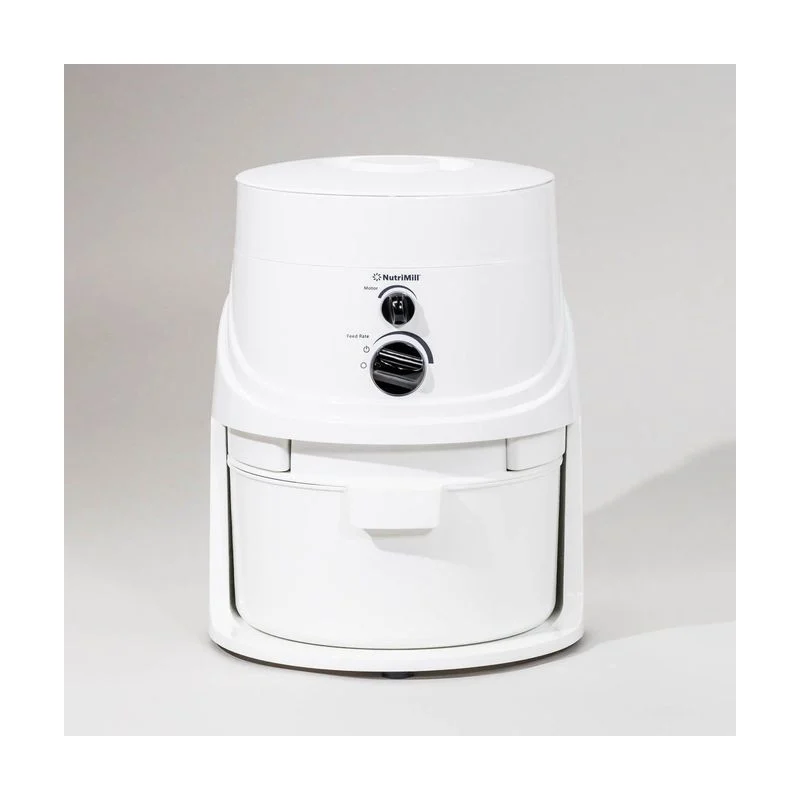
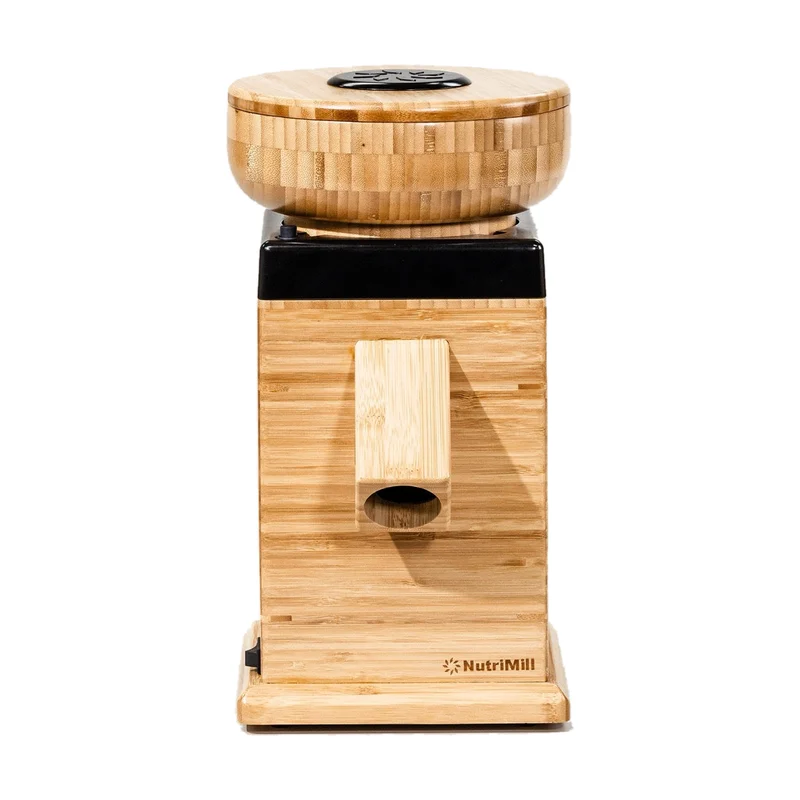
Every specification, side by side
| Attribute | NutriMill Classic | NutriMill Harvest |
|---|---|---|
| Milling mechanism Wording differs | High-speed impact chamber with stainless steel Microburst milling heads nutrimill.com product page | Corundum stone burrs, upper and lower nutrimill.com product page |
| Motor Figures differ | 1200 W, 10 amps Owner manual (PDF) | 450 watts nutrimill.com product page |
| Hopper capacity Figures differ | 12 cups (owner manual states 13 cups) — the manufacturer’s own documents disagree on this figure. nutrimill.com product page | 5 cups nutrimill.com product page |
| Flour container capacity Figures differ | 20 cups (owner manual's grain-to-flour section states the bowl holds 21 to 22 cups) — the manufacturer’s own documents disagree on this figure. nutrimill.com product page | None included; flour leaves through a continuous spout into a bowl the owner supplies nutrimill.com product page |
| Dimensions Figures differ | 12 in W x 12 in D x 13 in H nutrimill.com product page | h13" x w6" x d9" as printed in the product-page specification list; two other figures are published, see the documentation conflicts section nutrimill.com product page |
| Weight Figures differ | 14 lbs Owner manual (PDF) | 16 lbs nutrimill.com product page |
| Texture adjustment Wording differs | Two knobs: variable motor speed and variable grain feed rate Owner manual (PDF) | Patented texture control knob; coarse, medium or fine nutrimill.com product page |
| Flour fineness | Adjustable, fine to medium coarse Owner manual (PDF) | —No row for this attribute appears in the documents read for this mill. |
| Housing Wording differs | ABS plastic Owner manual (PDF) | Bamboo nutrimill.com product page |
| Warranty Figures differ | 5 years parts and plastics; limited lifetime on motor and milling heads; original noncommercial purchaser only Owner manual (PDF) | 5 years against manufacturing defects in materials and workmanship nutrimill.com product page |
| Intended use | Household use only Owner manual (PDF) | —No row for this attribute appears in the documents read for this mill. |
| Thermal protection | —No row for this attribute appears in the documents read for this mill. | Auto-shutoff thermal protection nutrimill.com product page |
| Safety certification | —No row for this attribute appears in the documents read for this mill. | Tested and listed by CSA; stated to meet all US safety standards nutrimill.com product page |
| Country of manufacture | —No row for this attribute appears in the documents read for this mill. | Designed and assembled in the USA nutrimill.com product page |

Two hopper units, and no way to convert between them

NutriMill Classic vs Harvest: what a shared brand and a shared warrantor hold constant
What this section establishes
- NutriMill warrants both mills for the same headline term — five years against manufacturing defects in materials and workmanship, from L’Chef, LLC, to the original noncommercial purchaser only — so warranty length is not a variable between the NutriMill Classic and the NutriMill Harvest.
- Both mills are identified by a retail SKU and nothing else, 760200 for the Classic and 789000 for the Harvest. Neither publishes an engineering model or part number.
- What the shared brand leaves as the variable is the mechanism: a 1200 W motor driving an impact chamber with stainless steel milling heads on the Classic, and a 450 W motor turning corundum stones on the Harvest.
NutriMill sells both mills, which removes most of the variables a cross-brand comparison has to argue about first. The Classic and the Harvest are warranted by the same company, L’Chef, LLC, for the same headline period of five years against manufacturing defects in materials and workmanship, and both warranties run only to the original noncommercial purchaser. Both are identified by a retail SKU and nothing else, 760200 for the Classic and 789000 for the Harvest. Both are documented in the same house pattern: a product page with a specifications accordion, a downloadable PDF, and a help center article set.
What is left over is the mechanism. The Classic mills in a high-speed impact chamber that NutriMill calls a micronizer, fitted with stainless steel milling heads. The Harvest mills between an upper and a lower corundum stone whose gap the operator sets. Nearly everything reported below follows from that single difference: the number of knobs, the size of the hopper, the shape of the flour path, the rule about water, and the two grains one mill permits that the other does not.
The control is not perfect, and the places where it breaks are worth as much as the places where it holds. NutriMill states a country of origin for the Harvest and states two different ones on the same page; for the Classic it states none at all. The five-year term is identical while the components it covers are not. The mechanism-level argument that sits underneath both mills is set out at Impact vs stone burr grain mills. This page keeps the brand fixed and reads what one manufacturer’s own paperwork says when it describes two of its own products.
| Attribute | NutriMill Classic | NutriMill Harvest | Documents these two values were read from |
|---|---|---|---|
| Milling mechanism | High-speed impact chamber (micronizer) with stainless steel milling heads | Upper and lower corundum Grainmaster stones, with the gap set by the operator | Classic product page and owner manual; Harvest product page and user guide |
| Motor rating | 10 Amps; 1200 W | 450 Watt Heavy-Duty Motor | Classic owner manual technical block; Harvest product page specification list |
| Grain hopper capacity | 12 cups on the product page, 13 cups in the owner manual | 5 cups | Classic product page and owner manual; Harvest technical illustration |
| Flour delivery | 20-cup flour bowl, listed in the manual’s parts diagram as part of the machine | Continuous flour spout; no flour container in the What’s Included list | Classic product page and owner manual; Harvest technical illustration for the spout and Harvest product page for the What’s Included list |
| Texture control | Two knobs: motor speed, and grain feed rate which is also the on/off switch | One patented texture control knob, which moves the stone gap | Classic owner manual; Harvest product page and user guide |
| Housing material | ABS plastic | Bamboo | Classic owner manual; Harvest product page |
| Weight | 14 lbs. | 16 Lbs. | Classic owner manual; Harvest product page and technical illustration |
| Height | 13 in | 13 in | Classic product page and owner manual; Harvest product page and technical illustration |
| Warranty | 5 years parts and plastics, limited lifetime on motor and milling heads | 5 years; no lifetime term published on motor or stones | Classic product page and owner manual; Harvest product page, user guide and help centre |
| Stated country of manufacture | Not stated in any document read | Designed and Assembled in the USA in the specification list, and German craftsmanship in a feature block on the same page | Classic product page, owner manual and quick start guide; Harvest product page |
| Identification | SKU 760200 | SKU 789000 | Classic product page; Harvest product page |
| Decibel rating and throughput rate | Not stated in any document read | Not stated in any document read | Classic product page, owner manual and quick start guide; Harvest product page, user guide and help centre |
A row draws on a Classic document and a Harvest document, and on more than one of each where the two halves of a cell come from different places, so the last column names them all rather than the row carrying a single link. A cell that says a figure is not stated is recording an absence in NutriMill’s own paperwork, not an omission here.
The NutriMill Harvest's 5-cup hopper and open spout against the NutriMill Classic's 20-cup flour bowl
What this section establishes
- The NutriMill Harvest’s hopper holds 5 cups of grain and delivers through a continuous flour spout into a bowl the owner supplies; no flour container appears in its What’s Included list.
- The NutriMill Classic’s flour bowl is part of the machine, rated at 20 cups on the product page and in the owner manual’s parts diagram, and fed from a hopper the same manufacturer rates at 12 cups on the page and 13 cups in the manual.
- On the Classic’s own arithmetic a full hopper is close to a full bowl: about 21 cups of flour from 13 cups of hard wheat milled at a medium texture. NutriMill states no batch ceiling for the Harvest at all.
- Neither hopper figure is a throughput rate, because NutriMill publishes no cups-per-minute or grams-per-minute figure for either mill. The practical consequence is loading, not speed: a Classic run is loaded once, and a Harvest run of the same size is loaded more than once against a 5-cup ceiling.
The NutriMill Classic holds 12 cups of grain in its hopper according to the product page’s specification list, which states “12 Cup Grain Hopper Capacity”, and 13 cups according to the owner manual’s technical block, which states “Hopper Capacity: 13 cups”. It delivers into a flour container the product page rates at “20 Cup Flour Bowl Capacity”. That container is part of the machine rather than an accessory: the manual’s parts diagram lists it as “Flour Bowl (Canister) / Large 20 cup capacity. / Large easy grip handles.”
The NutriMill Harvest holds 5 cups of grain, per the technical illustration NutriMill serves on the product page, which reads “CONTINUOUS FLOUR SPOUT” and “5 CUP HOPPER CAPACITY”. It delivers through an open spout into whatever the owner puts under it. The user guide’s second milling step is “Place bowl under flour spout.”, and the product page’s What’s Included list carries five entries, the Harvest Grain Mill, near diamond hard corundum milling stones, a removable hopper, a lid and a cleaning brush, with no flour container among them.
That is the mechanism showing up as furniture, and on the Classic the two capacities are sized against each other by NutriMill’s own arithmetic. The owner manual’s grain-to-flour section states “You will get about 21 cups of flour from 13 cups of hard wheat when milled at a medium texture”, and the same section states “The bowl holds 21 to 22 cups of flour” while the manual’s parts diagram and the product page both rate that bowl at 20 cups. On that one grain at that one texture, a full hopper is about a full bowl, which is also what the product page means when it states the motor produces “up to 20 cups of flour at a time”. The Harvest publishes no such pairing. Its hopper holds 5 cups, the illustration labels the outlet a “CONTINUOUS FLOUR SPOUT”, no flour container appears in the What’s Included list, and the user guide’s instruction is simply “Place bowl under flour spout.” Batch size on the stone mill is therefore set by whatever bowl the owner puts there, and NutriMill states no batch ceiling for the Harvest at all. Neither document explains why the two machines are built this way, and nothing here should be read as a statement about how either mechanism handles what it produces: the containment properties of the Classic’s bowl are not described on any NutriMill source, which lists it only by capacity and by its “Large easy grip handles”.
Neither figure should be read as throughput. NutriMill states no cups-per-minute or grams-per-minute rate for either mill, so “up to 20 cups of flour at a time” describes how much fits, not how long it takes to get there. The hopper figures do carry one practical consequence a buyer can act on: a Classic run is loaded once and left, while a Harvest run of the same size is loaded two or three times, because 5 cups is the ceiling on what its hopper holds.
Why the NutriMill Classic has two texture knobs and the Harvest has one
The NutriMill Classic adjusts texture with two knobs, and the owner manual gives them separate jobs. The upper knob is the Variable Motor Speed Control Knob: “For finer flour, upper knob should remain to the left (high speed)”, “For very coarse flour and medium fine corn meal, knob should be set to the far right, which slows the motor speed”, and “For heavy flour & dense textured breads, select a middle setting.” The lower knob is the Variable Texture, or Grain Feed Rate, Knob, and the manual is explicit that it does double duty: “This is the ON-OFF switch and controls grain flow into the mill. This affects the fineness of the grind.” Its settings are given as clock positions, 11:00 to 12:00 for finer flour, 12:00 to 1:00 for bread flour, and further right for coarser.
Two controls exist because an impact chamber has no gap to move. Fineness on the Classic is the product of two rates, how fast the heads turn and how fast grain arrives at them, so NutriMill supplies one knob for each rate. The manual also warns that the pairing is not absolute: “The point where grain begins to flow will vary depending on grain/bean size”, and it notes that flow may fluctuate at the finest setting. Most grains, it states, will not flow at all below a 10:00 knob position.
The NutriMill Harvest adjusts texture with one control, listed on its product page as a “Patented Texture Control Knob”. The user guide states the direction of travel in headings, “Coarse Flour | Loosen Stones | Counterclockwise” and “Fine Flour | Tighten Stones | Clockwise”, and again in the body: “Turn the control knob clockwise to tighten the stones, creating finer flour.” A second pair of dial graphics repeats “COARSE - COUNTERCLOCKWISE” and “FINE - CLOCKWISE”. One knob is sufficient because the knob moves the only variable in the system, the gap between the stones.
Neither mill publishes a numbered scale. The Classic’s manual states its range as “Flour Fineness: Adjustable - Fine to Medium Coarse”, while the same manufacturer’s product page claims “a 400% adjustment range” and, separately, “10 times more texture range” than earlier impact mills. Those are manufacturer claims, they are defined against no stated baseline, and 400 percent and ten times are not reconcilable with each other. The Harvest’s product page states its range as “coarse, medium, or fine” and elsewhere as “cracked grain to ultra-fine flour”. No micron figure, sieve number or numbered detent appears on any NutriMill source for either mill, so the word fine on one product page cannot be equated with the word fine on the other.
| Texture wanted | NutriMill Classic: motor speed knob (upper) | NutriMill Classic: grain feed rate knob (lower) | NutriMill Harvest: texture control knob |
|---|---|---|---|
| Finer flour | Left, high speed | 11:00 to 12:00 | Clockwise, tightening the stones |
| Bread flour | Not separately stated | 12:00 to 1:00 | Not separately stated |
| Heavy flour and dense textured breads | A middle setting | Not separately stated | Not separately stated |
| Coarser flour, including medium fine corn meal | Far right, which slows the motor | Toward the right | Counterclockwise, loosening the stones |
| Switching the mill off | Not the off control | All the way left turns the mill off | Loosen the stones once the hopper has emptied, then switch off |
Classic settings are summarised from the owner manual’s two-knob instructions and Harvest settings from the user guide’s texture-control pages; every cell is a summary rather than a quotation. The manual gives each knob its own list and never states that a motor-speed setting and a feed-rate setting belong together, so a row groups the texture word each list uses and a cell reads Not separately stated where only one knob’s list names that texture. Neither mill publishes a numbered scale, a micron figure or a sieve number, so a setting in one column cannot be matched to a setting in another. The Classic’s manual adds that most grains will not flow at all below a 10:00 feed-knob position, and that the point where grain begins to flow varies with grain and bean size.
Two ingredient lists, twenty-nine shared entries, and the oat clause
The permitted lists barely move between the two mills. The NutriMill Classic’s owner manual permits 31 items under the heading “THE NUTRIMILL CLASSIC WILL MILL THE FOLLOWING:”. The NutriMill Harvest’s user guide permits 33, twenty-four grains and nine legumes, under “Grains that can be milled”. Twenty-nine entries are common to both. The mechanism decides how a grain is broken far more than it decides whether the grain can be milled at all.
Rolled oats are the clearest case of a mechanism deciding a list. They are flat and light, an impact mill’s hopper meters grain by gravity through an adjustable opening, and the Classic’s manual says outright that they will not feed. The Harvest’s user guide carries no oat exclusion in the sources fetched here. That is a difference in what the documentation states, not a demonstration that a stone mill handles rolled oats well, and the honest reading is that NutriMill has published a feed limitation for one mill and has not addressed the question for the other.
The two caution tiers point at the same underlying problem from opposite ends. The Classic’s caution is about volume in the hopper, because impact milling expands the flour and thirteen listed items “produce more flour volume” than the bowl comfortably takes on a full load. The Harvest’s caution is about passes through the gap, because a chickpea or a lima bean is larger than a fine stone setting will accept on the first attempt. Both are mitigations for the same class of ingredient, expressed in the terms each mechanism understands.
The general exclusion rule is shared almost word for word, with one telling difference in the consequence. The Classic manual states “Avoid grains and beans that have high oil or moisture content. Non-commercially dried products may cause plugging.” The Harvest guide states the same sentence and ends it differently: “Non-commercially dried products may cause build-up and damage your grain mill.” A plugged impact chamber is a blockage; built-up oil on a corundum stone is glaze, and glaze is what the rice pass and the five-minute duty cycle exist to prevent. Both documents then set the same test for anything unlisted, which is to mill a quarter cup, pinch the flour between thumb and finger, and reject the grain if the pinch holds its shape rather than falling apart.
One caution applies to both mills equally and is easy to miss: each product page publishes a permitted list that differs from its own PDF. The Classic’s product page permits triticale, emmer, einkorn, dried sweet corn and pinto beans that its manual does not list, and omits bulgur wheat, kañiwa, blue corn, popcorn, wild rice, anasazi beans and kidney beans that its manual permits. The Harvest’s product page carries a three-column block of whole grains, gluten-free grains and gluten-free legumes that adds triticale, dried sweet corn, chickpeas, garbanzo beans and baby lima beans to what the user guide prints. A reader checking one grain against one page is checking against a list the same manufacturer contradicts elsewhere on the same site.
The divergence between the two permitted and excluded lists runs in both directions, and it is short enough to read in full:
- Permitted by the Harvest user guide and absent from the Classic manual’s list: emmer, einkorn (printed “Eikhorn” in the guide’s grain chart), dent corn and pinto beans.
- Permitted by the Classic manual and absent from the Harvest user guide’s chart: chickpeas (garbanzo beans) and lima beans.
- Excluded by the Classic manual and absent from the Harvest guide’s exclusions: oatmeal (rolled oats) and steel cut oats. The Classic manual supplies the reason: “NOTE: rolled oats will NOT feed into the NutriMill® Classic. Do not mill steel cut oats or rolled oats”.
- Excluded by both documents, identically: dried fruit or vegetables, spices, nuts, goji beans, sesame seeds, flax seeds, herbs, sunflower seeds, coffee beans, hemp, sugar, chia seeds, tapioca, chocolate, and sprouted grains or beans if not thoroughly dried.
- Handled rather than excluded, in mechanism-specific ways: the Classic manual adds a middle tier headed “USE CAUTION WHEN MILLING THE FOLLOWING” covering thirteen items, with the instruction “Fill the hopper no more than ⅔ to ¾ with these as they produce more flour volume”. The Harvest instead prescribes two passes for large legumes, a very coarse grind first and then a second pass at the wanted texture, stated in the user guide, in the product page FAQ and in the help center.
- Qualified only on the Harvest: a NutriMill staff answer in the product page’s own Q&A, dated Thursday 11 September 2025, states “We don’t recommend grinding whole buckwheat with the hull in the Harvest Grain Mill, as the hulls can affect performance and texture. It’s best to use dehulled buckwheat for milling.” The Classic manual lists buckwheat with no hull qualifier.
Both warranties run five years, and only the Classic adds a lifetime term on the milling heads
What this section establishes
- Both mills carry five years against manufacturing defects in materials and workmanship, written by L’Chef, LLC and running only to the original noncommercial purchaser, with commercial use excluded on both.
- Only the NutriMill Classic adds a limited lifetime warranty on the motor and milling heads. No lifetime term appears for the NutriMill Harvest’s motor or stones on its product page, in its user guide or in the help centre article, so the grinding element of the impact mill is covered for as long as the original purchaser owns it and the grinding element of the stone mill is covered for 5 years.
- The Harvest’s exclusions name its ingredient rule directly, refusing damage caused by any foreign objects, oily grains, or seeds getting into the mill. Nothing in the Classic’s warranty language names grain type at all.
Both mills carry five years. The Classic’s product page states “NutriMill warrants the Classic Grain Mill to be free of manufacturing defects in materials and workmanship for 5 years, with a limited lifetime warranty on the motor and milling heads.” The Harvest’s product page states “NutriMill warrants the Harvest grain mill to be free of manufacturing defects in materials and workmanship for 5 years”, the help center restates it as a “5-year limited warranty, covering defects in materials and workmanship”, and the technical illustration carries a five-year warranty badge.
The clause after the five years is where the two part company. The Classic’s manual states the term as “5 years for parts and plastics and limited lifetime on motor and milling heads”. The Harvest’s user guide states five years and stops. No lifetime term on the motor, and none on the stones, appears on the Harvest product page, in the Harvest user guide or in the help center article. On NutriMill’s own paperwork the grinding element of the impact mill is covered for as long as the original purchaser owns it, and the grinding element of the stone mill is covered for five years.
The rest of the terms track each other closely. Both warranties are written by L’Chef, LLC and both apply “to the original noncommercial purchaser”. Both exclude commercial use, normal wear, shipping, neglect and damage caused by foreign objects. The Classic’s manual adds that the warranty is void if the mill is disassembled and that “YOU MUST keep a dated sales receipt for warranty service”, and it states plainly that defective product will be repaired or replaced at the manufacturer’s sole discretion, with no refund of purchase price.
The Harvest’s exclusion list names its ingredient rule directly. It does not cover damage from “any foreign objects, oily grains, or seeds getting into the mill”. That converts the guide’s do-not-mill list from advice into a warranty condition, on the mill whose grinding surfaces glaze, and it is the one place where the mechanism reaches into the legal terms. Nothing in the Classic’s warranty language names grain type at all.
Support routing is nominally shared and practically inconsistent. Both documents give the same service email address at L’Chef. The Classic’s manual prints a service address of 4196 S 950 E, St. George, UT 84790, a back-cover phone number of 1-800-692-6724 and a customer service number of 1.877.267.2434 on its warranty page. The Harvest’s user guide prints 1 (801) 383-1920. Three published phone numbers for one service department across two products is not a mechanism difference, but it is what “support held constant” actually looks like in the documentation.
L’Chef, LLC warrants the NutriMill® Classic mill to be free of manufacturing defects in materials and workmanship for a period of 5 years for parts and plastics and limited lifetime on motor and milling heads.
1200 watts on the Classic, 450 on the Harvest, and a weight that runs the other way
What this section establishes
- The NutriMill Classic’s owner manual states Motor: 10 Amps; 1200 W. The NutriMill Harvest’s specification list states a 450 Watt Heavy-Duty Motor. The ratio between them is not a performance ranking, because NutriMill publishes no rotational speed and no throughput rate for either mill.
- Weight runs the other way to wattage: the 450 W Harvest is stated at 16 lbs on both its product page and its technical illustration, and the 1200 W Classic at 14 lbs in its owner manual.
- Both mills stand 13 in high, so the counter-space question is the Classic’s 12 in square footprint against a narrower Harvest column for which NutriMill publishes three different footprints.
The NutriMill Classic draws 1200 watts. The owner manual’s technical block states “Motor: 10 Amps; 1200 W” and the product page’s specification list states “1200 Watt Heavy-Duty Motor”. The same product page separately states a “10-amp, 1¾ horsepower motor” in its marketing prose. That horsepower figure appears nowhere in the manual’s technical block and is reported here as a manufacturer claim rather than as an electrical specification.
The NutriMill Harvest draws 450 watts. Its specification accordion states “450 Watt Heavy-Duty Motor”, and the body copy states that “The Harvest is equipped with an industry-leading 450-watt motor ready for anything from soft rice to the hardest ancient grains.”
The ratio between those two numbers is not a performance ranking, because the two motors do different physical work. Impact milling accelerates a rotor to the speed at which grain shatters on contact, and the energy goes into velocity. Stone milling turns one loaded stone against another, and the energy goes into torque against friction. NutriMill publishes no rotational speed for either mill, no throughput rate for either mill, and no voltage or frequency for either mill. Wattage here is an electrical rating and a circuit-planning number, not a ranking of how quickly either machine finishes a batch.
Weight and footprint invert the wattage. The Classic weighs 14 lbs per the owner manual and measures 12 inches wide by 12 deep by 13 high, a figure the product page and the manual agree on. The Harvest weighs 16 lbs, stated on both the product page and the technical illustration, and its footprint is the one figure NutriMill does not keep straight, published as h13" x w6" x d9" and as 7" W x 7" D x 13" H within the same specifications accordion, and drawn as a 6¾ inch square base on the illustration. The 13-inch height is the only dimension all three sources share.
Whichever footprint is correct, the direction holds: the Harvest is the narrower mill and the heavier one. The 450-watt stone mill is stated at 16 lbs on both the product page and the technical illustration, and the 1200-watt impact mill at 14 lbs in the owner manual’s technical block, a two-pound difference in the opposite direction to the wattage. Where that weight sits is not published. NutriMill states no component weight for either mill, no stone diameter, no milling-head diameter and no housing mass, so the delta cannot be assigned to the stones, to the bamboo or ABS casings or to the motors from anything the manufacturer prints. Both figures are whole-unit weights and that is all they are. The counter-space comparison is better documented than the weight: a tall narrow column against a squat 12-inch square, both 13 inches high, which matters for anyone milling under a wall cabinet. The Harvest’s illustration further splits its 13 inches into a 10-inch body and a 3-inch hopper and lid section, and because no flour container ships with the Harvest, its published footprint does not account for the bowl the user guide tells the owner to place under the spout. The Classic’s flour bowl is listed in the manual’s own parts diagram as part of the machine.
| Where the figure is published | Footprint stated | Height stated | Read from |
|---|---|---|---|
| NutriMill Harvest product page, specification list, Dimensions entry | w6" x d9" | h13" | nutrimill.com product page |
| NutriMill Harvest product page, specification list, Overall Dimensions entry | 7" W x 7" D | 13" H | nutrimill.com product page |
| NutriMill Harvest technical illustration, served on that same product page | 6 3/4" W x 6 3/4" D | 13" H overall, drawn as a 10" body and a 3" hopper and lid section | nutrimill.com product page |
| NutriMill Classic product page, for comparison; the owner manual states the same figure | 12" W x 12" D | 13" H | nutrimill.com product page |
Only the 13-inch height survives all three Harvest sources. The Harvest’s published footprint also excludes the bowl its user guide tells the owner to place under the spout, since no flour container ships with the mill; the Classic’s flour bowl is listed in the manual’s own parts diagram as part of the machine.
The NutriMill Classic's impact chamber against the NutriMill Harvest's corundum stones
What this section establishes
- The NutriMill Classic has no gap to set. Its product page describes a high-speed impact chamber, which NutriMill calls a micronizer, driven by a 10-amp motor and fitted with stainless steel milling heads that shatter grain rather than press it.
- The NutriMill Harvest sets texture with a gap. Its user guide shows grain falling through the centre of the milling unit and being pressed between an upper and a lower corundum stone, and states that the space between those stones determines the flour’s texture.
The NutriMill Classic mills by impact. Its product page states that “A 10-amp, 1¾ horsepower motor powers the Classic’s high-speed impact chamber (micronizer), using stainless steel milling heads to produce up to 20 cups of flour at a time,” and the owner manual’s technical block lists “Milling Heads: Stainless Steel”. Impact is a chamber in which grain is thrown against and between rotating heads until it shatters; there is no gap between two surfaces to set, because the grain is never squeezed between anything. The product page brands the heads “Stainless Steel Microburst™ Milling Heads”, and the manual lists the housing as “Housing: ABS plastic”.
The NutriMill Harvest mills between stones. Its product page lists “Near Diamond Hard Corundum Grainmaster Milling Stones” and states that “The grinding mechanism uses natural corundum stones to efficiently preserve the flavor and nutrients of the grains during grinding.” The user guide’s first page draws the path: “Grains flow down through the center of the milling unit”, past callouts marked “Upper Stone” and “Lower Stone”, and then “The grain is pressed through the stones creating flour.” Stone is a burr grinding surface, where grain is pressed and sheared between two faces rather than shattered in free space. The guide adds the sentence that governs everything else about running the machine: “The space between the stones determines the texture of your flour.” Its housing is listed as “Durable, Eco-Friendly, Sustainable Bamboo Housing”.
The two casings are as different as the two mechanisms, ABS plastic on the Classic and bamboo on the Harvest, and neither document explains the choice. Neither publishes a stone diameter, a milling head diameter, a rotational speed or a service life for either grinding element. Model-level detail on each mill sits at NutriMill Classic Grain Mill and NutriMill Harvest Grain Mill.
How the NutriMill Harvest must be started, run, shut down and cleaned, and what the Classic asks instead
The NutriMill Classic requires the hopper lid during milling, and the manual gives the reason: “The NutriMill is designed to operate with the lid on for quieter milling.” The parts diagram repeats it as “Hopper Lid / Use during milling for quiet operation.” The mill is switched off by the same knob that meters grain, since “Turning the knob all the way to the left will turn off the mill”, so stopping the Classic and starving the chamber of grain are a single action.
The NutriMill Harvest requires an order of operations that has no counterpart on an impact mill. The user guide instructs “ALWAYS TURN ON MILL BEFORE ADDING GRAIN”, then “Adjust texture control knob until you hear the stones begin to grind”, and at the end of a run “ALLOW THE GRAIN TO EMPTY FROM THE HOPPER AND LOOSEN STONES BEFORE TURNING OFF YOUR MILL.” Two stones closed against each other cannot be started under load, which is why the motor runs first and the gap closes second, and why the gap opens again before the motor stops.
The Harvest also imposes a duty cycle that the Classic’s documentation does not. Under the heading “To avoid Glazing Stones:”, the user guide states “When milling fine flour, mill grains in 5 minute increments. Mill for 5 min, rest for 10 min.” That guidance is conditional, tied to fine flour and to glaze prevention rather than to a motor rating, and the guide reinforces it with a warning: “Over tightening results in low flour flow, causing burned flour and glazed stones.” No comparable interval appears in the Classic’s owner manual or quick start guide.
Cleaning divides along the same line, and the two restrictions are not about the same thing. The Classic’s restriction is about plastics: its quick start guide states “Hand-wash the plastic bowl and lid. DO NOT put them in the dishwasher. High-heat dishwashers can warp the plastics.” The Harvest’s restriction is about the mechanism and it is absolute: “NEVER USE WATER TO CLEAN MILL STONES.” Its remedy is milling rather than washing, since “If stones become glazed mill 1 cup of white rice or more if needed on a COARSE setting to remove glaze”, and the guide adds a commissioning step with no Classic equivalent: “Before consuming flour, mill 2 cups of white rice & discard.”
The consumables differ in kind, not only in name. The Classic’s manual footnotes its exploded diagram with “*Inlet grommet and filter should be replaced every 2 years or as needed”, and the asterisks in that diagram mark the inlet grommet and the air filter. An impact chamber moves a large volume of air alongside the flour, so the parts that wear on a schedule are the airflow parts. The Harvest’s wearing part is the grinding surface itself, and NutriMill discourages disturbing it: the help center states “The lower stone is secured with a reverse-threaded screw, which must be turned clockwise to loosen. However, we do not recommend removing the lower stone.” Neither manufacturer publishes a replacement interval or a service life for either grinding element.
The NutriMill Harvest’s user-guide rules, in the order a run applies them
- Turn the mill on before adding grainThe user guide prints the instruction in capitals: ALWAYS TURN ON MILL BEFORE ADDING GRAIN. Two stones closed against each other cannot be started under load, which is why the motor runs first on a stone mill and has no equivalent requirement on the Classic’s impact chamber.
- Close the gap until the stones are grindingAdjust texture control knob until you hear the stones begin to grind. Clockwise tightens the stones for finer flour, and the guide bounds it with a warning: over tightening results in low flour flow, causing burned flour and glazed stones.
- Mill fine flour in five-minute incrementsWhen milling fine flour, mill grains in 5 minute increments. Mill for 5 min, rest for 10 min. The instruction is tied to glaze prevention rather than to a motor rating, and no comparable interval appears in the Classic’s owner manual or quick start guide.
- Empty the hopper and loosen the stones before switching offALLOW THE GRAIN TO EMPTY FROM THE HOPPER AND LOOSEN STONES BEFORE TURNING OFF YOUR MILL. The gap opens again before the motor stops, the reverse of the start-up order. On the Classic, stopping the mill and starving the chamber of grain are one action, because the feed knob is also the on-off switch.
- Clean the stones by milling, never with waterThe remedy for a glazed stone is another pass rather than a wash: if stones become glazed mill 1 cup of white rice or more if needed on a COARSE setting to remove glaze. The Classic’s cleaning restriction is a different kind of rule — its quick start guide bars the plastic bowl and lid from the dishwasher because high-heat dishwashers can warp the plastics.
Where the Classic and the Harvest are genuinely equivalent
Several rows that a comparison table would happily print twice are, on the published evidence, the same row. Holding the brand constant makes them visible.
- Warrantor and headline term: L’Chef, LLC, five years, materials and workmanship, original noncommercial purchaser only, commercial use excluded on both.
- Height: 13 inches for both mills, and the only dimension the Harvest’s three published footprints agree on.
- Identification: a retail SKU and nothing more, 760200 for the Classic and 789000 for the Harvest. Neither mill publishes an engineering model or part number.
- Noise: no decibel figure for either mill. The Classic’s page uses the trademark “Whisper Quiet™” with the analogy “a sound level similar to that of a vacuum cleaner”; the Harvest’s page uses the phrase whisper-quiet operation. Neither is a measurement.
- Throughput: neither mill publishes a milling rate in cups or grams per minute, so neither can be ranked on speed.
- Particle size: neither mill publishes a micron figure, a sieve number or a numbered setting scale.
- Electrical detail beyond wattage: neither mill publishes a voltage, a frequency or a rotational speed.
- Unlisted grains: both documents set the same quarter-cup pinch test and the same instruction to avoid grains and beans high in oil or moisture content.
- Exclusions: fifteen items match exactly across the two lists, including the identical conditional wording on sprouted grains and beans if not thoroughly dried.
- Grinding-element life: neither the stainless steel milling heads nor the corundum stones carry a stated service life on any manufacturer source.
Where NutriMill's own documents contradict themselves about the Classic and the Harvest
NutriMill’s documentation disagrees with itself about both mills, in different places and about different attributes. Every instance below is reported rather than resolved. We have not measured any of these objects and have no basis for preferring one published value over another.
The Classic’s grain hopper is 12 cups or 13. The product page’s specification list states “12 Cup Grain Hopper Capacity”, repeated in its feature block. The owner manual’s technical block states “Hopper Capacity: 13 cups”, and the manual’s grain-to-flour section supports the larger figure independently: “You will get about 21 cups of flour from 13 cups of hard wheat when milled at a medium texture.” The two values have never been reconciled by the manufacturer.
The Classic’s flour container is 20 cups or 21 to 22, and this conflict is internal to a single twelve-page document. The product page states “20 Cup Flour Bowl Capacity” and the manual’s parts diagram agrees at “Large 20 cup capacity”, but the manual’s grain-to-flour section states “The bowl holds 21 to 22 cups of flour.” The 21-cup output figure is conditional on hard wheat milled at a medium texture and is not a general conversion rate.
The Classic’s dishwasher instruction changes force between documents. The quick start guide prohibits, stating “DO NOT put them in the dishwasher.” The owner manual for the same components recommends, stating “We recommend hand-washing the plastic bowl and lid.” Same parts, same manufacturer, two different levels of obligation, and a buyer who reads only one of the two PDFs will take away a different rule than a buyer who reads the other.
The Harvest’s footprint is published three ways, two of them within one accordion. “Dimensions: h13" x w6" x d9"” and “Overall Dimensions: 7" W x 7" D x 13" H” both appear in the product page’s specifications, a few lines apart, and the technical illustration on the same page dimensions the base at 6¾ inches square with a 13-inch overall height made up of a 10-inch body and a 3-inch hopper and lid section. Only the height survives all three.
The Harvest’s origin is published two ways on one page. The specification list states “Designed and Assembled in the USA”. A feature block on the same page states “German Quality - The Harvest Grain Mill is a product of precise German craftsmanship, ensuring excellent durability and performance.” The German sentence sits inside the block describing the Grain Master stones, so it may be a claim about the stones rather than about assembly. NutriMill does not say which, and the Classic’s documentation states no country of manufacture at all, so the brand has three postures on origin across two products.
The pattern beneath every one of these is the same, and it is the most useful thing this comparison surfaces: the marketing surface and the engineering document are maintained separately, and neither is reconciled against the other. It holds for hopper capacity, for bowl capacity, for cleaning force, for footprint, for origin and for the permitted-ingredient lists. Anyone deciding between these two mills should treat a single number from a product page as one of two published values until the PDF has been checked.
Speed, fineness, noise and stone life: what NutriMill's documents cannot settle
Speed. Neither mill publishes a throughput rate, so the 1200-watt impact mill cannot be called faster than the 450-watt stone mill, nor slower. The Classic’s “up to 20 cups of flour at a time” is a batch ceiling, and the Harvest publishes no batch figure at all, so even the two claims are not the same kind of claim.
Fineness. Both mills claim a fine setting and neither defines it. The Classic’s manual caps its own stated range at “Medium Coarse” while its product page advertises grinding “super fine (finer than any other impact mill)” with a “400% adjustment range”; the Harvest’s page claims “ultra-fine flour” and lists four texture targets, all-purpose flour, coarse flour, cracked grain and fine flour, with the note to sift for fine flour. With no micron figure on either side, fine is two marketing words rather than one measurement, and any ranking between them would be invented here.
Flour temperature. The Classic’s product page states that its airflow design “keeps flour temperatures around 118°F” and calls the machine “the coolest-running impact mill in the world”. Both are manufacturer claims: no grain type, ambient temperature or run length is stated, and the specification bullet drops even the hedge “around”. The Harvest publishes no flour temperature figure at all, so the two mills cannot be compared on heat even at the level of claims, let alone measurements.
Noise. A vacuum-cleaner analogy and the phrase whisper-quiet are not comparable to each other, and neither is a decibel rating. Anyone milling in an open-plan kitchen at six in the morning is choosing without data on either mill.
Durability and reliability. The published inputs are warranty terms and one consumable interval, the Classic’s inlet grommet and air filter every two years. Warranty length is a commercial decision rather than a measured lifespan, and no stone service life, milling-head service life or failure-rate figure exists on any NutriMill source cited here. The Classic’s limited lifetime term on the motor and milling heads is a stronger commercial promise than the Harvest’s five years; it is not evidence that the heads outlast the stones.
Nutrient retention. The Classic’s page states that its flour temperature is “protecting nutrients during milling” and the Harvest’s page states that corundum stones “efficiently preserve the flavor and nutrients of the grains”. Neither claim carries a percentage, a nutrient, a method or a comparison baseline.
Price, availability, ratings and rank are outside this page’s evidence by design. What the paperwork does support is the mechanism argument itself: two knobs and a 20-cup flour bowl listed as part of the machine against one knob and a continuous spout with no container included, an airflow consumable against a glazing stone, a lifetime head term against a five-year stone term, and two permitted lists that agree on twenty-nine entries and diverge on six, four printed only in the Harvest’s user guide and two only in the Classic’s manual, plus the two oat entries the Classic alone excludes.
Is the NutriMill Harvest a replacement for the NutriMill Classic?
NutriMill publishes them as two different machines rather than as successive versions of one. The Classic mills by impact into a flour container that ships as part of the machine and that the manufacturer rates at 20 cups, fed from a hopper it rates at 12 cups on the product page and 13 in the manual. The Harvest mills between corundum stones from a 5-cup hopper through a continuous spout into a bowl the owner supplies. The Classic’s warranty adds a limited lifetime term on the motor and milling heads that the Harvest’s does not, and the Harvest carries stone-care rules with no Classic equivalent, including the instruction never to use water on the stones, a five-minute-on and ten-minute-rest cycle when milling fine flour, and a rice pass to remove glaze. They overlap heavily in what they permit and diverge in how they are run.
Which NutriMill mills flour finer, the Classic or the Harvest?
Neither manufacturer document answers this, because NutriMill publishes no micron figure, no sieve number and no numbered setting scale for either mill. The Classic’s owner manual states its range as “Adjustable - Fine to Medium Coarse” while the Classic’s product page advertises grinding “super fine (finer than any other impact mill)” within a “400% adjustment range”. The Harvest’s product page states “coarse, medium, or fine” and “cracked grain to ultra-fine flour”, and lists fine flour as a texture target with the note to sift for it. Those are unquantified claims from the same marketing department, so ranking one against the other would mean inventing a measurement neither mill has. A reader who needs a number should ask L’Chef’s service department for a stated particle-size specification and treat the absence of an answer as the answer.
Can the NutriMill Harvest mill everything the NutriMill Classic can?
Almost, on the published lists. Twenty-nine items appear on both permitted lists. The Classic’s owner manual permits chickpeas (garbanzo beans) and lima beans, which the Harvest user guide’s chart does not print, although the Harvest product page separately lists chickpeas, garbanzo beans and baby lima beans in its own grain block, so NutriMill’s two Harvest sources disagree on that point. The Harvest user guide permits emmer, einkorn, dent corn and pinto beans, which the Classic manual does not list. Both documents exclude the same fifteen oily, sugary and high-moisture ingredients. The Classic additionally excludes rolled oats and steel cut oats and states the mechanical reason, that rolled oats will not feed into the mill.
Do the Classic and the Harvest carry the same warranty?
Both carry five years against manufacturing defects in materials and workmanship, from the same warrantor, L’Chef, LLC, to the original noncommercial purchaser only, with commercial use excluded on both. They are not otherwise identical. The Classic’s product page and owner manual add “a limited lifetime warranty on the motor and milling heads”, and no lifetime term appears for the Harvest’s motor or stones on its product page, in its user guide or in the help center article. The Harvest’s exclusions name “oily grains, or seeds getting into the mill” explicitly, which ties its ingredient list to its warranty in a way the Classic’s language does not. The Classic’s manual voids the warranty if the mill is disassembled and requires a dated sales receipt for service.
Where are the NutriMill Classic and the NutriMill Harvest made?
NutriMill states two answers for the Harvest and none for the Classic. The Harvest product page’s specification list states “Designed and Assembled in the USA”, while a feature block on the same page states “German Quality - The Harvest Grain Mill is a product of precise German craftsmanship.” That sentence sits inside the block describing the Grain Master stones, so it may describe the stones rather than the assembly; the page does not say which, and the two statements are not reconciled anywhere. For the Classic, no country of manufacture appears on the product page, in the twelve-page owner manual or in the quick start guide. The only geography either Classic document supplies is the warrantor’s service address, L’Chef, LLC, 4196 S 950 E, St. George, UT 84790, which identifies who repairs the mill rather than who built it.
The documents this page was read from
- NutriMill Classic Grain Mill product page (manufacturer)
- NutriMill Classic full owner manual (PDF, 12 pages, manufacturer-hosted)
- NutriMill Classic Quick Start Guide (PDF, 2 pages, manufacturer-hosted)
- NutriMill Harvest Grain Mill product page (manufacturer)
- NutriMill Harvest technical illustration (dimension and capacity diagram served on the product page)
- NutriMill Harvest User Guide (PDF, 4 pages, manufacturer-hosted)
- Harvest Grain Mill FAQs (NutriMill Help Center)
Where to buy either mill, and the documents behind these figures
Prices and availability are on the seller’s site. Amazon links are affiliate links; we may earn a commission at no extra cost to you. Other seller links are unpaid.
- Publication
- By Millwright
- Source
- Manufacturer documentation
- Updated