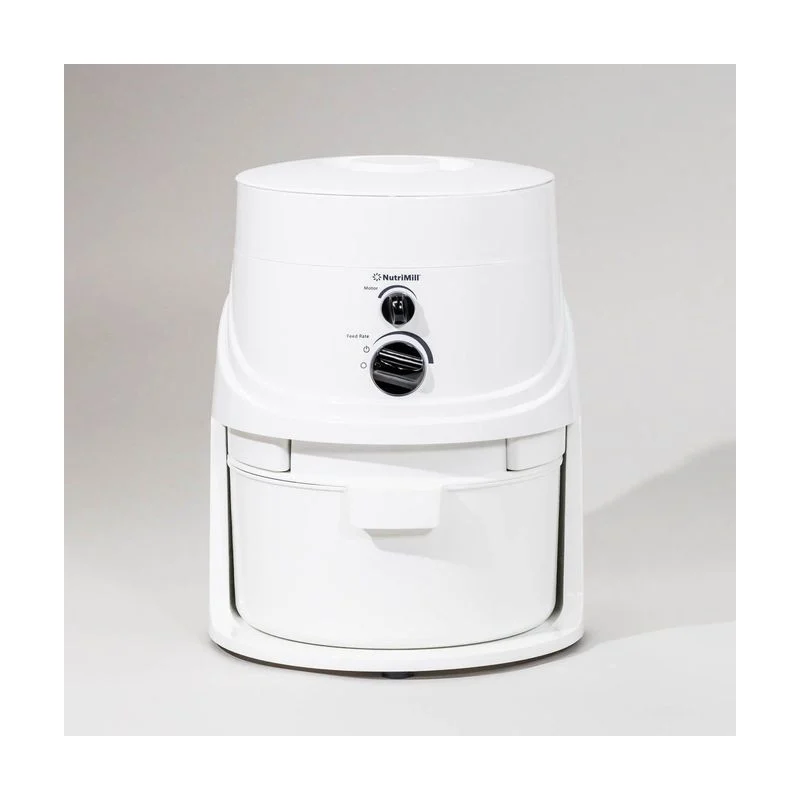
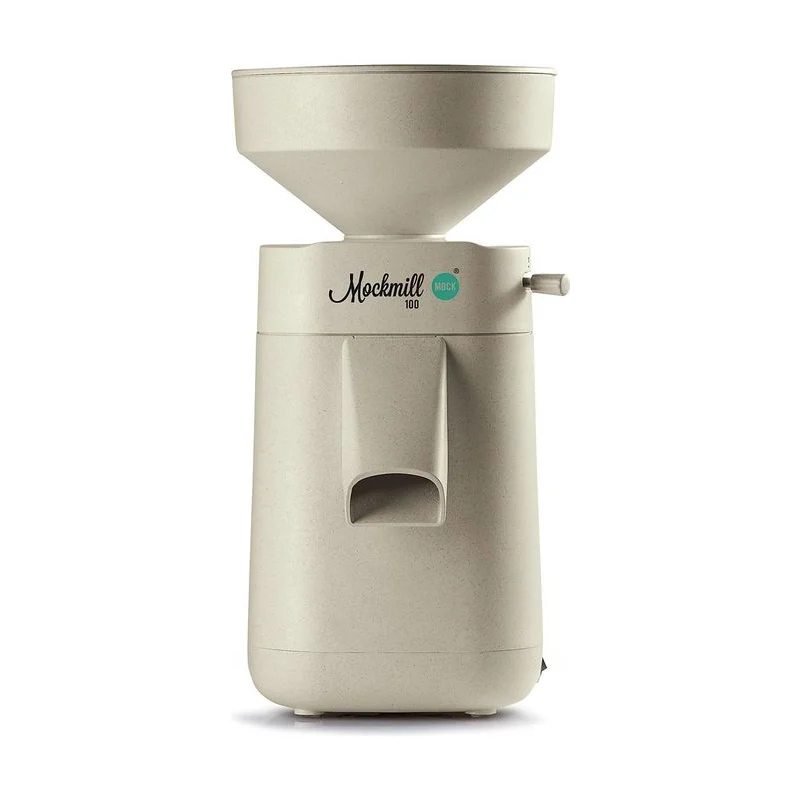
Every specification, side by side
| Attribute | NutriMill Classic | Mockmill 100 |
|---|---|---|
| Milling mechanism Wording differs | High-speed impact chamber with stainless steel Microburst milling heads nutrimill.com product page | Corundum ceramic grinding stones mockmill.us product page |
| Motor Figures differ | 1200 W, 10 amps Owner manual (PDF) | 360 W mockmill.us product page |
| Hopper capacity Figures differ | 12 cups (owner manual states 13 cups) — the manufacturer’s own documents disagree on this figure. nutrimill.com product page | 1,100 g | 2 lbs 7 oz (wheat) mockmill.us product page |
| Flour container capacity Figures differ | 20 cups (owner manual's grain-to-flour section states the bowl holds 21 to 22 cups) — the manufacturer’s own documents disagree on this figure. nutrimill.com product page | No container supplied; stated contents are the mill with hopper cover and the owner's manual mockmill.us product page |
| Dimensions Figures differ | 12 in W x 12 in D x 13 in H nutrimill.com product page | 380 x 220 x 190 mm | 15 x 8.7 x 7.5 in mockmill.us product page |
| Weight Figures differ | 14 lbs Owner manual (PDF) | 6 kg | 13 lbs 3.5 oz mockmill.us product page |
| Texture adjustment Wording differs | Two knobs: variable motor speed and variable grain feed rate Owner manual (PDF) | Stepless, variable from very fine to coarse mockmill.us product page |
| Flour fineness | Adjustable, fine to medium coarse Owner manual (PDF) | —No row for this attribute appears in the documents read for this mill. |
| Housing Figures differ | ABS plastic Owner manual (PDF) | Terluran GP-35 mockmill.us product page |
| Warranty Figures differ | 5 years parts and plastics; limited lifetime on motor and milling heads; original noncommercial purchaser only Owner manual (PDF) | 6 years, non-commercial use mockmill.us product page |
| Intended use | Household use only Owner manual (PDF) | —No row for this attribute appears in the documents read for this mill. |
| Voltage | —No row for this attribute appears in the documents read for this mill. | 110 V (US listing) mockmill.us product page |
| Milling speed | —No row for this attribute appears in the documents read for this mill. | Approx. 1,100 RPM (owner manual states approx. 1,300 rpm at 110 V, 60 Hz) — the manufacturer’s own documents disagree on this figure. mockmill.us product page |
| Milling rate | —No row for this attribute appears in the documents read for this mill. | Approx. 100 g/min | approx. 3.5 oz/min (soft wheat) mockmill.us product page |
| Country of manufacture | —No row for this attribute appears in the documents read for this mill. | Germany mockmill.us product page |
What the three mechanisms actually are

How the NutriMill Classic's impact chamber breaks grain
What this section establishes
- NutriMill’s product-page marketing copy credits “A 10-amp, 1¾ horsepower motor” with producing “up to 20 cups of flour at a time” through the Classic’s stainless steel milling heads, while the owner manual’s technical block states the motor as “Motor: 10 Amps; 1200 W” and carries no horsepower figure at all.
- No gap is set anywhere in an impact chamber, so the Classic’s owner manual states texture qualitatively - “Flour Fineness: Adjustable - Fine to Medium Coarse” - and never as a dimension.
- NutriMill attributes flour temperatures of around 118 degrees Fahrenheit to the Classic’s airflow design, and publishes no grain type, ambient temperature or run length alongside the figure.
- The Classic’s airflow path carries the only scheduled consumable either manufacturer publishes: “Inlet grommet and filter should be replaced every 2 years or as needed.”
Impact, in a grain mill, names a chamber that shatters grain against moving surfaces, as distinct from a burr, which is a pair of grinding surfaces that reduce grain in the gap between them. The NutriMill Classic is built the first way. NutriMill states that “A 10-amp, 1¾ horsepower motor powers the Classic’s high-speed impact chamber (micronizer), using stainless steel milling heads to produce up to 20 cups of flour at a time.” The owner manual’s technical block records the same mechanism in two words: “Milling Heads: Stainless Steel.” The product page trademarks them, listing “Stainless Steel Microburst™ Milling Heads” among its specifications.
Grain in an impact chamber never rests between two grinding surfaces. It falls out of the hopper through a feed opening, meets the heads at speed, and leaves as flour. Nothing in that sequence sets a physical gap, so nothing in it sets a particle dimension directly. The manual’s technical block reflects that: where a burr mill’s documentation could state a gap, the Classic’s states a qualitative range, “Flour Fineness: Adjustable - Fine to Medium Coarse.”
The chamber moves air as well as grain. The owner manual’s exploded parts diagram names an air filter and an inlet grommet among the serviceable components and footnotes both: “*Inlet grommet and filter should be replaced every 2 years or as needed.” NutriMill instructs owners to run the mill closed — “The NutriMill is designed to operate with the lid on for quieter milling” — and attributes the flour temperature to the same airflow, stating temperatures “around 118°F” and describing the result as “protecting nutrients during milling.” Both the temperature and the superlative attached to it, “coolest-running impact mill in the world,” are manufacturer statements. No test conditions, grain type, run length or ambient temperature accompanies the figure, and the product page’s specification list drops both the hedge “around” and the Fahrenheit unit.
The Classic’s housing is ABS plastic and the mill carries the rating “HOUSEHOLD USE ONLY”, both stated in the owner manual. The full set of published figures for this mill, including the hopper and flour container capacities argued over below, is set out at NutriMill Classic Grain Mill.
How the Mockmill 100's stone burr breaks grain
What this section establishes
- The Mockmill 100 reduces grain between two corundum ceramic stones, a fixed upper stator and a lower rotor carried on the motor shaft, and the distance between them is the single variable that sets fineness.
- The Mockmill 100's manual states rotor speed against supply: approximately 1,100 rpm at 230 V (50 Hz) and approximately 1,300 rpm at 110 V (60 Hz). No NutriMill source states a head speed for the Classic at all, so the two mills cannot be ranked on speed.
- The stone gap dictates the operating order. The manual instructs in bold that the Mockmill is switched on before the hopper is loaded and never switched off mid-mill, and it states that order three times without explaining it.
Stone, in a grain mill, names an abrasive burr — one of a pair of discs that reduce grain in the gap between them rather than by striking it. The Mockmill 100 mills between two such discs. Its owner manual carries the description on the cover, “Stone mill for milling grains, pulses and spices,” and names the material in the technical details: “Corundum ceramic milling stones.” The product specification tables repeat it as “Corundum ceramic grinding stones.”
The manual describes the pair from the inside, in its stone-cleaning procedure: “Now you can lift off the top stone (stator). The bottom stone (rotor) is then visible; it is attached to the motor shaft.” The upper stone is carried on springs, and the manual warns owners not to lose them during cleaning. One disc turns on the motor shaft, one does not, and the distance between the two is the single variable that determines how finely grain is reduced. That is the structural fact from which every other difference on this page follows.
The Mockmill 100 mills at a stated rotor speed. The manual gives two figures tied to supply: “230 V (50 Hz) Approx. 1 100 rpm” and “110 V (60 Hz) Approx. 1 300 rpm.” No NutriMill source states a head speed for the Classic, so the two mills cannot be compared on rotational speed at all. What can be compared is what a speed figure does in each mechanism. On the stone mill it governs how fast grain passes a gap that is already set. On the impact mill NutriMill sells motor speed as one of the two controls a baker uses to change texture.
The gap also dictates the operating order. The manual states, in bold, “ALWAYS switch the Mockmill on prior to loading the hopper!” and “Don’t switch the Mockmill off while it is milling.” The same order appears in the numbered quick guide, where switching on is step three and loading the hopper is step five, and again in the troubleshooting section. The manual does not explain the reason; it states the order three times. The Classic reverses the relationship between power and feed entirely, because its lower knob is both the on/off switch and the grain feed control. Published figures for the stone mill are set out at Mockmill 100 Stone Grain Mill.
Now you can lift off the top stone (stator). The bottom stone (rotor) is then visible; it is attached to the motor shaft.
Texture control: the Classic's two knobs against the Mockmill 100's 1 to 10 lever
What this section establishes
- The NutriMill Classic sets texture with two interacting knobs, an upper Variable Motor Speed Control Knob and a lower Grain Feed Rate Knob that is also the on/off switch, and the manual gives their settings as clock positions it says will shift with grain and bean size.
- The Mockmill 100 sets texture with one screw-in lever on a numbered 1 to 10 scale that moves the stone gap directly; position 1 is the finest setting, and the lever can be re-indexed at either end of the scale to shift the whole range coarser or finer.
- The Mockmill 100's manual publishes a lever setting for each of 41 foods on a 1 to 10 scale, so one number returns one stone gap. The Classic’s manual publishes clock positions only, and states that the point where grain begins to flow varies with grain and bean size.
The Classic adjusts texture with two knobs that act on different variables. The manual names the upper one the Variable Motor Speed Control Knob and instructs: “The motor speed allows you to determine and have greater control of the texture of your flour or meal. For finer flour, upper knob should remain to the left (high speed). For very coarse flour and medium fine corn meal, knob should be set to the far right, which slows the motor speed. For heavy flour & dense textured breads, select a middle setting.”
The lower knob is the Variable Texture Control Knob in the parts diagram and the Grain Feed Rate Knob in the body text, and it does two jobs at once: “This is the ON-OFF switch and controls grain flow into the mill. This affects the fineness of the grind.” The manual gives its settings as clock positions — “For finer flour, set the knob toward 11:00 – 12:00 (most grains will not flow at less than a 10:00 position on the knob). For bread flour, set the knob toward the 12:00 – 1:00 position. For coarser flour turn the knob toward the right” — and immediately qualifies them, stating that the point where grain begins to flow will vary depending on grain and bean size. A clock position is therefore not a repeatable setting across different grains on this mill; it is a starting point.
NutriMill quantifies the span two ways that do not reconcile. The product page states “With a 400% adjustment range, you can grind super fine (finer than any other impact mill) or coarser textures ideal for rustic bakes. That’s 10 times more texture range than earlier impact mills,” and the feature block repeats it as “400% Range Adjustment - This makes it ten times greater than previous impact mills.” A 400% range and a tenfold range are different quantities, neither is defined against a stated baseline, and the comparison is drawn against unnamed earlier impact mills. Both are manufacturer claims.
The Mockmill 100 adjusts texture with one lever moving across a numbered scale, and the variable it moves is the stone gap. Both product pages state “Stepless adjustment of the settings from very fine to coarse,” and the manual’s technical details state “Milling grades: Variable from very fine to very coarse.” Position 1 is the fine end, and the manual describes how the mill announces it: “The setting is pre-adjusted so that you can hear a quiet sound of the stones touching at lever position 1 when idling without grain. This is the finest setting, at higher settings you get coarser results.” The screw-in lever can be loosened at either end of the scale and re-indexed, shifting the whole 1 to 10 range coarser or finer.
The practical consequence is repeatability rather than range. A Mockmill setting is a number on a scale that the manual then publishes per food, so the same number returns the same gap. A Classic setting is the interaction of a motor speed and a feed rate, expressed as knob positions the manual itself says will move with grain size. Neither manufacturer publishes a particle size in microns for any setting, so no numeric texture comparison between the mechanisms is possible from published sources. The practical routine of milling, batching and storing flour is covered at How to mill your own flour.
| Mill | How texture is set | The fine end of the range | Published range | Particle size | Read from |
|---|---|---|---|---|---|
| NutriMill Classic (impact chamber) | Two knobs acting on different variables: an upper Variable Motor Speed Control Knob and a lower Grain Feed Rate Knob that is also the on/off switch | Upper knob left, at high speed; lower knob toward 11:00 to 12:00, with the manual noting most grains will not flow below a 10:00 position | “Flour Fineness: Adjustable - Fine to Medium Coarse” | Not stated in any document read | Owner manual (PDF) |
| Mockmill 100 (corundum ceramic stones) | One screw-in lever across a numbered 1 to 10 scale, moving the gap between the stator and the rotor; the lever can be loosened and re-indexed to shift the whole range | Lever position 1, described in the manual as pre-adjusted to a quiet sound of the stones touching when idling without grain | “Milling grades: Variable from very fine to very coarse” | Not stated in any document read | Owner manual (PDF) |
Every cell in each row is printed in the manual that row cites. The table settles how each control works, not how fine either mill grinds. NutriMill’s “400% adjustment range” and “10 times more texture range” are marketing quantities on the product page with no stated baseline for either.
What each manual permits: 31 foods on the Classic, 41 on the Mockmill 100
What this section establishes
- The NutriMill Classic’s owner manual publishes 31 permitted foods under “THE NUTRIMILL CLASSIC WILL MILL THE FOLLOWING”. The Mockmill 100's manual publishes 41, each carrying a lever setting, plus dried spices and seasonings as a general category.
- Spices are the largest divergence and both manufacturers state it plainly: the Mockmill manual’s cover names spices as an intended use and its table publishes a setting for each, while the Classic’s manual lists Spices and Herbs under DO NOT MILL and the Quick Start Guide repeats “DO NOT MILL SEEDS, NUTS, SUGARS, OR SPICES.”
- The divergences run in both directions. The Classic’s manual permits popcorn, which the Mockmill table excludes by name, and permits white, brown and wild rice where the Mockmill table permits natural long grain rice only, annotated “No parboiled rice”.
The permitted lists are where the mechanism argument stops being theoretical. The Classic’s owner manual publishes 31 foods under the heading “THE NUTRIMILL CLASSIC WILL MILL THE FOLLOWING”, covering hard wheat, soft wheat, spelt, kamut, barley, farro, rye, bulgur wheat, teff, kañiwa, blue corn, popcorn, whole oat groats, white rice, brown rice, wild rice, sorghum, millet, buckwheat, quinoa and amaranth, plus ten pulses. The Mockmill manual publishes a table of 41 foods, each with a lever setting for the Mockmill 100, and adds dried spices and seasonings as a general category.
The single largest divergence is spices, and it is a mechanism difference the two manufacturers state plainly rather than a matter of interpretation. The Mockmill manual’s own cover names spices as an intended use and its table publishes a setting for each one. The Classic’s manual lists Spices and Herbs under DO NOT MILL, and the Quick Start Guide states the short form in capitals: “DO NOT MILL SEEDS, NUTS, SUGARS, OR SPICES.” A buyer who wants one machine for flour and for spice work is not choosing between two products here; only one of the two mechanisms is documented for it.
The rest of the divergences are narrower and run in both directions.
The Classic’s manual also publishes a middle tier the Mockmill documentation has no equivalent of. Under “USE CAUTION WHEN MILLING THE FOLLOWING”, it instructs owners to “Fill the hopper no more than ⅔ to ¾ with these as they produce more flour volume,” listing dried lentils, legumes generally, dried sweet corn, dried garbanzo beans, barley, dried pinto beans, quinoa, soybeans, dried green beans, oat groats, kamut, dried mung beans and spelt. That is a hopper capacity instruction, not an exclusion, and it applies to foods the same manual permits on the page before.
- Spices: the Mockmill manual publishes Mockmill 100 settings for aniseed whole (4), fennel seeds (2), cardamom pods (0–1), coriander seeds (1), cumin (4), caraway seeds (4–5), cloves (3), allspice (1), star anise (2–3, “Cut into small pieces”), pepper (2), tonka beans (9–10), cinnamon flowers (0–1), cinnamon sticks (1, “Cut into small pieces”), dried rosemary (2) and fenugreek seeds (1). The Classic’s manual excludes spices and herbs outright.
- Oats: the Mockmill manual lists Oats at setting 3. The Classic’s manual permits whole oat groats only and states “NOTE: rolled oats will NOT feed into the NutriMill® Classic. Do not mill steel cut oats or rolled oats”.
- Popcorn: the Classic’s manual permits popcorn. The Mockmill table annotates its corn and maize entry (1–2) with “No Popcorn”.
- Rice: the Classic’s manual permits white, brown and wild rice. The Mockmill table permits natural long grain rice (0–1) with the note “No parboiled rice”.
- Buckwheat: both permit it, but the current Mockmill manual restricts it — buckwheat is listed at 0–1 with the note “Only hulled and not pre-toasted”. The Classic’s manual lists buckwheat with no qualifier.
- Pulses: both mechanisms are documented for them. The Classic’s manual permits lentils, chickpeas, lima beans, soybeans, anasazi beans, mung beans, black beans, kidney beans, navy beans and split peas; the Mockmill table gives settings for dried peas (1), chickpeas (4–5), kidney beans (1), lentils (1), lupin seeds (2), pinto beans (2), soya beans (1–2) and white beans (0–1).
- Ancient wheats: the Mockmill table lists einkorn wheat (1), emmer wheat (0–1), green spelt (1), spelt (1) and kamut (1). The Classic’s manual lists spelt, kamut and farro; its product page carries a different list that adds einkorn and emmer.
- Chia: the Mockmill table lists chia seeds at 6–7. The Classic’s manual lists chia seeds under DO NOT MILL.
| Mill | Spices | Oats | Popcorn | Rice | Chia | Read from |
|---|---|---|---|---|---|---|
| NutriMill Classic | Listed under DO NOT MILL, together with Herbs | Whole oat groats only: “rolled oats will NOT feed into the NutriMill® Classic. Do not mill steel cut oats or rolled oats” | Permitted | White, brown and wild rice all permitted | Chia seeds listed under DO NOT MILL | Owner manual (PDF) |
| Mockmill 100 | Fifteen table entries carry a published lever setting, from cardamom pods at 0 to 1 up to tonka beans at 9 to 10 | Oats at setting 3, with no distinction of form | Excluded: the corn and maize entry at 1 to 2 is annotated “No Popcorn” | Natural long grain rice at 0 to 1 only, annotated “No parboiled rice” | Chia seeds at settings 6 to 7 | Owner manual (PDF) |
Buckwheat is a sixth divergence too narrow for a column: both manuals permit it, but the current Mockmill manual lists it at 0 to 1 with the note “Only hulled and not pre-toasted” while the Classic’s manual carries no qualifier. The table records what each manufacturer documents as permitted, and settles nothing about the flour that results.
What each mechanism excludes, and on what grounds
Both mechanisms exclude nuts, oily seeds and coffee, and only one of the two manufacturers says why. The Mockmill manual ties the exclusion to the stones: it excludes coffee beans on the stated grounds that they contain a great deal of oil, which coats the milling stones and stops them processing grain properly. The mechanism’s weakness is a film on an abrasive surface. NutriMill publishes its exclusions as a flat list under “DO NOT MILL ANY OF THE FOLLOWING” with no stated reason, which means the impact chamber’s failure mode is undisclosed even where the ingredient overlap is identical.
The Classic’s DO NOT MILL list runs to seventeen items: oatmeal (rolled oats), steel cut oats, nuts, coffee beans, sesame seeds, sugar, spices, dried fruit or vegetables, flax seeds, goji beans, tapioca, sunflower seeds, herbs, chocolate, chia seeds, hemp, and sprouted grains or beans if not thoroughly dried. Two further restrictions are stated elsewhere in the same manual and at different force. The safety instructions carry the imperative “Do not mill damp, wet or oily grains.” Re-milling is a caution rather than a prohibition, and the distinction matters: the manual states “CAUTION: WE DO NOT RECOMMEND MILLING FLOUR THAT HAS ALREADY BEEN MILLED. THIS MAY CAUSE PROBLEMS IN YOUR MILLING UNIT.” That is a recommendation with a conditional consequence, and it should not be repeated as a ban.
The Mockmill manual excludes fewer named foods but draws a wider boundary around the ones it does not name. Under “Selecting grain” it states “Use only cleaned grains. Unclean grain may contain small stones that can damage the milling stones. Milling foods or substances other than those listed on pages 14 - 16 can damage your mill and void the warranty.” Anything outside the published table is therefore excluded by default and tied to warranty consequences. Moist grain is handled differently again — the manual frames it as a dry-grain requirement with a described remedy rather than as a prohibition, which is a weaker instruction than a ban and should be reported as such.
Six of the seventeen items on the Classic’s list are not absences on the Mockmill side at all, and this is where the exclusion comparison has to be read carefully rather than tallied. Chia seeds, spices generally, herbs and oats are all named in the Mockmill manual’s own table with a published setting, so for those four the Mockmill’s default-exclusion rule never applies: one manual bans them by name while the other prices them into its scale. Only the remainder — sugar, chocolate, dried fruit or vegetables, tapioca, goji beans, sunflower seeds and hemp — sit outside both documents, banned by name on one side and by the unlisted-food rule on the other. The Mockmill’s own oilseed instruction cuts across its table here too: the manual asks owners to refrain from milling oily foods, then publishes a setting for chia seeds, and does not reconcile the two.
The two manufacturers give opposite instructions for the same situation, a grain that appears on neither list. The Classic’s manual publishes a test: “For any grains not listed above, mill only ¼ cup, then test the flour by pinching a small amount between your thumb and finger. If it holds the shape of a pinch and does not fall apart, it contains too much moisture. Do not mill this grain.” The Mockmill manual publishes no test and permits no experiment; unlisted foods sit outside the warranty. An impact mill’s documentation invites a small trial, a stone mill’s forbids one.
- Excluded by both: nuts, sesame, flax and coffee beans.
- Named on the Classic’s do-not-mill list and named nowhere in the Mockmill manual’s table or its general categories, so excluded on both sides — by name on one and by the unlisted-food rule on the other: sugar, chocolate, dried fruit or vegetables, tapioca, goji beans, sunflower seeds and hemp.
- Named on the Classic’s do-not-mill list but carrying a published Mockmill 100 setting, which is the reverse case and not a shared exclusion: chia seeds (Mockmill 6–7), spices (fifteen table entries from cardamom pods at 0–1 to tonka beans at 9–10, plus “dried spices and seasonings” as a general category), herbs (dried rosemary at 2), and rolled and steel cut oats, which the Classic’s manual bans by name while the Mockmill table lists Oats at 3 without distinguishing the form.
- Named by the Mockmill manual and not by NutriMill: poppy seeds, popcorn, parboiled rice, un-hulled or pre-toasted buckwheat, and unclean grain that may contain small stones. Popcorn and all three rice types are permitted by the Classic’s manual.
- Excluded by the Classic as a safety instruction rather than as a list entry: damp, wet or oily grains.
- Discouraged rather than banned by the Classic: milling flour that has already been milled.
- Discouraged rather than banned by the Mockmill: moist grain, which the manual treats as a dry-grain requirement with a stated remedy.
- Excluded by the Mockmill by default: anything not on the manual’s table or the manufacturer’s website, which “can damage your mill and void the warranty”.
- Excluded by the Classic conditionally: sprouted grains or beans, if not thoroughly dried.
1200 W against 360 W: why power and throughput do not compare
The Classic draws 1200 W and the Mockmill 100 draws 360 W, and the gap says less than it appears to. The Classic’s owner manual states “Motor: 10 Amps; 1200 W” in its technical block and the product page lists a “1200 Watt Heavy-Duty Motor”. The Mockmill 100's power draw is stated as 360 W on the US product page, as 360W in the manufacturer’s own shop table, and as the first figure of “Power 360 W / 600 W” in the manual covering the 100 and the 200 together. The two numbers are the electrical cost of two different jobs: driving heads fast enough to shatter grain in free air, and turning a stone at a stated speed against a set gap. Nothing in either manufacturer’s documentation converts one into the other.
The horsepower figure widely quoted for the Classic is a manufacturer claim and not an electrical specification. “10-amp, 1¾ horsepower” appears only in the product page’s marketing prose. It is absent from the owner manual’s technical block, which states amps and watts only.
Throughput is published in incompatible units. The Mockmill 100 states a rate: “Milling Rate: Approx. 100 g/min | Approx. 3.5 oz/min (Soft Wheat)” on the US product page, “Approx. 100 g / 200 g per minute” for the 100 and 200 pair in the manual, and “100 g/min” in the mockmill.us model comparison table. The manual’s wording is “with wheat”; the word soft appears only on the US listing. The Classic states no rate at all. Its only throughput figure is a batch ceiling, “produce up to 20 cups of flour at a time,” and no cups-per-minute or grams-per-minute figure appears on the product page, the owner manual or the quick start guide. A rate and a ceiling cannot be divided into each other without a milling time, and neither manufacturer publishes one.
Batch size is where the impact mill’s specification is unambiguously larger. The Classic’s grain hopper capacity is stated as 12 cups on the product page and 13 cups in the manual, and its flour container capacity as 20 cups. The Mockmill 100's hopper capacity is 1,100 g of wheat, about 2 lbs 7 oz, rounded to 2.4 lbs in the mockmill.us comparison table, and no flour container is supplied at all — the box contains “Mockmill with hopper cover / Owner’s manual”, and the manual’s getting-started step is to place a bowl beneath the chute. A baker milling twenty cups of flour on the Mockmill 100 is refilling the hopper repeatedly and supplying the receiving vessel.
Supply specifications also disclose at different depths. The Mockmill 100 states 110 V for the US listing, 220 V / 230 V internationally, protection class 1, and a cable length of approximately 150 cm or 6 feet. No fetched NutriMill source states a voltage or a frequency for the Classic; the electrical disclosure stops at 10 amps and 1200 W.
| Mill | Motor power | Throughput rate | Grain hopper capacity | Flour container |
|---|---|---|---|---|
| NutriMill Classic (impact chamber) | 1200 W: the owner manual’s technical block states “Motor: 10 Amps; 1200 W” and the product page lists a “1200 Watt Heavy-Duty Motor” | Not stated as a rate in any document read. The only published throughput figure is the product page’s batch ceiling, “up to 20 cups of flour at a time” | 12 cups on the product page, 13 cups in the owner manual’s technical block | 20 cups on the product page and in the manual’s parts diagram, 21 to 22 cups in the manual’s grain-to-flour section; the canister is part of the mill |
| Mockmill 100 (corundum ceramic stones) | 360 W: the manual states “Power 360 W / 600 W” for the 100 and the 200 together, and both product spec tables state 360 W | Approx. 100 g/min, approx. 3.5 oz/min. The manual says with wheat; the US listing says soft wheat | 1,100 g of wheat, 2 lbs 7 oz on the US listing and in the manual, rounded to 2.4 lbs in the mockmill.us model comparison table | None supplied and no capacity published anywhere; the manual’s getting-started step is to place a bowl beneath the chute |
Each cell names the document its figure is printed in, because most of these figures appear in more than one document from the same maker and several appear differently in each; no row is cited to a single document it does not wholly come from. A rate and a batch ceiling cannot be divided into each other without a milling time, and neither manufacturer publishes one. This table settles what each document states, not which mill finishes a given quantity first.
Cleaning: dry disassembly on the Mockmill 100, hand-washed plastics on the Classic
A stone burr can be taken apart and must never be washed. The Mockmill manual is explicit on both halves: “Never submerge the Mockmill in water or any other liquid. Wipe the casing clean with a slightly damp cloth. It is important that no water enter the mill. The millstones should never be cleaned with water or a wet cloth!” Access to the stones themselves is a documented procedure — the stator lifts off to expose the rotor on the motor shaft — and the manual warns owners not to lose the two small springs that support the upper stone while it is off. Cleaning a stone mill therefore means dry disassembly, and the manual’s stated reason for excluding oily foods — a film left on the milling stones — is a description of that same surface going out of service. NutriMill publishes no equivalent reason for the Classic’s exclusions.
The Classic’s cleaning burden sits on removable plastic parts and on consumables, not on the milling heads. The Quick Start Guide instructs: “Hand-wash the plastic bowl and lid. DO NOT put them in the dishwasher. High-heat dishwashers can warp the plastics.” The owner manual states the same restriction at materially weaker force, as a recommendation to hand-wash rather than a prohibition. Two manufacturer documents for one mill disagree on whether the dishwasher is forbidden or merely inadvisable, and a buyer reading only one of them gets a different rule.
Only the impact mill carries a scheduled consumable. The Classic’s manual footnotes its parts diagram “*Inlet grommet and filter should be replaced every 2 years or as needed,” which is a recurring cost and a recurring task with a stated interval. No Mockmill source states a replacement interval for the milling stones or for any other part, so the stone mill has no published maintenance schedule at all — an absence of instruction, not a claim of maintenance-free operation.
Handling instructions differ in the same direction. The Mockmill manual states “Never use the Mockmill’s spout cover (its “nose”) as a handle, as it is not made to resist the unit’s weight and may well break off!” and directs owners to lift by the base or by cradling the hopper. The Classic’s manual publishes no equivalent lifting restriction; its flour bowl callout notes “Large easy grip handles” on the removable canister instead.
Never submerge the Mockmill in water or any other liquid. Wipe the casing clean with a slightly damp cloth. It is important that no water enter the mill. The millstones should never be cleaned with water or a wet cloth!
Where the documentation disagrees with itself
Both manufacturers publish figures that contradict their own other figures, and in several cases the contradicting documents are linked from the same product page. These are reported rather than resolved, because no fetched source settles any of them.
The Classic’s hopper capacity and flour container capacity are each stated two ways. The product page states “12 Cup Grain Hopper Capacity”; the owner manual’s technical block states “Hopper Capacity: 13 cups”, and the manual’s grain-to-flour section reinforces the larger number by stating “You will get about 21 cups of flour from 13 cups of hard wheat when milled at a medium texture.” That same sentence sets the flour container capacity against itself: the product page and the manual’s own parts diagram both state 20 cups, while the manual’s body states “The bowl holds 21 to 22 cups of flour.” The 21-cup yield is conditional on hard wheat at a medium texture and is not a flat conversion.
The Classic’s texture ceiling is also contested internally. The manual’s technical block states “Flour Fineness: Adjustable - Fine to Medium Coarse”, while the product page states the mill grinds “coarser textures ideal for rustic bakes” and claims a range “finer than any other impact mill”. A ceiling of medium coarse and a claim of rustic coarse textures are not the same specification.
The Classic’s permitted ingredient list differs between its two manufacturer sources. The product page’s list and the owner manual’s list are not the same list: the page adds triticale, emmer, einkorn, dried sweet corn and pinto beans, and omits bulgur wheat, kañiwa, blue corn, popcorn, wild rice, anasazi beans and kidney beans. Separately, six foods — barley, quinoa, soybeans, oat groats, kamut and spelt — appear on both the manual’s permitted list and its use-caution list without the manual flagging the overlap.
The Mockmill 100's weight is stated as 6 kg (13 lbs 3.5 oz) on the US product page and as 6.6 kg (14 lbs 9 oz) in both the current and the 2019 owner manual and in the manufacturer’s own shop table. Its rotor speed contradicts three ways: the US page pairs 110 V with approximately 1,100 RPM, both manuals pair 110 V at 60 Hz with approximately 1,300 rpm and 230 V at 50 Hz with approximately 1,100 rpm, and the manufacturer’s shop states approximately 1,300 rpm at 50 Hz alongside a 220 V / 230 V supply, contradicting its own manual.
The Mockmill 100's casing material has two incompatible descriptions in circulation. The current manual and both specification tables state Terluran® or Terluran® GP-35, a plastic. The 2019 manual, still the PDF linked from the live US product page as the owner’s manual, states “Arboblend ® made from renewable raw materials”, and the manufacturer’s shop still carries the bullet “Innovative casing made from renewable materials” directly above a specification row reading “Housing: Terluran® GP-35". No source states whether the material changed or whether one description is stale.
Two further Mockmill contradictions sit in the ingredient and warranty documentation. The manual excludes oily foods such as sesame, flax and poppy seeds, then lists chia seeds in its permitted table at settings 6–7, and does not reconcile the two. The manual states the mill “is not designed for commercial use,” while the manufacturer’s shop advertises a “2-year warranty for commercial use, 6 years”.
- NutriMill Classic grain hopper capacity: 12 cups (product page) against 13 cups (owner manual technical block and grain-to-flour section).
- NutriMill Classic flour container capacity: 20 cups (product page and manual parts diagram) against 21 to 22 cups (manual grain-to-flour section).
- NutriMill Classic texture ceiling: “Fine to Medium Coarse” (manual) against “coarser textures ideal for rustic bakes” (product page).
- NutriMill Classic texture range claim: “400% adjustment range” against “10 times more texture range”, on the same page, with no stated baseline for either.
- NutriMill Classic dishwasher rule: “DO NOT put them in the dishwasher” (Quick Start Guide) against a recommendation to hand-wash (owner manual).
- NutriMill Classic permitted foods: the product page list and the owner manual list differ in twelve entries.
- Mockmill 100 weight: 6 kg / 13 lbs 3.5 oz (US product page) against 6.6 kg / 14 lbs 9 oz (both manuals and the manufacturer’s shop).
- Mockmill 100 rotor speed: three published pairings of voltage, frequency and rpm that cannot all be right.
- Mockmill 100 casing: Terluran® GP-35 (current manual, both spec tables) against Arboblend® renewable raw materials (2019 manual, still linked from the live product page) and, until Mockmill revised it between 12 September and 22 October 2026, a renewable-materials bullet on the shop page itself.
- Mockmill 100 commercial use: “not designed for commercial use” (manual) against a 2-year commercial warranty (manufacturer’s shop).
- Mockmill 100 oilseeds: chia seeds permitted at 6–7 in the table, while the same manual instructs owners to refrain from milling oily foods.
Where the NutriMill Classic and the Mockmill 100 are effectively the same purchase
The mechanism argument is often overdrawn, and the published evidence contains several places where the two mills are effectively the same purchase. Both manuals rate their machine for domestic use. The Classic’s manual carries the standalone heading “HOUSEHOLD USE ONLY” and its warranty “applies to the original noncommercial purchaser”. The Mockmill manual states “The Mockmill is intended for home use and milling quantities appropriate for normal family needs. It is not designed for commercial use in which large quantities of grains are to be ground.”
The equivalence stops at the warranty counter, and it stops in one direction only. No fetched NutriMill source states any commercial warranty term for the Classic; the manual’s warranty runs to the original noncommercial purchaser and stops there. Wolfgang Mock GmbH is not silent in the same way — its own shop’s specification table publishes “2-year warranty for commercial use, 6 years” for the same mill whose manual says it is not designed for commercial use, and the US listing states only “6-year warranty for non-commercial use”. A buyer asking whether either manufacturer will stand behind commercial operation gets a flat no from NutriMill and two different answers from the same manufacturer on the Mockmill side. That contradiction is reported in the conflicts section above and is not resolved here.
Both housings are plastic, despite the marketing distance between the two brands. The Classic’s manual states “Housing: ABS plastic”. The Mockmill 100's current manual and both specification tables state Terluran®, a plastic, whatever the renewable-materials bullet still says elsewhere. Neither mill is a metal-bodied machine on published evidence.
Both warranty periods are long, conditional and land within a year of each other. NutriMill warrants the Classic “for a period of 5 years for parts and plastics and limited lifetime on motor and milling heads”, with repair or replacement at the manufacturer’s discretion, no refund of purchase price, and a dated sales receipt required. Wolfgang Mock GmbH guarantees the Mockmill “for home use against material and manufacturing defects for a period of 6 years from the date of purchase”, and requests online registration to ensure the warranty is valid, with fragile parts excluded. The lengths are comparable; the scopes, as set out above, are not.
Both mills are of comparable mass and neither is a countertop fixture. The Classic weighs 14 lbs per its manual. The Mockmill 100 weighs 13 lbs 3.5 oz or 14 lbs 9 oz depending on which manufacturer source is read. Their footprints differ in shape rather than in scale — the Classic is stated as 12" W x 12" D x 13" H, the Mockmill 100 as 380 x 220 x 190 mm or 15 x 8.7 x 7.5 inches, with the Mockmill figures unlabeled as to which dimension is which.
Most importantly, both manufacturers are silent on the measurements a buyer would actually want. Neither publishes a decibel rating, a particle size in microns, a nutrient-retention figure or a service-life figure. On those four questions the mechanism choice is undecidable from published evidence, and any source that decides it is not working from either manufacturer’s documentation.
- Intended use: household or home use only, stated by both manuals.
- Housing: plastic in both cases — ABS for the Classic, Terluran® for the Mockmill 100.
- Warranty length: 5 years parts and plastics with limited lifetime on motor and milling heads (Classic) against 6 years for home use (Mockmill 100); both conditional, and within a year of each other.
- Warranty scope: not equivalent. The Classic’s warranty “applies to the original noncommercial purchaser” and no NutriMill source publishes a commercial term at all, while the Mockmill 100's manufacturer shop publishes “2-year warranty for commercial use, 6 years” alongside a manual stating the mill “is not designed for commercial use”.
- Weight: within roughly a pound and a half across every published figure for both mills.
- Excluded ingredients: nuts, sesame, flax and coffee beans excluded by both.
- Noise: no decibel rating published by either manufacturer.
- Particle size: no micron figure published by either manufacturer.
- Service life: no lifespan or duty-cycle figure published by either manufacturer.
Which buyer each mill suits: batch size against ingredient range
What this section establishes
- The Classic’s published batch figures are a 12 to 13 cup grain hopper, a 20 cup flour canister supplied with the mill and a ceiling of up to 20 cups of flour at a time; the Mockmill 100's are a 1,100 g hopper, approximately 100 g of wheat per minute, and no flour container in the box.
- Spices are the outright split: the Mockmill 100's manual publishes a lever setting for each of fifteen spice entries, while the Classic’s manual lists Spices, Herbs and chia seeds under DO NOT MILL.
- The Mockmill 100's manual carries a numbered 1 to 10 lever position for each of 41 permitted foods, where the Classic’s manual gives two-knob clock positions it states will shift with grain and bean size.
- Neither manufacturer publishes a particle size in microns, a decibel rating, a nutrient-retention figure or a service life, so flour quality decides nothing in this comparison.
The decision resolves on ingredient scope and batch size, not on flour quality, because flour quality is the one thing neither manufacturer quantifies. Reasoning only from what is published, the impact chamber suits a household milling large single batches of grain and pulses, and the stone burr suits a household milling smaller batches across a wider range of foods with repeatable settings.
Batch size favors the Classic decisively. A 12 or 13 cup grain hopper capacity, a 20 cup flour container capacity and a stated ceiling of up to 20 cups of flour at a time describe a machine sized for a baking day. The Mockmill 100's hopper capacity of 1,100 g of wheat and its rate of approximately 100 g per minute describe a machine sized for a loaf or two, with a bowl the buyer supplies.
Ingredient scope favors the Mockmill 100 just as decisively, and for a reason that is structural rather than incidental. Spices, listed on the stone mill’s cover as an intended use with a published setting for each one, are on the impact mill’s DO NOT MILL list. So is chia. Anyone buying one machine to cover flour, pulses and spice work has one documented option here.
Repeatability favors the stone burr as well. A numbered lever position maps to a stone gap and the manual publishes a setting per food across 41 entries. The Classic’s two-knob guidance is expressed as clock positions the manual itself says will shift with grain size, which is a starting point rather than a repeatable setting. A baker who wants to record a setting and return to it later is better served by the scale.
Two smaller factors break in opposite directions. Country of manufacture is stated for the Mockmill 100 — “Made in Germany”, with Wolfgang Mock GmbH of Groß-Umstadt named as manufacturer of record — and is not stated on any fetched NutriMill source, which names only the warrantor, L’Chef, LLC of St. George, Utah. Popcorn runs the other way: the Classic’s manual permits it, the Mockmill table excludes it. The routine each mill implies for a week of baking is set out at How to mill your own flour.
- Choose the impact chamber if the priority is batch size: 12 to 13 cup grain hopper capacity, 20 cup flour container capacity, and a supplied flour canister.
- Choose the stone burr if the priority is ingredient range: spices, pulses and grains all carry published settings on one machine.
- Choose the stone burr if settings must be repeatable: a numbered 1 to 10 lever against 41 published per-food settings.
- Choose the impact chamber if popcorn is on the list; the Mockmill table excludes it by name.
- Choose the stone burr if a stated country of manufacture matters; no NutriMill source names one.
- Choose neither on flour temperature, noise or particle size — the evidence to compare on those does not exist on either side.
What this comparison cannot settle
This page argues from published manufacturer documentation only. Nothing here rests on possession, operation or measurement of either mill, and several of the questions buyers most want answered are not answerable from the documents at all.
Flour temperature cannot be compared. NutriMill states temperatures “around 118°F” for the Classic and publishes no test conditions, no grain type, no ambient temperature and no run length; its own specification list drops the hedge and the unit. Wolfgang Mock GmbH publishes no flour temperature for the Mockmill 100 at all. One unconditioned claim against silence is not a comparison.
Texture cannot be compared numerically. The Classic’s range is stated as “Fine to Medium Coarse” and the Mockmill 100's as “Variable from very fine to very coarse”, both qualitative. No micron figure exists on either side, and the Classic’s “400%” and “10 times” claims are marketing quantities with no defined baseline.
Speed cannot be compared. The Mockmill 100 publishes a rotor speed that its own sources contradict three ways. NutriMill publishes no head speed for the Classic whatsoever. Throughput is equally unresolvable, because one mill publishes a rate in grams per minute and the other publishes a batch ceiling in cups, and no source publishes the milling time that would connect them.
Commercial suitability cannot be compared either, and for a different reason: one side is silent and the other disagrees with itself. Neither manufacturer publishes a duty cycle, a run-time limit or a thermal-protection rating, so “home use” is a warranty category on both sides rather than a measured limit. NutriMill states the category once, in the manual heading and in the warranty’s noncommercial-purchaser clause. Wolfgang Mock GmbH states it in the manual and then sells the same mill under a published 2-year commercial-use warranty term, which no fetched source explains.
Durability cannot be compared. No source states a stone diameter, a stone lifespan, a milling-head lifespan, a duty cycle or a thermal-protection rating for either machine. The only durability-adjacent figures published anywhere are warranty terms and the Classic’s two-year consumable interval for the inlet grommet and filter.
Bread outcome is outside the evidence entirely. Neither manufacturer publishes a comparison of loaves, an extraction rate, a starch-damage figure or a nutrient-retention percentage; NutriMill’s only nutrient statement is the qualitative claim that its flour temperature is “protecting nutrients during milling”. Anyone reading a definitive verdict on which mechanism bakes better is reading an opinion, not a published measurement.
- Not published by either manufacturer: particle size in microns, decibel rating, nutrient-retention percentage, service life, duty cycle, thermal-protection rating.
- Not published by NutriMill for the Classic: voltage, frequency, head rotational speed, throughput rate, country of manufacture, any commercial-use warranty term.
- Not published by Wolfgang Mock GmbH for the Mockmill 100: flour temperature, milling-stone diameter, a fixed count of texture settings, any flour container capacity.
- Published but unusable for comparison: the Classic’s 20-cup batch ceiling against the Mockmill 100's 100 g per minute rate.
- Published but internally contradicted: the Mockmill 100's rotor speed, weight, casing material and commercial-use position; the Classic’s hopper and flour container capacities and its texture ceiling.
- Published as manufacturer claims rather than measurements: 1¾ horsepower, 400% adjustment range, 10 times more texture range, around 118°F, “coolest-running impact mill in the world”, “Whisper Quiet™”, “Sturdy industrial motor”.
Is a stone mill better than an impact mill?
Neither manufacturer publishes the measurements that would answer this. No micron figure, nutrient-retention percentage or comparative baking result appears on the NutriMill Classic’s product page, owner manual or quick start guide, nor on the Mockmill 100's product pages or either edition of its owner manual. What the documentation does establish is scope and batch size: the Mockmill 100 mills grains, pulses and spices at published per-food settings and holds 1,100 g of wheat in the hopper, while the NutriMill Classic excludes spices, herbs and several seeds and holds 12 to 13 cups of grain with a 20-cup flour container. Choose on those two axes, because they are the two the manufacturers actually document.
Can an impact mill grind spices?
The NutriMill Classic excludes them. Spices and Herbs both appear on the owner manual’s “DO NOT MILL ANY OF THE FOLLOWING” list, and the Quick Start Guide repeats the restriction in capitals: “DO NOT MILL SEEDS, NUTS, SUGARS, OR SPICES.” The Mockmill 100 permits them, and its manual publishes a lever setting for each — cardamom pods at 0–1, coriander seeds at 1, fennel seeds at 2, cloves at 3, cumin at 4, caraway seeds at 4–5 and tonka beans at 9–10 among others, with star anise and cinnamon sticks to be cut into small pieces first. This is the sharpest single divergence between the two mechanisms as documented, and it is stated by the manufacturers rather than inferred.
Can either mill be used commercially?
The documentation says no on one side and both things at once on the other. The NutriMill Classic’s owner manual carries the standalone heading “HOUSEHOLD USE ONLY” and its warranty “applies to the original noncommercial purchaser”; no fetched NutriMill source publishes any commercial warranty term. The Mockmill 100's manual is written the same way — “It is not designed for commercial use in which large quantities of grains are to be ground” — and its US listing states “6-year warranty for non-commercial use”, but Wolfgang Mock GmbH’s own shop publishes a specification row reading “2-year warranty for commercial use, 6 years” for the same model. No source reconciles the shop’s commercial term with the manual’s statement, and neither manufacturer publishes a duty cycle or run-time limit that would define the boundary in the first place.
Does an impact mill or a stone mill run cooler?
This cannot be answered from published sources. NutriMill states that the Classic’s airflow design “keeps flour temperatures around 118°F” and describes the mill as the “coolest-running impact mill in the world”, both manufacturer claims with no published test conditions — no grain type, no ambient temperature, no run length, and no unit in the specification list where the figure is repeated. Wolfgang Mock GmbH publishes no flour temperature for the Mockmill 100 on any product page or in either edition of the owner manual. A reader who needs a temperature comparison has to measure it, because neither manufacturer has published one.
Do the milling stones or the impact heads wear out?
No source states a lifespan for either. The Mockmill 100's manual publishes no replacement interval and no wear figure for its corundum ceramic stones, and no stone diameter is published anywhere; the warranty covers material and manufacturing defects for six years of home use, with fragile parts excluded and online registration requested. The NutriMill Classic carries a limited lifetime warranty on the motor and milling heads alongside five years on parts and plastics, which is a warranty term rather than a durability measurement. The only scheduled replacement either manufacturer publishes is the Classic’s: “Inlet grommet and filter should be replaced every 2 years or as needed.”
Is a stone mill quieter than an impact mill?
No decibel figure exists on either side, so the comparison cannot be made. NutriMill publishes a trademarked qualitative claim for the Classic — “Whisper Quiet™ - Noise reduction is achieved with a sound level similar to that of a vacuum cleaner. This is quieter than the first generation of impact mill designs” — and the manual adds an operating instruction that bears on it: “The NutriMill is designed to operate with the lid on for quieter milling.” Wolfgang Mock GmbH publishes no noise rating or noise description for the Mockmill 100 on either product page, the model comparison table, or either edition of the manual. A vacuum-cleaner analogy against silence is not a measurement, and no source on either side supports a ranking.
The documents this page was read from
- NutriMill Classic Grain Mill product page (manufacturer)
- NutriMill Classic full user manual (PDF, manufacturer-hosted)
- NutriMill Classic Quick Start Guide (PDF, manufacturer-hosted)
- Mockmill 100 Stone Grain Mill product page, mockmill.us
- Mockmill 100 product page, Wolfgang Mock GmbH webshop
- Operating Instructions Mockmill 100 / Mockmill 200 (English, current edition, PDF)
- Operating Instructions Mockmill 100 / Mockmill 200 (English, 2019 edition hosted on mockmill.us, PDF)
- Compare Mockmills model comparison table, mockmill.us
Where to buy either mill, and the documents behind these figures
Prices and availability are on the seller’s site. Amazon links are affiliate links; we may earn a commission at no extra cost to you. Other seller links are unpaid.
- Publication
- By Millwright
- Source
- Manufacturer documentation
- Updated