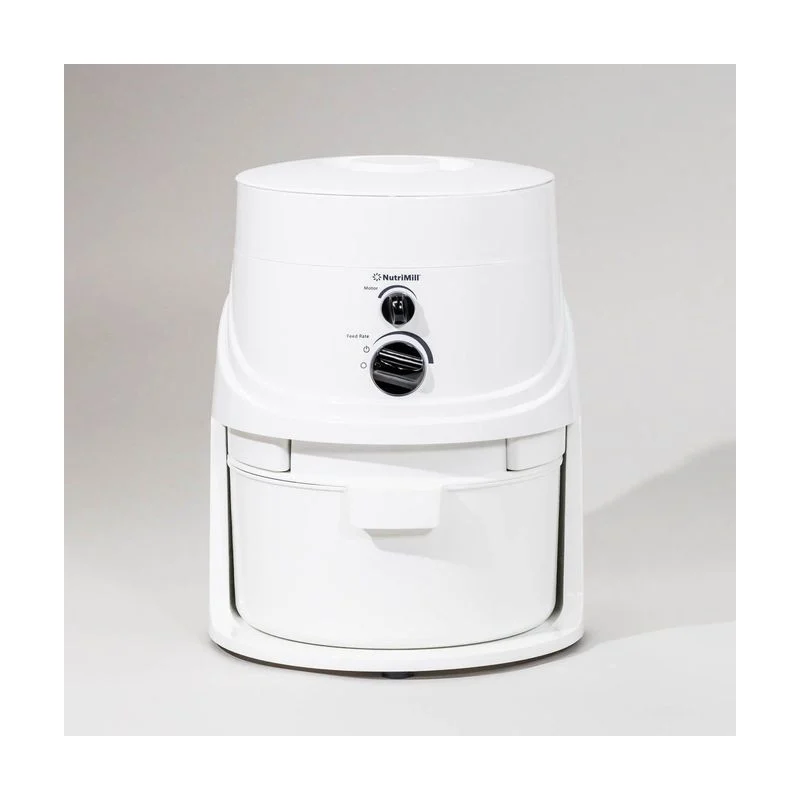
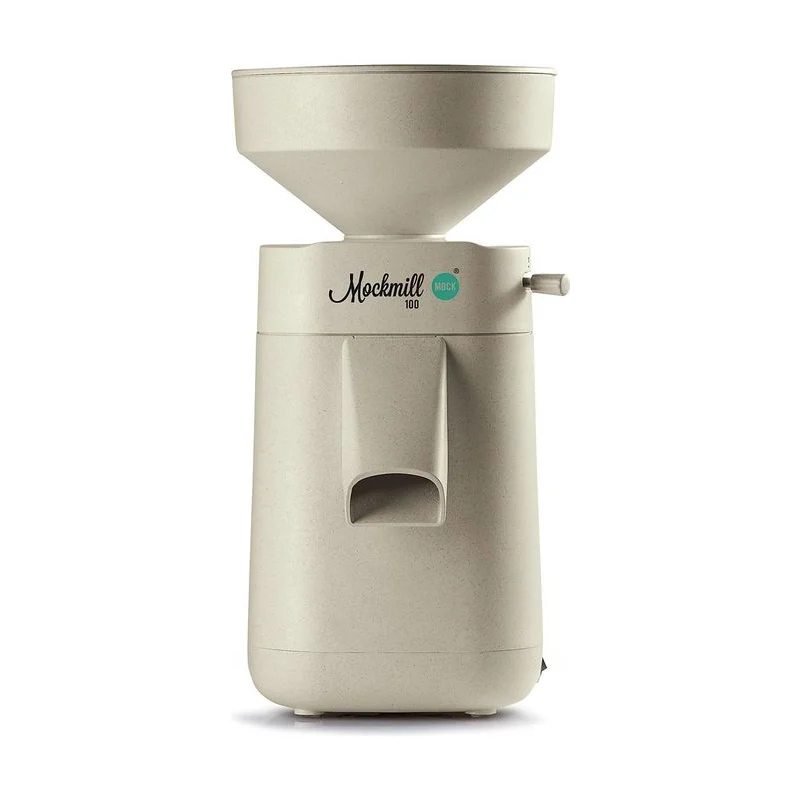
The three rates a maker will print

Impact milling heads on the Classic, corundum stones on the Mockmill 100: what each changes in the routine
What this section establishes
- The NutriMill Classic mills by impact: its owner manual records the motor as “Motor: 10 Amps; 1200 W” and the mechanism as “Milling Heads: Stainless Steel”.
- The Mockmill 100 mills between corundum ceramic stones and draws 360 W. Its US listing and the manufacturer’s webshop each state 360 W for the model; the shared manual states “360 W / 600 W” for the 100 and the 200 together.
- Texture is set at a different moment on each: two knobs held in balance while the Classic runs, against one lever set to a number on a 1 to 10 scale before the Mockmill 100 starts.
- Only the Classic ships a flour container. The Mockmill 100's stated contents are the mill, its hopper cover and the manual, and its getting-started step is “Place a bowl beneath the chute.”
The routine differs by mechanism before it differs by brand. Impact, in a grain mill, names a chamber that shatters grain against moving heads. NutriMill states that “A 10-amp, 1¾ horsepower motor powers the Classic’s high-speed impact chamber (micronizer), using stainless steel milling heads to produce up to 20 cups of flour at a time.” The horsepower figure appears only in that marketing sentence; the owner manual’s technical block records the motor as “Motor: 10 Amps; 1200 W” and the heads as “Milling Heads: Stainless Steel.”
Stone, in a grain mill, names an abrasive burr — one of a pair of discs that reduce grain in the gap between them. The Mockmill 100 mills that way. Its owner manual carries the description on the cover, “Stone mill for milling grains, pulses and spices,” and names the mechanism in its technical details as “Corundum ceramic milling stones.” The Mockmill 100 draws 360 W, and its spec tables and manual agree on that figure, against the Classic’s 1200 W.
The operating consequence is where the operator’s attention goes. On the Classic, texture is the product of two knobs — motor speed and grain feed rate — that the operator holds in balance while the mill runs. On the Mockmill 100, texture is one lever set to a number before the mill runs, and the operator then leaves it alone. One routine is adjusted during the batch; the other is set before it.
What arrives in the box differs too, and it changes the first ten minutes. The Classic’s parts diagram names a supplied “Flour Bowl (Canister)”. The Mockmill 100's stated contents are “Mockmill with hopper cover / Owner’s manual”, and the manufacturer’s own shop lists “Mockmill with Cone-Lid, Instruction Manual”. No flour container is supplied with the stone mill, and the manual’s getting-started step is simply “Place a bowl beneath the chute.”
The mechanism argument underneath this decision — what each way of breaking grain permits, excludes and requires — is set out at Impact vs stone burr grain mills. This page takes the mechanism as already chosen and follows a batch through.
| Mill | Milling mechanism, as the manual names it | Power, as the manual states it | Texture control, as the manual describes it | Read from |
|---|---|---|---|---|
| NutriMill Classic | Milling Heads: Stainless Steel | Motor: 10 Amps; 1200 W | Two knobs — an upper motor speed control and a lower grain feed rate knob that is also the on/off switch | Owner manual (PDF) |
| Mockmill 100 | Corundum ceramic milling stones | 360 W | One screw-in lever on a numbered 1 to 10 scale, position 1 stated as the finest, with milling grades “Variable from very fine to very coarse” | Owner manual (PDF) |
Neither manual states a particle size, a decibel rating or a duty cycle. The mechanism argument itself — what each way of breaking grain permits, excludes and requires — is set out at /compare/impact-vs-stone-burr-grain-mills/.
Before the first batch: the Mockmill's position-1 listening test and both warranty conditions
The Mockmill manual’s first-run instruction is addressed to the other model in the same document. It reads, in bold, “ATTENTION: Only for Mockmill 200. Before starting your Mockmill 200 for the first time, you’ll need to remove the transport lock.” The manual restricts the removal step to the 200 and says elsewhere that it “applies only to Mockmill 200". It does not state whether the Mockmill 100 carries such a part at all, so the honest reading is that a Mockmill 100 owner is given no first-run removal step, not that the part is documented as absent.
The second pre-batch step on the stone mill is a listening test, and it is the calibration reference for every setting afterwards. The manual states: “The setting is pre-adjusted so that you can hear a quiet sound of the stones touching at lever position 1 when idling without grain. This is the finest setting, at higher settings you get coarser results.” The screw-in adjustment lever can be loosened at either end of the scale and re-indexed, which shifts the whole 1 to 10 range coarser or finer, so the position-1 sound is what tells an owner where their own scale actually sits.
Both manufacturers attach paperwork conditions to the warranty before the mill is ever used. The Mockmill manual asks: “Please register your device online under www.grainlovers.shop ⟶ to ensure that your warranty is valid,” against a term of six years for home use. That is phrased as a request carrying a condition, not as a flat requirement. NutriMill’s condition is documentary in a different way: the warranty runs five years for parts and plastics with a limited lifetime on motor and milling heads, applies to the original noncommercial purchaser, is void if the mill is disassembled, and the manual states that you must keep a dated sales receipt for warranty service.
Neither mill is meant to move once sited. The Classic measures 12" W x 12" D x 13" H and the manual states a weight of 14 lbs. The Mockmill 100 measures 380 x 220 x 190 mm, or 15 x 8.7 x 7.5 inches, with a cable of approximately 150 cm — about 6 feet — and a weight that its own sources dispute at 6 kg or 6.6 kg. The Classic’s technical block records amperage and wattage but no voltage or frequency; the US Mockmill listing states 110 V and protection class 1.
What each manual puts before the first batch, in the order it states them
- Transport lock — an instruction addressed to the Mockmill 200, not the 100The shared manual’s bold note reads “ATTENTION: Only for Mockmill 200. Before starting your Mockmill 200 for the first time, you’ll need to remove the transport lock.” A Mockmill 100 owner is given no removal step, and the manual does not state whether the part exists on the 100 at all.
- Listen at lever position 1 on the Mockmill 100The manual states the lever is pre-adjusted so that a quiet sound of the stones touching is audible at position 1 when the mill idles without grain, and that this is the finest setting. Because the screw-in lever can be loosened and re-indexed, that sound is what tells an owner where their own 1 to 10 range actually sits.
- Register the Mockmill online before the warranty is relied onWolfgang Mock GmbH asks owners to register the device online to ensure the warranty is valid, against a stated term of 6 years for home use. It is phrased as a request carrying a condition rather than a flat requirement.
- Keep the NutriMill's dated sales receiptThe Classic’s warranty runs 5 years for parts and plastics with a limited lifetime on the motor and milling heads, applies to the original noncommercial purchaser, is void if the mill is disassembled, and the manual states that a dated sales receipt must be kept for warranty service.
- Site the mill where it can stayThe Classic measures 12" W x 12" D x 13" H at a stated weight of 14 lbs. The Mockmill 100 measures 380 x 220 x 190 mm, or 15 x 8.7 x 7.5 inches, and its cable is approximately 150 cm — about 6 feet — which sets how far it can sit from an outlet.
Checking the grain before it reaches the hopper
Moisture is the check both manufacturers put ahead of loading, and each names a different failure. The NutriMill manual instructs: “Avoid grains and beans that have high oil or moisture content. Non-commercially dried products may cause plugging.” Its safety section states the same rule as an imperative — “Do not mill damp, wet or oily grains” — and the Quick Start Guide compresses the whole input rule to “DO NOT MILL SEEDS, NUTS, SUGARS, OR SPICES / Be cautious milling any grains with high oil or moisture content.”
NutriMill is the only one of the two that publishes a test for an input it has not listed, and it is a quarter-cup procedure: “For any grains not listed above, mill only ¼ cup, then test the flour by pinching a small amount between your thumb and finger. If it holds the shape of a pinch and does not fall apart, it contains too much moisture. Do not mill this grain.” That is a repeatable bench test with a stated pass condition, which is more than either manufacturer offers for texture.
The Mockmill manual frames the same territory around the stones. It states: “Use only cleaned grains. Unclean grain may contain small stones that can damage the milling stones. Milling foods or substances other than those listed on pages 14 - 16 can damage your mill and void the warranty.” On moisture it describes a mechanism rather than a plug — moist grain leads to a build-up of film on the milling stones — and it adds a storage instruction no other document here carries: “Rye should be stored for at least six months following harvesting before milling.”
Oil is treated as the more serious contaminant on the stone mill, because it does not pass through. The manual instructs: “Please refrain from milling nuts or oily foods such as sesame, flax, or poppy seeds. Even coffee beans contain a great deal of oil, which leaves a film on the milling stones, rendering them incabable [sic] of processing the grain properly. Immediately afterwards, clean the Mockmill as described on page 9.” The misspelling is the manufacturer’s. On the impact mill the same class of ingredient is excluded outright by the Quick Start Guide rather than made conditional on cleaning.
- Dry: the NutriMill manual instructs “Do not mill damp, wet or oily grains”; the Mockmill manual states that moist grain builds a film on the milling stones.
- Clean: the Mockmill manual requires cleaned grain specifically because unclean grain may contain small stones that can damage the milling stones. The NutriMill rules quoted above address oil and moisture rather than foreign objects.
- Listed: the Mockmill manual confines milling to the foods tabulated on its pages 14 to 16 or named on the manufacturer’s website, and states that going outside that list can void the warranty. The NutriMill manual publishes three tiers instead — a permitted list of 31 foods, a use-caution list, and a do-not-mill list.
- Tested, if unlisted: only NutriMill publishes a procedure, the quarter-cup pinch test, and it ends in a stop instruction rather than a setting.
- Rested, for rye on the Mockmill: at least six months after harvest before it goes into the hopper.
- Not oats in any rolled or cut form on the Classic: “NOTE: rolled oats will NOT feed into the NutriMill® Classic. Do not mill steel cut oats or rolled oats.” Whole oat groats are on its permitted list, and oats sit at scale setting 3 on the Mockmill.
How much grain goes in the hopper: 12 or 13 cups on the Classic, 1,100 g on the Mockmill 100
What this section establishes
- NutriMill publishes two hopper capacities for the same Classic: “12 Cup Grain Hopper Capacity” on the product page and “Hopper Capacity: 13 cups” in the owner manual, whose own worked example also uses 13 cups.
- The Mockmill 100's hopper is published as 1,100 g of wheat by all three manufacturer sources: the US listing, the manual, and the webshop, which prints it “1.100 g” with a European decimal point. Only the US listing and the manual add the imperial 2 lbs 7 oz, and the Compare Mockmills table rounds the same quantity to 2.4 lbs.
- Thirteen use-caution foods on the Classic are to fill the hopper no more than ⅔ to ¾ full, and six of them also sit on the manual’s permitted list without the manual saying which instruction wins.
The Classic’s grain hopper capacity is published twice, with two different numbers. The product page’s specification list states “12 Cup Grain Hopper Capacity” and repeats it in the feature block. The owner manual’s technical block states “Hopper Capacity: 13 cups”, and the manual’s own grain-to-flour section reinforces 13 by working an example from it. A reader following the manual and a reader following the product page are working to hoppers a cup apart before anything is poured.
For a substantial group of foods the working capacity is smaller still, and the manual says so directly. Its use-caution tier is headed with an instruction rather than a warning: “Fill the hopper no more than ⅔ to ¾ with these as they produce more flour volume.” Thirteen foods sit under that heading, including dried lentils, legumes generally, dried sweet corn, dried garbanzo beans, dried pinto beans, dried green beans and dried mung beans. Six of them — barley, quinoa, soybeans, oat groats, kamut and spelt — also appear on the manual’s permitted list, and the manual does not flag the overlap or say which instruction wins.
The Mockmill 100 publishes one hopper figure, and it publishes it three ways. The US listing states “Hopper Capacity | 1,100 g | 2 lbs 7 oz (Wheat)”; the manual states the same 1,100 g and 2 lbs 7 oz; the manufacturer’s shop states “Filling Capacity (Wheat): 1.100 g”, using the European decimal point. The model comparison table rounds it to 2.4 lbs, which is the same quantity to one decimal place rather than a fourth figure. Every published hopper capacity for this mill is quoted for wheat.
Grain volume is not the ceiling on either mill, though. On the Classic the ceiling is also the flour bowl, which NutriMill describes as producing “up to 20 cups of flour at a time”. On the Mockmill 100 there is no supplied container at all, so the ceiling is whatever bowl the owner places under the chute, and a longer run means either a larger bowl or a pause to swap one. The published figures for the stone mill, including its disputed weight and every capacity above, are set out at Mockmill 100 Stone Grain Mill.
| Mill and document | Stated hopper capacity | Read from |
|---|---|---|
| NutriMill Classic — manufacturer product page, specification list | 12 Cup Grain Hopper Capacity | nutrimill.com product page |
| NutriMill Classic — owner manual, technical block | Hopper Capacity: 13 cups | Owner manual (PDF) |
| Mockmill 100 — mockmill.us product page | 1,100 g | 2 lbs 7 oz (Wheat) | mockmill.us product page |
| Mockmill 100 — owner’s manual, current English edition | 1,100 g / 2 lbs 7 oz (wheat) | Owner manual (PDF) |
| Mockmill 100 — Wolfgang Mock GmbH webshop | 1,100 g (wheat) | grainlovers.shop product page |
| Mockmill 100 — Compare Mockmills table | 2.4 lbs | mockmill.us product page |
Every Mockmill figure is stated for wheat; no other grain has a published hopper figure on either mill. The manual’s grain-to-flour section works its example from 13 cups of hard wheat, which is an input quantity rather than a further published capacity. The Classic’s use-caution foods carry a separate instruction to fill the hopper no more than ⅔ to ¾ full, so the working capacity for those is smaller than any figure in this table.
Switching on, and the order the Mockmill manual insists on
What this section establishes
- The Mockmill manual states the order four times across two editions — “ALWAYS switch the Mockmill on prior to loading the hopper!” — and never publishes a reason for it.
- No NutriMill document cited here states whether the Classic’s hopper is filled before or after the mill is switched on. The manual gives a feed threshold instead: most grains will not flow at less than a 10:00 position on the lower knob.
- The Mockmill 100's milling rate is published as approximately 100 g/min, or 3.5 oz/min, for wheat. NutriMill publishes no rate in any unit, only a ceiling of up to 20 cups of flour at a time.
The Mockmill manual states the order in bold and states it more than once: “ALWAYS switch the Mockmill on prior to loading the hopper!” and, immediately before it, “Don’t switch the Mockmill off while it is milling.” The numbered quick guide carries the same sequence, with switching on as step three and loading the hopper as step five, and the troubleshooting section repeats it. The 2019 edition of the manual, still linked from the US product page as the owner’s manual, gives the same order. The manufacturer never publishes the reason; it publishes the instruction four times.
On the Classic no loading-order instruction appears at all. The manual describes the lower knob rather than a sequence: “This is the ON-OFF switch and controls grain flow into the mill. This affects the fineness of the grind,” and it adds that “Turning the knob all the way to the left will turn off the mill.” Neither the owner manual, the Quick Start Guide nor the product page states whether the hopper is filled before or after that knob is moved. What the manual qualifies instead is the feed itself: it states that “most grains will not flow at less than a 10:00 position on the knob”, and that the point where grain begins to flow varies with grain and bean size. The two documents are therefore not answering the same question. The Mockmill manual gives a sequence, stated four times and never explained; the NutriMill manual gives a knob position with a stated threshold and a stated variable, and leaves the sequence unaddressed.
The Classic is also meant to run closed. Operating instructions state that “The NutriMill is designed to operate with the lid on for quieter milling,” and the parts diagram repeats it on the component itself: “Hopper Lid / Use during milling for quiet operation.” How loud the mill is with the lid on is described but not measured. NutriMill states “Whisper Quiet™ - Noise reduction is achieved with a sound level similar to that of a vacuum cleaner. This is quieter than the first generation of impact mill designs.” No decibel figure appears on the product page, the owner manual or the Quick Start Guide, and none appears on any Mockmill source either.
What the run itself looks like is documented on one mill and not the other. The Mockmill 100's milling rate is stated as “Approx. 100 g/min | Approx. 3.5 oz/min (Soft Wheat)” on the US listing, and the manual gives the same figure for wheat without the word soft. NutriMill publishes no rate in cups or grams per minute on any source fetched for this page — only the batch ceiling of up to 20 cups of flour at a time. The duration of a Classic batch cannot be estimated from published figures at all.
Don’t switch the Mockmill off while it is milling. ALWAYS switch the Mockmill on prior to loading the hopper!
The order the Mockmill manual states, four times, for every batch
- Switch the Mockmill on first“ALWAYS switch the Mockmill on prior to loading the hopper!” appears in bold in the current manual, again in its numbered quick guide, again in the troubleshooting section, and again in the older edition still linked from the US product page as the owner’s manual. No reason is published in any of them.
- Then load the hopperThe Mockmill 100's hopper holds 1,100 g, or 2 lbs 7 oz, of wheat, and every published hopper figure for this mill is quoted for wheat rather than for the other foods in its own scale table.
- Leave it running until the batch is through“Don’t switch the Mockmill off while it is milling” sits immediately before the loading instruction and is repeated in the quick guide and the troubleshooting section. No restart procedure for a mill stopped with grain still between the stones appears in the documents cited here.
Setting the texture: the Mockmill 100's 1-to-10 lever scale against the Classic's two knobs
What this section establishes
- The Mockmill 100 manual turns texture into a lookup: wheat, rye, spelt, einkorn, millet, kamut and lentils at scale 1, oats at 3, chickpeas at 4 to 5, tonka beans at 9 to 10, with position 1 stated as the finest setting.
- The NutriMill Classic publishes no scale number per food. Its upper knob is described in words — high speed for finer flour, far right for very coarse — and its lower knob in clock positions: 11:00 to 12:00 for finer flour, 12:00 to 1:00 for bread flour.
- Neither manufacturer publishes a particle size in microns for any setting, so no position on either mill converts into a figure a baker can check. The Classic’s “400% adjustment range” is stated against no baseline.
The Mockmill 100 turns texture into a lookup. Its manual tabulates a scale setting per food across a 1 to 10 range, and the operator reads the number rather than judging it: wheat 1, rye 1, spelt 1, einkorn 1, millet 1, kamut 1, lentils 1, corn or maize 1 to 2 with the note “No Popcorn”, soya beans 1 to 2, pinto beans 2, lupin seeds 2, oats 3, chickpeas 4 to 5, and at the coarse end of the range tonka beans at 9 to 10. Quinoa, teff, amaranth, milo, white beans and natural long grain rice are all listed at 0 to 1, with rice carrying the note “No parboiled rice” and buckwheat the note “Only hulled and not pre-toasted”.
Because the lever moves a physical gap, a number returns the same gap next time. The fine end of that scale is audible rather than printed — the stones can be heard touching quietly at lever position 1 when the mill idles empty — and the manual states plainly that “This is the finest setting, at higher settings you get coarser results.” The 2019 manual words the coarse end differently, as “with lever position 10 you get coarser result”. Adjustment is stepless; both product pages state “Stepless adjustment of the settings from very fine to coarse”, and no source states how many discrete positions the scale contains.
The Classic has no lookup table and no numbers. Its upper knob is the Variable Motor Speed Control Knob, and the manual instructs: “For finer flour, upper knob should remain to the left (high speed). For very coarse flour and medium fine corn meal, knob should be set to the far right, which slows the motor speed. For heavy flour & dense textured breads, select a middle setting.” Its lower knob is given in clock positions: “For finer flour, set the knob toward 11:00 – 12:00 (most grains will not flow at less than a 10:00 position on the knob). For bread flour, set the knob toward the 12:00 – 1:00 position. For coarser flour turn the knob toward the right.”
The manual then qualifies its own clock positions in a way that matters for the first batch. It states that the point at which grain begins to flow will vary depending on grain and bean size, and that flow may fluctuate at the finest setting. A clock position is therefore a starting point per grain rather than a repeatable setting across grains, which is the opposite of what the Mockmill’s numbered table offers. The Classic’s stated span is “Flour Fineness: Adjustable - Fine to Medium Coarse” in the manual; the Mockmill’s is “Variable from very fine to very coarse”.
Two claims about the Classic’s range should be read as marketing rather than specification. The product page states “With a 400% adjustment range, you can grind super fine (finer than any other impact mill) or coarser textures ideal for rustic bakes. That’s 10 times more texture range than earlier impact mills,” and the feature block restates it as “400% Range Adjustment - This makes it ten times greater than previous impact mills”. A 400% range and a tenfold range are not the same quantity, neither is defined against a stated baseline, and the comparison is drawn against unnamed earlier mills. Neither manufacturer publishes a particle size in microns for any setting, so no setting on either mill converts into a number a baker could check.
If a first batch comes out coarser than wanted, the Classic’s manual does not endorse a second pass: “CAUTION: WE DO NOT RECOMMEND MILLING FLOUR THAT HAS ALREADY BEEN MILLED. THIS MAY CAUSE PROBLEMS IN YOUR MILLING UNIT.” That is a recommendation with a stated risk, not a prohibition, and it should not be repeated as one. The practical alternative it implies is to change the knob positions and mill fresh grain rather than to re-feed flour.
| Food | Mockmill 100 lever setting | Note the manual attaches | Read from |
|---|---|---|---|
| Quinoa, teff, amaranth, milo, white beans | 0 to 1 | None stated | Owner manual (PDF) |
| Natural long grain rice | 0 to 1 | No parboiled rice | Owner manual (PDF) |
| Buckwheat | 0 to 1 | Only hulled and not pre-toasted | Owner manual (PDF) |
| Wheat, rye, spelt, einkorn, millet, kamut, lentils | 1 | Position 1 is the manual’s stated finest setting | Owner manual (PDF) |
| Corn or maize | 1 to 2 | No Popcorn | Owner manual (PDF) |
| Soya beans | 1 to 2 | None stated | Owner manual (PDF) |
| Pinto beans | 2 | None stated | Owner manual (PDF) |
| Lupin seeds | 2 | None stated | Owner manual (PDF) |
| Oats | 3 | None stated | Owner manual (PDF) |
| Chickpeas | 4 to 5 | None stated | Owner manual (PDF) |
| Chia seeds | 6 to 7 | Tabulated here while the same manual instructs owners to refrain from oily foods, and to clean the mill immediately afterwards | Owner manual (PDF) |
| Tonka beans | 9 to 10 | None stated | Owner manual (PDF) |
The rows above are a selection from a longer table: the manual also tabulates hulled barley, emmer, green spelt, dried peas and kidney beans, and fifteen dried spice entries running from cardamom pods at 0 to 1 to caraway seeds at 4 to 5, of which only tonka beans appears above. The NutriMill Classic has no equivalent table. Its manual gives knob positions rather than a number per food, and qualifies them with the caveat that the point at which grain begins to flow varies with grain and bean size. Adjustment on the Mockmill is stepless, so any position between two printed numbers is reachable.
Where the flour lands: the Classic's bowl at 20 or 21 to 22 cups, and the Mockmill 100's absent container
What this section establishes
- The Classic’s supplied flour bowl is published at 20 cups in the manual’s parts diagram and on the product page, and at 21 to 22 cups in the grain-to-flour section of that same manual.
- NutriMill’s own worked example returns about 21 cups of flour from 13 cups of hard wheat at a medium texture — above the 20-cup figure its diagram and product page both state.
- No flour container is supplied with the Mockmill 100 and no container capacity is published on any source, so the planning unit is the 1,100 g of wheat its hopper holds and whatever bowl the owner places beneath the chute.
The Classic mills into a supplied container. The parts diagram describes it as “Flour Bowl (Canister) / Large 20 cup capacity. / Large easy grip handles,” and the product page’s specification list agrees at “20 Cup Flour Bowl Capacity”. That figure is also the batch ceiling NutriMill advertises, since the marketing sentence about the motor ends at “up to 20 cups of flour at a time”.
The same manual states a larger number a few pages later. Under its grain-to-flour ratio heading it reads: “The bowl holds 21 to 22 cups of flour. You will get about 21 cups of flour from 13 cups of hard wheat when milled at a medium texture.” Read together with the diagram, one document gives the same container a 20-cup and a 21-to-22-cup capacity. The yield sentence is worth reading precisely as written: it is stated for hard wheat at a medium texture, and it is the ratio the manual works through rather than a general conversion for every grain and every setting.
That arithmetic is also the clearest illustration of why the hopper conflict matters. The manual’s example fills 13 cups of hard wheat and returns about 21 cups of flour, which is under the manual’s own bowl figure but over the diagram’s and the product page’s. A reader who takes the product page’s 12-cup hopper and 20-cup bowl as the pair, and mills hard wheat at medium texture to the top of the hopper, is working near the edge of the container on the manufacturer’s own numbers.
The Mockmill 100 supplies nothing to catch flour. Its stated contents are the mill, the hopper cover and the manual, and no flour-container capacity is published on any source — not on either product page, not in either manual, not in the comparison table. The getting-started instruction is “Place a bowl beneath the chute,” which puts the choice, and the ceiling, entirely on the owner. In practice the hopper’s 1,100 g of wheat is the unit that has to be planned around, since that is the quantity the mill will process before it needs refilling.
Neither manufacturer publishes anything about the flour once it is out of the mill. The Classic’s stated flour temperature of around 118°F is a manufacturer claim about the milling process, not a storage figure, and the Mockmill sources publish no flour temperature at all. Recipe choice and storage after milling are covered at Fresh milled flour: baking and storage basics, using baking guidance alongside the mill manuals.
The bowl holds 21 to 22 cups of flour. You will get about 21 cups of flour from 13 cups of hard wheat when milled at a medium texture.
After the batch: no water on the Mockmill's stones, and the dishwasher instruction NutriMill states two ways
The Mockmill’s cleaning rule is absolute about water and states it twice in one paragraph: “Never submerge the Mockmill in water or any other liquid. Wipe the casing clean with a slightly damp cloth. It is important that no water enter the mill. The millstones should never be cleaned with water or a wet cloth!” The stones are reached by lifting the upper stone off — the manual’s procedure states that “Now you can lift off the top stone (stator). The bottom stone (rotor) is then visible; it is attached to the motor shaft” — and it warns owners not to lose the two small springs that support the upper stone during the operation.
Cleaning on the stone mill is not scheduled by time; it is triggered by what was milled. The manual instructs that the mill be cleaned right away when oilseeds have been included in the milling, and after coffee beans it says to clean “Immediately afterwards”. The manufacturer’s own tables create a tension here that the manual never resolves: chia seeds appear in the permitted milling table at settings 6 to 7, alongside a general instruction to refrain from oily foods such as sesame, flax or poppy seeds. An owner milling chia is following one instruction and breaking another, and the cleaning trigger is the only guidance the document offers for the collision.
The Classic’s cleaning instruction exists in two manufacturer documents with two different forces, and the difference is not cosmetic. The Quick Start Guide states: “Hand-wash the plastic bowl and lid. DO NOT put them in the dishwasher. High-heat dishwashers can warp the plastics.” The owner manual states the same fact as a preference: “We recommend hand-washing the plastic bowl and lid. High-heat dishwashers can warp the plastics.” One document forbids, the other advises, and both are current NutriMill publications for the same parts.
The two mills also diverge on whether an owner is expected to open the machine. The Mockmill’s routine cleaning procedure requires lifting the stator off the rotor, which is a documented user operation. The Classic’s warranty is void if the mill is disassembled, and the owner-serviceable parts named in its diagram are consumables rather than the milling chamber: “*Inlet grommet and filter should be replaced every 2 years or as needed.” Those two facts point at different maintenance habits over the life of each mill.
Moving the mill afterwards carries its own instruction on the Mockmill, and it is a warning about a specific part: “Never use the Mockmill’s spout cover (its 'nose') as a handle, as it is not made to resist the unit’s weight and may well break off!” The manual directs lifting by the base or by cradling the hopper instead. This lifting section appears only in the current manual. The 2019 edition, which is the PDF the US product page links as the owner’s manual, has no lifting section at all, so a buyer following the linked document is never given the warning.
Where the documentation disagrees about the procedure
Every conflict below is between two manufacturer sources for the same mill, and each one changes something an operator does. They are recorded here as they stand. Neither manufacturer has reconciled them, and this page does not attempt to pick a winner between two documents that carry equal authority.
Three of these are procedural rather than cosmetic. The hopper and bowl conflicts change how much grain is poured and how close a full batch runs to the rim of the container. The dishwasher conflict changes whether a part goes in the machine after every bake. The rest change what a reader believes about the mill rather than what they do with it, but they are the reason a specification quoted from one page should always be traced to its document before it is trusted.
One thing that is not on this list is the operating order. The Mockmill manual instructs switching on before loading and the NutriMill documents cited here state no order at all, and silence on one side is not a disagreement between the two. It is a gap in one manufacturer’s instructions, and it is recorded in the section on what this guide cannot settle rather than here.
- Classic grain hopper capacity: “12 Cup Grain Hopper Capacity” on the product page against “Hopper Capacity: 13 cups” in the owner manual. The manual’s own worked example uses 13 cups, which makes the manual internally consistent and the pair of documents inconsistent with each other.
- Classic flour bowl capacity: “Large 20 cup capacity” in the manual’s parts diagram and “20 Cup Flour Bowl Capacity” on the product page, against “The bowl holds 21 to 22 cups of flour” in the manual’s own ratio section. This is a contradiction inside a single document.
- Classic dishwasher instruction: the Quick Start Guide’s “DO NOT put them in the dishwasher” against the owner manual’s “We recommend hand-washing”. Same manufacturer, same parts, prohibition against preference.
- Mockmill 100 weight: “6 kg | 13 lbs 3.5 oz” on the US product page against “6.6 kg” and “14 lbs 9 oz” in the current manual, the 2019 manual and the manufacturer’s shop. Three sources agree on the heavier figure and the US listing does not.
- Mockmill 100 milling speed, a three-way disagreement: the US page pairs “Voltage 110 V” with “Milling Speed Approx. 1,100 RPM”; both manuals pair 110 V at 60 Hz with approximately 1,300 rpm and 230 V at 50 Hz with approximately 1,100 rpm; and the manufacturer’s shop states “Rotation (50 Hz): ca. 1.300 U / Min”, contradicting its own manual’s figure for 50 Hz.
- Mockmill 100 casing: “Terluran® GP-35" in both current spec tables and “Terluran®” in the current manual, against “Arboblend ®made from renewable raw materials” in the 2019 manual — and the manufacturer’s shop still advertises a casing made from renewable materials in the bullet list directly above its own Terluran® GP-35 specification row.
- Mockmill 100 coarse limit: “Variable from very fine to coarse” on the US page against “Variable from very fine to very coarse” in the manual.
- Mockmill 100 commercial use: the manual states the mill “is not designed for commercial use”, while the manufacturer’s shop specification table states “2-year warranty for commercial use, 6 years”.
Where the two routines are genuinely equivalent
Both mills are rated for the same scale of use, in almost the same words. The Classic’s manual carries “HOUSEHOLD USE ONLY” as a standalone heading under its technical block, and its warranty is written for the original noncommercial purchaser. The Mockmill’s product page states: “For home use: The Mockmill is intended for home use and milling quantities appropriate for normal family needs. It is not designed for commercial use in which large quantities of grains are to be ground.” A buyer choosing between them is not choosing between a domestic and a light-commercial machine.
Both put the same demand on the grain, even though each names a different consequence. Dry and clean is the requirement in both documents; oil is the ingredient both flag; and both manufacturers publish an explicit list of what may enter the hopper rather than leaving it to judgment. The Classic risks plugging, the Mockmill risks a film on its stones, and in both cases the remedy the manufacturer describes is preventive rather than corrective.
Both are counter-top machines on a household outlet that neither manufacturer surrounds with running-time rules. No duty cycle, maximum continuous run time, cool-down interval or thermal-protection rating is stated on any source fetched for either mill. Whatever an owner does about resting the motor between batches, they are doing it without manufacturer guidance.
Both leave texture unquantified in the same way. Neither publishes a particle size in microns, so on both mills the first batch is a calibration exercise: mill a small quantity, look at it, bake with it, and write down the setting that produced it. The Mockmill’s numbered scale makes that note reusable; the Classic’s clock positions make it grain-specific. Neither publishes a decibel rating, and neither publishes a service life for its milling stones or its impact heads, so the two mills are equally undocumented on noise and on wear.
What this guide cannot settle: no observations here, and the gaps in the NutriMill and Mockmill documents
Nothing on this page comes from operating either mill. Every instruction above is quoted from a manufacturer document, and where a document is silent this page says it is silent rather than filling the gap. We have not milled a batch on either machine, and no sentence here should be read as an observation.
The operating order on the Classic is one of those silences, and it is a large one. The Mockmill manual states its sequence four times; the NutriMill owner manual, Quick Start Guide and product page state none, and none of them describes how the mill behaves between the knob’s off position and the 10:00 position at which the manual states most grains begin to flow. Whether a Classic should be started empty or loaded first is not answerable from the published documents, and no inference about the knob drawn on this page or elsewhere is a substitute for the manufacturer stating it.
Texture cannot be settled numerically. Neither manufacturer states a micron figure or a particle size for any setting, so the Classic’s “Fine to Medium Coarse” and the Mockmill’s “very fine to very coarse” cannot be placed on a common scale, and the 400% adjustment range on the Classic’s product page is a claim with no stated baseline. A reader who wants a comparable fineness figure will not find one in the published documents.
Duration cannot be settled either. NutriMill publishes no milling rate at all, only a 20-cup batch ceiling, so a Classic batch has no published time. The Mockmill’s approximately 100 g per minute is published for wheat and is not stated for the other 40 foods in its table. Heat is in the same position: the Classic’s around 118°F is a manufacturer claim carrying no grain type, run length or ambient temperature, its specification list drops both the hedge and the unit, and no Mockmill source publishes a flour temperature to compare it against.
Several straightforward equipment questions have no published answer on either mill. No decibel rating exists for either, only NutriMill’s vacuum-cleaner analogy. No stone diameter is published for the Mockmill and no count of discrete lever positions. No nutrient-retention figure, motor duty cycle or component lifespan is published for either. Country of manufacture is stated for the Mockmill as Germany and is not stated on any NutriMill source fetched.
The document conflicts above are recorded, not resolved, and they cannot be resolved from outside. Whether the Classic’s hopper holds 12 or 13 cups, whether its bowl holds 20 or 21 to 22, and whether the Mockmill 100 weighs 6 or 6.6 kg are questions only the manufacturers can answer. Both companies print a service address on the documents cited in the source list below — L’Chef, LLC in St. George, Utah for the Classic, Wolfgang Mock GmbH in Groß-Umstadt for the Mockmill — which is where a reader with a batch to plan should take them.
How long does it take to mill a batch of flour?
The Mockmill 100 mills at approximately 100 g per minute, or approximately 3.5 oz per minute, and its hopper holds 1,100 g of wheat. Both figures are published in the same specification table, and the rate is quoted for wheat — soft wheat on the US listing, wheat without qualifier in the manual. Dividing one by the other is arithmetic a reader can do, not a manufacturer figure, and it accounts for neither loading, refilling nor cleaning.
The NutriMill Classic has no published rate in any form. Its documents state a batch ceiling — up to 20 cups of flour at a time — and nothing about how long producing that takes. No comparison of milling time between the two mills is possible from published sources, and any figure quoted elsewhere is not coming from either manufacturer.
Can the Mockmill 100 or the NutriMill Classic be switched off partway through a batch?
The Mockmill manual instructs against it directly: “Don’t switch the Mockmill off while it is milling.” It sits alongside the instruction to switch the mill on before loading the hopper, and both are repeated in the quick guide and the troubleshooting section. No reason for the instruction, and no restart procedure for a mill stopped with grain still between the stones, is recorded in the documents cited here.
On the Classic the documents answer a narrower question. The manual states that the lower knob “is the ON-OFF switch and controls grain flow into the mill” and that “Turning the knob all the way to the left will turn off the mill”, so one control and one off position are documented for both functions. No NutriMill document cited here instructs against stopping partway, and none states what becomes of grain already inside the milling chamber when the knob is turned off. The nearest qualification the manual publishes is a feed threshold rather than a stop rule — “most grains will not flow at less than a 10:00 position on the knob” — together with its caveat that the point where grain begins to flow varies with grain and bean size. A reader who needs an authoritative answer on stopping a Classic mid-batch will not find one in the owner manual, the Quick Start Guide or the product page, and should put it to L’Chef, LLC at the service address the manual prints.
Does fresh flour need sifting, or a second pass through the mill?
A second pass is discouraged on the Classic, in the manual’s own capitals: “CAUTION: WE DO NOT RECOMMEND MILLING FLOUR THAT HAS ALREADY BEEN MILLED. THIS MAY CAUSE PROBLEMS IN YOUR MILLING UNIT.” That is a recommendation attached to a stated risk rather than a ban, and it should not be reported as a prohibition. The route the manual leaves open is to adjust the two knobs and mill fresh grain at a finer setting.
No sifting step appears in any of the operating instructions cited on this page, for either mill. No bran-removal or extraction procedure appears in those documents either, and neither manufacturer states a particle size that would tell a baker whether sifting is needed. For recipe choice, water-adjustment cautions and flour storage, continue to Fresh milled flour: baking and storage basics.
Which setting produces bread flour on the NutriMill Classic and the Mockmill 100?
The Classic names the setting explicitly. The manual instructs “For bread flour, set the knob toward the 12:00 – 1:00 position” on the lower grain feed knob, and for the upper motor speed knob it advises that “For heavy flour & dense textured breads, select a middle setting.” Those positions come with the manual’s own caveat that the point where grain begins to flow varies with grain and bean size, so the same clock position will not behave identically across wheat, rye and corn.
The Mockmill 100 does not label any setting as bread flour. Its manual publishes a number per food instead — wheat at scale 1, rye at 1, spelt at 1 — with position 1 being the finest setting on the lever’s range. A baker wanting something coarser than the tabulated number moves up the scale from it, and the mill’s stepless adjustment allows any position between the printed numbers. Neither approach is anchored to a stated particle size, so both come down to milling a test batch and recording what worked.
Can either mill handle a large or commercial batch?
Neither is sold for it. The Classic’s manual states “HOUSEHOLD USE ONLY” and its warranty covers the original noncommercial purchaser, excluding commercial use. The Mockmill 100 is described as “intended for home use and milling quantities appropriate for normal family needs” and as “not designed for commercial use in which large quantities of grains are to be ground,” with a six-year warranty stated for non-commercial use.
The one crack in that picture is on the manufacturer’s own shop, whose specification table states “2-year warranty for commercial use, 6 years” — a commercial term that neither manual nor the US listing mentions, on a product the manual says is not designed for commercial use. Anyone weighing a small business use should put that contradiction to Wolfgang Mock GmbH directly rather than rely on either document.
Batch size, meanwhile, is bounded by the containers. The Classic produces up to 20 cups of flour at a time into its supplied bowl, and its use-caution foods are to fill the hopper no more than two-thirds to three-quarters full. The Mockmill 100 holds 1,100 g of wheat per hopper fill and supplies no flour container at all, so the practical run length is set by the bowl placed beneath the chute.
Both mills' published specifications, side by side
| Attribute | NutriMill Classic | Mockmill 100 |
|---|---|---|
| Milling mechanism Wording differs | High-speed impact chamber with stainless steel Microburst milling heads nutrimill.com product page | Corundum ceramic grinding stones mockmill.us product page |
| Motor Figures differ | 1200 W, 10 amps Owner manual (PDF) | 360 W mockmill.us product page |
| Hopper capacity Figures differ | 12 cups (owner manual states 13 cups) — the manufacturer’s own documents disagree on this figure. nutrimill.com product page | 1,100 g | 2 lbs 7 oz (wheat) mockmill.us product page |
| Flour container capacity Figures differ | 20 cups (owner manual's grain-to-flour section states the bowl holds 21 to 22 cups) — the manufacturer’s own documents disagree on this figure. nutrimill.com product page | No container supplied; stated contents are the mill with hopper cover and the owner's manual mockmill.us product page |
| Dimensions Figures differ | 12 in W x 12 in D x 13 in H nutrimill.com product page | 380 x 220 x 190 mm | 15 x 8.7 x 7.5 in mockmill.us product page |
| Weight Figures differ | 14 lbs Owner manual (PDF) | 6 kg | 13 lbs 3.5 oz mockmill.us product page |
| Texture adjustment Wording differs | Two knobs: variable motor speed and variable grain feed rate Owner manual (PDF) | Stepless, variable from very fine to coarse mockmill.us product page |
| Flour fineness | Adjustable, fine to medium coarse Owner manual (PDF) | —No row for this attribute appears in the documents read for this mill. |
| Housing Figures differ | ABS plastic Owner manual (PDF) | Terluran GP-35 mockmill.us product page |
| Warranty Figures differ | 5 years parts and plastics; limited lifetime on motor and milling heads; original noncommercial purchaser only Owner manual (PDF) | 6 years, non-commercial use mockmill.us product page |
| Intended use | Household use only Owner manual (PDF) | —No row for this attribute appears in the documents read for this mill. |
| Voltage | —No row for this attribute appears in the documents read for this mill. | 110 V (US listing) mockmill.us product page |
| Milling speed | —No row for this attribute appears in the documents read for this mill. | Approx. 1,100 RPM (owner manual states approx. 1,300 rpm at 110 V, 60 Hz) — the manufacturer’s own documents disagree on this figure. mockmill.us product page |
| Milling rate | —No row for this attribute appears in the documents read for this mill. | Approx. 100 g/min | approx. 3.5 oz/min (soft wheat) mockmill.us product page |
| Country of manufacture | —No row for this attribute appears in the documents read for this mill. | Germany mockmill.us product page |
The documents this page was read from
- NutriMill Classic Grain Mill product page (manufacturer)
- NutriMill Classic full user manual (PDF, manufacturer-hosted)
- NutriMill Classic Quick Start Guide (PDF, manufacturer-hosted)
- Mockmill 100 Stone Grain Mill product page, mockmill.us
- Mockmill 100 product page, Wolfgang Mock GmbH webshop
- Operating Instructions Mockmill 100 / Mockmill 200 (English, current edition, PDF)
- Operating Instructions Mockmill 100 / Mockmill 200 (English, 2019 edition hosted on mockmill.us, PDF)
- Compare Mockmills model comparison table, mockmill.us
Decide between two of these mills
This guide works from published documents rather than choosing for you. Each comparison below settles one named pair on the rows both makers print.
- Impact vs stone burr grain millsThe NutriMill Classic's impact chamber and the Mockmill 100's ceramic stones, compared on what each mechanism permits, adjusts, excludes and requires.
- NutriMill Classic vs WonderMillBoth mills shatter grain by impact, so the mechanism decides nothing. Ingredient scope, texture control, container capacity and documentation quality do.
- NutriMill Classic vs NutriMill HarvestNutriMill Classic vs Harvest: the Classic's 12- or 13-cup hopper and 20-cup bowl (21 to 22 in its manual) against the Harvest's 5-cup hopper and spout.
- NutriMill Harvest vs Mockmill 100Two corundum stone mills compared on stone material, texture adjustment, hopper capacity, housing and how much each manufacturer documents.
- Mockmill 100 vs KoMo Fidibus ClassicBoth mill on corundum ceramic stones at 360 watts. The split is the case: Terluran GP-35 against oiled beech, six years of warranty against twelve.
- Mockmill 100 vs Mockmill 200Mockmill 100 vs 200: Mockmill rates the 200 at 600 W and about 200 g of wheat a minute, the 100 at 360 W and 100 g. Hopper and warranty match.
Where to buy the mills this guide works from, and the documents behind these figures
Prices and availability are on the seller’s site. Amazon links are affiliate links; we may earn a commission at no extra cost to you. Other seller links are unpaid.
- Publication
- By Millwright
- Source
- Manufacturer documentation
- Updated