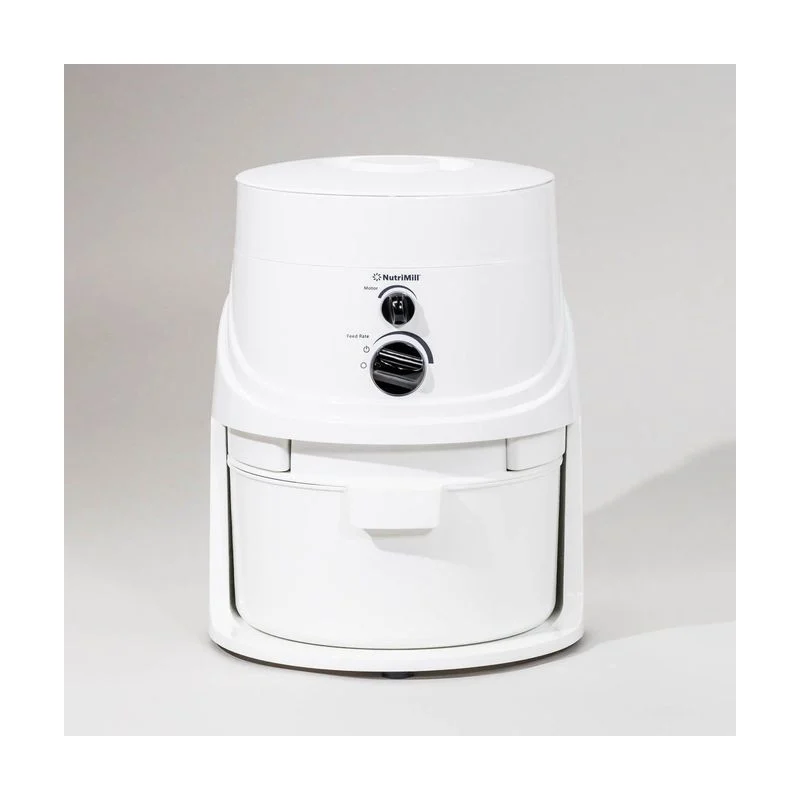
How the NutriMill Classic grain mill shatters grain without a burr gap
The NutriMill Classic mills by impact. NutriMill’s product page describes a “high-speed impact chamber (micronizer)” driven by the motor and using stainless steel milling heads, and the manual’s technical block lists “Milling Heads: Stainless Steel”. The product page names the same parts “Stainless Steel Microburst” milling heads. An impact chamber is a housing in which grain is thrown against and between fast-moving steel surfaces until the kernel shatters. A stone burr, the other mechanism common in home mills, grinds grain between two abrasive surfaces held a set distance apart, and texture is changed by moving those surfaces closer together or further apart.
That difference governs everything downstream on this page. A stone mill has a gap; the Classic does not. Nothing in NutriMill’s documentation describes a grinding stone, a stone gap, or a dial that narrows one. The milling surfaces the documentation names are steel heads, and the only controls it names are a motor speed knob and a grain feed rate knob. Texture on the Classic is therefore a question of how fast the heads turn and how fast grain reaches them, which is a different kind of adjustment from the one a stone mill offers and produces a different set of tradeoffs. The mechanism choice underneath this whole decision is set out at Impact vs stone burr grain mills.
The rest of the build follows from the same design. The manual states an ABS plastic housing and a weight of 14 lbs, and it prints “HOUSEHOLD USE ONLY” as a standalone heading directly beneath its technical information block. The manufacturer publishes no bearing specification, no head diameter, no chamber speed and no rated duty cycle, so the mechanism can be described from the documentation but not quantified from it.

How the NutriMill Classic's two texture knobs set flour fineness
What this section establishes
- The NutriMill Classic has no single fineness dial: texture is set by two knobs, an upper Variable Motor Speed Control Knob and a lower Grain Feed Rate Knob that is also the on/off switch.
- The owner manual’s finest setting is the upper knob held to the left at high speed with the lower knob at 11:00 to 12:00; its bread flour setting is the lower knob at 12:00 to 1:00, and most grains will not flow at less than a 10:00 position.
The Classic adjusts texture with two separate knobs rather than one fineness dial, and the owner manual assigns each a different job. The upper control is the Variable Motor Speed Control Knob. The lower control is labelled the Variable Texture Control Knob in the manual’s exploded parts diagram and called the Grain Feed Rate Knob in the body text of the same manual, and it doubles as the on/off switch. Two names for one knob is worth knowing before reading either document, because the diagram and the instructions describe the same part in different vocabulary.
The upper knob changes flour texture by changing how fast the milling heads turn. The manual states that motor speed “allows you to determine and have greater control of the texture of your flour or meal”, that finer flour calls for the upper knob left at high speed, that very coarse flour and medium fine corn meal call for the knob at the far right where motor speed slows, and that heavy flour and dense textured breads call for a middle setting. The lower knob changes texture by changing how much grain enters the chamber per unit of time, and the manual states plainly that this “affects the fineness of the grind”.
Read together, the manual’s own settings pair a fast motor with a restricted feed at the fine end, and a slowed motor with a more open feed at the coarse end. The two knobs are not two labels for one scale; they are two variables that have to be set as a pair, which is why the manual publishes positions for both rather than a single numbered fineness scale.
Two operating details qualify the knob guide. First, the manual notes that the point at which grain begins to flow varies with grain and bean size, so the clock positions below are starting points rather than fixed calibrations, and flow can fluctuate at the finest feed setting. Second, because the lower knob is also the on/off switch, and the manual’s instruction for stopping the mill is to turn that knob all the way to the left, the feed setting is disturbed every time the mill is switched off. A texture setting arrived at by trial is not preserved by the control itself, and has to be found again on the next run.
- Upper knob held to the left, high motor speed: the manual’s setting for finer flour.
- Upper knob at a middle position: the manual’s setting for heavy flour and dense textured breads.
- Upper knob to the far right, slowed motor: the manual’s setting for very coarse flour and medium fine corn meal.
- Lower knob all the way left: the mill is off. This knob is the on/off switch as well as the feed control.
- Lower knob at 11:00 to 12:00: the manual’s setting for finer flour. Most grains will not flow at less than a 10:00 position.
- Lower knob at 12:00 to 1:00: the manual’s setting for bread flour.
- Lower knob turned further right: coarser flour.
What the 400 percent range claim states, and what it leaves undefined
NutriMill states a “400% adjustment range” for the Classic and states in the same sentence that this is “10 times more texture range than earlier impact mills”. Both figures are manufacturer claims, and we report them as claims rather than as measurements, for three reasons. Neither figure names the baseline it is measured against, beyond the phrase “earlier impact mills”. Neither names the quantity being ranged over, so it is not clear whether 400 percent refers to particle size, feed rate, motor speed or something else. And the two numbers on the same page are not reconcilable with each other: a 400 percent range and a tenfold range are different multiples, and no published method connects them.
The manual’s technical block gives the only stated texture boundary in the documentation: “Flour Fineness: Adjustable - Fine to Medium Coarse”. That ceiling of medium coarse sits awkwardly against the product page, which markets “coarser textures ideal for rustic bakes” and “super fine (finer than any other impact mill)” at the other end. NutriMill publishes no micron figure, no sieve mesh equivalence and no particle-size distribution at any setting, so there is no number on either side of the range to compare against another mill’s number.
For a buyer, the operative specification is not the percentage. It is the knob guide in the section above, which is the only place NutriMill states which settings produce which flour. The Classic’s texture range is published as a settings recipe, and it should be evaluated as one. Whether that recipe is enough control for a given baking habit is the practical question, and the head-to-head against the other widely sold impact mill in this category is set out at NutriMill Classic vs WonderMill.
The NutriMill Classic specifications NutriMill's own documents contradict
What this section establishes
- The disagreement sits between NutriMill’s documents rather than inside them, with one exception: the product page is consistent at a 12 cup hopper, the owner manual is consistent at 13 cups, and the manual alone rates the flour bowl at both 20 cups and 21 to 22 cups.
- The two permitted ingredient lists are not interchangeable: the product page adds five items the manual omits and omits seven the manual includes, so which document a buyer reads decides what the mill is stated to take.
- Every figure on both sides was read from a NutriMill page or a NutriMill-hosted PDF, and NutriMill states nowhere why its own documents differ.
Four published values for the NutriMill Classic conflict across NutriMill’s own documents, and one of them conflicts inside a single document. These are not third-party discrepancies or retailer errors. Every figure below was read from a manufacturer page or a manufacturer-hosted PDF, and each is quoted as published. We record both sides and do not choose between them.
The hopper conflict is the one most likely to affect a purchase decision, because it is the number a buyer uses to plan a batch. The product page states “12 Cup Grain Hopper Capacity” twice, once in its specifications list and once in its feature block. The owner manual’s technical block states “Hopper Capacity: 13 cups”, and the manual’s grain-to-flour section repeats the larger figure in an operating instruction: “You will get about 21 cups of flour from 13 cups of hard wheat when milled at a medium texture.” The manual is therefore internally consistent at 13 cups, and the product page is internally consistent at 12. Why the two documents differ is not stated anywhere in the material NutriMill publishes.
The flour bowl conflict is stranger, because the manual contradicts itself. The manual’s exploded parts diagram calls out “Flour Bowl (Canister) / Large 20 cup capacity”, matching the product page’s “20 Cup Flour Bowl Capacity”. Twelve pages of the same manual also state, under GRAIN TO FLOUR RATIO, that “The bowl holds 21 to 22 cups of flour.” One document publishes both a 20-cup rating and a 21-to-22-cup rating for the same part.
Two further disagreements are about force and about scope rather than about numbers. The Quick Start Guide prohibits the dishwasher outright, while the owner manual states the same instruction as a preference. And the permitted ingredient list on the product page is not the permitted ingredient list in the manual: the page adds five items the manual omits and omits seven the manual includes, itemized in the ingredient sections below. A buyer working from one document will not have the same permissions as a buyer working from the other.
- Hopper capacity: 12 cups on the product page, 13 cups in the owner manual’s technical block and reinforced by the manual’s own yield example. Not reconciled.
- Flour bowl capacity: 20 cups on the product page and in the manual’s parts diagram, 21 to 22 cups in the manual’s grain-to-flour section. Not reconciled.
- Dishwasher instruction: the Quick Start Guide states “DO NOT put them in the dishwasher”, while the owner manual states “We recommend hand-washing”. An absolute in one document, a recommendation in the other.
- Texture ceiling: the manual’s technical block states the range as “Fine to Medium Coarse”, while the product page markets “coarser textures ideal for rustic bakes” and “super fine” at the opposite end.
- Permitted grains: the product page’s list adds Triticale, Emmer, Einkorn, Dried Sweet Corn and Pinto Beans, and omits Bulgur Wheat, Kañiwa, Blue Corn, Popcorn, Wild Rice, Anasazi Beans and Kidney Beans, relative to the manual’s list.
- Horsepower: the product page’s marketing prose states a 1 3/4 horsepower motor, a figure that does not appear anywhere in the manual’s technical block, which lists only 10 amps and 1200 W.
| Specification | NutriMill document | What that document states | Read from |
|---|---|---|---|
| Grain hopper capacity | Product page, specifications list | “12 Cup Grain Hopper Capacity” | nutrimill.com product page |
| Grain hopper capacity | Owner manual, Technical Information block | “Hopper Capacity: 13 cups” | Owner manual (PDF) |
| Flour bowl capacity | Product page, specifications list | “20 Cup Flour Bowl Capacity” | nutrimill.com product page |
| Flour bowl capacity | Owner manual, exploded parts diagram | “Flour Bowl (Canister) / Large 20 cup capacity.” | Owner manual (PDF) |
| Flour bowl capacity | Owner manual, GRAIN TO FLOUR RATIO section | “The bowl holds 21 to 22 cups of flour.” | Owner manual (PDF) |
| Dishwasher instruction | Quick Start Guide, How to Clean Your Mill | “DO NOT put them in the dishwasher.” | Owner manual (PDF) |
| Dishwasher instruction | Owner manual | “We recommend hand-washing the plastic bowl and lid.” | Owner manual (PDF) |
| Permitted ingredients | Owner manual | 31 named items under “THE NUTRIMILL CLASSIC WILL MILL THE FOLLOWING” | Owner manual (PDF) |
| Permitted ingredients | Product page | A different list, which adds Triticale, Emmer, Einkorn, Dried Sweet Corn and Pinto Beans and omits Bulgur Wheat, Kañiwa, Blue Corn, Popcorn, Wild Rice, Anasazi Beans and Kidney Beans | nutrimill.com product page |
Every row above is a NutriMill publication, quoted as NutriMill prints it, and cited to the document it was read from rather than to the pairing. Neither document corrects the other and NutriMill publishes nothing reconciling them, so this page prints both figures wherever the figure appears.
NutriMill Classic bowl capacity, batch ceiling and 12 by 12 by 13 inch footprint
What this section establishes
- The NutriMill Classic measures 12 in W by 12 in D by 13 in H and weighs 14 lbs, so 13 inches is the clearance figure to check against a wall cabinet before assuming the mill lives on the counter assembled.
- The manual states that 13 cups of hard wheat at a medium texture yields about 21 cups of flour, which is more than the 20 cup rating its own parts diagram prints on the bowl.
- For the thirteen ingredients on the manual’s USE CAUTION tier the hopper is to be filled no more than two-thirds to three-quarters, because the manual states they produce more flour volume.
The flour bowl is where the capacity conflict stops being a documentation curiosity and becomes an operating problem. The product page states that the Classic can “produce up to 20 cups of flour at a time” and rates the bowl at 20 cups. The manual states that 13 cups of hard wheat milled at a medium texture yields about 21 cups of flour. Those two statements do not sit together: a hopper filled to the manual’s own stated capacity produces, on the manual’s own worked example, more flour than the 20-cup rating printed on the bowl in the same manual’s diagram. The manual’s alternative bowl figure of 21 to 22 cups would absorb it; the 20-cup figure would not.
The yield figure is conditional and should not be restated as a flat ratio. It is specified for hard wheat at a medium texture, and the manual gives no yield for soft wheat, rye, rice, legumes or any other permitted ingredient, and none for a fine or a coarse setting. Different grains and different knob positions will not produce 21 cups from 13. What the arithmetic does establish is that the published headroom between a full hopper and a full bowl is small enough that it disappears entirely depending on which of NutriMill’s two bowl figures is correct, so a first full-hopper run is not the moment to leave the mill unattended.
The manual adds a second reason to watch the bowl. Its USE CAUTION tier instructs that the hopper be filled no more than two-thirds to three-quarters with thirteen listed items “as they produce more flour volume”. For those ingredients the practical hopper capacity is not 12 cups or 13 cups but roughly 8 to 10, and the constraint that sets that number is the volume arriving in the bowl rather than anything about the motor.
The storage footprint is the other half of the problem, and here the documentation is unambiguous. The Classic measures 12 in W by 12 in D by 13 in H and weighs 14 lbs. Thirteen inches is the figure to measure against the clearance under a wall cabinet before assuming the mill can live on the counter assembled; twelve inches square is the figure to measure against a shelf if it cannot. The 14 lb weight makes moving it between the two realistic, but the bowl and lid are hand-wash items, so the storage question is genuinely two objects: a 12-inch-square machine and a 20-cup plastic canister that cannot be cycled through a dishwasher between uses.
The documentation does not state whether the flour bowl is intended as a storage container, and it publishes no storage life for flour left in it. Anyone planning to mill in full batches and store the output should plan on separate containers, because the manufacturer makes no claim either way. The same footprint and batch-size question against NutriMill’s own stone mill is worked through at NutriMill Classic vs NutriMill Harvest.
The bowl holds 21 to 22 cups of flour. You will get about 21 cups of flour from 13 cups of hard wheat when milled at a medium texture.
The 31 grains, rices and legumes the NutriMill Classic manual permits, and the pinch test for anything it does not list
The manual permits 31 named ingredients under the heading “THE NUTRIMILL CLASSIC WILL MILL THE FOLLOWING”. The list is broad by the standards of home mills, covering wheats, minor grains, all three rices and ten legumes, and it is the list a buyer should work from because it is the one printed in the document that ships with the mill.
A second tier sits between permitted and excluded. The manual heads it “USE CAUTION WHEN MILLING THE FOLLOWING” and instructs: “Fill the hopper no more than two-thirds to three-quarters with these as they produce more flour volume.” The thirteen items in that tier are Dried Lentils, Legumes generally, Dried Sweet Corn, Dried Garbanzo Beans, Barley, Dried Pinto Beans, Quinoa, Soybeans, Dried Green Beans, Oat Groats, Kamut and Dried Mung Beans, plus Spelt.
Six ingredients appear on both lists at once: Barley, Quinoa, Soybeans, Oat Groats, Kamut and Spelt. The manual does not flag the overlap or explain it, but the two instructions are compatible rather than contradictory when read together. These six are permitted, and the hopper should be filled only two-thirds to three-quarters when milling them. Spelt and Kamut in particular are staples for anyone milling ancient wheats, so the reduced fill applies to routine use rather than to an edge case.
For anything not named on either list, the manual specifies a moisture test rather than a judgment call: mill only a quarter cup, then pinch a small amount of the flour between thumb and finger. If it holds the shape of the pinch and does not fall apart, the manual states it contains too much moisture and should not be milled. The general rule published alongside it is to avoid grains and beans with high oil or moisture content, and the manual notes that non-commercially dried products may cause plugging.
The product page publishes a different permitted list from the manual, which is why the two documents should not be treated as interchangeable. Relative to the manual, the page adds Triticale, Emmer, Einkorn, Dried Sweet Corn and Pinto Beans, and it omits Bulgur Wheat, Kañiwa, Blue Corn, Popcorn, Wild Rice, Anasazi Beans and Kidney Beans. Where the two disagree, the manual is the document that carries the caution tier and the pinch test, and is the more conservative of the two.
- Hard Wheat, Soft Wheat, Spelt, Kamut, Barley, Farro, Rye and Bulgur Wheat.
- Teff, Kañiwa, Sorghum, Millet, Buckwheat, Quinoa and Amaranth.
- Blue Corn and Popcorn.
- White Rice, Brown Rice and Wild Rice.
- Oat Groats, whole groats only.
- Lentils, Chickpeas (Garbanzo Beans), Split Peas, Lima Beans, Soybeans, Anasazi Beans, Mung Beans, Black Beans, Kidney Beans and Navy Beans.
The moisture test the manual specifies for any grain not named on either of its lists
- Mill a quarter cup, and no moreThe manual bounds the trial before anything else: for any grain not listed, mill only ¼ cup rather than filling the hopper.
- Pinch the flour between thumb and fingerThe test the manual specifies is physical rather than visual. Take a small amount of the resulting flour and pinch it between thumb and finger.
- Read the pinch, then stop or continueIf the flour holds the shape of the pinch and does not fall apart, the manual states it contains too much moisture and instructs that the grain not be milled. The general rule printed alongside the test is to avoid grains and beans with high oil or moisture content, because non-commercially dried products may cause plugging.
What the NutriMill Classic manual excludes, and two cautions that are not exclusions
The manual excludes 17 named items under the heading “DO NOT MILL ANY OF THE FOLLOWING”. The pattern is consistent: oily seeds, anything sugary, anything that softens or melts under heat, and anything not thoroughly dried. Sprouted grains and beans are excluded conditionally rather than absolutely, and the condition is printed on the list itself.
Oats deserve their own line because the manual treats them in two places at once. Oat groats are permitted, subject to the two-thirds to three-quarters hopper fill of the caution tier. Rolled oats and steel cut oats are excluded, and the manual adds a mechanical reason rather than a warranty one: “rolled oats will NOT feed into the NutriMill Classic”. Anyone buying the Classic specifically to make oat flour needs to buy whole groats, not the oats in the breakfast cupboard.
Two frequently repeated prohibitions are not on the exclusion list, and the difference in force is worth preserving rather than flattening. Damp, wet or oily grains are addressed in the manual’s Safety Instructions as an imperative, “Do not mill damp, wet or oily grains”, which carries the same weight as an exclusion but appears in a different part of the document. Re-milling is weaker still: the manual states “CAUTION: WE DO NOT RECOMMEND MILLING FLOUR THAT HAS ALREADY BEEN MILLED. THIS MAY CAUSE PROBLEMS IN YOUR MILLING UNIT.” That is a recommendation plus a possibility, not a prohibition, and any source that lists already-milled flour as banned is publishing an absolute NutriMill never wrote.
The Quick Start Guide compresses all of this into one line for the reader who never opens the full manual: “DO NOT MILL SEEDS, NUTS, SUGARS, OR SPICES”, followed by “Be cautious milling any grains with high oil or moisture content.” It is a fair summary of the manual’s exclusions, but it is not a substitute for the caution tier or the pinch test, neither of which appears on the quick start card.
- Oatmeal (Rolled Oats) and Steel Cut Oats.
- Nuts, Sesame Seeds, Flax Seeds, Sunflower Seeds and Chia Seeds.
- Coffee Beans, Chocolate, Sugar, Spices and Herbs.
- Dried Fruit or Vegetables, Goji Beans, Tapioca and Hemp.
- Sprouted Grains or Beans, if not thoroughly dried.
- Separately, in the Safety Instructions rather than on the exclusion list: damp, wet or oily grains.
- Not an exclusion but a caution: milling flour that has already been milled, which the manual states it does not recommend and says may cause problems.
The NutriMill Classic's 1200 watt motor, and the throughput rate NutriMill never publishes
The Classic draws 10 amps and 1200 watts according to the manual’s technical block, which states “Motor: 10 Amps; 1200 W”. The product page publishes the same wattage in its specifications list as a “1200 Watt Heavy-Duty Motor”. Those two agree, and 1200 W is the figure to carry into any comparison, because it is the only motor rating both documents share.
The 1 3/4 horsepower figure is a different matter and we attribute it rather than assert it. NutriMill states, in the marketing prose on the product page, that “a 10-amp, 1 3/4 horsepower motor powers the Classic’s high-speed impact chamber”. That horsepower number appears nowhere in the manual’s technical block, which is the document that lists every other electrical figure NutriMill publishes for this mill. A specification that exists only in the sales copy of one document and not in the technical section of another is a manufacturer claim, and this page treats it as one.
Neither document states an operating voltage or frequency. The only electrical figures NutriMill publishes are the amperage and the wattage, so the Classic cannot be assessed for use outside its intended market from published data alone. The manual’s “HOUSEHOLD USE ONLY” heading and the warranty’s exclusion of commercial use are the only two statements about duty in the entire documentation set.
Throughput is the largest missing number. NutriMill publishes a batch ceiling, “up to 20 cups of flour at a time”, but no rate: no cups per minute, no grams per minute, no time-to-mill for any stated quantity of any stated grain. Because milling time on an impact mill also depends on the feed rate knob, a rate figure would need stated settings to be meaningful, and NutriMill states neither the rate nor the settings it would have been measured at. Any published comparison that ranks the Classic against another mill by milling speed is not working from NutriMill’s own figures, because NutriMill has not published one.
The 118 degree and Whisper Quiet claims, attributed
NutriMill states that the Classic’s “newly improved airflow design also keeps flour temperatures around 118 F, protecting nutrients during milling”. We report that as a manufacturer claim, and the hedge in it is load-bearing. The prose says “around”; the specifications list on the same page drops both the hedge and the unit, printing “Grain Nutrient Protection 118 Flour Temperature”. No test conditions accompany either version. Grain type, ambient kitchen temperature, run length, batch size and both knob positions all move the temperature of milled flour, and NutriMill publishes none of them alongside the figure.
The same sentence carries a superlative, “the coolest-running impact mill in the world”, which is not substantiated by any published measurement and is not repeated here as fact. Nor does NutriMill publish nutrient retention figures of any kind. The claim is that the temperature protects nutrients; there is no percentage, no nutrient named, and no comparison against a stated alternative. A reader who cares specifically about heat-sensitive nutrients has a qualitative claim to work with and nothing quantitative.
Noise is published the same way. NutriMill markets the Classic as “Whisper Quiet” and describes it as achieving “a sound level similar to that of a vacuum cleaner”, adding that this is quieter than the first generation of impact mill designs. There is no decibel figure. A search of the product page for a dB rating returns nothing, and neither the owner manual nor the Quick Start Guide publishes one. The vacuum cleaner analogy is the entire published noise specification, and it is a comparison to an appliance whose own loudness varies widely by model.
One operating instruction is relevant to noise and is easy to miss: the manual states that “The NutriMill is designed to operate with the lid on for quieter milling”, and the parts diagram repeats it on the hopper lid callout. The lid is not optional equipment for quiet operation; it is part of how the published claim is meant to be achieved. Anyone milling with the lid off is not running the machine in the configuration NutriMill describes.
NutriMill Classic warranty terms, hand-washing and the 2 year consumable interval
Cleaning is where NutriMill’s two documents disagree in force rather than in content. The Quick Start Guide states: “Hand-wash the plastic bowl and lid. DO NOT put them in the dishwasher. High-heat dishwashers can warp the plastics.” The owner manual states the same instruction as a preference, recommending hand-washing and giving the same warping reason. The content is identical and the force is not. The stricter of the two is the safe rule to follow, because the consequence both documents name, warped plastics, is not reversible and is unlikely to be covered as a manufacturing defect.
The Classic has published consumables, which not every mill does. The manual footnotes its parts diagram: “Inlet grommet and filter should be replaced every 2 years or as needed”, and the diagram marks both the inlet grommet and the air filter with that asterisk. Two years is therefore the manufacturer’s own replacement interval for two parts, and it is the only recurring maintenance the documentation specifies. It should be budgeted as part of ownership rather than treated as a repair.
The warranty runs 5 years on parts and plastics with a limited lifetime warranty on the motor and the milling heads. The manual gives the full terms, and they are narrower than the summary suggests. The warrantor is L’Chef, LLC. Defective product is repaired or replaced with a comparable model at L’Chef’s sole discretion, and the manual states explicitly that L’Chef “will not refund purchase price or provide any other remedy”. The warranty applies to the original noncommercial purchaser, which is consistent with the mill’s “HOUSEHOLD USE ONLY” rating.
The exclusions matter as much as the term length. The manual voids the warranty if the mill is disassembled, excludes commercial use, and excludes normal wear, shipping, neglect and foreign-object damage. It also requires proof of purchase in capitals: a dated sales receipt must be kept for warranty service. A buyer who discards the receipt has a mill with a nominal five-year warranty and no documented way to claim on it, which is a stronger reason to file the paperwork than most appliance warranties provide.
Service goes to L’Chef, LLC, Attn: Service Dept., 4196 S 950 E, St. George, UT 84790. The manual prints a customer service telephone number and a service email address on its warranty page and its back cover; check the current ones on NutriMill’s help center rather than a third-party listing, since contact details change more often than specifications do.
What this analysis does not establish
This page is built entirely from NutriMill’s published documentation: the manufacturer product page, the 12-page owner manual and the 2-page Quick Start Guide, all fetched and independently re-verified against the source. Nothing here comes from handling the mill. We have not milled a batch, timed a run, measured a flour temperature, weighed an output or opened a chamber, and no sentence above should be read as reporting an observation.
That method has a defined ceiling. Where NutriMill publishes a figure, this page cites it and says which document it came from. Where two documents disagree, this page reports both and does not pick a winner. Where NutriMill publishes nothing, this page says so rather than filling the gap from another mill’s data or from a plausible estimate. The list below is what remains unknown after reading everything the manufacturer publishes.
- Milling speed. No cups-per-minute or grams-per-minute rate is published for any grain at any knob setting; the only published figure is a 20-cup batch ceiling.
- Actual flour temperature. The 118 F figure is a manufacturer claim with no stated grain, ambient temperature, run length or knob positions.
- Noise in decibels. No dB or dB(A) figure appears on the product page, in the owner manual or in the Quick Start Guide.
- Particle size. No micron figure, sieve equivalence or particle distribution is published at the fine end or the coarse end.
- Nutrient retention. No percentages are published, only the qualitative claim that the airflow design protects nutrients.
- Lifespan and duty cycle. No rated hours, no continuous-run limit and no expected service life; the warranty terms and the 2-year consumable interval are the only durability-adjacent figures published.
- Country of manufacture. Not stated on the product page, in the owner manual or in the Quick Start Guide. The only location published is the warrantor and service address in St. George, Utah, which the documentation does not present as a manufacturing site.
- Voltage and frequency. Only 10 amps and 1200 W are published.
- Model identification. The product page carries SKU 760200 and neither PDF prints a model number, so whether 760200 identifies the model or only the retail listing is not stated.
- Price, ratings, review counts, rank and availability. Excluded by policy, not by absence; these are volatile commerce data rather than specifications.
Does the NutriMill Classic hold 12 cups of grain or 13?
NutriMill publishes both figures. The product page states 12 cups of grain hopper capacity, in its specifications list and again in its feature block. The owner manual states 13 cups in its technical block, and the manual’s grain-to-flour section uses 13 cups again in a worked example. The documentation disagrees and NutriMill does not explain the difference, so we report both rather than resolving them.
For planning purposes, the lower figure is the safer assumption, because it is the one that cannot cause an overfill. Plan a batch at 12 cups and the mill will accept it under either document’s rating. Plan at 13 and the outcome depends on which figure is correct, and on how much flour the bowl underneath will hold, which is itself a disputed number.
How fine can the NutriMill Classic mill flour?
The owner manual states the range as “Adjustable - Fine to Medium Coarse”, which is the only bounded description NutriMill publishes. The product page claims the Classic can grind “super fine (finer than any other impact mill)”, a comparative claim with no stated measurement behind it. No micron figure, sieve mesh or particle-size distribution is published at either end of the range, so the Classic’s fineness cannot be compared numerically against any other mill.
What is published is the settings recipe. The manual states that finer flour calls for the upper motor speed knob held to the left at high speed and the lower feed knob set toward 11:00 to 12:00, and it notes that most grains will not flow at less than a 10:00 position and that flow can fluctuate at the finest setting. That is the practical answer to how fine the mill goes: as fine as those two positions produce with the grain being milled.
Is the NutriMill Classic flour bowl dishwasher safe?
NutriMill’s two documents answer differently. The Quick Start Guide prohibits it: “Hand-wash the plastic bowl and lid. DO NOT put them in the dishwasher. High-heat dishwashers can warp the plastics.” The owner manual recommends against it rather than forbidding it, using the same warping reason. Both name the same risk, so the disagreement is about how strongly the instruction is worded rather than about what happens.
Hand-washing is the instruction that satisfies both documents. It also matters for the storage question, because a 20-cup canister that cannot be run through a dishwasher between batches is a hand-wash item on the counter or in the sink after every use, which is a real part of what owning this mill involves.
Can the NutriMill Classic mill oats?
Whole oat groats are permitted and appear on the manual’s list of 31 ingredients, but they also appear on the USE CAUTION tier, so the manual instructs filling the hopper no more than two-thirds to three-quarters with them because they produce more flour volume. Rolled oats and steel cut oats are excluded outright, and the manual gives a mechanical reason as well as a warning: rolled oats will not feed into the mill at all.
Practically, that means oat flour is achievable on the Classic only by buying whole groats, and a reduced hopper fill is the manufacturer’s own instruction for them. It also means an owner cannot repurpose the oats already in the cupboard if those are rolled or steel cut.
How loud is the NutriMill Classic in decibels?
NutriMill publishes no decibel rating. The only noise information in the documentation is the trademarked “Whisper Quiet” claim and a comparison: “Noise reduction is achieved with a sound level similar to that of a vacuum cleaner. This is quieter than the first generation of impact mill designs.” No dB or dB(A) figure appears on the product page, in the 12-page owner manual or in the Quick Start Guide.
Two things follow. First, the Classic cannot be ranked against another mill on noise using manufacturer data, because there is no number on either side of such a comparison. Second, the manual’s instruction to run the mill with the hopper lid on is part of the quiet-operation claim rather than an aside, so any impression of loudness formed with the lid off is not a fair test of the published claim. NutriMill’s help center hosts the current Classic user guides if you want to check whether a later revision of either document adds a rating.
Every published figure, with the document it came from
Every row this maker publishes for this mill, printed as its own document prints it, with the document named beside it.
| Attribute | As published | Read from |
|---|---|---|
| Milling mechanism | High-speed impact chamber with stainless steel Microburst milling heads | nutrimill.com product page |
| Motor | 1200 W, 10 amps | Owner manual (PDF) |
| Hopper capacity | 12 cups (owner manual states 13 cups) — the manufacturer’s own documents disagree on this figure. | nutrimill.com product page |
| Flour container capacity | 20 cups (owner manual's grain-to-flour section states the bowl holds 21 to 22 cups) — the manufacturer’s own documents disagree on this figure. | nutrimill.com product page |
| Dimensions | 12 in W x 12 in D x 13 in H | nutrimill.com product page |
| Weight | 14 lbs | Owner manual (PDF) |
| Texture adjustment | Two knobs: variable motor speed and variable grain feed rate | Owner manual (PDF) |
| Flour fineness | Adjustable, fine to medium coarse | Owner manual (PDF) |
| Housing | ABS plastic | Owner manual (PDF) |
| Warranty | 5 years parts and plastics; limited lifetime on motor and milling heads; original noncommercial purchaser only | Owner manual (PDF) |
| Intended use | Household use only | Owner manual (PDF) |
This mill against the other eight
The catalogue reduced to five columns and grouped by the mechanism each maker's own documents describe. This mill keeps its place in the order.
| Mill | Mechanism | Motor | Hopper | Warranty |
|---|---|---|---|---|
| Impact — the grain is shattered against steel heads, there is no gap to setTwo mills · 1,200 to 1,250 W | ||||
| NutriMill Classic Grain Mill — this pageRead from NutriMill product page · Owner manual (PDF)View NutriMill Classic on Amazon | High-speed impact chamber with stainless steel Microburst milling heads | 1200 W, 10 amps | 12 cups 13 cups | 5 years parts and plastics; limited lifetime on motor and milling heads; original noncommercial purchaser only |
| WonderMill Electric Grain MillRead from Pleasant Hill Grain dealer specifications · WonderMill product page · Owner manual (PDF)View WonderMill Electric at Unsifted | Impact; two fin-studded stainless steel plates, one rotating | 1250 W LG Electronics motor (manufacturer states) | 8 cups (wheat) | Lifetime on milling heads to the original owner; six years on all other parts |
| Stone burr — the grain is ground between two corundum discs you can moveFour mills · 360 to 600 W | ||||
| Mockmill 100 Stone Grain MillRead from Mockmill product pageView Mockmill 100 at Mockmill USA | Corundum ceramic grinding stones | 360 W | 1,100 g | 2 lbs 7 oz (wheat) | 6 years, non-commercial use |
| KoMo Fidibus Classic Grain MillRead from KoMo product pageView KoMo Fidibus Classic at Pleasant Hill Grain | Stone burr; infinitely adjustable, self-sharpening, made of premium corundum ceramic | 360 watts | Approx. 1,000 g of wheat | 12 years on household grain mills |
| Mockmill 200 Stone Grain MillRead from Mockmill product pageView Mockmill 200 at Mockmill USA | Corundum ceramic grinding stones | 600 W | 1,100 g | 2 lbs 7 oz (wheat) | 6-year warranty for non-commercial use |
| NutriMill Harvest Grain MillRead from NutriMill product page · NutriMill technical illustrationView NutriMill Harvest on Amazon | Corundum stone burrs, upper and lower | 450 watts | 5 cups | 5 years against manufacturing defects in materials and workmanship |
| Steel burr — the grain is ground between steel platesThree mills · one at 1,500 W, two with no motor of their own | ||||
| Country Living Grain MillRead from Country Living product pageView Country Living Grain Mill on Amazon | Opposed burr plates — one fixed plate held by three screws, one rotating plate on the drive shaft, fed by an auger | — | 4 1/2 cups standard; nearly 11 cups with the optional hopper extension | Lifetime of the original owner on all parts excluding the finish; grinding plates one year |
| KitchenAid All Metal Grain Mill AttachmentRead from Owner manual (PDF)View KitchenAid grain mill attachment on Amazon | Metal burr: a grind worm drives the grinding action and a movable burr grinds whole grains into flour | — | — | One-year full warranty from date of purchase with hassle-free replacement, for the 50 United States and the District of Columbia; limited one-year warranty in Puerto Rico |
| VEVOR Electric Grain Mill Grinder MFS-140Read from Owner manual (PDF) · VEVOR product listingView VEVOR MFS-140 at VEVOR | One stationary and one moving grinding plate, supplied as a dry-grinding pair and a wet-grinding pair | 1500 W | — | 12-month standard manufacturer's warranty, from VEVOR's site-wide policy rather than the product listing |
Impact — the grain is shattered against steel heads, there is no gap to set
Two mills · 1,200 to 1,250 W
NutriMill Classic Grain Mill — this page
Read from NutriMill product page · Owner manual (PDF)
View NutriMill Classic on Amazon- Mechanism
- High-speed impact chamber with stainless steel Microburst milling heads
- Motor
- 1200 W, 10 amps
- Hopper
- 12 cups 13 cups
- Warranty
- 5 years parts and plastics; limited lifetime on motor and milling heads; original noncommercial purchaser only
WonderMill Electric Grain Mill
Read from Pleasant Hill Grain dealer specifications · WonderMill product page · Owner manual (PDF)
View WonderMill Electric at Unsifted- Mechanism
- Impact; two fin-studded stainless steel plates, one rotating
- Motor
- 1250 W LG Electronics motor (manufacturer states)
- Hopper
- 8 cups (wheat)
- Warranty
- Lifetime on milling heads to the original owner; six years on all other parts
Stone burr — the grain is ground between two corundum discs you can move
Four mills · 360 to 600 W
Mockmill 100 Stone Grain Mill
Read from Mockmill product page
View Mockmill 100 at Mockmill USA- Mechanism
- Corundum ceramic grinding stones
- Motor
- 360 W
- Hopper
- 1,100 g | 2 lbs 7 oz (wheat)
- Warranty
- 6 years, non-commercial use
KoMo Fidibus Classic Grain Mill
Read from KoMo product page
View KoMo Fidibus Classic at Pleasant Hill Grain- Mechanism
- Stone burr; infinitely adjustable, self-sharpening, made of premium corundum ceramic
- Motor
- 360 watts
- Hopper
- Approx. 1,000 g of wheat
- Warranty
- 12 years on household grain mills
Mockmill 200 Stone Grain Mill
Read from Mockmill product page
View Mockmill 200 at Mockmill USA- Mechanism
- Corundum ceramic grinding stones
- Motor
- 600 W
- Hopper
- 1,100 g | 2 lbs 7 oz (wheat)
- Warranty
- 6-year warranty for non-commercial use
NutriMill Harvest Grain Mill
Read from NutriMill product page · NutriMill technical illustration
View NutriMill Harvest on Amazon- Mechanism
- Corundum stone burrs, upper and lower
- Motor
- 450 watts
- Hopper
- 5 cups
- Warranty
- 5 years against manufacturing defects in materials and workmanship
Steel burr — the grain is ground between steel plates
Three mills · one at 1,500 W, two with no motor of their own
Country Living Grain Mill
Read from Country Living product page
View Country Living Grain Mill on Amazon- Mechanism
- Opposed burr plates — one fixed plate held by three screws, one rotating plate on the drive shaft, fed by an auger
- Motor
- —
- Hopper
- 4 1/2 cups standard; nearly 11 cups with the optional hopper extension
- Warranty
- Lifetime of the original owner on all parts excluding the finish; grinding plates one year
KitchenAid All Metal Grain Mill Attachment
Read from Owner manual (PDF)
View KitchenAid grain mill attachment on Amazon- Mechanism
- Metal burr: a grind worm drives the grinding action and a movable burr grinds whole grains into flour
- Motor
- —
- Hopper
- —
- Warranty
- One-year full warranty from date of purchase with hassle-free replacement, for the 50 United States and the District of Columbia; limited one-year warranty in Puerto Rico
VEVOR Electric Grain Mill Grinder MFS-140
Read from Owner manual (PDF) · VEVOR product listing
View VEVOR MFS-140 at VEVOR- Mechanism
- One stationary and one moving grinding plate, supplied as a dry-grinding pair and a wet-grinding pair
- Motor
- 1500 W
- Hopper
- —
- Warranty
- 12-month standard manufacturer's warranty, from VEVOR's site-wide policy rather than the product listing
If this is not the mill
Three mills to read next, each with the first catalogue figure it prints differently from this one.
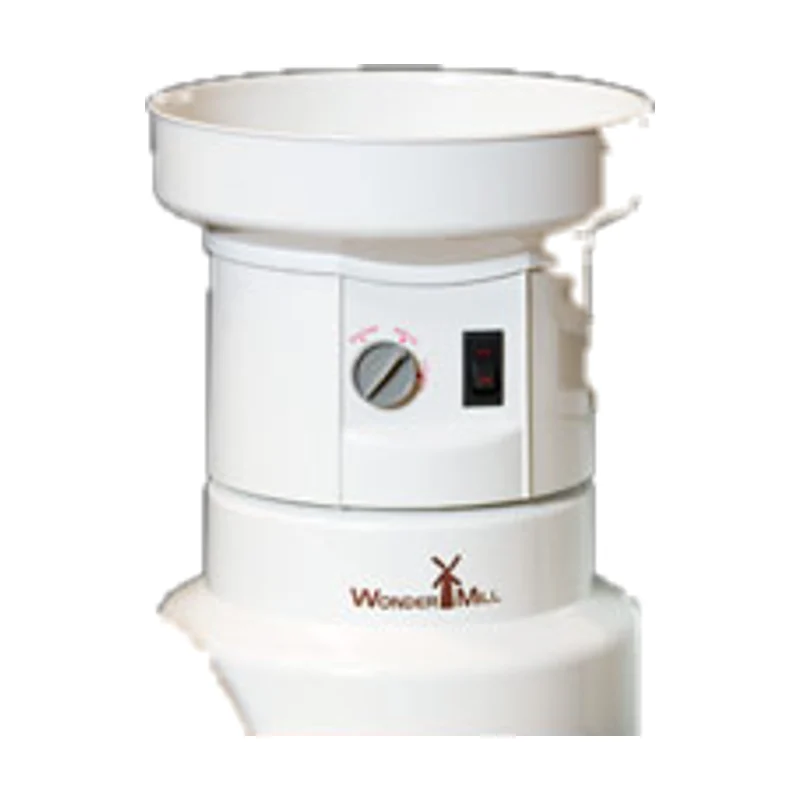
WonderMill Electric Grain Mill
- Motor, NutriMill Classic
- 1200 W, 10 amps
- Motor, WonderMill
- 1250 W LG Electronics motor (manufacturer states)
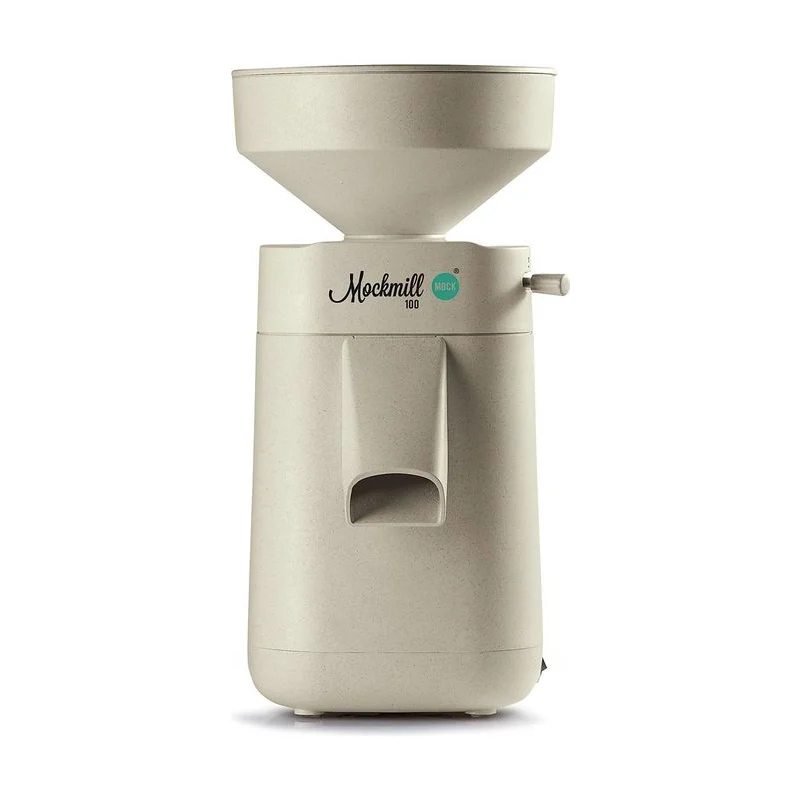
- Motor, NutriMill Classic
- 1200 W, 10 amps
- Motor, Mockmill 100
- 360 W
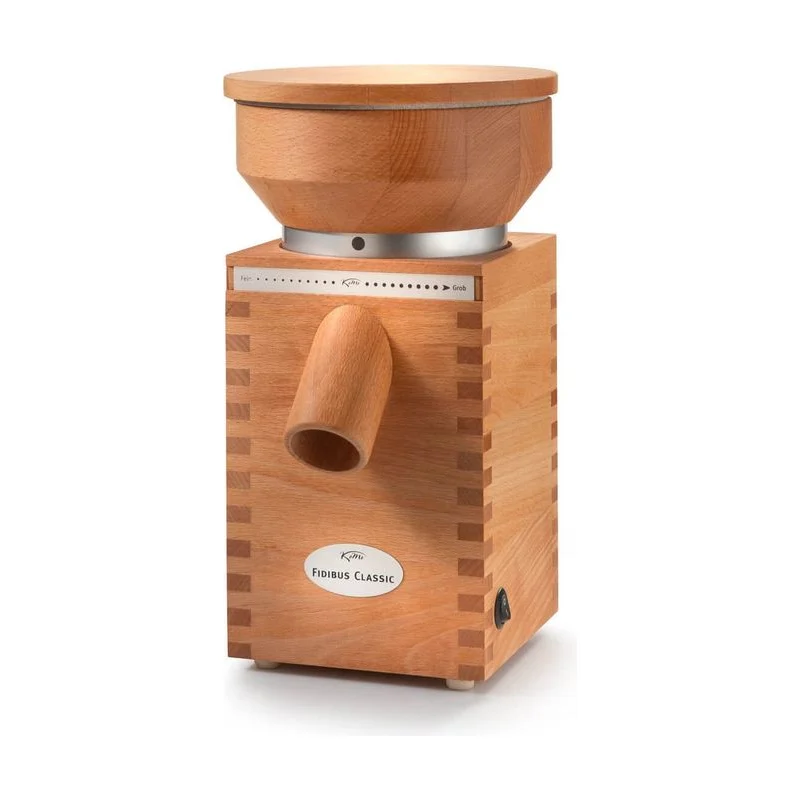
KoMo Fidibus Classic Grain Mill
- Motor, NutriMill Classic
- 1200 W, 10 amps
- Motor, KoMo Fidibus Classic
- 360 watts
The comparisons this mill appears in
Each of these decides this mill against one other model, on the rows both makers publish.
- Impact vs stone burr grain millsThe NutriMill Classic's impact chamber and the Mockmill 100's ceramic stones, compared on what each mechanism permits, adjusts, excludes and requires.
- NutriMill Classic vs WonderMillBoth mills shatter grain by impact, so the mechanism decides nothing. Ingredient scope, texture control, container capacity and documentation quality do.
- NutriMill Classic vs NutriMill HarvestNutriMill Classic vs Harvest: the Classic's 12- or 13-cup hopper and 20-cup bowl (21 to 22 in its manual) against the Harvest's 5-cup hopper and spout.
The documents this page was read from
Prices and availability are on the seller’s site. Amazon links are affiliate links; we may earn a commission at no extra cost to you. Other seller links are unpaid.
- Publication
- By Millwright
- Source
- Manufacturer documentation
- Reviewed
- Documented
- 9 of 10 attributespublished by the makerCounts published attributes, not quality.