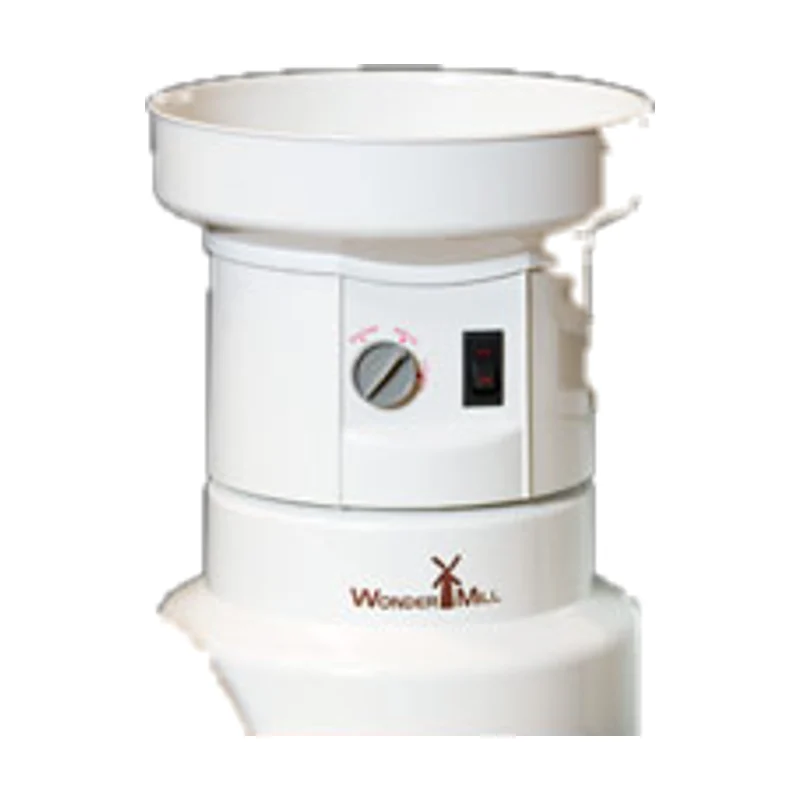
How the WonderMill grain mill manual was read, and why every dimension here comes from a dealer
What this section establishes
- WonderMill publishes no specification table on thewondermill.com. Every dimension, weight, burr diameter, throughput rate, hertz figure, cord length and country of manufacture on this page was read from an authorized-dealer sheet, not from the manufacturer.
- The owner manual is a six-page PDF carrying a 2007 copyright, and its warranty and texture-control pages are set in two columns that an automated fetch interleaved; the file was re-extracted locally and every quoted claim re-confirmed against it before publication.
- Both dealer sheets this page relies on, Pleasant Hill Grain and Unsifted, are listed as Featured Dealers on WonderMill’s own dealer page, which matters because the manual excludes purchases from unauthorized dealers from warranty coverage.
The WonderMill owner manual is a six-page PDF whose warranty and texture-control pages are set in two columns. An earlier automated fetch of that file produced clipped and duplicated passages: sentences broken mid-clause, the two columns interleaved into each other, and warranty terms repeated out of order. Nothing on this page rests on that first pass. The PDF was downloaded and re-extracted locally, and a second agent then re-confirmed every quoted claim against the source document before it was allowed onto this page. Where the second reading disagreed with the first, the second reading is what appears below.
That disclosure is the reason this page takes the shape it does. The manual is the only source for the two things a WonderMill buyer most needs before ordering: the ingredient list and the real warranty terms. If the manual is read badly, both are reported wrongly, and the failure is invisible to a reader, because a garbled two-column extraction still yields fluent-looking sentences that no amount of editing will flag.
WonderMill publishes no formal specification table anywhere on thewondermill.com. Every dimension, weight, burr diameter, throughput rate, hertz figure, cord length and country of manufacture cited below comes from an authorized-dealer spec sheet — Pleasant Hill Grain or Unsifted, both listed as Featured Dealers on WonderMill’s own dealer page — and not from the manufacturer. That provenance is repeated at each figure rather than assumed once and forgotten.
Two further extraction notes are recorded so the work is repeatable. The Unsifted product page returns only its gallery and customer reviews under default main-content extraction; its technical-details table appears only when the full page is retrieved. And several strings that read as dealer quotations are in fact adjacent rows of a spec table: watts, hertz, cord length and plug type occupy four separate lines rather than one sentence. They are reported here as table values, never typeset as manufacturer prose.
| Figure | Value as published | Document it was read from | Read from |
|---|---|---|---|
| Model or part number | WM2000, printed as Manufacturer Part Number; not stated by WonderMill | Pleasant Hill Grain spec table (authorized dealer) | pleasanthillgrain.com product page |
| Rotational speed | Not stated as a number; the dealer writes “thousands of RPM’s” | Pleasant Hill Grain (authorized dealer) | pleasanthillgrain.com product page |
| Fineness in microns | Not stated in any document read | Absent from every source this page lists | Not stated in any document read for this page. |
| Noise in decibels | Not stated in any document read | Absent from every source this page lists | Not stated in any document read for this page. |
Two of the four are stated only by an authorized dealer and not by WonderMill, which publishes no specification table of its own; the other two are stated by no document this page lists. The figures that do appear in both places — motor, mechanism, hopper, canister, milling rate, burr diameter, dimensions, weight, warranty, housing and country of manufacture — are carried once, in the specifications block, each with the document it was read from.

The 18 ingredients the WonderMill manual permits, and the rule the list is built on
What this section establishes
- The WonderMill owner manual permits 18 named ingredients, introduced as covering “most dry grains, and ... most dry, non-oily legumes and lentils”, which makes the list a set of worked examples of a rule rather than an exhaustive schedule.
- No maximum batch size, rest interval or per-ingredient rate is stated for any of the 18. The only rate in the whole evidence set is a dealer figure of 24 oz per minute at the bread-flour setting, with no grain named.
- Twelve of the 18 entries are grains or pseudo-grains and six are dried legumes and pulses, but the manual’s coarse-setting instruction divides on “large grains and beans” instead, leaving dried field corn, popcorn and sorghum classified neither way.
The manual permits 18 named ingredients, introduced on page four with the sentence “The WonderMill will provide your family with fresh flour from most dry grains, and from most dry, non-oily legumes and lentils. Including all of these:”. This is the most specific ingredient scope any source in this evidence set publishes, and it is the list against which a warranty question would be read.
Twelve of the 18 entries are grains or pseudo-grains and six are dried legumes and pulses, but the manual does not organize its texture instructions along that division. Its coarse-setting instruction reads “For large grains and beans ALWAYS make sure that your texture knob is set to the coarse setting in the 3 o’clock position”, which names large grains alongside beans rather than separating grains from legumes. The manual does not define large, and it does not state which of its twelve grain entries fall under that instruction — dried field corn, popcorn and sorghum are classified neither way. What the manual does state without qualification is the default: the bread setting at 1 to 3 o’clock “will give you perfect flour” on “the majority of milling procedures”, and the 11 to 12 o’clock fine setting is reserved for the rare case of a super-fine flour. The permitted table and the texture section are written to two different criteria, and the documentation never maps one onto the other.
The qualifying phrase in the manual’s own introduction does as much work as the 18 names. “Most dry grains” and “most dry, non-oily legumes and lentils” is a rule, and the entries are worked examples of it. One entry sits awkwardly against that rule in the manual’s own terms: soybeans appear on a list the manual introduces as covering non-oily legumes and lentils, while the same manual bans high-oil grains as a category two paragraphs later. The documentation does not reconcile the two, and this page does not reconcile them either.
The manual does not state a maximum batch, a rest interval between batches, or a per-ingredient rate for any entry on this list. The single rate figure in the whole evidence set — 24 oz per minute — is a dealer table value stated for the bread-flour texture, with no grain named. Nothing on the permitted list carries a nutritional or particle-size claim either. The manual permits an ingredient; it does not state what the flour from that ingredient measures. How the published ingredient scope differs across the mills in this cluster, including which manufacturers publish a list at all, is set out at What you can and cannot mill.
The manual’s 18 permitted entries, in its own order:
- Wheat (hard and soft)
- Spelt
- Oats
- Kamut
- Rice
- Rye
- Triticale
- Millet
- Dried pinto beans
- Sorghum (milo)
- Dried green beans
- Dried mung beans
- Popcorn (unpopped)
- Soybeans
- Split peas
- Dried field corn
- Buckwheat
- Chick peas
The nine foods the manual bans, and the two rules behind them
The manual excludes nine named foods under a heading printed in capitals as “NEVER MILL THE FOLLOWING:”. The wording is a prohibition, not a caution. The manual offers no workaround, no reduced-quantity allowance and no coarse-setting exception for any of the nine, and it does not describe them as merely unsuitable or not recommended.
Six of the nine are explained by the manual’s own categorical warning about oil. Sesame seeds, sunflower seeds, flax seed, nuts of all types, peanuts and coffee beans are all oil-bearing, and the manual bans high-oil grains as a class in a standalone all-caps line rather than only as a list of examples. Dried fruits, including dates and raisins, sit under the companion warning about wet or damp products. A reader who understands those two rules can predict most of the list without having read it.
Two entries are not explained by either rule. Sugar and tapioca carry neither high oil nor high moisture, and the manual gives no reason for excluding them. It states the ban and moves on. That gap is reported here rather than filled: the documentation excludes sugar and tapioca, and the documentation does not state why.
The exclusion list is also the manual’s own definition of a warranty boundary. It instructs the reader, verbatim, that “If you have any questions about whether or not this mill will grind a particular product please call WonderMill before proceeding to ensure that you do not void your warranty.” The manual separately warns that damage from foreign objects — plastics, metals and rocks — is not covered, and recommends triple-cleaned grain. Milling an excluded food is therefore framed by the manufacturer as a coverage question first and a performance question second, which is a materially stronger statement than a recommendation.
The nine named foods, followed by the two categorical bans the manual prints alongside them:
- Sugar
- Sesame seeds
- Sunflower seeds
- Flax seed
- Nuts (all types)
- Coffee beans
- Dried fruits (including dates and raisins)
- Peanuts
- Tapioca
- Categorical ban: any grain with a high oil or moisture content, printed separately as “NEVER MILL GRAINS THAT HAVE A HIGH OIL OR MOISTURE CONTENT.”
- Categorical ban: wet or damp products of any kind, printed separately as “DO NOT ATTEMPT TO MILL WET OR DAMP PRODUCTS.”
If you have any questions about whether or not this mill will grind a particular product please call WonderMill before proceeding to ensure that you do not void your warranty.
Quinoa, amaranth and barley: where WonderMill's manual, marketing page and attachment disagree on scope
The manufacturer product page promotes ingredients the manual’s permitted table never names. It states that the mill “will not only grind wheat, corn, rice, and other small grains like Quinoa and Amaranth, but it will also grind legumes and beans”, and it publishes a gluten-free list reading “brown rice, white rice, sorghum, quinoa, soy, millet, amaranth, bean, corn, chickpeas/garbanzos”. Quinoa and amaranth appear in both marketing passages. Neither appears among the manual’s 18 permitted entries.
The gap runs in the other direction too. The manual’s own introduction invites the reader to mill barley, and barley is absent from the permitted table on the following page. That is an internal contradiction inside a single six-page document, not a discrepancy between a manufacturer and a retailer, and it is the reason the permitted list should be treated as illustrative of a rule rather than as an exhaustive schedule.
Neither source resolves the other. The manual does not state that its 18 entries are complete; it states that the mill handles “most dry grains” and gives examples. The product page does not state that its quinoa and amaranth claims are subject to the manual’s list, or that they require anything extra. A buyer whose primary intended use is quinoa or amaranth is relying on marketing copy that the shipped documentation does not corroborate — and the manual itself tells that buyer to call before milling anything uncertain.
A third document adds a further condition. WonderMill sells a separate Small Grains Attachment, and the authorized dealer states its purpose plainly: “Without this attachment, extra-small grains and large beans can clog the milling heads.” The wording is specific — the clogging risk is stated at the milling heads, not at the mill generally.
That sentence changes how the permitted list reads. Six of the manual’s permitted entries are beans and pulses — dried pinto beans, dried green beans, dried mung beans, soybeans, split peas and chick peas — and no source states which of them count as large for the attachment’s purpose. The dealer’s note implies some permitted entries can clog the heads on the base machine, while the manual’s texture section separately requires the coarse 3 o’clock setting for large grains and beans. Two documents describe the same risk with two different remedies, and neither cross-references the other. No source fetched states which grains count as extra-small, gives a kernel-size threshold, or says whether the attachment is required or merely recommended for the beans already on the permitted list. The manual does not mention the attachment at all.
The manual does publish a clog-recovery procedure. It walks the reader through clearing the grinding chamber and, in a conditional clause, notes that “if it doesn’t and the fuse on the bottom of the machine pops then wait 2 minutes, push the button to reset the fuse” before repeating the recovery steps. That is a troubleshooting instruction referring to a reset button on the underside; it is not a published overload-protection rating. The manual has no specifications section, states no trip current, and that clog section is the manual’s United Kingdom material, identifiable by its metric quantities and a UK telephone number.
The WonderMill mechanism: impact plates, a 1250 W LG motor, and a plug that is polarized rather than grounded
What this section establishes
- WonderMill states a 1250 W LG Electronics motor on three of its own pages, one of them framing it as a 25% increase over the earlier Whispermill. All three statements are the same company’s; no LG-side or third-party confirmation appears on any source read.
- The WonderMill is an impact machine rather than a burr machine: two fin-studded stainless steel plates, the left one rotating, at a grinding burr diameter both dealer sheets give as 3.5 in.
- The manual states a polarized plug, “one blade is wider than the other”, which is not a grounded plug; no amperage draw, duty cycle, maximum continuous run time or thermal cut-out rating is published anywhere.
The WonderMill mills by impact, not by burr. Impact means a chamber in which spinning elements shatter the kernel against fixed elements; a stone or burr mill instead grinds the kernel between two shaped surfaces. The authorized dealer describes the geometry as “Two fin-studded, precision stainless steel plates (pictured above) fit together, with the left plate rotating at thousands of RPM’s.” The manufacturer calls the WonderMill one of “the most powerful micronizing mills available” and states that the milling heads are made of surgical stainless steel. “Surgical stainless steel” is marketing language rather than a material specification — no source names an alloy grade, so the documentation does not establish whether the heads are 304, 316 or anything else. “Thousands of RPM’s” is the only rotational figure published anywhere here, and it is not a number.
Both dealer tables give a grinding burr diameter of 3.5 in. That is genuine agreement between two separate sheets rather than one figure repeated, which is worth noting because much of the dealer data on this model is identical wording from a common source. The mechanism also sets the ceiling on what the mill can be asked to do, and it is why the exclusion list looks the way it does: an impact chamber has no setting that accommodates an oily seed. The trade-offs between the two mechanisms, and which household jobs each suits, are set out at Impact vs stone burr grain mills.
The manufacturer states a 1250 W motor supplied by LG Electronics: “You don’t have to worry about overloading The WonderMill because of its LARGE 1250 WATT LG ELECTRONICS MOTOR.” A second manufacturer article repeats figure and supplier — “The WonderMill grain mill is now powered by a 1250 WATT LG motor that is superior in quality and power” — and a third frames it as an increase over the earlier Whispermill: “This New High Powered LG Electronics Motor increased its power 25% to a whopping 1250 Watts in THE NEW WONDERMILL.” All three statements come from the same company. None is independent corroboration, and no LG-side or third-party confirmation appears on any source fetched.
The dealer’s electrical rows give 1250 watts, 60 hertz, a 60 in cord and a standard 120 V cord-end plug, on four separate lines of a spec table. The manual adds a detail the dealer table does not: “This appliance has a POLARIZED plug (one blade is wider than the other) to reduce risk of electric shock this plug will fit into a polarized outlet only one way”, continuing “If it does not fit, contact a qualified electrician. DO NOT modify the plug in any way.” Polarized is not grounded. A polarized two-blade plug carries no earth pin, which matters to anyone planning to run the mill through an adapter, an extension lead or a non-North American supply. The documentation states no amperage draw, no duty cycle, no maximum continuous run time and no thermal cut-out rating.
The manufacturer states that the mill passes three certification regimes: “we at The WonderMill Company have GONE THE EXTRA MILE to make sure that our mill passes The World’s most demanding electronic testing and Certification Standards - UL(for USA), CSA (for Canada), and CE (for Europe and UK).” A second manufacturer page repeats the same three standards. No UL file or listing number appears on any source fetched, so this remains self-asserted certification that a reader cannot verify from the published material.
| Electrical specification | Value as published | Document | Read from |
|---|---|---|---|
| Watts | 1250 | Pleasant Hill Grain spec table | pleasanthillgrain.com product page |
| Hertz | 60 | Pleasant Hill Grain spec table | pleasanthillgrain.com product page |
| Cord length | 60 in | Pleasant Hill Grain spec table | pleasanthillgrain.com product page |
| Cord-end plug | Std. 120 V | Pleasant Hill Grain spec table | pleasanthillgrain.com product page |
| Plug type | Polarized, one blade wider than the other; no grounded three-pin plug is stated on any source | WonderMill owner manual | Owner manual (PDF) |
| Motor supplier | LG Electronics, stated by WonderMill on three of its own pages | WonderMill motor article | thewondermill.com product page |
| Certifications | UL (USA), CSA (Canada), CE (Europe and UK), self-asserted with no file or listing number | WonderMill product page | thewondermill.com product page |
| Amperage draw | Not stated in any document read | Absent from every source this page lists | Not stated in any document read for this page. |
| Duty cycle and maximum continuous run time | Not stated in any document read | Absent from every source this page lists | Not stated in any document read for this page. |
The table settles supply and certification only. The reset button on the underside is not a published protection rating: it appears inside a conditional clause of the manual’s clog-recovery procedure, with no trip current stated.
WonderMill capacity: a 12-cup canister, an 8-cup hopper only a dealer specifies, and two throughput rates that do not reconcile
What this section establishes
- The flour canister holds 12 cups of flour, printed in capitals in the owner manual and corroborated by a dealer. The 8-cup hopper figure is a dealer specification; WonderMill states it only as a yield, and only for wheat.
- WonderMill states over 100 pounds of flour per hour, while both dealer sheets state 24 oz per minute at the bread-flour setting, which is 90 pounds per hour. The two figures do not reconcile.
- The manufacturer states a flour temperature of “an average of about 115 degrees” and names no unit, no grain, no run length and no measurement point, so the figure stands as a manufacturer claim rather than a specification this page can carry forward.
The flour canister holds 12 cups of flour, stated in the manual in capitals: “DO NOT overfill the flour canister. REMEMBER: approximately 8 cups of grain in the hopper produces about 12 cups of flour. THE CANISTER CAPACITY IS 12 CUPS OF FLOUR!” The second authorized dealer corroborates with “CAPACITY: large canister can hold up to 12 cups of flour at a time”. This is the one capacity figure that both a manufacturer document and a dealer sheet state.
The hopper is a weaker case. The manual never states a hopper capacity as a specification. It states a yield relationship — 8 cups of grain in the hopper produces about 12 cups of flour — from which the 8-cup figure is inferred. The explicit specification “Hopper Fill Capacity (wheat) 8 cups” comes from the dealer spec table, and the dealer body copy repeats it as “Hopper capacity is 8 cups; flour bowl capacity is 12 cups. The flour bowl easily detaches from the milling assembly for easy storage.” The number is the same in both readings, but the manufacturer publishes it only as a yield, and only for wheat.
A third capacity figure appears on both dealer tables and is attached to nothing. Pleasant Hill Grain prints “Capacity (weight) 3 lbs. 12 oz.” and Unsifted agrees with “Capacity (by weight) 3 lb. 12 oz.” Neither page states whether that is the hopper, the canister, or a per-batch limit. It is recorded here as an unassigned figure rather than assigned by guess.
The throughput figures do not agree with each other. The manufacturer states “The WonderMill Electric Grain Mill has the capacity to perform big jobs. You can grind over 100 pounds of flour in an hour.” Both dealer tables state a rate of 24 oz per minute at the bread-flour setting, one of them also rendering it as 5 cups of flour per minute. Twenty-four ounces per minute is 90 pounds per hour. The manufacturer’s “over 100 pounds” is therefore not reconcilable with the dealer-stated rate at the bread setting, and the manufacturer names no grain, no texture setting and no test method for its figure. Both numbers are reported; neither is treated as measured.
The manufacturer also states a flour temperature: “With these great qualities, the WonderMill keeps flour temperatures at an average of about 115 degrees, assuring you that your grains will maintain their nutrient value through the milling process.” Two caveats travel with that sentence and must not be dropped. The page never states a unit — it says 115 degrees, not 115 F — and it states no grain, ambient temperature, run length or measurement point. No test method is published anywhere, so the figure is a manufacturer claim rather than a measurement this site can carry forward.
The WonderMill texture knob as a clock face, and the operating routine the manual builds around it
The mill adjusts texture through a single knob whose positions the manual gives as clock positions, under the heading “6. TEXTURE CONTROL SETTINGS”. Three settings are named. The optimum or bread setting: “For the best results on the majority of milling procedures you will find that the bread setting (1 o’clock to 3 o’clock), will give you perfect flour and allow your mill to function at its best.” The fine setting: “In the rare case that you need a super fine flour (angel food cakes, or pastry, etc.) You will find good results by setting your texture knob in the 11 o’clock to 12 o’clock position”. The coarse setting: “For large grains and beans ALWAYS make sure that your texture knob is set to the coarse setting in the 3 o’clock position.”
The manual attaches a return instruction to the fine setting: “Make sure that when you are done milling a fine flour that you return the texture knob to the 1 -3 o’clock position”. It also gives an emergency stopping instruction that uses the same knob, turning it to the far left — the 11 o’clock pastry position — before switching off. Describing this control as a texture selector alone describes only half of what the manual asks it to do.
The manufacturer summarizes the range as “You can create super-fine flour or coarse flour”, and that is the whole of its texture description. No micron figure, mesh number or particle-size range appears on any source fetched — not on the manufacturer pages, not in the manual, not on either dealer spec sheet. The documentation therefore establishes three named knob positions and no measured output, which means fineness on this mill cannot be compared numerically against any mill that does publish a micron figure. It can be compared only by named setting, a weaker basis than it looks.
The manual requires a short run after the hopper empties: “After the hopper is empty allow the mill to run for approximately five seconds. This creates a self-cleaning action in the grinding chamber.” The full operating step supplies the cue that tells the operator when to start counting — the mill produces “a noticeable change in the way the mill sounds (higher pitch)” as the hopper empties. That cue is part of the instruction rather than decoration, because the five seconds run from it.
Water is prohibited on the milling path. The manual states “NEVER immerse the mill in water and don’t let water run into the grinding chamber from the hopper.” Combined with the standing ban on wet or damp products, the documented routine for the grinding chamber is the five-second empty run plus wiping, and nothing wet. The manual also gives its first-use instruction twice in two quantities: page two states “Mill at least two cups of wheat or other hard grain, and then discard the flour”, while page five states “Mill at least 400 grams of wheat or other hard grain, then discard the flour”. Both are recorded rather than one chosen, because the manual does not indicate which supersedes the other.
The dealer states what ships in the box: “1 mill, 1 flour cannister, 2 filters, 1 cup, 1 lid, and the instruction manual”, reproduced here with the vendor’s own spelling. The manufacturer publishes no box-contents list.
The order the owner manual puts these in
- First use: the manual states a discard batch twice, in two different quantitiesThe manual gives this instruction twice, in two quantities: “Mill at least two cups of wheat or other hard grain, and then discard the flour” on page two, and “Mill at least 400 grams of wheat or other hard grain, then discard the flour” on page five. It does not indicate which supersedes the other.
- Texture: the manual sets the knob by clock position1 to 3 o’clock is the bread or optimum setting, which the manual says will “give you perfect flour” on the majority of milling procedures; 11 to 12 o’clock is the fine setting for angel food cake or pastry; 3 o’clock is the coarse setting the manual requires, with ALWAYS in capitals, for large grains and beans.
- Loading: the manual ties about 8 cups of grain to a 12-cup canister limitThe manual states that approximately 8 cups of grain in the hopper produces about 12 cups of flour, and prints the limit in capitals: “THE CANISTER CAPACITY IS 12 CUPS OF FLOUR!”
- Hopper empty: the manual names a higher pitch as the cueThe manual’s operating step describes “a noticeable change in the way the mill sounds (higher pitch)” as the hopper empties. That cue is part of the instruction rather than decoration, because the next step is timed from it.
- After the hopper empties: the manual's run of approximately five seconds“After the hopper is empty allow the mill to run for approximately five seconds. This creates a self-cleaning action in the grinding chamber.”
- After a fine flour: the manual's instruction to return the knob to 1 to 3 o'clock“Make sure that when you are done milling a fine flour that you return the texture knob to the 1 -3 o’clock position”. The same knob is also the manual’s emergency stop, turned to the far left at the 11 o’clock pastry position before switching off.
- Cleaning: the manual permits wiping and prohibits immersion“NEVER immerse the mill in water and don’t let water run into the grinding chamber from the hopper.” Combined with the standing ban on wet or damp products, the documented routine for the grinding chamber is the empty run plus wiping, and nothing wet.
WonderMill's lifetime warranty covers the milling heads only, and six years covers the rest
What this section establishes
- The lifetime term covers the milling heads and nothing else. The manual states “All other parts are warrantied for six years”, which puts the motor, the housing and the canister on the six-year term.
- The manufacturer’s product page, the manufacturer’s homepage and one dealer table all print an unqualified or bare lifetime. Only the owner manual and Pleasant Hill Grain publish the six-year limit on non-head parts.
The manual states the warranty in two clauses that are routinely quoted as one: “Grote Molen Inc. warrants the WonderMill Grain Mill, to the original owner, to be free of manufacturing defects in materials and workmanship as follows: The WonderMill milling heads are warrantied for the lifetime of the original owner. All other parts are warrantied for six years.” Lifetime covers the heads. Six years covers the motor, the housing, the canister and everything else.
The manual restricts who and where. It states “This warranty applies only to the original, noncommercial owner”, prints “HOUSEHOLD USE ONLY” at the foot of the same page and again on the back cover, and states “This warranty applies to products purchased and operated in the U.S.A. or Canada. Transportation, handling, and/or shipping costs are NOT included in this warranty.” The exclusion block between those clauses runs to roughly fifteen lines and includes purchases from unauthorized dealers as well as any commercial use.
Three of the four sources state the term differently, which is why the manual’s wording matters. The manufacturer product page says only “A lifetime warranty is included with every WonderMill”. The manufacturer homepage says “A limited lifetime warranty is included with every WonderMill”. The second authorized dealer’s table prints a bare “Warranty Length: Lifetime”. Only the manual and Pleasant Hill Grain publish the six-year limit on non-head parts, the dealer stating it as “Lifetime on milling head/6 yrs on all other parts”. A buyer reading any of the three short forms would reasonably conclude the motor is covered for life. The manual states it is not.
The unauthorized-dealer exclusion gives WonderMill’s own dealer page unusual practical weight. Both spec sheets relied on here belong to Featured Dealers listed on that page, which is also the document a buyer would use to confirm a seller is covered before purchasing.
Grote Molen Inc. warrants the WonderMill Grain Mill, to the original owner, to be free of manufacturing defects in materials and workmanship as follows: The WonderMill milling heads are warrantied for the lifetime of the original owner. All other parts are warrantied for six years.
Six disagreements inside WonderMill's published material
Six disagreements sit inside the published material for this model. Each is stated with both values and both sources rather than resolved, because no source fetched arbitrates between them.
Weight. Pleasant Hill Grain prints “Weight (lbs.) 7.05" while Unsifted prints “Product Weight (lbs.) 7-1/4 lb.” That is a 0.2 lb gap between two authorized dealers, and neither page states whether the figure is net or shipping weight. The manufacturer publishes no weight at all, so there is no third value to break the tie.
Warranty term. The manual and Pleasant Hill Grain state lifetime on the milling heads and six years on all other parts. The manufacturer product page states an unqualified lifetime warranty, the homepage a limited lifetime warranty, and Unsifted’s table a bare lifetime. Whether the six-year term on non-head parts is still current could not be resolved from the sources fetched; the manual carries a 2007 copyright.
Warrantor identity. The manual names Grote Molen Inc. as the warrantor. The current site trades as The WonderMill Company. The manufacturer’s own Whispermill article names Brownwick LLC as the Idaho company that acquired the molds. No source fetched reconciles the three names, which matters because a warranty claim is made against a named legal entity rather than against a brand.
Ingredient scope. The manual’s permitted table omits quinoa and amaranth, both promoted on the manufacturer product page, and omits barley, which the manual’s own introduction invites the reader to mill. That divergence is set out in full in the scope section above.
Throughput. The manufacturer states over 100 pounds of flour per hour; both dealer tables state 24 oz per minute at the bread-flour setting, which is 90 pounds per hour. The two figures are not compatible at the same setting.
First use. The manual states two cups of wheat on page two and 400 grams of wheat on page five, without indicating which applies.
Three further gaps are provenance rather than contradiction, and they are the reason this page repeats its sourcing at every figure. The hopper capacity of 8 cups is a dealer specification derived from a manufacturer yield statement, not a manufacturer specification. The country of manufacture, South Korea, appears only in the Pleasant Hill Grain table, alongside a separate row reading “Origin: Imported”; no manufacturer page and no page of the manual states a country of manufacture, and the manufacturer states only that the motor is made by LG Electronics while printing a company address in Pocatello, Idaho. The model identifier follows the same pattern: no manufacturer source prints a model or part number, and “WM2000" with UPC 798304043747 appears only in that same dealer spec table.
What this analysis does not establish: no possession of the mill, and no published figure for noise, fineness or RPM
Nothing here rests on physical possession of the mill. No sentence above describes handling, running, listening to or measuring the machine. The evidence is the manufacturer’s published pages, the owner manual PDF, and two authorized-dealer spec sheets, read carefully and re-verified against the sources.
Several figures a buyer might expect are absent from every source fetched. Their absence is itself a finding, not an omission on this page:
- Noise. No decibel figure and no test standard exist on any source. The manufacturer claims the WonderMill is “the quietest and fastest mills available” and the dealers repeat a sound-reduction phrase, none of which is a measurement.
- Fineness. No micron, mesh or particle-size figure is published anywhere, so the three named knob positions are the whole of the texture evidence.
- Rotational speed. “Thousands of RPM’s” from a dealer page is the only figure, and it is not a number.
- Motor amperage and duty cycle. Not published, and neither is a maximum continuous run time or a rest interval between batches.
- Flour temperature method. The 115-degree average carries no unit on the page, no grain, no ambient temperature, no run length and no measurement point.
- Overload protection rating. The reset button on the underside appears only inside a conditional clause of the clog-recovery procedure, with no trip rating and no specification entry.
- Durability and service life. No source states a service interval, a spare-parts list, or an expected lifespan for the heads or the motor.
- Alloy grade. “Surgical stainless steel” is stated for the milling heads with no grade attached on any page.
- Price, availability, ratings and rank. Deliberately outside the scope of every page on this site.
Who the WonderMill's published evidence fits, and who it does not
The documentation fits a household that mills bread grains and dry legumes and wants an explicit, printed list of what is allowed. WonderMill publishes an 18-item permitted list and a nine-item prohibition in the shipped manual, and that list is the most specific thing the company puts in a buyer’s hands before purchase. A reader whose intended ingredients all appear on it is buying with more certainty than the specification table alone would suggest.
The documentation fits poorly where the intended use is oilseeds, nuts, coffee or dried fruit. Those are not marginal cases on this mill; they are named prohibitions that the manual ties to a warranty question, and an impact chamber offers no setting that changes the answer.
It also fits poorly where the buying decision needs measured numbers. Fineness, noise, rotational speed and duty cycle are unpublished, and the one throughput figure the manufacturer does publish is contradicted by its own dealers’ rate. A buyer comparing on measured specifications will find more to work with on models whose manufacturers publish a specification table at all.
Buyers weighing this mill against the alternative it is most often cross-shopped with, including how the two manufacturers’ ingredient documentation differs in scope and specificity, will find that comparison at NutriMill Classic vs WonderMill.
Can the WonderMill mill flax, nuts or coffee beans?
No. The manual excludes flax seed, nuts of all types, peanuts, sesame seeds, sunflower seeds and coffee beans by name under the heading “NEVER MILL THE FOLLOWING:”, and separately bans any grain with a high oil content as a category. The manual offers no reduced-quantity allowance and no coarse-setting exception for any of them, and it links uncertain ingredients to warranty coverage, instructing the reader to call WonderMill before proceeding.
The exclusions follow from the mechanism rather than being arbitrary: an impact chamber shatters kernels rather than grinding them between adjustable surfaces, so there is no setting that accommodates an oily seed.
Does the WonderMill mill quinoa and amaranth?
The sources disagree. The manufacturer product page names both, stating that the mill grinds “other small grains like Quinoa and Amaranth” and listing quinoa and amaranth again in its gluten-free list. The owner manual’s permitted table of 18 ingredients names neither.
A separate factor sits between the two. WonderMill sells a Small Grains Attachment, and the authorized dealer states that “Without this attachment, extra-small grains and large beans can clog the milling heads.” No source fetched states which grains count as extra-small or gives a size threshold, so the documentation does not establish whether quinoa and amaranth require the attachment. A buyer for whom these are a primary use should confirm directly with the manufacturer, which is what the manual itself instructs.
How fine is WonderMill flour, in microns?
The manufacturer does not publish a micron figure, and neither does the manual nor either authorized-dealer spec sheet. No mesh number and no particle-size range appears on any source fetched.
What is published is three named knob positions: 11 to 12 o’clock for a super-fine flour intended for angel food cake or pastry, 1 to 3 o’clock as the bread or optimum setting, and 3 o’clock as the coarse setting the manual requires for large grains and beans. The manufacturer summarizes the range as “super-fine flour or coarse flour”. A reader who needs a numeric fineness comparison will have to obtain it from the manufacturer, because it is not in the published material.
How loud is the WonderMill in decibels?
No decibel figure exists on any source fetched. The manufacturer claims the WonderMill is “the quietest and fastest mills available” and the authorized dealers repeat a sound-reduction phrasing, but none of the three publishes a measurement, a test standard, a measuring distance or a comparison method.
This page records no noise specification for the model, because recording a marketing adjective as a specification would misrepresent what the manufacturer actually states. A reader who needs a figure should ask WonderMill for a measured value and for the conditions under which it was taken.
What does the WonderMill lifetime warranty actually cover?
The milling heads, and only the milling heads. The manual states that “The WonderMill milling heads are warrantied for the lifetime of the original owner. All other parts are warrantied for six years.” The motor, housing and canister therefore fall under the six-year term, not the lifetime term.
Three restrictions travel with it. The warranty applies only to the original, noncommercial owner; the manual prints “HOUSEHOLD USE ONLY”; and it applies to products purchased and operated in the U.S.A. or Canada, with transportation, handling and shipping costs excluded. Purchases from unauthorized dealers, and damage from foreign objects such as plastics, metals and rocks, are also excluded. Because the manufacturer product page and one dealer table both print an unqualified “lifetime”, the manual is the document to read before relying on the term.
Every published figure, with the document it came from
Every row this maker publishes for this mill, printed as its own document prints it, with the document named beside it.
| Attribute | As published | Read from |
|---|---|---|
| Milling mechanism | Impact; two fin-studded stainless steel plates, one rotating | pleasanthillgrain.com product page |
| Motor | 1250 W LG Electronics motor (manufacturer states) | thewondermill.com product page |
| Hopper capacity | 8 cups (wheat) | pleasanthillgrain.com product page |
| Flour container capacity | 12 cups of flour | Owner manual (PDF) |
| Milling rate | 24 oz/min at the bread-flour setting | unsifted.com product page |
| Grinding burr diameter | 3.5 in | pleasanthillgrain.com product page |
| Dimensions | 16.3 in wide x 8.5 in deep x 12 in high | pleasanthillgrain.com product page |
| Weight | 7.05 lb (a second authorized dealer prints 7-1/4 lb) | pleasanthillgrain.com product page |
| Texture adjustment | Single knob by clock position: 11 to 12 o'clock fine, 1 to 3 o'clock bread, 3 o'clock coarse | Owner manual (PDF) |
| Housing | ABS; BPA-free plastic | pleasanthillgrain.com product page |
| Warranty | Lifetime on milling heads to the original owner; six years on all other parts | Owner manual (PDF) |
| Country of manufacture | South Korea (dealer spec table; the manufacturer does not state it) | pleasanthillgrain.com product page |
This mill against the other eight
The catalogue reduced to five columns and grouped by the mechanism each maker's own documents describe. This mill keeps its place in the order.
| Mill | Mechanism | Motor | Hopper | Warranty |
|---|---|---|---|---|
| Impact — the grain is shattered against steel heads, there is no gap to setTwo mills · 1,200 to 1,250 W | ||||
| NutriMill Classic Grain MillRead from NutriMill product page · Owner manual (PDF)View NutriMill Classic on Amazon | High-speed impact chamber with stainless steel Microburst milling heads | 1200 W, 10 amps | 12 cups 13 cups | 5 years parts and plastics; limited lifetime on motor and milling heads; original noncommercial purchaser only |
| WonderMill Electric Grain Mill — this pageRead from Pleasant Hill Grain dealer specifications · WonderMill product page · Owner manual (PDF)View WonderMill Electric at Unsifted | Impact; two fin-studded stainless steel plates, one rotating | 1250 W LG Electronics motor (manufacturer states) | 8 cups (wheat) | Lifetime on milling heads to the original owner; six years on all other parts |
| Stone burr — the grain is ground between two corundum discs you can moveFour mills · 360 to 600 W | ||||
| Mockmill 100 Stone Grain MillRead from Mockmill product pageView Mockmill 100 at Mockmill USA | Corundum ceramic grinding stones | 360 W | 1,100 g | 2 lbs 7 oz (wheat) | 6 years, non-commercial use |
| KoMo Fidibus Classic Grain MillRead from KoMo product pageView KoMo Fidibus Classic at Pleasant Hill Grain | Stone burr; infinitely adjustable, self-sharpening, made of premium corundum ceramic | 360 watts | Approx. 1,000 g of wheat | 12 years on household grain mills |
| Mockmill 200 Stone Grain MillRead from Mockmill product pageView Mockmill 200 at Mockmill USA | Corundum ceramic grinding stones | 600 W | 1,100 g | 2 lbs 7 oz (wheat) | 6-year warranty for non-commercial use |
| NutriMill Harvest Grain MillRead from NutriMill product page · NutriMill technical illustrationView NutriMill Harvest on Amazon | Corundum stone burrs, upper and lower | 450 watts | 5 cups | 5 years against manufacturing defects in materials and workmanship |
| Steel burr — the grain is ground between steel platesThree mills · one at 1,500 W, two with no motor of their own | ||||
| Country Living Grain MillRead from Country Living product pageView Country Living Grain Mill on Amazon | Opposed burr plates — one fixed plate held by three screws, one rotating plate on the drive shaft, fed by an auger | — | 4 1/2 cups standard; nearly 11 cups with the optional hopper extension | Lifetime of the original owner on all parts excluding the finish; grinding plates one year |
| KitchenAid All Metal Grain Mill AttachmentRead from Owner manual (PDF)View KitchenAid grain mill attachment on Amazon | Metal burr: a grind worm drives the grinding action and a movable burr grinds whole grains into flour | — | — | One-year full warranty from date of purchase with hassle-free replacement, for the 50 United States and the District of Columbia; limited one-year warranty in Puerto Rico |
| VEVOR Electric Grain Mill Grinder MFS-140Read from Owner manual (PDF) · VEVOR product listingView VEVOR MFS-140 at VEVOR | One stationary and one moving grinding plate, supplied as a dry-grinding pair and a wet-grinding pair | 1500 W | — | 12-month standard manufacturer's warranty, from VEVOR's site-wide policy rather than the product listing |
Impact — the grain is shattered against steel heads, there is no gap to set
Two mills · 1,200 to 1,250 W
NutriMill Classic Grain Mill
Read from NutriMill product page · Owner manual (PDF)
View NutriMill Classic on Amazon- Mechanism
- High-speed impact chamber with stainless steel Microburst milling heads
- Motor
- 1200 W, 10 amps
- Hopper
- 12 cups 13 cups
- Warranty
- 5 years parts and plastics; limited lifetime on motor and milling heads; original noncommercial purchaser only
WonderMill Electric Grain Mill — this page
Read from Pleasant Hill Grain dealer specifications · WonderMill product page · Owner manual (PDF)
View WonderMill Electric at Unsifted- Mechanism
- Impact; two fin-studded stainless steel plates, one rotating
- Motor
- 1250 W LG Electronics motor (manufacturer states)
- Hopper
- 8 cups (wheat)
- Warranty
- Lifetime on milling heads to the original owner; six years on all other parts
Stone burr — the grain is ground between two corundum discs you can move
Four mills · 360 to 600 W
Mockmill 100 Stone Grain Mill
Read from Mockmill product page
View Mockmill 100 at Mockmill USA- Mechanism
- Corundum ceramic grinding stones
- Motor
- 360 W
- Hopper
- 1,100 g | 2 lbs 7 oz (wheat)
- Warranty
- 6 years, non-commercial use
KoMo Fidibus Classic Grain Mill
Read from KoMo product page
View KoMo Fidibus Classic at Pleasant Hill Grain- Mechanism
- Stone burr; infinitely adjustable, self-sharpening, made of premium corundum ceramic
- Motor
- 360 watts
- Hopper
- Approx. 1,000 g of wheat
- Warranty
- 12 years on household grain mills
Mockmill 200 Stone Grain Mill
Read from Mockmill product page
View Mockmill 200 at Mockmill USA- Mechanism
- Corundum ceramic grinding stones
- Motor
- 600 W
- Hopper
- 1,100 g | 2 lbs 7 oz (wheat)
- Warranty
- 6-year warranty for non-commercial use
NutriMill Harvest Grain Mill
Read from NutriMill product page · NutriMill technical illustration
View NutriMill Harvest on Amazon- Mechanism
- Corundum stone burrs, upper and lower
- Motor
- 450 watts
- Hopper
- 5 cups
- Warranty
- 5 years against manufacturing defects in materials and workmanship
Steel burr — the grain is ground between steel plates
Three mills · one at 1,500 W, two with no motor of their own
Country Living Grain Mill
Read from Country Living product page
View Country Living Grain Mill on Amazon- Mechanism
- Opposed burr plates — one fixed plate held by three screws, one rotating plate on the drive shaft, fed by an auger
- Motor
- —
- Hopper
- 4 1/2 cups standard; nearly 11 cups with the optional hopper extension
- Warranty
- Lifetime of the original owner on all parts excluding the finish; grinding plates one year
KitchenAid All Metal Grain Mill Attachment
Read from Owner manual (PDF)
View KitchenAid grain mill attachment on Amazon- Mechanism
- Metal burr: a grind worm drives the grinding action and a movable burr grinds whole grains into flour
- Motor
- —
- Hopper
- —
- Warranty
- One-year full warranty from date of purchase with hassle-free replacement, for the 50 United States and the District of Columbia; limited one-year warranty in Puerto Rico
VEVOR Electric Grain Mill Grinder MFS-140
Read from Owner manual (PDF) · VEVOR product listing
View VEVOR MFS-140 at VEVOR- Mechanism
- One stationary and one moving grinding plate, supplied as a dry-grinding pair and a wet-grinding pair
- Motor
- 1500 W
- Hopper
- —
- Warranty
- 12-month standard manufacturer's warranty, from VEVOR's site-wide policy rather than the product listing
If this is not the mill
Three mills to read next, each with the first catalogue figure it prints differently from this one.
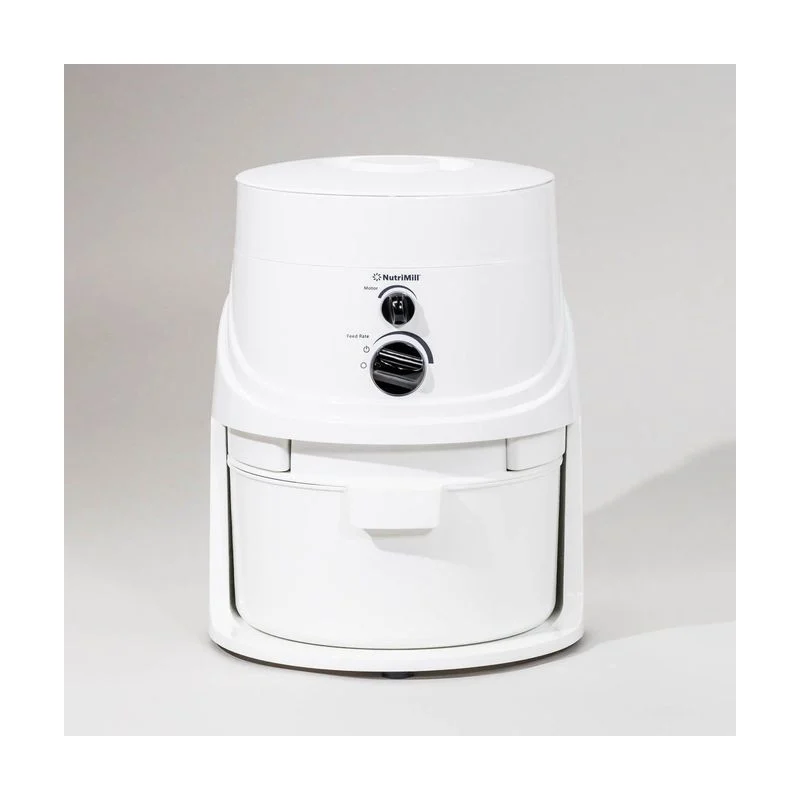
- Motor, WonderMill
- 1250 W LG Electronics motor (manufacturer states)
- Motor, NutriMill Classic
- 1200 W, 10 amps
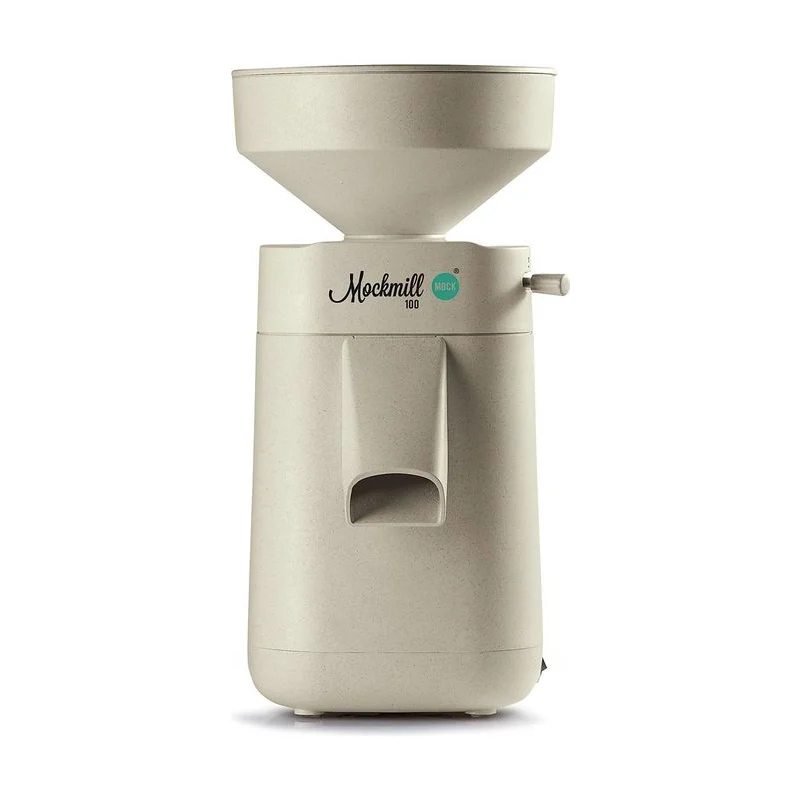
- Motor, WonderMill
- 1250 W LG Electronics motor (manufacturer states)
- Motor, Mockmill 100
- 360 W
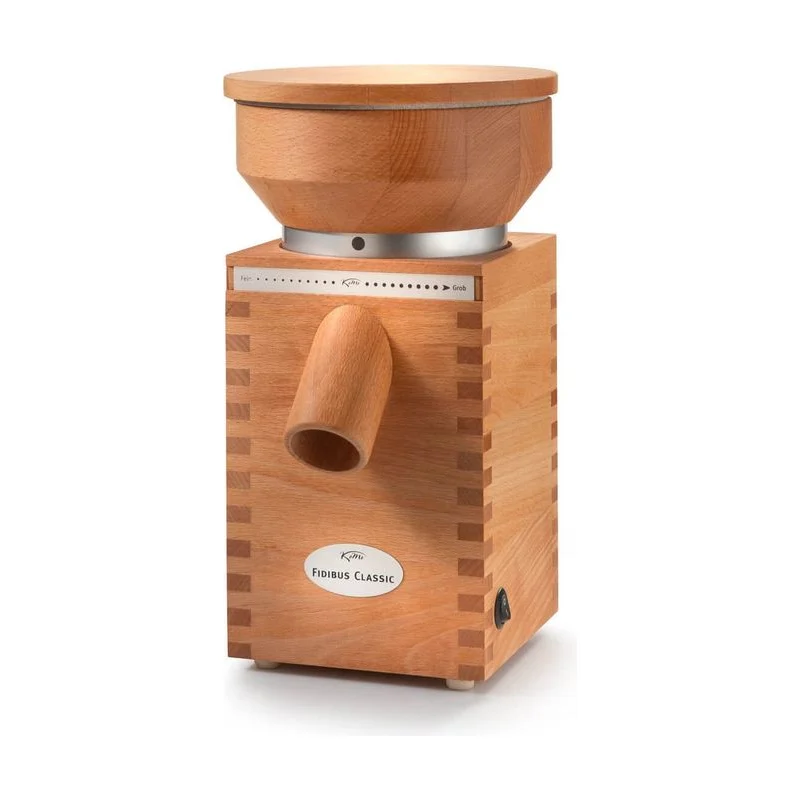
KoMo Fidibus Classic Grain Mill
- Motor, WonderMill
- 1250 W LG Electronics motor (manufacturer states)
- Motor, KoMo Fidibus Classic
- 360 watts
The comparisons this mill appears in
Each of these decides this mill against one other model, on the rows both makers publish.
- NutriMill Classic vs WonderMillBoth mills shatter grain by impact, so the mechanism decides nothing. Ingredient scope, texture control, container capacity and documentation quality do.
The documents this page was read from
- WonderMill manufacturer product page
- WonderMill manufacturer homepage
- WonderMill manufacturer article: The Best Grain Mill Motor (1250 W LG motor)
- WonderMill manufacturer article: WonderMill vs. the old Whispermill
- WonderMill owner manual PDF (2007, six pages)
- WonderMill Company dealer list (used to confirm which retailers are manufacturer-authorized)
- Pleasant Hill Grain WonderMill spec table (Featured Dealer on WonderMill's dealer page)
- Unsifted WonderMill technical details table (Featured Dealer on WonderMill's dealer page)
Prices and availability are on the seller’s site. Amazon links are affiliate links; we may earn a commission at no extra cost to you. Other seller links are unpaid.
- Publication
- By Millwright
- Source
- Manufacturer documentation
- Reviewed
- Documented
- 9 of 10 attributespublished by the makerCounts published attributes, not quality.