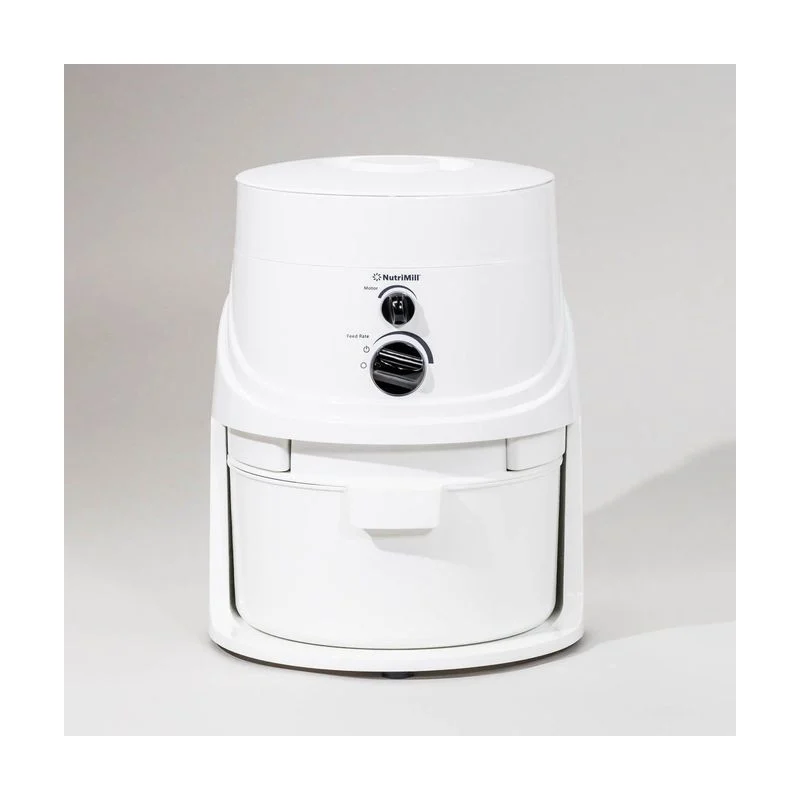
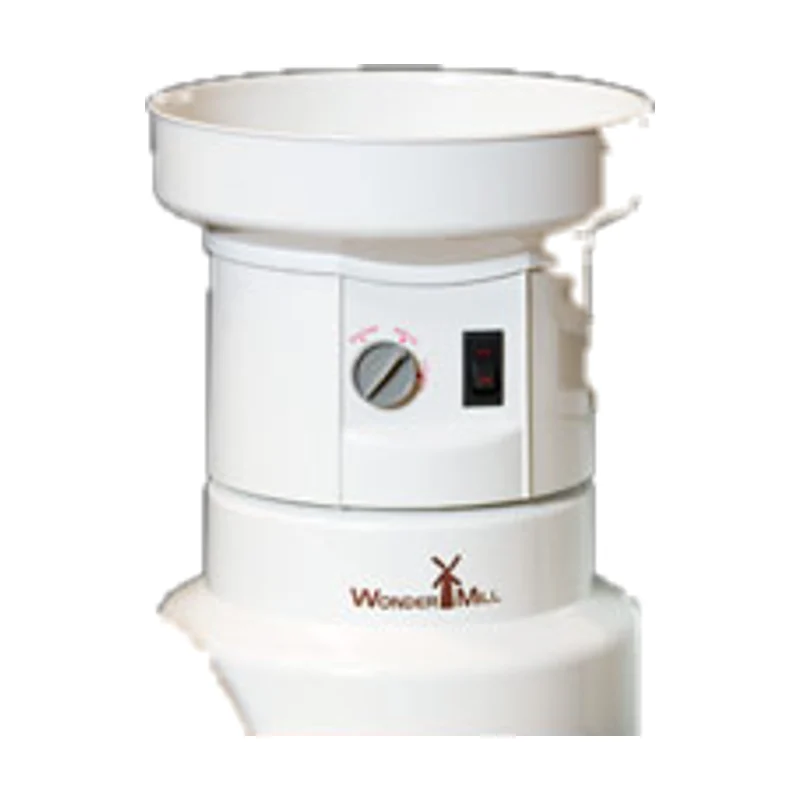
Every specification, side by side
| Attribute | NutriMill Classic | WonderMill |
|---|---|---|
| Milling mechanism Wording differs | High-speed impact chamber with stainless steel Microburst milling heads nutrimill.com product page | Impact; two fin-studded stainless steel plates, one rotating pleasanthillgrain.com product page |
| Motor Figures differ | 1200 W, 10 amps Owner manual (PDF) | 1250 W LG Electronics motor (manufacturer states) thewondermill.com product page |
| Hopper capacity Figures differ | 12 cups (owner manual states 13 cups) — the manufacturer’s own documents disagree on this figure. nutrimill.com product page | 8 cups (wheat) pleasanthillgrain.com product page |
| Flour container capacity Figures differ | 20 cups (owner manual's grain-to-flour section states the bowl holds 21 to 22 cups) — the manufacturer’s own documents disagree on this figure. nutrimill.com product page | 12 cups of flour Owner manual (PDF) |
| Dimensions Figures differ | 12 in W x 12 in D x 13 in H nutrimill.com product page | 16.3 in wide x 8.5 in deep x 12 in high pleasanthillgrain.com product page |
| Weight Figures differ | 14 lbs Owner manual (PDF) | 7.05 lb (a second authorized dealer prints 7-1/4 lb) pleasanthillgrain.com product page |
| Texture adjustment Figures differ | Two knobs: variable motor speed and variable grain feed rate Owner manual (PDF) | Single knob by clock position: 11 to 12 o'clock fine, 1 to 3 o'clock bread, 3 o'clock coarse Owner manual (PDF) |
| Flour fineness | Adjustable, fine to medium coarse Owner manual (PDF) | —No row for this attribute appears in the documents read for this mill. |
| Housing Wording differs | ABS plastic Owner manual (PDF) | ABS; BPA-free plastic pleasanthillgrain.com product page |
| Warranty Figures differ | 5 years parts and plastics; limited lifetime on motor and milling heads; original noncommercial purchaser only Owner manual (PDF) | Lifetime on milling heads to the original owner; six years on all other parts Owner manual (PDF) |
| Intended use | Household use only Owner manual (PDF) | —No row for this attribute appears in the documents read for this mill. |
| Milling rate | —No row for this attribute appears in the documents read for this mill. | 24 oz/min at the bread-flour setting unsifted.com product page |
| Grinding burr diameter | —No row for this attribute appears in the documents read for this mill. | 3.5 in pleasanthillgrain.com product page |
| Country of manufacture | —No row for this attribute appears in the documents read for this mill. | South Korea (dealer spec table; the manufacturer does not state it) pleasanthillgrain.com product page |
The three rates a maker will print

WonderMill vs NutriMill Classic: what each manufacturer publishes in its own name
What this section establishes
- NutriMill publishes a Technical Information block inside the Classic’s 12-page owner manual that states the motor at 10 amps and 1200 W, the hopper at 13 cups, the measurements, a weight of 14 lbs, the milling head material, the housing material and the flour fineness range in one place.
- WonderMill publishes no specification table anywhere: no manufacturer page and no page of its six-page owner manual states a dimension, a weight, a burr diameter, a supply frequency, a cord length or a country of manufacture.
- Those WonderMill figures reach the public only through two authorized-dealer tables, and the cost of that arrangement shows on weight, where Pleasant Hill Grain states 7.05 lb and Unsifted states 7-1/4 lb with no manufacturer figure to settle it.
Impact here means a chamber that shatters grain between spinning stainless steel heads, as distinct from a stone burr, which is an abrasive grinding surface that shears grain between two faces. Both machines on this page are impact mills, and the mechanism argument is settled separately at Impact vs stone burr grain mills. What is not settled, and what a buyer actually has to work with, is the evidence each manufacturer puts in public.
NutriMill publishes three documents for the Classic: a product page, a twelve-page owner manual and a two-page quick start guide. The manual carries a block headed Technical Information that states the motor, the hopper capacity, the measurements, the weight, the milling head material, the housing material and the flour fineness range in one place. That is what a specification table is for, and NutriMill supplies one.
WonderMill publishes no specification table anywhere. Its product page states a motor wattage, a milling head material, a throughput claim and a set of certifications, all inside marketing prose. Its six-page owner manual states the canister capacity, the warranty terms, the ingredient lists and the texture settings. Between them, the manufacturer’s own pages and manual do not state a dimension, a weight, a burr diameter, a supply frequency, a cord length or a country of manufacture.
Every one of those figures in circulation for the WonderMill comes from an authorized dealer instead. Pleasant Hill Grain and Unsifted both publish specification tables, and both appear as Featured Dealers on WonderMill’s own dealer list, which is what makes their tables usable as evidence at all. It also means the figures are a retailer’s transcription of something the manufacturer never published in its own name.
The consequence shows up the moment two dealers disagree. Pleasant Hill Grain states the WonderMill’s weight as 7.05 pounds; Unsifted states it as 7-1/4 pounds. There is no manufacturer document that breaks the tie, because the manufacturer never published a weight. NutriMill’s weight, by contrast, is stated once and unambiguously in the owner manual: “Weight: 14 lbs.”
None of this makes NutriMill’s documentation uniformly better. NutriMill’s documents contradict each other twice on capacity, in ways set out below, and the WonderMill’s documents never do. The difference is in where the contradictions live: NutriMill argues with itself, while WonderMill leaves whole categories of specification to other people. A reader who treats a dealer table and a manufacturer manual as the same class of evidence will get the WonderMill’s numbers wrong in both directions.
| Specification | NutriMill Classic | WonderMill | Read from |
|---|---|---|---|
| Motor | 1200 W at 10 amps — owner manual, Technical Information block | 1250 W — manufacturer product page; no amperage published | thewondermill.com product page |
| Grain hopper | 12 cups on the product page; 13 cups in the owner manual | 8 cups of wheat — Pleasant Hill Grain table; the manual states a yield, not a capacity | pleasanthillgrain.com product page |
| Flour container | 20 cups on the product page and in the manual’s parts diagram; 21 to 22 cups in the same manual | 12 cups — owner manual | Owner manual (PDF) |
| Width x depth x height | 12" x 12" x 13" — owner manual and product page agree | 16.3" x 8.5" x 12" — Pleasant Hill Grain and Unsifted agree; not stated by the manufacturer | pleasanthillgrain.com product page |
| Weight | 14 lbs — owner manual | 7.05 lb (Pleasant Hill Grain) against 7-1/4 lb (Unsifted); no manufacturer figure | pleasanthillgrain.com product page |
| Milling heads | Stainless steel — owner manual | Surgical stainless steel — manufacturer product page | thewondermill.com product page |
| Housing | ABS plastic — owner manual | ABS, BPA-free — Pleasant Hill Grain table; the manufacturer states only BPA Free | pleasanthillgrain.com product page |
| Milling rate | Not stated in any document read; the product page states a batch ceiling of up to 20 cups of flour at a time | 24 oz/min at the bread-flour setting — both dealers; over 100 pounds an hour — manufacturer product page | pleasanthillgrain.com product page |
| Warranty | 5 years on parts and plastics, limited lifetime on motor and milling heads — product page and owner manual | Lifetime on milling heads, six years on all other parts — owner manual dated 2007 | Owner manual (PDF) |
| Noise | No decibel figure in any document read; a vacuum-cleaner analogy only | No decibel figure in any document read; a sound-reduction phrase only | Not stated in any document read for this page. |
Each cell names the document its figure was read from. The Read from column links the WonderMill-side document — manufacturer page, owner manual or authorized dealer — in every row that has one, because WonderMill is the manufacturer with no specification table of its own and its provenance is the half that varies; the NutriMill document is named inside the NutriMill cell. The noise row links nothing, because neither manufacturer publishes a decibel value, a test standard or a measurement distance.
Grain hopper: 12 or 13 cups on the NutriMill Classic against 8 on the WonderMill
What this section establishes
- The NutriMill Classic’s grain hopper is stated at 12 cups on the manufacturer’s product page and at 13 cups in the owner manual’s Technical Information block, and the manual’s own worked example is built on 13 cups of hard wheat.
- The WonderMill’s 8-cup hopper figure comes from the Pleasant Hill Grain dealer table; the WonderMill owner manual states a yield instead, that approximately 8 cups of grain in the hopper produces about 12 cups of flour.
- Whichever NutriMill figure is taken it exceeds the WonderMill’s 8 cups, and the NutriMill manual caps its own hopper at two-thirds to three-quarters full for the thirteen use-caution items, among them barley, quinoa, soybeans and oat groats.
The NutriMill Classic’s grain hopper holds 12 cups according to the product page, which states “12 Cup Grain Hopper Capacity” in its specification list and repeats it in the feature block. The owner manual’s Technical Information block states “Hopper Capacity: 13 cups”. Both are current manufacturer documents and neither acknowledges the other.
The manual’s own arithmetic sides with 13. Its Grain to Flour Ratio section states: “You will get about 21 cups of flour from 13 cups of hard wheat when milled at a medium texture.” A worked example built on 13 cups is harder to dismiss than a bullet, but the product page is the document a buyer reads first, and it states 12.
The WonderMill’s hopper is not given a capacity by the manufacturer at all. The owner manual states a yield rather than a volume: “approximately 8 cups of grain in the hopper produces about 12 cups of flour.” The flat figure appears only in the dealer tables, where Pleasant Hill Grain states “Hopper Fill Capacity (wheat) 8 cups” and its body copy states “Hopper capacity is 8 cups; flour bowl capacity is 12 cups.”
Whichever NutriMill figure is used, it exceeds the WonderMill’s stated 8 cups. The comparison is 12 or 13 cups of grain against 8, and the smaller number is the one that comes from a retailer rather than a manufacturer.
The parenthesis on the dealer’s figure is doing real work: it states 8 cups for wheat specifically. Denser or bulkier material is not covered by that number, and no source states what the hopper holds for beans, corn or a pseudocereal.
NutriMill attaches its own qualifier from the other direction. Its manual defines a use-caution tier of thirteen items and instructs: “Fill the hopper no more than ⅔ to ¾ with these as they produce more flour volume.” So the NutriMill’s effective hopper ceiling drops for barley, quinoa, soybeans, oat groats, kamut, spelt, dried lentils, legumes generally, dried sweet corn, dried garbanzo beans, dried pinto beans, dried green beans and dried mung beans. The 12-or-13-cup figure describes wheat-like grain at full fill, not the whole permitted list.
Flour container: the NutriMill Classic's 20 cups against the WonderMill's 12
What this section establishes
- The NutriMill Classic’s flour bowl is stated at 20 cups by the product page and by the owner manual’s parts diagram, and at 21 to 22 cups by the Grain to Flour Ratio section of that same manual.
- The WonderMill’s canister is stated at 12 cups, and its owner manual states the figure as a prohibition rather than a feature, instructing the owner not to overfill.
- A bake needing more than 12 cups of flour takes a second WonderMill run with the canister emptied in between, and sits inside the NutriMill Classic’s documented single-batch ceiling of 20 cups.
The NutriMill Classic’s flour bowl holds 20 cups according to three separate places in the documentation. The product page’s specification list states “20 Cup Flour Bowl Capacity” and its feature block restates it as “20 Cup - Flour Canister Capacity”. The manual’s exploded parts diagram states “Flour Bowl (Canister) / Large 20 cup capacity.”
The same manual then states, in its Grain to Flour Ratio section, “The bowl holds 21 to 22 cups of flour.” One document, two capacities, no reconciliation. Twenty is the figure to plan a batch around because it is the one three sources agree on, but the discrepancy is the manufacturer’s, not a transcription error.
The WonderMill’s flour canister holds 12 cups, and its manual states the figure as a warning rather than as a feature: “DO NOT overfill the flour canister. REMEMBER: approximately 8 cups of grain in the hopper produces about 12 cups of flour. THE CANISTER CAPACITY IS 12 CUPS OF FLOUR!” The capitals are the manual’s. Unsifted’s table corroborates it as “large canister can hold up to 12 cups of flour at a time.”
Flour container capacity is the largest single documented difference between the two machines. The NutriMill’s product page frames its ceiling as an achievement, stating the Classic can “produce up to 20 cups of flour at a time”. The WonderMill’s manual frames 12 cups as a limit not to be exceeded, in a sentence that begins with a prohibition.
Set the two published yields side by side and they describe similar behavior with different confidence. NutriMill states about 21 cups of flour from 13 cups of hard wheat at a medium texture; WonderMill states about 12 cups of flour from approximately 8 cups of grain. NutriMill’s figure carries two conditions, the grain and the texture setting, and should never be restated as a flat yield. WonderMill’s carries neither condition and names no grain at all.
The practical consequence stays inside the evidence. A bake requiring more than 12 cups of flour requires a second WonderMill run with the canister emptied in between, because the manual instructs against overfilling it. The same bake sits inside the NutriMill’s documented single-batch ceiling. Anyone milling for one or two loaves at a time will never meet either limit.
The bowl holds 21 to 22 cups of flour. You will get about 21 cups of flour from 13 cups of hard wheat when milled at a medium texture.
Permitted list: 31 items in the NutriMill Classic manual, 18 in the WonderMill's
Both owner manuals print a permitted list, and the lists are neither the same length nor the same shape. The NutriMill Classic manual runs to 31 items under the heading “THE NUTRIMILL CLASSIC WILL MILL THE FOLLOWING”. The WonderMill manual runs to 18, introduced as “most dry grains, and from most dry, non-oily legumes and lentils.”
The overlap is the ordinary bread-and-porridge core. The divergence is at the edges, and the edges are where a buyer with a specific grain in mind actually gets an answer.
The two manuals also handle the unlisted grain in opposite ways, and this is the more useful difference. NutriMill publishes a test the reader can run: “For any grains not listed above, mill only ¼ cup, then test the flour by pinching a small amount between your thumb and finger. If it holds the shape of a pinch and does not fall apart, it contains too much moisture. Do not mill this grain.” WonderMill publishes a phone number instead: “If you have any questions about whether or not this mill will grind a particular product please call WonderMill before proceeding to ensure that you do not void your warranty.”
WonderMill also sells a separate small grains attachment, and its dealer states the reason plainly: “Without this attachment, extra-small grains and large beans can clog the milling heads.” That is a scope limit expressed as an accessory. NutriMill’s manual states no equivalent accessory requirement for any item on its permitted list.
- On both manuals’ permitted lists: hard and soft wheat, spelt, kamut, rye, millet, sorghum, buckwheat, popcorn, soybeans, split peas, mung beans, chickpeas and rice.
- On the NutriMill Classic manual’s list only: barley, farro, bulgur wheat, teff, kañiwa, blue corn, oat groats, white rice, brown rice and wild rice named separately, quinoa, amaranth, lentils, lima beans, anasazi beans, black beans, kidney beans and navy beans.
- On the WonderMill manual’s list only: oats, triticale, dried pinto beans, dried green beans and dried field corn.
- NutriMill adds a middle tier the WonderMill manual has no equivalent for, headed “USE CAUTION WHEN MILLING THE FOLLOWING” with the instruction to fill the hopper no more than two-thirds to three-quarters: dried lentils, legumes generally, dried sweet corn, dried garbanzo beans, barley, dried pinto beans, quinoa, soybeans, dried green beans, oat groats, kamut, dried mung beans and spelt.
- NutriMill states a general rule above both lists: “Avoid grains and beans that have high oil or moisture content. Non-commercially dried products may cause plugging.”
- WonderMill’s manual recommends triple-cleaned grain and warns that foreign-object damage from plastics, metals or rocks is not covered by the warranty.
What each mill excludes, and in what words
The WonderMill manual excludes nine named items under a heading in capitals, “NEVER MILL THE FOLLOWING”: sugar, sesame seeds, sunflower seeds, flax seed, nuts of all types, coffee beans, dried fruits including dates and raisins, peanuts and tapioca. It then adds two categorical bans as standalone all-caps lines of their own: “NEVER MILL GRAINS THAT HAVE A HIGH OIL OR MOISTURE CONTENT.” and “DO NOT ATTEMPT TO MILL WET OR DAMP PRODUCTS.”
The NutriMill Classic manual carries a page headed “DO NOT MILL ANY OF THE FOLLOWING” listing oatmeal in the form of rolled oats, steel cut oats, nuts, coffee beans, sesame seeds, sugar, spices, dried fruit or vegetables, flax seeds, goji beans, tapioca, sunflower seeds, herbs, chocolate, chia seeds, hemp, and sprouted grains or beans if not thoroughly dried. The conditional on that last entry is the manufacturer’s own wording, not a softening added here.
Two further NutriMill restrictions are widely quoted as though they belonged on that page, and they do not. “Do not mill damp, wet or oily grains” is a line in the manual’s safety instructions. Re-milling is a caution rather than a prohibition: “CAUTION: WE DO NOT RECOMMEND MILLING FLOUR THAT HAS ALREADY BEEN MILLED. THIS MAY CAUSE PROBLEMS IN YOUR MILLING UNIT.” A do-not-recommend attached to a may-cause is weaker than a ban, and reporting it as a ban would publish an absolute the manufacturer never wrote.
The NutriMill quick start guide compresses the whole exclusion set into four categories: “DO NOT MILL SEEDS, NUTS, SUGARS, OR SPICES / Be cautious milling any grains with high oil or moisture content.” That short form is the version most owners will actually read, and it is stricter on seeds than the manual’s itemized page, which permits several seed-like items by name.
Oats are the sharpest divergence between the two machines. The WonderMill manual names “Oats” flat, with no form specified anywhere on the list. The NutriMill manual permits oat groats and excludes the processed forms outright: “NOTE: rolled oats will NOT feed into the NutriMill® Classic. Do not mill steel cut oats or rolled oats”. NutriMill states a mechanical reason for the exclusion; WonderMill states no form and no reason, so the difference in the documents is a difference in specificity rather than a proven difference in the machines.
The overlap between the two exclusion lists is nearly total for the oily and sugary categories. Both mills exclude nuts, coffee beans, sesame seeds, sunflower seeds, flax, sugar, tapioca and dried fruit by name, and both exclude high-oil and high-moisture material as a class. Anyone hoping to grind nut flours or coffee is excluded by both manufacturers in writing.
Outside that shared core the two lists stop matching, and the mismatch is one of enumeration rather than of demonstrated capability. NutriMill excludes spices twice, by name on the manual’s do-not-mill page and again in the quick start guide’s four-category short form, while the WonderMill manual’s “NEVER MILL THE FOLLOWING” heading names no spice at all. The same asymmetry runs through herbs, chocolate, chia seeds, hemp and goji beans: NutriMill names all five and no WonderMill source names any of them. The traffic runs the other way once, on peanuts, which WonderMill excludes by name and which NutriMill’s page reaches only through the broader entry “Nuts”.
Silence on a list is not permission, and the WonderMill manual states as much itself. A reader holding a product that appears on neither of its lists is instructed to “call WonderMill before proceeding to ensure that you do not void your warranty.” NutriMill answers the same situation with a procedure rather than a phone number, the quarter-cup pinch test quoted above, but that test reads on moisture content and is written for grains, so it settles nothing about the oil in a spice or a seed. Neither document converts an absent name into a permitted ingredient, which is why the eight-item overlap is the only part of the two exclusion lists that can be reported as shared.
Where each ingredient list contradicts its own marketing page
NutriMill’s product page carries a permitted list that is not the manual’s. The page adds triticale, emmer, einkorn, dried sweet corn and pinto beans. It drops bulgur wheat, kañiwa, blue corn, popcorn, wild rice, anasazi beans and kidney beans. Neither document says which supersedes the other, and both are live on the manufacturer’s own properties. A reader who checks the page and a reader who checks the manual will come away with different beliefs about whether the Classic mills popcorn.
Six items sit on both of NutriMill’s own lists at once: barley, quinoa, soybeans, oat groats, kamut and spelt appear as permitted and as use-caution. The manual never states that the caution tier is a subset of the permitted tier rather than a separate category, so the two-thirds-to-three-quarters hopper instruction is easy to miss for exactly the grains it applies to.
WonderMill’s gap runs the other way, with the marketing page claiming more than the manual authorizes. Page 52 states that the mill “will not only grind wheat, corn, rice, and other small grains like Quinoa and Amaranth, but it will also grind legumes and beans”, and publishes a gluten-free list naming “brown rice, white rice, sorghum, quinoa, soy, millet, amaranth, bean, corn, chickpeas/garbanzos”. Quinoa and amaranth appear on neither the manual’s permitted table nor its prohibited one.
The WonderMill manual also contradicts itself on barley. Its introduction invites the reader to mill barley; its permitted table omits barley entirely. NutriMill’s manual, by contrast, names barley twice, on the permitted list and on the use-caution list.
The reason to care is contractual rather than culinary. WonderMill’s manual is the document that ties ingredient scope to the warranty, and it instructs the owner to call before milling anything questionable specifically “to ensure that you do not void your warranty.” Where a marketing page and a manual disagree about what a mill will grind, the manual is the document that governs the remedy.
Texture control: the NutriMill Classic's two knobs against the WonderMill's one
The NutriMill Classic adjusts texture with two controls, listed on the product page as “Motor Speed & Texture Control Knobs”. The manual’s diagram names them the Variable Motor Speed Control Knob and the Variable Texture Control Knob, and the body text calls the second one the Grain Feed Rate Knob. That lower knob is also the power switch: “This is the ON-OFF switch and controls grain flow into the mill. This affects the fineness of the grind.”
The upper knob works on motor speed. The manual states: “For finer flour, upper knob should remain to the left (high speed).” For the coarse end: “For very coarse flour and medium fine corn meal, knob should be set to the far right, which slows the motor speed.” And in between: “For heavy flour & dense textured breads, select a middle setting.”
The lower knob works on feed rate, by clock position. “For finer flour, set the knob toward 11:00 - 12:00 (most grains will not flow at less than a 10:00 position on the knob).” “For bread flour, set the knob toward the 12:00 - 1:00 position.” “For coarser flour turn the knob toward the right.” Two axes, set independently, which is the substantive control difference between these machines.
The WonderMill adjusts texture with a single knob on the same clock face, and the settings do not map onto NutriMill’s. Optimum: “For the best results on the majority of milling procedures you will find that the bread setting (1 o’clock to 3 o’clock), will give you perfect flour and allow your mill to function at its best.” Fine: “In the rare case that you need a super fine flour (angel food cakes, or pastry, etc.) You will find good results by setting your texture knob in the 11 o’clock to 12 o’clock position”, with the instruction “Make sure that when you are done milling a fine flour that you return the texture knob to the 1 -3 o’clock position”. Coarse: “For large grains and beans ALWAYS make sure that your texture knob is set to the coarse setting in the 3 o’clock position.”
The near-collision is worth pinning down, because the two clock faces look interchangeable and are not. Both machines put the finest setting at 11 to 12 o’clock. From there they diverge: on the WonderMill, 1 to 3 o’clock is the default bread band and 3 o’clock is a mandatory setting for large grains and beans, while on the NutriMill the 12 to 1 o’clock band is bread flour and coarser textures live further right again, on a knob that also governs whether the mill is running at all.
NutriMill attaches a caveat that keeps its own clock positions honest. The manual states that the point where grain begins to flow varies with grain and bean size, and that flow may fluctuate at the finest setting. The positions are starting points for a given grain, not calibrated stops.
Neither manufacturer converts any of this into a measurement. NutriMill’s manual states the range as “Flour Fineness: Adjustable - Fine to Medium Coarse”. Its product page states a “400% adjustment range” and, in the same passage, “10 times more texture range than earlier impact mills” - two figures that do not reconcile with each other and neither of which is anchored to a stated baseline, so both are reported here as what the manufacturer states rather than as a measured range. The page also states the Classic can “grind super fine (finer than any other impact mill)”.
WonderMill states less and quantifies no more. Its product page states “You can create super-fine flour or coarse flour”, and its dealer states “The WonderMill can easily be adjusted to grind fine, coarse, or anywhere in between.” No micron figure, mesh size or particle-size distribution appears on any source fetched for either machine. Comparing NutriMill’s “Fine to Medium Coarse” against WonderMill’s “super-fine flour or coarse flour” compares two vocabularies, not two outputs.
Throughput and power: the WonderMill's 1250 W and published rate against the NutriMill Classic's 1200 W
What this section establishes
- The WonderMill is rated 1250 W on three of the manufacturer’s own pages; the NutriMill Classic is rated 1200 W at 10 amps in the owner manual’s Technical Information block. Both are manufacturer self-declarations, checked by nobody in common.
- WonderMill is the only one of the two with a published milling rate: 24 oz/min at the bread-flour setting, stated identically by both authorized dealers, which works out to 90 pounds an hour, short of the manufacturer’s own claim of over 100 pounds of flour in an hour.
- NutriMill publishes no milling rate anywhere. Its product page states a batch ceiling only, up to 20 cups of flour at a time, and a ceiling is not a rate.
WonderMill publishes a throughput claim; NutriMill publishes none. WonderMill’s product page states “The WonderMill Electric Grain Mill has the capacity to perform big jobs. You can grind over 100 pounds of flour in an hour.” No grain, texture setting or method accompanies it.
Both authorized dealers publish a rate for one specific setting instead, and they agree with each other. Pleasant Hill Grain states “Milling Rate for Bread Flour Texture 24 oz/min” and Unsifted states “Milling rate for bread flour setting 5 cups of flour/min (24 oz/min)”. Twenty-four ounces a minute works out to 90 pounds an hour, which is short of the manufacturer’s own “over 100 pounds” figure. The two published numbers do not reconcile, and no source states which conditions would close the gap.
NutriMill states no rate anywhere. Its product page states a batch ceiling only, describing a motor that produces “up to 20 cups of flour at a time”. A ceiling is not a rate, and nothing in the NutriMill documentation supports a cups-per-minute or pounds-per-hour comparison against the WonderMill.
On power, the NutriMill Classic draws 1200 watts at 10 amps according to the manual’s Technical Information block, which states “Motor: 10 Amps; 1200 W”, corroborated by the product page’s “1200 Watt Heavy-Duty Motor”. A third figure, “a 10-amp, 1¾ horsepower motor”, appears only in the product page’s marketing prose and never in the manual’s technical block; it is reported here as a manufacturer statement rather than an electrical specification.
The WonderMill draws 1250 watts according to three of the manufacturer’s own pages. The product page states “its LARGE 1250 WATT LG ELECTRONICS MOTOR”, a companion article states “The WonderMill grain mill is now powered by a 1250 WATT LG motor that is superior in quality and power”, and a third states “This New High Powered LG Electronics Motor increased its power 25% to a whopping 1250 Watts”. The three agree, but they are one manufacturer stating the same thing three times, not independent confirmation.
WonderMill publishes no amperage. The supporting electrical figures - 60 hertz, a 60-inch cord, a standard 120-volt cord-end plug - come from the Pleasant Hill Grain table, not from WonderMill. The manual does state the plug type: “This appliance has a POLARIZED plug (one blade is wider than the other) to reduce risk of electric shock this plug will fit into a polarized outlet only one way.” Polarized rather than grounded is worth knowing before an outlet is chosen.
Fifty watts separate two manufacturer self-claims measured by nobody in common. Treated as a specification the difference is real; treated as a performance prediction it is unsupported, because neither manufacturer publishes an RPM figure, a duty cycle or a load test. The one rotational description on record is a dealer’s phrase, “the left plate rotating at thousands of RPM’s”, which is not a number.
The WonderMill Electric Grain Mill has the capacity to perform big jobs. You can grind over 100 pounds of flour in an hour.
Heat and noise: NutriMill's 118°F against WonderMill's 115 degrees, and no decibel figure from either
Both manufacturers publish a flour temperature and neither publishes a method. NutriMill’s product page states that its airflow design “keeps flour temperatures around 118°F, protecting nutrients during milling”. WonderMill states that “the WonderMill keeps flour temperatures at an average of about 115 degrees, assuring you that your grains will maintain their nutrient value through the milling process.”
Two details make those numbers non-comparable. WonderMill’s page never states a unit at all - it says 115 degrees, not 115 degrees Fahrenheit. NutriMill’s prose hedges with “around”, and its own specification list then drops both the hedge and the unit, printing “Grain Nutrient Protection 118° Flour Temperature”. Neither source states the grain milled, the ambient temperature, the run length or where in the machine the reading was taken, and all four move flour temperature.
Three degrees between two unmethoded figures is not a difference a buyer can act on. The honest reading is that both manufacturers claim their mills run cool enough to matter and neither has published anything a reader could check or reproduce.
Nutrient retention is claimed by both and quantified by neither. NutriMill states its temperature is “protecting nutrients during milling”; WonderMill states its temperature assures “your grains will maintain their nutrient value”. No retention percentage, assay or reference appears on any source fetched for either mill.
Neither manufacturer publishes a decibel figure. NutriMill’s claim is trademarked and qualitative: “Whisper Quiet™ - Noise reduction is achieved with a sound level similar to that of a vacuum cleaner. This is quieter than the first generation of impact mill designs.” Its manual adds an operating instruction that bears directly on perceived noise: “The NutriMill is designed to operate with the lid on for quieter milling.” WonderMill states only that it makes “the quietest and fastest mills available”, and its dealers repeat a “sound reduction design” phrase. There is no dB value, no test standard and no A-weighting on either side.
The superlatives should be read as marketing, because that is all the evidence supports. NutriMill states the Classic is “the coolest-running impact mill in the world” and grinds “finer than any other impact mill”. WonderMill states its mills are “the quietest and fastest mills available” and, on certification, that it is the only mill to have passed the standards it names. None of those comparative claims is accompanied by the competitor set, the test or the result that would make them checkable.
WonderMill does publish a certification statement, which is more than a noise adjective: “we at The WonderMill Company have GONE THE EXTRA MILE to make sure that our mill passes The World’s most demanding electronic testing and Certification Standards - UL(for USA), CSA (for Canada), and CE (for Europe and UK).” A second WonderMill page repeats the list. No UL file number or listing reference appears anywhere, so the certification is self-asserted rather than independently traceable from the pages published.
Where else the documents disagree with themselves
Capacity is not the only place the paperwork argues. Each manufacturer carries a second set of internal conflicts, and the shape of those conflicts is a fair proxy for how carefully each company maintains its own record.
The WonderMill conflicts cluster around the warranty and around who exactly is standing behind the machine. The NutriMill conflicts cluster around how forcefully an instruction is worded in one document versus another. Both patterns are recorded below with both sources, because reconciling them is not something a reader of published pages can do.
- WonderMill weight. Pleasant Hill Grain states “Weight (lbs.) 7.05"; Unsifted states “Product Weight (lbs.) 7-1/4 lb.” Both are authorized dealers, neither states whether the figure is net or shipping weight, and the manufacturer publishes no weight to settle it.
- WonderMill warranty terms. The owner manual states “The WonderMill milling heads are warrantied for the lifetime of the original owner. All other parts are warrantied for six years”, and Pleasant Hill Grain matches with “Lifetime on milling head/6 yrs on all other parts”. The manufacturer’s product page states only “A lifetime warranty is included with every WonderMill”, the homepage says “A limited lifetime warranty”, and Unsifted’s table prints “Warranty Length Lifetime”. Three of the five sources omit the six-year limit on everything except the heads.
- WonderMill warrantor identity. The manual names Grote Molen Inc. as warrantor; the current site trades as The WonderMill Company; the Whispermill article names Brownwick LLC as the Idaho company that bought the molds. No fetched source reconciles the three names.
- WonderMill first use. The manual states “Mill at least two cups of wheat or other hard grain, and then discard the flour” on one page and “Mill at least 400 grams of wheat or other hard grain, then discard the flour” on another. Both are seasoning instructions for the same machine, in the same document, at different quantities.
- WonderMill overload protection. The manual publishes no protection specification and no trip rating. A reset button for a fuse on the underside appears only inside the clog-recovery procedure: “if it doesn’t and the fuse on the bottom of the machine pops then wait 2 minutes, push the button to reset the fuse”. That section uses metric quantities and a UK telephone number, so it reads as a regional insert rather than a specification.
- NutriMill dishwasher instruction. The quick start guide states “Hand-wash the plastic bowl and lid. DO NOT put them in the dishwasher. High-heat dishwashers can warp the plastics.” The owner manual states the same point as a preference: “We recommend hand-washing the plastic bowl and lid.” Same manufacturer, same parts, two different forces.
- NutriMill fineness ceiling. The manual states the range as “Fine to Medium Coarse”; the product page promises “coarser textures ideal for rustic bakes” and describes settings suitable for cornbread. The manual’s stated ceiling is the more conservative claim.
- NutriMill warranty scope. The product page states 5 years on materials and workmanship with a limited lifetime warranty on the motor and milling heads. The manual states the same terms and adds exclusions the page omits: the warranty is void if the mill is disassembled, does not cover commercial use, normal wear, shipping, neglect or foreign-object damage, applies to the original noncommercial purchaser only, and requires that “YOU MUST keep a dated sales receipt for warranty service.”
- Consumables. NutriMill states a replacement interval in the manual’s diagram footnote: “Inlet grommet and filter should be replaced every 2 years or as needed.” WonderMill’s box contents include two filters per its dealer, but no WonderMill source states a replacement interval.
Where the two are genuinely equivalent
A comparison that only finds differences is not reporting, and a great deal of what these two machines publish is functionally the same. The equivalences below are drawn from the same documents as the differences, and several of them are more decision-relevant than the gaps.
The most useful equivalence is negative: on every measurement a buyer would most want - decibels, microns, RPM, duty cycle, lifespan - both manufacturers are silent. Choosing between them on quietness, fineness or durability means choosing on adjectives.
- Both are impact mills with stainless steel heads. NutriMill’s manual states “Milling Heads: Stainless Steel” and its page states “Stainless Steel Microburst™ Milling Heads”; WonderMill’s page states “Milling Heads made of surgical stainless steel.” Neither states an alloy grade.
- Both housings are ABS. NutriMill’s manual states “Housing: ABS plastic”; the WonderMill dealer table states “Housing Material ABS” alongside “Material BPA-free plastic”, and the manufacturer’s page states “BPA Free.” with no scope or certificate given.
- Both are rated for domestic use only. NutriMill’s manual prints “HOUSEHOLD USE ONLY” as a standalone heading; WonderMill’s manual prints “[FOR HOUSEHOLD USE ONLY]” and confines the warranty to “the original, noncommercial owner.”
- Both warranties pair a lifetime term on the milling heads with a finite term on everything else - 5 years for NutriMill’s parts and plastics, six years for WonderMill’s other parts - and both restrict coverage to the original purchaser.
- Both exclude the same eight items by name: nuts, coffee beans, sesame seeds, sunflower seeds, flax, sugar, tapioca and dried fruit. Both also exclude high-oil and high-moisture material as a category.
- Both set texture by knob position on a clock face rather than by a numbered or calibrated scale, and neither converts any position into a particle size.
- Neither publishes a decibel figure, a micron or mesh figure, an RPM figure or a duty cycle on any source fetched.
- Neither manufacturer states a country of manufacture. NutriMill’s page, manual and quick start guide name none; WonderMill’s pages and manual name none, and “Country of Manufacture South Korea” appears only in a dealer’s table.
- Both require hand cleaning without immersion, though the instructions target different parts: NutriMill directs hand-washing of the plastic bowl and lid, while WonderMill directs “NEVER immerse the mill in water and don’t let water run into the grinding chamber from the hopper.”
- Both give a running-empty or lid-on operating instruction rather than a maintenance schedule. WonderMill states “After the hopper is empty allow the mill to run for approximately five seconds. This creates a self-cleaning action in the grinding chamber.” NutriMill states the mill “is designed to operate with the lid on for quieter milling.”
NutriMill Classic or WonderMill: which the published evidence suits
What this section establishes
- The NutriMill Classic is the larger machine on every published capacity — a flour bowl stated at 20 cups against 12, a hopper at 12 or 13 cups against 8 — and its manual permits 31 named items against the WonderMill manual’s 18.
- The WonderMill is the lighter machine, at 7.05 lb or 7-1/4 lb by its two dealers against the NutriMill Classic’s manual-stated 14 lbs, and it is the only one of the two with a published rate, 24 oz/min at the bread-flour setting.
- Footprint decides the counter: the WonderMill is 16.3" wide against 12", but 8.5" deep against 12" and 12" tall against 13", so it is the shallower and the shorter of the two.
The NutriMill Classic suits the larger batch and the wider grain list. Its flour bowl is stated at not less than 20 cups against the WonderMill’s 12, its hopper at 12 or 13 cups against 8, and its manual permits teff, kañiwa, farro, bulgur wheat, blue corn, quinoa, amaranth, lentils and five bean types the WonderMill manual never names. For an unlisted grain it supplies a quarter-cup pinch test the reader can run at home rather than a phone number.
The WonderMill suits the smaller and lighter machine, and the one with a published rate. It is stated at 7.05 pounds by one dealer and 7-1/4 by the other, against the NutriMill’s manual-stated 14 pounds. Its footprint is 16.3 inches wide by 8.5 deep and 12 inches tall, against the NutriMill’s 12 by 12 by 13 - wider on the counter, but markedly shallower front to back and an inch shorter, which is what decides whether it fits under a wall cabinet.
Anyone who needs a published milling rate has one option and it is the WonderMill: 24 ounces a minute at the bread-flour setting, stated identically by two authorized dealers. NutriMill publishes no rate at all, so a buyer comparing speed is comparing a number against an absence.
Anyone who needs a manufacturer-published dimension and weight has one option and it is the NutriMill. Its manual states measurements and weight in the same technical block as the motor. The WonderMill’s equivalents exist only in retailer tables, and those tables already disagree with each other about the weight.
Anyone milling large beans should note that the WonderMill manual makes the coarse setting mandatory for them - “ALWAYS make sure that your texture knob is set to the coarse setting in the 3 o’clock position” - and that its dealer states extra-small grains and large beans can clog the milling heads without the separate small grains attachment. NutriMill handles the same category through hopper fill instead, capping the hopper at two-thirds to three-quarters for its caution-tier legumes.
Anyone who wants two independent axes of texture control should note that only the NutriMill exposes them, with motor speed on one knob and grain feed rate on the other. Whether that produces a materially different flour is not something either manufacturer’s published evidence establishes. The record behind each of these judgments is laid out in full at NutriMill Classic Grain Mill and WonderMill Electric Grain Mill.
What this comparison cannot settle
Nothing on this page comes from handling either machine. No milling was performed, no flour was measured, no sound was recorded. Every figure here is what a manufacturer or an authorized dealer publishes, read back against the source page and reported with the source attached. The limits below are therefore limits of the public record, not of a test that went badly.
Where a figure is missing, the honest answer is that the manufacturer does not publish it, and the place to check is the manufacturer’s own current documentation, since both companies have revised their pages before.
- Which mill is quieter. Neither manufacturer publishes a decibel figure, a test standard or a measurement distance. A vacuum-cleaner analogy and a “sound reduction design” phrase are not comparable quantities.
- Which mill runs cooler. NutriMill states around 118°F, WonderMill states about 115 degrees with no unit, and neither states the grain, the ambient temperature, the run length or the measurement point.
- Which mill is faster in practice. NutriMill publishes no rate. WonderMill publishes two figures that do not reconcile: over 100 pounds an hour on its own page, and 24 ounces a minute at the bread setting from its dealers, which works out to 90 pounds an hour.
- Which mill produces finer flour. No micron, mesh or particle-size figure appears on any source fetched for either machine at any texture setting.
- How long either machine lasts. No lifespan, duty-cycle or hours rating is published by either manufacturer. The only durability-adjacent published figures are the warranty terms and NutriMill’s two-year interval for the inlet grommet and filter.
- The NutriMill Classic’s true hopper and flour bowl capacities. The manufacturer states 12 and 13 cups for the hopper in different documents, and 20 and 21 to 22 cups for the bowl in the same manual.
- The WonderMill’s true weight. Two authorized dealers state 7.05 pounds and 7-1/4 pounds, and the manufacturer publishes nothing.
- Where either mill is made. Neither manufacturer states a country of manufacture; only a dealer table names one, and only for the WonderMill.
- Whether WonderMill’s six-year term on non-head parts is still current. The manual carrying it is dated 2007, while the current manufacturer pages state only a lifetime warranty without the qualifier.
- How the two machines compare against a stone burr mill. That is a mechanism question rather than a specification question, and it is worked through at Impact vs stone burr grain mills.
Does the NutriMill Classic or the WonderMill hold more grain and flour?
The NutriMill Classic holds more of both, on every published figure. Its grain hopper is stated at 12 cups on the product page and 13 cups in the owner manual, against the WonderMill’s 8 cups, which comes from an authorized dealer rather than from WonderMill itself. Its flour bowl is stated at 20 cups on the product page and in the manual’s parts diagram, and at 21 to 22 cups elsewhere in the same manual, against the WonderMill’s 12 cups.
The WonderMill’s canister figure is the firmer of the two, oddly enough, because its manual states it as an instruction rather than a boast: “THE CANISTER CAPACITY IS 12 CUPS OF FLOUR!” NutriMill’s bowl figure has to be chosen between two numbers the manufacturer prints in one document.
Do the two mills permit the same grains?
No. The NutriMill Classic manual permits 31 named items and the WonderMill manual permits 18. Thirteen items appear on both: hard and soft wheat, spelt, kamut, rye, millet, sorghum, buckwheat, popcorn, soybeans, split peas, mung beans, chickpeas and rice.
NutriMill’s list adds barley, farro, bulgur wheat, teff, kañiwa, blue corn, oat groats, three named rice varieties, quinoa, amaranth, lentils and five further bean types. WonderMill’s list adds oats, triticale, dried pinto beans, dried green beans and dried field corn, none of which appear on NutriMill’s manual list, although the NutriMill product page separately names triticale and dried sweet corn.
Both manufacturers also publish marketing lists that differ from their own manual lists, so the answer depends on which document is consulted. The manual is the document tied to the warranty in WonderMill’s case, which it states explicitly.
Can the NutriMill Classic or the WonderMill grind oats?
Both permit oats, but only NutriMill states which form. The NutriMill Classic manual permits oat groats, places them on the use-caution tier requiring the hopper to be filled no more than two-thirds to three-quarters, and excludes the processed forms in plain terms: “NOTE: rolled oats will NOT feed into the NutriMill® Classic. Do not mill steel cut oats or rolled oats”.
The WonderMill manual names “Oats” on its permitted list with no form specified, and no WonderMill source states whether that covers groats, rolled oats or steel cut oats. Anyone planning to mill oats on a WonderMill has the manufacturer’s own instruction to fall back on: call before milling a questionable product, to avoid voiding the warranty.
Which mill gives finer control over flour texture?
The NutriMill Classic exposes two controls where the WonderMill exposes one. NutriMill’s upper knob adjusts motor speed and its lower knob adjusts the grain feed rate, and the manual gives separate settings for each. The WonderMill has a single texture knob set by clock position.
More controls is not the same as finer flour, and neither manufacturer publishes anything that would settle the output question. NutriMill’s manual states the range as “Fine to Medium Coarse” while its product page states a “400% adjustment range” and “10 times more texture range” - two claims that do not agree with each other and neither of which names a baseline. WonderMill states only that “You can create super-fine flour or coarse flour”. No micron figure exists on either side.
Is the WonderMill or the NutriMill Classic warranty longer?
WonderMill’s non-head warranty is one year longer on paper. Its manual states that the milling heads are warranted for the lifetime of the original owner and that “All other parts are warrantied for six years.” NutriMill states 5 years on parts and plastics with a limited lifetime warranty on the motor and milling heads, so NutriMill’s lifetime term additionally covers the motor, which WonderMill’s does not name.
Both restrict coverage to the original noncommercial purchaser and both exclude commercial use. WonderMill adds a geographic limit: “This warranty applies to products purchased and operated in the U.S.A. or Canada. Transportation, handling, and/or shipping costs are NOT included in this warranty.” NutriMill adds a documentation requirement, stating that a dated sales receipt must be kept for warranty service, and voids coverage if the mill is disassembled.
One caution before treating six years as settled: three of the five WonderMill sources state only “lifetime” without the six-year qualifier, and the manual carrying the full terms is dated 2007. Whether the six-year term is still current is not resolvable from the pages published.
Why do the WonderMill's dimensions come from retailers?
Because WonderMill does not publish them. No manufacturer page and no page of the owner manual states a width, a depth, a height, a weight, a burr diameter, a supply frequency, a cord length or a country of manufacture. Those figures reach the public through Pleasant Hill Grain and Unsifted, both of which publish specification tables and both of which appear as Featured Dealers on WonderMill’s own dealer list.
The tables agree on the important ones. Both state the dimensions as 16.3 inches wide by 8.5 deep by 12 tall, both state a 3.5-inch grinding burr diameter, both state a 24 ounce per minute rate at the bread-flour setting, and both state a capacity by weight of 3 pounds 12 ounces, although neither says whether that weight refers to the hopper or the canister.
They disagree on weight, which is where the arrangement shows its cost: 7.05 pounds against 7-1/4 pounds, with no manufacturer figure to arbitrate. NutriMill’s equivalent figures are stated by the manufacturer itself, in the owner manual’s technical block: measurements of 12 by 12 by 13 inches, matching the product page, and a weight given as “Weight: 14 lbs.” Both can be quoted without a retailer anywhere in the chain.
| Figure | What the authorized-dealer tables state | What WonderMill’s own pages and manual state | Read from |
|---|---|---|---|
| Width x depth x height | 16.3" x 8.5" x 12" — Pleasant Hill Grain and Unsifted state the same figures | Not stated on any manufacturer page or in the owner manual | pleasanthillgrain.com product page |
| Weight | 7.05 lb (Pleasant Hill Grain) against 7-1/4 lb (Unsifted) | Not stated on any manufacturer page or in the owner manual | pleasanthillgrain.com product page |
| Grinding burr diameter | 3.5" — Pleasant Hill Grain; Unsifted’s table lists 3.5 with no unit mark | Not stated on any manufacturer page or in the owner manual | pleasanthillgrain.com product page |
| Milling rate, bread-flour setting | 24 oz/min — both dealers; Unsifted adds 5 cups of flour per minute | The product page states over 100 pounds of flour in an hour, naming no grain and no setting | pleasanthillgrain.com product page |
| Capacity by weight | 3 lbs. 12 oz. — Pleasant Hill Grain, and Unsifted’s table agrees | Not stated on any manufacturer page or in the owner manual | pleasanthillgrain.com product page |
| Supply frequency, cord and plug | 60 Hz, 60" cord, standard 120 V cord-end plug — Pleasant Hill Grain | The owner manual states the plug is polarized; no frequency and no cord length | pleasanthillgrain.com product page |
| Country of manufacture | South Korea — Pleasant Hill Grain | Not stated on any manufacturer page or in the owner manual | pleasanthillgrain.com product page |
Both dealers appear as Featured Dealers on WonderMill’s own dealer list, which is what makes their tables usable as evidence; the Read from column links Pleasant Hill Grain because its table carries every row, and Unsifted’s differing or corroborating figure is named inside the cell. Neither dealer states whether the 3 lbs. 12 oz. capacity by weight refers to the hopper or the flour canister.
The documents this page was read from
- NutriMill Classic Grain Mill product page (manufacturer)
- NutriMill Classic full owner manual (PDF, 12 pages, manufacturer-hosted)
- NutriMill Classic quick start guide (PDF, 2 pages, manufacturer-hosted)
- WonderMill Electric Grain Mill product page (manufacturer)
- WonderMill manufacturer homepage
- WonderMill article: The Best Grain Mill Motor, WonderMill's 1250 watt LG motor (manufacturer)
- WonderMill article: WonderMill vs. the old Whispermill (manufacturer)
- WonderMill owner manual (PDF, 6 pages, manufacturer-hosted)
- The WonderMill Company authorized dealer list
- Pleasant Hill Grain WonderMill specification table (authorized dealer)
- Unsifted WonderMill technical details table (authorized dealer)
Where to buy either mill, and the documents behind these figures
Prices and availability are on the seller’s site. Amazon links are affiliate links; we may earn a commission at no extra cost to you. Other seller links are unpaid.
- Publication
- By Millwright
- Source
- Manufacturer documentation
- Updated