What the three mechanisms actually are

Grain mill ingredient compatibility is set by the owner manual, not by baking advice
What this section establishes
- The NutriMill Classic owner manual names 31 permitted items and 17 prohibited ones on its DO NOT MILL page; the WonderMill owner manual names 18 permitted and 9 prohibited, plus two categorical bans on high-oil and wet material.
- Ingredient scope sits inside the warranty on both machines: the WonderMill manual directs owners to call before milling an unlisted product “to ensure that you do not void your warranty”, and both manuals print HOUSEHOLD USE ONLY.
- Neither manufacturer publishes an oil percentage, a moisture percentage or a particle-size figure, so each permitted list is a set of names plus two categorical rules and nothing more precise.
Both exemplar machines publish their ingredient scope as two facing lists rather than as advice. The NutriMill Classic owner manual heads one page “THE NUTRIMILL CLASSIC WILL MILL THE FOLLOWING:” and another “DO NOT MILL ANY OF THE FOLLOWING”. The WonderMill owner manual uses the same two-part structure in different words: its permitted table opens “The WonderMill will provide your family with fresh flour from most dry grains, and from most dry, non-oily legumes and lentils. Including all of these:”, and its prohibitions sit under “NEVER MILL THE FOLLOWING:”. Everything on this page is drawn from those two manuals, the two manufacturers’ own product pages, the NutriMill Quick Start Guide, and one authorized-dealer specification sheet.
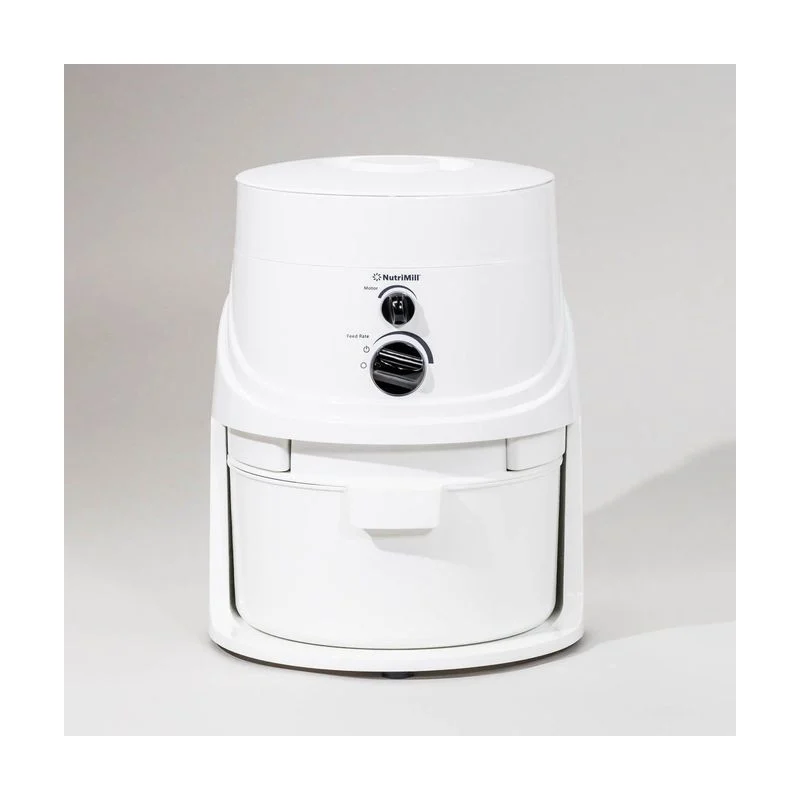
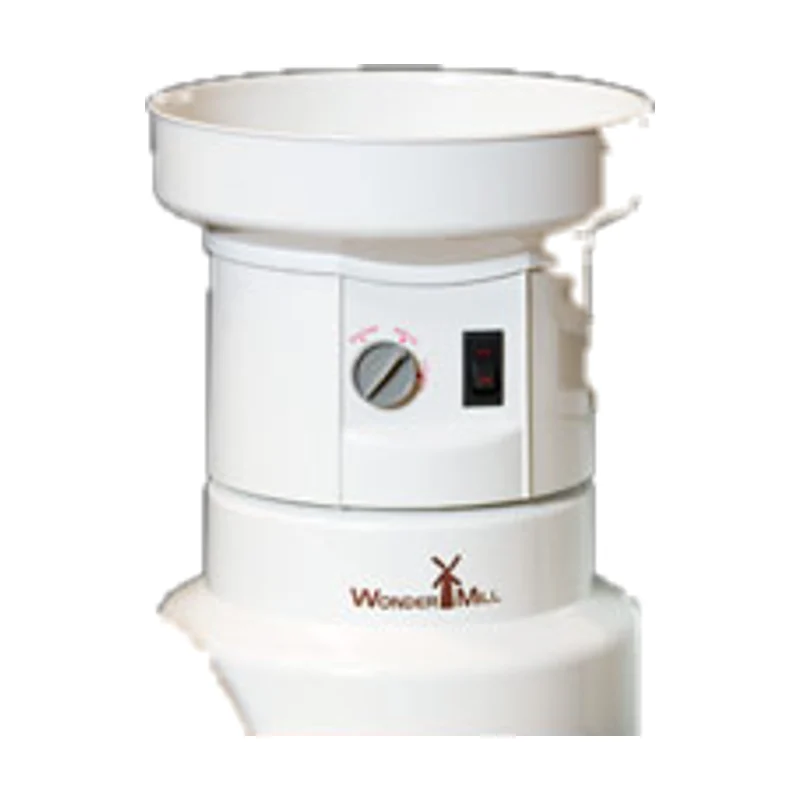
Both machines mill by impact, meaning a chamber in which rotating steel heads shatter the grain, rather than by stone, meaning a burr grinding surface that reduces grain between two abrasive faces. Where the manuals give a reason for a restriction at all, it is feeding and plugging rather than grinding force. The NutriMill manual states the general rule as “Avoid grains and beans that have high oil or moisture content. Non-commercially dried products may cause plugging.” The WonderMill manual states its equivalent in capitals, “NEVER MILL GRAINS THAT HAVE A HIGH OIL OR MOISTURE CONTENT.”, and gives no mechanism at all.
Neither list is advisory. The WonderMill manual ties ingredient scope directly to the warranty: “If you have any questions about whether or not this mill will grind a particular product please call WonderMill before proceeding to ensure that you do not void your warranty.” The NutriMill manual prints “HOUSEHOLD USE ONLY” as a standalone heading under its technical block, and its warranty terms exclude commercial use, neglect and foreign-object damage. Ingredient choice on both machines sits inside those terms rather than outside them.
The operating sequence these lists sit inside, from hopper fill through texture setting to emptying the flour container, is covered at How to mill your own flour. This page covers only what may go into the hopper in the first place.
| Mill | Items named permitted | Items named prohibited | Middle caution tier | Published route for an unlisted ingredient | Read from |
|---|---|---|---|---|---|
| NutriMill Classic | 31 | 17 on the DO NOT MILL page | Yes - 13 items under USE CAUTION, hopper filled no more than ⅔ to ¾ | Mill ¼ cup, then pinch the flour and stop if it holds its shape | Owner manual (PDF) |
| WonderMill | 18 | 9 under NEVER MILL THE FOLLOWING | None published | Call WonderMill before proceeding, so as not to void the warranty | Owner manual (PDF) |
The counts are of named items only, taken from the page each column names. Above each list both manuals add a categorical rule on oil and moisture that reaches further than the names, and neither manufacturer states an oil percentage, a moisture percentage or a threshold at which that rule bites.
The 31 items the NutriMill Classic manual permits
The NutriMill Classic owner manual permits 31 named items. The list spans gluten grains, gluten-free grains, pseudocereals, three rices and a long run of dried legumes and beans, and it is specific about form where form matters: it names Oat Groats rather than oats generally, and Bulgur Wheat as an entry of its own.
Six of those 31 items reappear on the manual’s own middle tier, headed “USE CAUTION WHEN MILLING THE FOLLOWING”: Barley, Quinoa, Soybeans, Oat Groats, Kamut and Spelt. The manual does not acknowledge the double listing anywhere. Read literally, those six are permitted with a hopper-fill restriction attached, and that restriction is set out further down this page.
Two corns appear on the manual’s list, Blue Corn and Popcorn, and no sweet corn. The manual’s list also does not name Triticale, Emmer, Einkorn or Pinto Beans, all of which appear on the version of the same list published on the NutriMill product page. That divergence is the manufacturer’s, not a gap in the reading, and it has its own section below.
- Hard Wheat
- Soft Wheat
- Spelt
- Kamut
- Barley
- Farro
- Rye
- Bulgur Wheat
- Teff
- Kañiwa
- Blue Corn
- Popcorn
- Oat Groats (whole oat groats)
- White Rice
- Brown Rice
- Wild Rice
- Sorghum
- Millet
- Buckwheat
- Quinoa
- Amaranth
- Lentils
- Chickpeas (Garbanzo Beans)
- Lima Beans
- Soybeans
- Anasazi Beans
- Mung Beans
- Black Beans
- Kidney Beans
- Navy Beans
- Split Peas
The 18 items the WonderMill manual permits
The WonderMill owner manual permits 18 named items under a heading that does the categorical work the list itself does not: “most dry grains, and from most dry, non-oily legumes and lentils”. The list is shorter than NutriMill’s and less specific about form. It names Rice where NutriMill names three rices, and it names Oats without naming a form at all.
Lentils are the odd case on this list. The heading admits lentils as a category, yet no lentil entry appears in the table beneath it. The NutriMill manual, by contrast, names Lentils as a permitted item and Dried Lentils again on its caution tier. A reader who wants a documented lentil permission has a table entry on the NutriMill Classic and only a heading on the WonderMill.
The WonderMill product page states a wider scope than the manual it ships with: “The WonderMill will not only grind wheat, corn, rice, and other small grains like Quinoa and Amaranth, but it will also grind legumes and beans.” Quinoa and amaranth are absent from the manual’s permitted table. The manual’s own introduction also invites milling barley, which is likewise absent from the table that introduction precedes.
- Wheat (hard and soft)
- Spelt
- Oats
- Kamut
- Rice
- Rye
- Triticale
- Millet
- Dried Pinto Beans
- Sorghum (Milo)
- Dried Green Beans
- Dried Mung Beans
- Popcorn (unpopped)
- Soybeans
- Split Peas
- Dried Field Corn
- Buckwheat
- Chick Peas
Nuts and oily seeds are excluded by name on both the NutriMill Classic and the WonderMill
What this section establishes
- Five oily items are prohibited by name in both owner manuals: sesame seeds, sunflower seeds, flax seed, nuts and coffee beans.
- Soybeans are the exception both manuals permit despite their own high-oil rule, and the NutriMill Classic manual lists soybeans a second time on its caution tier, where the stated reason is flour volume rather than oil.
- The exclusions are not symmetric: the NutriMill Classic manual names chocolate, chia seeds, hemp and goji beans, none of which appear on any WonderMill document, and WonderMill names peanuts where NutriMill names only the class “Nuts”.
Oil content is the one restriction both manufacturers state in the same direction. The NutriMill Classic manual excludes Sesame Seeds, Flax Seeds, Sunflower Seeds, Chia Seeds, Hemp, Nuts, Chocolate, Coffee Beans and Goji Beans by name on its DO NOT MILL page. The WonderMill manual excludes Sesame Seeds, Sunflower Seeds, Flax Seed, Nuts (all types), Peanuts and Coffee Beans by name under NEVER MILL THE FOLLOWING. Five entries are common to both prohibited lists: sesame seeds, sunflower seeds, flax seed, nuts and coffee beans.
Above the named items, each manual states a categorical rule that reaches further than the names. NutriMill states “Avoid grains and beans that have high oil or moisture content. Non-commercially dried products may cause plugging.” The NutriMill Quick Start Guide compresses the same rule to “DO NOT MILL SEEDS, NUTS, SUGARS, OR SPICES” followed by “Be cautious milling any grains with high oil or moisture content.” WonderMill states “NEVER MILL GRAINS THAT HAVE A HIGH OIL OR MOISTURE CONTENT.” Neither manufacturer publishes an oil percentage, a threshold, or any test for oil content, so the categorical rule is left for the reader to apply by judgment.
Soybeans break the pattern on both machines. Both manuals permit soybeans outright, and NutriMill lists them a second time on its caution tier, where the stated reason is flour volume rather than oil: “Fill the hopper no more than ⅔ to ¾ with these as they produce more flour volume.” Neither manual explains how a permitted soybean and a prohibited sunflower seed sit under the same high-oil rule. Both facts are reported here and neither is reconciled, because the manufacturers do not reconcile them.
The exclusions are also not symmetric across categories the two companies name differently. NutriMill excludes “Dried Fruit or Vegetables” and so reaches dried vegetables; WonderMill excludes “Dried Fruits (including dates and raisins)” and says nothing about vegetables. NutriMill excludes Chocolate, Chia Seeds and Hemp; the WonderMill manual names none of the three. Silence on the WonderMill side is not a permission. Its general oil rule may or may not reach those items, and its documentation does not say which.
What the NutriMill Classic and WonderMill manuals agree on: 13 permitted names, 8 prohibitions, household use only
What this section establishes
- 13 permitted names line up across the two owner manuals once naming differences are set aside - wheat, spelt, kamut, rye, rice, millet, sorghum, buckwheat, popcorn, soybeans, split peas, chickpeas and mung beans - a count taken by reading one permitted list against the other, not a figure either manufacturer publishes.
- The prohibited lists share 8 names, again counted across the two documents: sugar, sesame seeds, sunflower seeds, flax seed, nuts, coffee beans, dried fruit and tapioca.
- Both machines are bounded by the same rating - HOUSEHOLD USE ONLY - and neither manufacturer publishes a separate commercial ingredient scope.
Thirteen permitted names line up across the two manuals once naming differences are set aside. This is the part of the category where the choice of machine does not change the answer, and it covers most of what a home baker mills.
The prohibited lists agree on eight names: Sugar, Sesame Seeds, Sunflower Seeds, Flax Seed, Nuts, Coffee Beans, Dried Fruit and Tapioca. Both manufacturers additionally exclude wet material as a category rather than as an item. NutriMill states it in the safety instructions, “Do not mill damp, wet or oily grains.” WonderMill states it as a standalone warning, “DO NOT ATTEMPT TO MILL WET OR DAMP PRODUCTS.” Same instruction, different page of the same kind of document.
Both machines are rated for domestic use only, and that rating bounds both ingredient lists. The NutriMill manual prints “HOUSEHOLD USE ONLY” beneath its technical block. The WonderMill manual prints the same phrase and restricts its warranty to “the original, noncommercial owner”. Neither manufacturer extends its permitted list to a commercial setting, and neither publishes a separate commercial scope.
The shared core answers most home baking: bread wheat, spelt, kamut, rye, rice, millet, sorghum, buckwheat, corn in the form of popcorn, and the dry beans and peas both lists name are documented on both machines. The disagreements start at the edges, on oats, pseudocereals, spices and sprouted grain, and those edges are where a choice between the two actually turns. The full head-to-head on specification and warranty sits at NutriMill Classic vs WonderMill.
- Wheat: NutriMill names Hard Wheat and Soft Wheat; WonderMill names Wheat (hard and soft).
- Spelt: named on both permitted lists, and carried again on NutriMill’s caution tier.
- Kamut: named on both permitted lists, and carried again on NutriMill’s caution tier.
- Rye: named on both, with no qualifier on either.
- Millet: named on both, with no qualifier on either.
- Sorghum: NutriMill names Sorghum; WonderMill names Sorghum (Milo).
- Buckwheat: named on both, with no qualifier on either.
- Popcorn: NutriMill names Popcorn; WonderMill names Popcorn (unpopped).
- Rice: NutriMill names White Rice, Brown Rice and Wild Rice; WonderMill names Rice.
- Soybeans: named on both, and carried again on NutriMill’s caution tier.
- Split Peas: named on both, with no qualifier on either.
- Chickpeas: NutriMill names Chickpeas (Garbanzo Beans); WonderMill names Chick Peas.
- Mung beans: NutriMill names Mung Beans; WonderMill names Dried Mung Beans.
Oats, quinoa and amaranth: where the NutriMill and WonderMill lists diverge
What this section establishes
- The NutriMill Classic manual permits Oat Groats and prohibits rolled oats and steel cut oats as two separate entries, with a stated feeding reason: “rolled oats will NOT feed into the NutriMill® Classic”.
- Quinoa, Amaranth, Teff and Kañiwa are permitted entries in the NutriMill Classic manual and appear nowhere in the WonderMill manual’s permitted table; quinoa and amaranth appear only on the WonderMill product page.
- The NutriMill manual list names 15 items that appear on no WonderMill list, and the WonderMill list names 4 that appear on no NutriMill manual permitted list; both counts come from setting the two permitted lists against each other on this page, and neither manufacturer publishes either figure.
Oats are the clearest place where one manufacturer’s restriction cannot be carried across to the other. The NutriMill Classic manual permits Oat Groats, meaning whole groats, and its DO NOT MILL list names Oatmeal (Rolled Oats) and Steel Cut Oats as two separate exclusions. The manual adds a stated reason and repeats the instruction: “NOTE: rolled oats will NOT feed into the NutriMill® Classic. Do not mill steel cut oats or rolled oats”. The WonderMill manual permits “Oats” with no form qualifier and names no oat product anywhere on its prohibited list. The WonderMill documentation does not state which oat forms it means, so neither a permission for rolled oats nor a prohibition on them can honestly be read out of it.
Pseudocereals sit almost entirely on the NutriMill side. Quinoa, Amaranth, Teff and Kañiwa are all named permitted items in the NutriMill manual, with Quinoa carried again on the caution tier. The WonderMill manual’s permitted table names none of the four, while its product page states that the mill grinds “other small grains like Quinoa and Amaranth”. A buyer choosing on quinoa alone is choosing between a manual entry on one machine and a marketing sentence on the other.
Spices, Herbs, Chocolate, Chia Seeds, Hemp and Goji Beans appear on NutriMill’s prohibited list and on no WonderMill document. Peanuts run the other way: WonderMill names Peanuts as a distinct prohibited entry where NutriMill names only the class “Nuts”. Neither absence is a permission on the machine that is silent, and neither list should be treated as complete for the other manufacturer.
Gluten-free scope is published as a group in only one place. The WonderMill product page states the list “brown rice, white rice, sorghum, quinoa, soy, millet, amaranth, bean, corn, chickpeas/garbanzos”, two entries of which, quinoa and amaranth, are absent from the manual’s own permitted table. NutriMill publishes no equivalent labeled group. Its manual simply permits White Rice, Brown Rice, Wild Rice, Sorghum, Millet, Buckwheat, Quinoa, Amaranth and Teff as individual entries.
Items named on the NutriMill manual list and on no WonderMill list: Barley, Farro, Bulgur Wheat, Teff, Kañiwa, Blue Corn, Wild Rice, Quinoa, Amaranth, Lentils, Lima Beans, Anasazi Beans, Black Beans, Kidney Beans and Navy Beans. Items named on the WonderMill list and on no NutriMill manual permitted list: Triticale, Dried Field Corn, Dried Pinto Beans and Dried Green Beans. Two of those four are close: NutriMill’s product-page list adds Triticale and Pinto Beans, and its caution tier names Dried Pinto Beans, Dried Green Beans and Dried Sweet Corn.
Sprouted grain, moisture, and the pinch test
The sprouted-grain entry is conditional, and the condition is the entire entry. NutriMill’s prohibited list reads “Sprouted Grains or Beans (if not thoroughly dried)”. Sprouted grain as such is not excluded by the NutriMill Classic manual; sprouted grain that has not been thoroughly dried is. The manual does not define thoroughly dried, does not state a moisture percentage, and does not name a drying method or duration.
The WonderMill manual names sprouted grain nowhere, in either direction. It states two categorical warnings, “NEVER MILL GRAINS THAT HAVE A HIGH OIL OR MOISTURE CONTENT.” and “DO NOT ATTEMPT TO MILL WET OR DAMP PRODUCTS.”, and leaves sprouted grain to be judged under them. Carrying NutriMill’s conditional permission onto a WonderMill is precisely the generalization the two documents do not support, and this page does not make it.
NutriMill publishes the only bench test either manufacturer states for an unlisted grain: “For any grains not listed above, mill only ¼ cup, then test the flour by pinching a small amount between your thumb and finger. If it holds the shape of a pinch and does not fall apart, it contains too much moisture. Do not mill this grain.” The test is qualitative, it costs a quarter cup of grain, and by its own wording it applies to grains not on the permitted list rather than to items already named as prohibited.
Drying source matters to NutriMill as a separate point from moisture level. The manual states “Non-commercially dried products may cause plugging.” Home-dried material is not excluded by that sentence, but the manufacturer attributes plugging risk to it specifically, which is a narrower and more useful statement than a blanket moisture warning.
The WonderMill manual approaches contamination from a different angle again. It recommends triple-cleaned grain and states that foreign-object damage from plastics, metals or rocks is not covered by the warranty. That is a restriction on what arrives alongside the grain rather than on the grain itself, and the NutriMill documents make no equivalent statement about grain cleanliness.
For any grains not listed above, mill only ¼ cup, then test the flour by pinching a small amount between your thumb and finger. If it holds the shape of a pinch and does not fall apart, it contains too much moisture. Do not mill this grain.
Beans and large seeds: NutriMill's hopper-fill limit against WonderMill's coarse setting
What this section establishes
- The NutriMill Classic manual restricts 13 items to a hopper filled no more than ⅔ to ¾, on the stated ground that they “produce more flour volume”.
- The WonderMill manual restricts the same class of ingredient by control setting instead: “For large grains and beans ALWAYS make sure that your texture knob is set to the coarse setting in the 3 o’clock position.”
- WonderMill sells a Small Grains Attachment separately for very small grains and large beans; the NutriMill Classic documentation names no equivalent accessory at either size extreme.
Beans are permitted on both machines and restricted on both, by two different mechanisms. NutriMill’s restriction is volumetric. Its middle tier states “Fill the hopper no more than ⅔ to ¾ with these as they produce more flour volume”, and names thirteen items, most of them legumes and large seeds.
That rule bites against a hopper capacity the manufacturer states two ways. The NutriMill product page states a 12-cup grain hopper capacity; the owner manual’s technical block states “Hopper Capacity: 13 cups”. Two thirds of 12 cups and two thirds of 13 cups are materially different working limits, and no NutriMill document reconciles the two figures. Flour container capacity is published inconsistently on the same machine: 20 cups on the product page and in the manual’s parts diagram, against “The bowl holds 21 to 22 cups of flour” in the manual’s grain-to-flour ratio section.
WonderMill’s restriction is a control setting rather than a fill level. Its manual states “For large grains and beans ALWAYS make sure that your texture knob is set to the coarse setting in the 3 o’clock position.” The same section requires a return to the bread band afterward: “Make sure that when you are done milling a fine flour that you return the texture knob to the 1 -3 o’clock position”. Flour container capacity is stated as 12 cups, with the manual’s own yield line attached: “approximately 8 cups of grain in the hopper produces about 12 cups of flour. THE CANISTER CAPACITY IS 12 CUPS OF FLOUR!”
The WonderMill’s scope at the small end is partly conditional on an accessory. The manufacturer sells a Small Grains Attachment separately, and the authorized dealer Pleasant Hill Grain states “Without this attachment, extra-small grains and large beans can clog the milling heads”. No equivalent accessory appears in NutriMill’s documentation. NutriMill’s published answer at both size extremes is the caution tier and the fill limit, not a part. The full published specification for the WonderMill, including its dimensions and warranty terms, is set out at WonderMill Electric Grain Mill.
- Dried Lentils
- Legumes (generally)
- Dried Sweet Corn
- Dried Garbanzo Beans
- Barley
- Dried Pinto Beans
- Quinoa
- Soybeans
- Dried Green Beans
- Oat Groats
- Kamut
- Dried Mung Beans
- Spelt
Where the NutriMill and WonderMill documents contradict themselves
The NutriMill Classic has two different permitted lists published by the same manufacturer. The owner manual’s list runs to 31 items. The product page’s version of the same list adds Triticale, Emmer, Einkorn, Dried Sweet Corn and Pinto Beans, and omits Bulgur Wheat, Kañiwa, Blue Corn, Popcorn, Wild Rice, Anasazi Beans and Kidney Beans. Five additions and seven omissions on one machine, and neither document acknowledges the existence of the other.
The same manual permits and cautions six items at once. Barley, Quinoa, Soybeans, Oat Groats, Kamut and Spelt appear on the permitted page and on the USE CAUTION page. The consistent reading is permitted with a fill restriction attached, and that is how this page treats them, but the manual never states the relationship between its own two tiers.
Two NutriMill restrictions are commonly republished as prohibitions and do not appear on the prohibited page. “Do not mill damp, wet or oily grains.” is a safety instruction: the same imperative force, a different page, and worth citing accurately. Re-milling is weaker still. The manual states “CAUTION: WE DO NOT RECOMMEND MILLING FLOUR THAT HAS ALREADY BEEN MILLED. THIS MAY CAUSE PROBLEMS IN YOUR MILLING UNIT.” A recommendation against, qualified by a stated may, is not a prohibition, and publishing it as one puts an absolute in the manufacturer’s mouth that the manufacturer never wrote.
WonderMill’s manual contradicts its own introduction and its own product page. The introduction invites milling barley, and barley is not in the permitted table that follows it. The product page states quinoa and amaranth, and the manual’s table names neither. The gluten-free list on the product page names quinoa and amaranth a second time. Where the two disagree, the manual is the document the warranty language points at, and the manual is the narrower of the two.
Neither of these is a small-print curiosity. A reader who buys against a product-page list and then mills against a manual-page warranty is exposed to the gap between the two documents, and that gap belongs to the manufacturer. The honest position is to name both figures and both lists, cite both sources, and let the reader decide which document they want to be holding if something plugs.
An ingredient on neither list: NutriMill's pinch test, WonderMill's phone call
The two manufacturers answer the same question with two different procedures. WonderMill refers the decision back to itself and names the stake: “If you have any questions about whether or not this mill will grind a particular product please call WonderMill before proceeding to ensure that you do not void your warranty.” There is no published test, no threshold, and no list of borderline cases. The published route is a phone call.
NutriMill publishes a test instead of a phone number. Mill a quarter cup, pinch the resulting flour, and stop if it holds its shape. The instruction is scoped by its own wording to “any grains not listed above”, which means it settles nothing about seeds, nuts, spices or sugars, all of which are already named on the prohibited page and are excluded regardless of how they behave in a pinch.
Both procedures leave the same blank. Neither manufacturer publishes a numeric oil threshold, a moisture percentage, a hardness limit, a maximum seed diameter, or a mesh or micron figure for either machine. The NutriMill manual states its range qualitatively as “Flour Fineness: Adjustable - Fine to Medium Coarse”, and no micron, mesh or particle-size figure appears on any WonderMill source fetched. Ingredient scope on both machines is a named list plus two categorical rules, and nothing more precise than that has been published.
The practical consequence is narrow and worth stating plainly. An ingredient named on neither list has no documented answer on that machine. The published routes are the manufacturers’ own, WonderMill’s call before proceeding and NutriMill’s quarter-cup pinch test, and any other answer is inference rather than evidence.
If you have any questions about whether or not this mill will grind a particular product please call WonderMill before proceeding to ensure that you do not void your warranty.
What the NutriMill and WonderMill documents leave unsettled
Nothing on this page rests on physical testing. Every permission and every exclusion here is a document published by a manufacturer or by an authorized dealer, read against the source and re-verified against it. No mill was operated, no ingredient was milled, and no flour was measured, so no sentence here should be read as an observation.
The evidence covers two impact mills and nothing beyond them. Both machines shatter grain in a chamber; neither is a stone mill. A restriction printed in the NutriMill Classic manual is evidence about the NutriMill Classic. It is not evidence about the WonderMill, about any other impact mill, or about a stone burr mill from any manufacturer, and this page never carries one company’s list onto another company’s machine.
No threshold is published on either side. Neither manufacturer states the oil percentage at which a seed becomes prohibited, the moisture percentage the pinch test is standing in for, or the particle size either machine produces at any control setting. NutriMill states “Fine to Medium Coarse” as its stated range. The WonderMill’s texture positions are given as clock-face settings with no micron equivalent published anywhere.
Consequences are stated only in the vaguest terms. NutriMill attributes the risk to plugging; the WonderMill’s authorized dealer attributes it to clogged milling heads. Neither manufacturer states what a single prohibited item does to the machine, whether the resulting damage is recoverable, or whether milling a listed-prohibited item voids the warranty by itself. WonderMill’s instruction to call before proceeding is the closest either company comes to answering that question, and it answers it by declining to.
Two NutriMill permitted lists cannot both be complete, and no published document says which one the manufacturer intends to govern. Where a reader needs certainty about one specific ingredient on one specific machine, the published route is the manufacturer’s own service contact, and this page can only show what each document actually says.
Can either mill grind nuts, peanuts or oily seeds?
Neither manufacturer permits them, and both say so in their own documents. The NutriMill Classic manual excludes Nuts, Sesame Seeds, Sunflower Seeds, Flax Seeds, Chia Seeds and Hemp on its DO NOT MILL page, and the Quick Start Guide compresses the rule to “DO NOT MILL SEEDS, NUTS, SUGARS, OR SPICES”. The WonderMill manual excludes “Nuts (all types)”, Peanuts, Sesame Seeds, Sunflower Seeds and Flax Seed under NEVER MILL THE FOLLOWING, above the standalone warning “NEVER MILL GRAINS THAT HAVE A HIGH OIL OR MOISTURE CONTENT.”
Neither manufacturer documents a nut-butter or seed-paste function, and neither publishes an oil percentage that would let a reader judge a seed that is not on the list. Coffee beans are excluded by name on both machines. Soybeans are the one high-oil item both manuals permit, and neither manual explains the exception.
Can you mill sprouted grain?
On the NutriMill Classic, the manual’s own wording permits it once it is dry. The prohibited entry carries its condition inside it: “Sprouted Grains or Beans (if not thoroughly dried)”. Thoroughly dried sprouted grain therefore sits outside the exclusion as written. The manual publishes no definition of thoroughly dried and no moisture figure, and its quarter-cup pinch test is the nearest published check a reader can run.
On the WonderMill, the manual names sprouted grain nowhere. It states only “DO NOT ATTEMPT TO MILL WET OR DAMP PRODUCTS.” and the high-moisture warning, and the manufacturer’s published instruction for a product it has not addressed is to call the company before milling so as not to void the warranty. The NutriMill condition should not be read across to it.
Can either mill produce gluten-free flour?
Both manuals permit gluten-free grains, but only WonderMill publishes them as a labeled group. The WonderMill product page states the list “brown rice, white rice, sorghum, quinoa, soy, millet, amaranth, bean, corn, chickpeas/garbanzos”, two entries of which, quinoa and amaranth, are absent from the manual’s own permitted table. The NutriMill Classic manual permits White Rice, Brown Rice, Wild Rice, Sorghum, Millet, Buckwheat, Quinoa, Amaranth and Teff as individual entries, without grouping them under any gluten heading of its own.
On carryover between batches, the only published statement of the two is WonderMill’s self-cleaning step: “After the hopper is empty allow the mill to run for approximately five seconds. This creates a self-cleaning action in the grinding chamber.” The manual states that as a general operating step, not as a gluten measure, and neither manufacturer publishes a residue figure of any kind.
Can you mill rolled oats or steel-cut oats?
The NutriMill Classic permits whole Oat Groats and excludes both rolled and steel-cut oats, with a stated feeding reason: “NOTE: rolled oats will NOT feed into the NutriMill® Classic. Do not mill steel cut oats or rolled oats”. Oat Groats also carry the caution-tier restriction, so the manual asks for a hopper filled no more than two thirds to three quarters when milling them.
The WonderMill manual permits “Oats” and states no form, and names no oat product on its prohibited list. That silence is a gap rather than a documented permission for rolled oats, and WonderMill’s own published route for an ingredient its manual has not addressed is to call before proceeding. The NutriMill feeding restriction is specific to the NutriMill Classic and is not evidence about the WonderMill.
Does the WonderMill need its small grains attachment?
The manufacturer sells a Small Grains Attachment separately for very small grains and large beans, and the authorized dealer Pleasant Hill Grain states “Without this attachment, extra-small grains and large beans can clog the milling heads”. No source fetched names a seed diameter, a grain, or a bean size at which the attachment becomes necessary, so the threshold is undocumented and the accessory decision cannot be made from published figures alone.
The NutriMill Classic has no equivalent accessory in its documentation. Its published handling for both extremes is the USE CAUTION tier and the instruction to fill the hopper no more than two thirds to three quarters with the thirteen items listed there. That is a different design answer to the same problem, and it costs nothing extra to apply.
Both mills' published specifications, side by side
| Attribute | NutriMill Classic | WonderMill |
|---|---|---|
| Milling mechanism Wording differs | High-speed impact chamber with stainless steel Microburst milling heads nutrimill.com product page | Impact; two fin-studded stainless steel plates, one rotating pleasanthillgrain.com product page |
| Motor Figures differ | 1200 W, 10 amps Owner manual (PDF) | 1250 W LG Electronics motor (manufacturer states) thewondermill.com product page |
| Hopper capacity Figures differ | 12 cups (owner manual states 13 cups) — the manufacturer’s own documents disagree on this figure. nutrimill.com product page | 8 cups (wheat) pleasanthillgrain.com product page |
| Flour container capacity Figures differ | 20 cups (owner manual's grain-to-flour section states the bowl holds 21 to 22 cups) — the manufacturer’s own documents disagree on this figure. nutrimill.com product page | 12 cups of flour Owner manual (PDF) |
| Dimensions Figures differ | 12 in W x 12 in D x 13 in H nutrimill.com product page | 16.3 in wide x 8.5 in deep x 12 in high pleasanthillgrain.com product page |
| Weight Figures differ | 14 lbs Owner manual (PDF) | 7.05 lb (a second authorized dealer prints 7-1/4 lb) pleasanthillgrain.com product page |
| Texture adjustment Figures differ | Two knobs: variable motor speed and variable grain feed rate Owner manual (PDF) | Single knob by clock position: 11 to 12 o'clock fine, 1 to 3 o'clock bread, 3 o'clock coarse Owner manual (PDF) |
| Flour fineness | Adjustable, fine to medium coarse Owner manual (PDF) | —No row for this attribute appears in the documents read for this mill. |
| Housing Wording differs | ABS plastic Owner manual (PDF) | ABS; BPA-free plastic pleasanthillgrain.com product page |
| Warranty Figures differ | 5 years parts and plastics; limited lifetime on motor and milling heads; original noncommercial purchaser only Owner manual (PDF) | Lifetime on milling heads to the original owner; six years on all other parts Owner manual (PDF) |
| Intended use | Household use only Owner manual (PDF) | —No row for this attribute appears in the documents read for this mill. |
| Milling rate | —No row for this attribute appears in the documents read for this mill. | 24 oz/min at the bread-flour setting unsifted.com product page |
| Grinding burr diameter | —No row for this attribute appears in the documents read for this mill. | 3.5 in pleasanthillgrain.com product page |
| Country of manufacture | —No row for this attribute appears in the documents read for this mill. | South Korea (dealer spec table; the manufacturer does not state it) pleasanthillgrain.com product page |
The documents this page was read from
- NutriMill Classic Full User Manual (PDF, manufacturer-hosted)
- NutriMill Classic Quick Start Guide (PDF, manufacturer-hosted)
- NutriMill Classic Grain Mill product page (manufacturer)
- WonderMill owner manual (PDF, manufacturer-hosted)
- WonderMill Electric Grain Mill product page (manufacturer)
- Pleasant Hill Grain WonderMill specification table (manufacturer-listed authorized dealer)
Decide between two of these mills
This guide works from published documents rather than choosing for you. Each comparison below settles one named pair on the rows both makers print.
- Impact vs stone burr grain millsThe NutriMill Classic's impact chamber and the Mockmill 100's ceramic stones, compared on what each mechanism permits, adjusts, excludes and requires.
- NutriMill Classic vs WonderMillBoth mills shatter grain by impact, so the mechanism decides nothing. Ingredient scope, texture control, container capacity and documentation quality do.
- NutriMill Classic vs NutriMill HarvestNutriMill Classic vs Harvest: the Classic's 12- or 13-cup hopper and 20-cup bowl (21 to 22 in its manual) against the Harvest's 5-cup hopper and spout.
Where to buy the mills this guide works from, and the documents behind these figures
Prices and availability are on the seller’s site. Amazon links are affiliate links; we may earn a commission at no extra cost to you. Other seller links are unpaid.
- Publication
- By Millwright
- Source
- Manufacturer documentation
- Updated