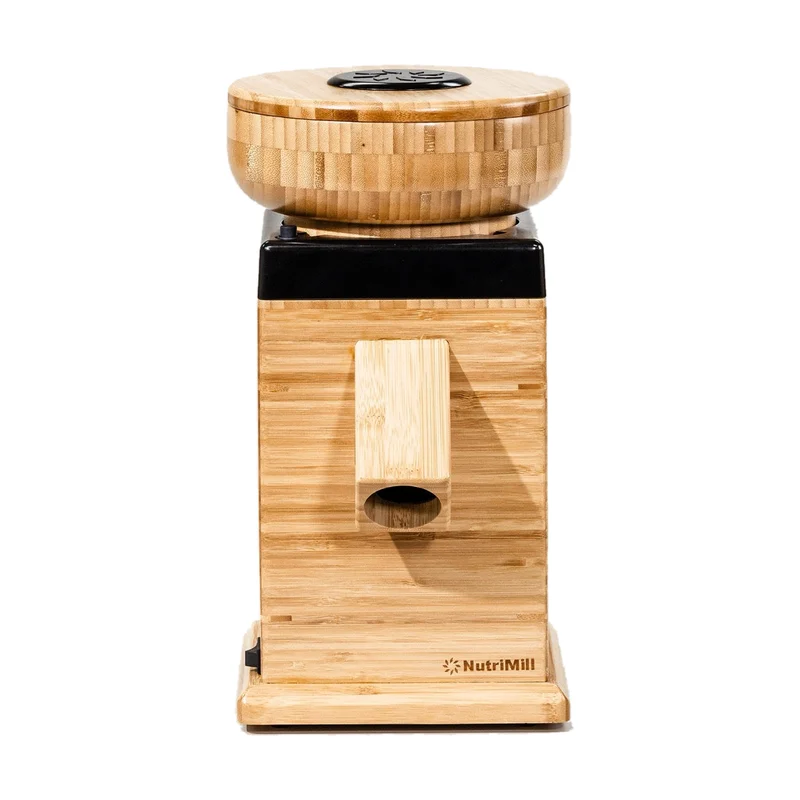
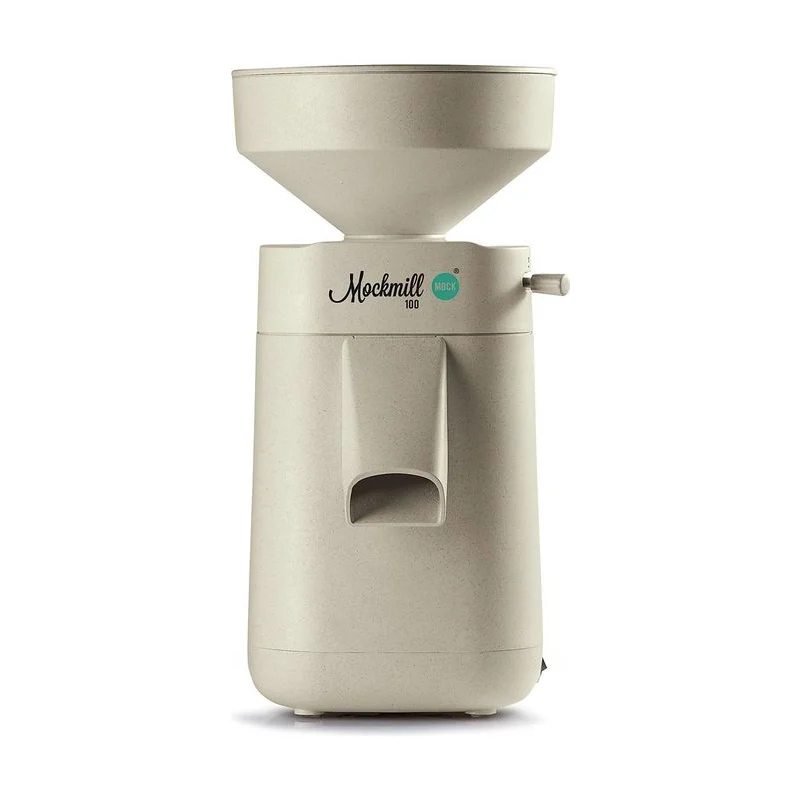
Every specification, side by side
| Attribute | NutriMill Harvest | Mockmill 100 |
|---|---|---|
| Milling mechanism Wording differs | Corundum stone burrs, upper and lower nutrimill.com product page | Corundum ceramic grinding stones mockmill.us product page |
| Motor Figures differ | 450 watts nutrimill.com product page | 360 W mockmill.us product page |
| Hopper capacity Figures differ | 5 cups nutrimill.com product page | 1,100 g | 2 lbs 7 oz (wheat) mockmill.us product page |
| Flour container capacity | None included; flour leaves through a continuous spout into a bowl the owner supplies nutrimill.com product page | No container supplied; stated contents are the mill with hopper cover and the owner's manual mockmill.us product page |
| Texture adjustment Wording differs | Patented texture control knob; coarse, medium or fine nutrimill.com product page | Stepless, variable from very fine to coarse mockmill.us product page |
| Dimensions Figures differ | h13" x w6" x d9" as printed in the product-page specification list; two other figures are published, see the documentation conflicts section nutrimill.com product page | 380 x 220 x 190 mm | 15 x 8.7 x 7.5 in mockmill.us product page |
| Weight Figures differ | 16 lbs nutrimill.com product page | 6 kg | 13 lbs 3.5 oz mockmill.us product page |
| Housing Figures differ | Bamboo nutrimill.com product page | Terluran GP-35 mockmill.us product page |
| Thermal protection | Auto-shutoff thermal protection nutrimill.com product page | —No row for this attribute appears in the documents read for this mill. |
| Safety certification | Tested and listed by CSA; stated to meet all US safety standards nutrimill.com product page | —No row for this attribute appears in the documents read for this mill. |
| Warranty Figures differ | 5 years against manufacturing defects in materials and workmanship nutrimill.com product page | 6 years, non-commercial use mockmill.us product page |
| Country of manufacture Wording differs | Designed and assembled in the USA nutrimill.com product page | Germany mockmill.us product page |
| Voltage | —No row for this attribute appears in the documents read for this mill. | 110 V (US listing) mockmill.us product page |
| Milling speed | —No row for this attribute appears in the documents read for this mill. | Approx. 1,100 RPM (owner manual states approx. 1,300 rpm at 110 V, 60 Hz) — the manufacturer’s own documents disagree on this figure. mockmill.us product page |
| Milling rate | —No row for this attribute appears in the documents read for this mill. | Approx. 100 g/min | approx. 3.5 oz/min (soft wheat) mockmill.us product page |

The three rates a maker will print

NutriMill vs Mockmill: two stone mills, so the mechanism decides nothing
What this section establishes
- The NutriMill Harvest and the Mockmill 100 are both corundum stone mills, so the mechanism separates nothing; the published differences are the texture control, the hopper figure, the housing material, the warranty term and the depth of each manufacturer’s own documentation.
- Wolfgang Mock GmbH publishes voltage, rotation speed, protection class, cable length and a milling rate of approximately 100 g of wheat per minute for the Mockmill 100. NutriMill publishes none of those for the Harvest.
- NutriMill states a 450-watt motor and a 5-cup hopper for the Harvest; Mockmill states 360 W and a 1,100 g hopper with wheat for the Mockmill 100, and the two hopper figures do not convert without a bulk density neither manufacturer publishes.
The NutriMill Harvest and the Mockmill 100 are both stone mills, meaning grain is reduced in the gap between two grinding surfaces rather than shattered against spinning heads inside a chamber, which is what an impact mill does. NutriMill’s user guide describes the Harvest’s action directly: “Grains flow down through the center of the milling unit,” and “The grain is pressed through the stones creating flour.” Wolfgang Mock GmbH titles the Mockmill 100 operating instructions “Stone mill for milling grains, pulses and spices.” Neither brand disputes what the other one is.
That shared mechanism removes the usual first question from this comparison. A buyer choosing between an impact mill and a stone mill is choosing between two different physical processes with different ingredient rules and different adjustment logic, and that decision is set out separately at Impact vs stone burr grain mills. A buyer choosing between the Harvest and the Mockmill 100 has already made it. What remains are five narrower questions: what the stones are made of, how the gap between them is set, how much grain the hopper holds, what the body is made of, and how thoroughly each manufacturer documents its own machine.
The last of those five turns out to carry more weight than it should. Wolfgang Mock GmbH publishes voltage, rotation speed, protection class, cable length, a milling rate in grams per minute, and an ingredient table naming more than forty foods with a numeric lever setting against each entry. NutriMill publishes none of those for the Harvest.
| Attribute | NutriMill Harvest | Mockmill 100 | Where each figure is stated |
|---|---|---|---|
| Milling mechanism | Corundum stones, listed as “Near Diamond Hard Corundum Grainmaster Milling Stones” | Corundum ceramic grinding stones | Harvest product page; Mockmill 100 US listing and operating instructions |
| Texture adjustment | Patented Texture Control Knob, unnumbered; clockwise tightens the stones for finer flour | Screw-in lever on a numbered 1–10 scale; the manual states position 1 is the finest setting | Harvest product page and user guide; Mockmill operating instructions |
| Hopper capacity | 5 cups, with no grain named | 1,100 g, or 2 lbs 7 oz, with wheat; 2.4 lbs on Mockmill’s own model comparison page | Harvest technical illustration; Mockmill US listing, manufacturer’s shop, operating instructions and model comparison page |
| Flour container | None included; the user guide’s second milling step reads “Place bowl under flour spout” | None included; the manual’s getting-started step is to place a bowl beneath the chute | Harvest product page and user guide; Mockmill US listing and operating instructions |
| What is in the box | Mill, corundum milling stones, removable hopper, lid, cleaning brush | Mill with its hopper cover, called a cone-lid on the manufacturer’s shop, plus the instruction manual | Harvest product page; Mockmill US listing and manufacturer’s shop |
| Motor rating | 450 watts | 360 W | Harvest product page; Mockmill US listing, manufacturer’s shop and operating instructions |
| Weight | 16 lbs | 6 kg, or 13 lbs 3.5 oz, on the US listing; 6.6 kg, or 14 lbs 9 oz, in the operating instructions and on the manufacturer’s shop | Harvest product page and technical illustration; Mockmill US listing, operating instructions and manufacturer’s shop |
| Housing material | Bamboo, stated identically wherever it appears | Terluran® GP-35 in both specification tables and Terluran® in the current manual; Arboblend® in the 2019 manual still linked from the US product page | Harvest product page; Mockmill US listing, manufacturer’s shop and both editions of the operating instructions |
| Published milling rate | Not stated in any document read | Approx. 100 g/min, or approx. 3.5 oz/min, with soft wheat | Mockmill US listing and operating instructions; NutriMill publishes no rate for the Harvest |
| Published duty cycle | Mill for 5 min, rest for 10 min, when milling fine flour | Not stated in any document read | Harvest user guide; Mockmill publishes no rest interval and no maximum run time |
| Whole spices | Excluded — spices and herbs are both named on the user guide’s “Do not mill” list | Permitted, with a lever setting given against each spice in the manual’s table | Harvest user guide; Mockmill operating instructions |
| Warranty | 5 years, warranted by L’Chef, LLC to the original noncommercial purchaser | 6 years for home use, from Wolfgang Mock GmbH | Harvest product page and user guide; Mockmill US listing and operating instructions |
| Stone diameter and stone service life | Not stated in any document read | Not stated in any document read | Neither manufacturer publishes either figure on any document read for this page |
Cups and grams do not convert without a bulk density for the specific grain, and neither manufacturer publishes one. A cell reading “not stated” means the figure is absent from every document read for this page, not that the figure is zero.
Corundum stones in both, but only the Mockmill 100 manual says which stone turns
Corundum is the abrasive in both mills, but the two brands describe it differently. NutriMill states “Near Diamond Hard Corundum Grainmaster Milling Stones” on the Harvest product page and, in body copy on the same page, “The grinding mechanism uses natural corundum stones to efficiently preserve the flavor and nutrients of the grains during grinding.” Both are manufacturer statements, and the flavor-and-nutrient half is marketing copy with no supporting figure published anywhere. Mockmill’s specification table states “Corundum ceramic grinding stones” and the manual repeats “Corundum ceramic milling stones.” Nothing in either set of documents establishes that one corundum formulation is harder, finer or longer-lived than the other.
Arrangement is documented unevenly. The Mockmill manual states which stone turns: lifting the top stone reveals that “The bottom stone (rotor) is then visible; it is attached to the motor shaft,” and the manual warns against losing the two small springs that support the upper stone. The Harvest user guide names an upper stone and a lower stone and states that “The grain is pressed through the stones creating flour,” but does not state which of the two rotates. A reader who wants to know how the Harvest’s grinding surfaces are held and sprung will not find it in NutriMill’s guide.
Neither manufacturer publishes a stone diameter, and neither publishes a stone service life. For a machine whose entire output depends on two abrasive discs, those are the two numbers a buyer would most want, and both brands omit them. NutriMill does state that the Harvest’s lower stone “is secured with a reverse-threaded screw, which must be turned clockwise to loosen,” and adds “we do not recommend removing the lower stone.” Mockmill’s manual, by contrast, treats lifting the upper stone off as a routine cleaning step and illustrates it.
A knob against a numbered lever: how the Harvest and the Mockmill 100 set the stone gap
What this section establishes
- The Mockmill 100's stone gap is set by a screw-in lever on a numbered 1–10 scale, and the operating instructions state that position 1 is the finest setting, with higher numbers giving coarser results.
- The NutriMill Harvest’s stone gap is set by an unnumbered Patented Texture Control Knob: clockwise tightens the stones for finer flour, counterclockwise loosens them for coarse.
- Neither scale is tied to a particle size, and no Mockmill source states a fixed count of settings, so a lever number is repeatable on one machine but is not a published measurement of fineness on either.
The Harvest adjusts texture with what NutriMill calls a “Patented Texture Control Knob.” The user guide gives the direction of travel: coarse flour means loosening the stones counterclockwise, fine flour means tightening them clockwise, and “Turn the control knob clockwise to tighten the stones, creating finer flour.” The knob carries no numbers. NutriMill describes the range as “coarse, medium, or fine” and, elsewhere on the same page, as running from cracked grain to ultra-fine flour.
The Mockmill 100 adjusts steplessly along a numbered scale. The manual states that lever position 1 is the finest setting, in these terms: “The setting is pre-adjusted so that you can hear a quiet sound of the stones touching at lever position 1 when idling without grain. This is the finest setting, at higher settings you get coarser results.” It also describes loosening the screw-in lever and re-indexing it at position 10 or position 1 to move the whole one-to-ten range coarser or finer. The US listing states the milling grades as “Variable from very fine to coarse”; the manual states “Variable from very fine to very coarse.”
The difference that matters to an owner is repeatability. A numbered lever position can be written down, handed to someone else, and returned to after cleaning. A knob without numbers cannot. Against that, the Mockmill’s scale is not a set of fixed detents: no source states a count of settings, and because the lever can be re-indexed, a given number on one mill is not guaranteed to describe the same stone gap on another. Neither system is calibrated to a particle size, because neither manufacturer publishes one.
Both mills are set by ear rather than by eye, which is the closest the two adjustment systems come to each other. NutriMill’s guide instructs the owner to “Adjust texture control knob until you hear the stones begin to grind.” Mockmill’s pre-adjustment reference is the quiet sound of the stones touching at position 1 with the hopper empty. In both cases the audible point of stone contact is the zero the owner works outward from, and in both cases that zero is a sound rather than a mark on the housing.
NutriMill publishes a failure mode for the knob that Mockmill does not publish for the lever: “Over tightening results in low flour flow, causing burned flour and glazed stones.” The Harvest guide pairs that with a shutdown rule, which is to let the grain empty from the hopper and loosen the stones before switching the mill off. Mockmill’s manual has its own operating-order rules, covered below, but states no equivalent over-tightening warning and names no consequence for setting the lever too fine.
From switching on to switching off: the order each manual prints
- The mill is switched on before any grain goes inNutriMill’s guide prints “ALWAYS TURN ON MILL BEFORE ADDING GRAIN.” Mockmill’s manual prints “ALWAYS switch the Mockmill on prior to loading the hopper!” Neither document explains why, and neither states an exception.
- The texture is set with the stones already turningNutriMill instructs the owner to adjust the texture control knob until the stones begin to grind audibly. Mockmill’s lever is pre-adjusted so that a quiet sound of the stones touching is audible at position 1 while the hopper is empty.
- The Harvest is loosened before it is switched off; the Mockmill is not switched off mid-millNutriMill instructs the owner to let the grain empty from the hopper and loosen the stones before turning the mill off. Mockmill instructs the owner not to switch the Mockmill off while it is milling, and states no loosening step.
Five cups against 1,100 grams: two hopper figures that do not convert
What this section establishes
- NutriMill states a 5-cup hopper for the Harvest on its technical illustration and names no grain; Mockmill states 1,100 g, or 2 lbs 7 oz, of wheat for the Mockmill 100 on the US listing, in the manual and on the manufacturer’s shop.
- Mockmill publishes the Mockmill 100's hopper capacity in four documents and NutriMill publishes the Harvest’s in one: 1,100 g on the US listing, in the manual and on the manufacturer’s shop, and 2.4 lbs on the model comparison page, against 5 cups on a single technical illustration.
- Neither mill includes a flour container. The Harvest’s five listed items end at a cleaning brush, and the Mockmill 100 ships with its hopper cover and the instruction manual, so hopper capacity is the only capacity either manufacturer states.
The two hopper capacities cannot be compared without an assumption neither manufacturer supplies. NutriMill’s technical illustration states “5 CUP HOPPER CAPACITY” and names no grain. Mockmill states a hopper capacity of “1,100 g | 2 lbs 7 oz (Wheat)” on the US listing, “1 100 g, 2 lbs 7 oz” in the manual, “1.100 g” in the manufacturer’s own shop table, and 2.4 lbs on its own model comparison page. Cups measure volume and grams measure mass; converting between them requires a bulk density for the specific grain, and no source publishes one.
What is comparable is what each figure is for. Mockmill’s is a working number tied to a named grain and repeated across three independent documents, which makes it usable for planning a bake. NutriMill’s is a single figure on a single illustration with no grain attached, which makes it a container size rather than a load specification. Neither is wrong; they answer different questions, and only one of them answers the question a baker is actually asking.
Neither mill ships with anything to catch the flour. The Harvest’s What’s Included list runs to five items and no bowl. The Mockmill 100's stated contents are “Mockmill with hopper cover / Owner’s manual,” listed on the manufacturer’s shop as “Mockmill with Cone-Lid, Instruction Manual.” The single item the Harvest includes and the Mockmill does not list is a cleaning brush.
- NutriMill Harvest hopper: “5 CUP HOPPER CAPACITY,” stated on the technical illustration served with the product page, with no grain specified.
- Mockmill 100 hopper: 1,100 g, or 2 lbs 7 oz, with wheat, stated identically on the US product page, on the manufacturer’s shop and in the current owner’s manual.
- Mockmill 100 hopper, rounded: 2.4 lbs on the Mockmill comparison table, which is the same figure to one decimal place rather than a second measurement.
- Harvest flour delivery: a continuous flour spout, with the user guide’s second milling step reading “Place bowl under flour spout.”
- Mockmill 100 flour delivery: a chute, with the manual’s getting-started step telling the owner to place a bowl beneath it.
- Flour container, both mills: none supplied, and no flour-container capacity published by either manufacturer.
- Harvest box contents: the mill, corundum milling stones, a removable hopper, a lid and a cleaning brush.
- Mockmill 100 box contents: the mill with its hopper cover, called a cone-lid on the manufacturer’s shop, and the instruction manual.
Milling speed: the Mockmill 100's 100 g per minute against the Harvest's 5-minute duty cycle
Only one of these two mills has a published milling rate. Mockmill states “Approx. 100 g/min | Approx. 3.5 oz/min (Soft Wheat)” on the US listing and approximately 100 g per minute with wheat in the manual, and the manufacturer’s shop adds roughly 100 g of finest flour per minute. NutriMill publishes no throughput figure for the Harvest on the product page, in the user guide or in the help-centre article. A rate comparison between these two mills is therefore not available from either manufacturer, and any number offered for the Harvest elsewhere did not come from NutriMill.
The Harvest instead publishes something the Mockmill does not: a duty cycle. Its user guide states, under guidance for avoiding glazed stones, “When milling fine flour, mill grains in 5 minute increments. Mill for 5 min, rest for 10 min.” That rule is conditional. It applies to fine flour, and NutriMill gives glaze prevention as the reason rather than motor temperature. But it changes what a sustained-output estimate would mean for the Harvest: fifteen minutes of clock time yields five minutes of fine milling.
Mockmill’s operating instruction runs the other way. The manual states “Don’t switch the Mockmill off while it is milling,” alongside the requirement to switch on before loading the hopper. No rest interval appears in either edition of the Mockmill manual, and no maximum run time is published. That absence is not a claim of continuous duty; it is an absence, and it should be read as one.
The practical consequence is that these two mills cannot be ranked on speed from published evidence at all. One has a rate and no stated duty cycle; the other has a duty cycle and no stated rate. Multiplying the Mockmill’s 100 g per minute out to an hour would describe a machine nobody has documented, and doing the same for the Harvest would require inventing the starting figure.
When milling fine flour, mill grains in 5 minute increments. Mill for 5 min, rest for 10 min
450 watts in the Harvest against 360 watts in the Mockmill 100, and what wattage does not settle
NutriMill states a “450 Watt Heavy-Duty Motor” for the Harvest and, in body copy on the same page, describes it as “an industry-leading 450-watt motor ready for anything from soft rice to the hardest ancient grains.” That second sentence is a manufacturer claim rather than a comparison against measured competitors. Mockmill states a power draw of 360 W on the US listing, in the manufacturer’s shop table and under the technical details in the manual. The Harvest therefore draws about a quarter more power on paper.
The gap is not a capability ranking, for reasons the documentation itself supplies. Wattage is drawn power, not work done at the stones. The two mills turn different stone assemblies at rotation speeds that only one manufacturer publishes. And the one manufacturer that does publish rotation speed contradicts itself: Mockmill’s manual pairs 230 V at 50 Hz with approximately 1,100 rpm and 110 V at 60 Hz with approximately 1,300 rpm, the US 110 V listing states approximately 1,100 rpm, and the manufacturer’s international shop states roughly 1,300 rpm at 50 Hz. NutriMill publishes no rotation speed at all, so there is no figure on the Harvest side to set against any of the three.
NutriMill publishes no voltage, amperage or frequency for the Harvest either. Mockmill publishes voltage on both regional listings, 110 V on the US page and 220 V or 230 V on the international shop, together with a protection class of 1 and a cable length of approximately 150 cm, about six feet. None of those figures exists for the Harvest in any NutriMill source fetched, which means an owner planning where the mill will plug in has more to work with from Mockmill.
In one respect the Harvest documents more. NutriMill states “Auto-Shutoff Thermal Protection,” that the mill is “Tested and Listed by CSA,” and that it “Meets all US Safety Standards.” No thermal-protection rating is stated for the Mockmill 100 on any fetched source. Mockmill’s protection class of 1 is an electrical-safety classification, and no source states that it involves a thermal cutoff, so it should not be read as one. Beyond 360 W and the marketing phrase “Sturdy industrial motor,” Mockmill states no motor type, amperage or duty rating.
Bamboo against Terluran, and the mass each body carries
The Harvest’s housing is bamboo. NutriMill states “Durable, Eco-Friendly, Sustainable Bamboo Housing” in the specification list and describes it in body copy as sustainably sourced bamboo. That statement is consistent everywhere it appears across the NutriMill sources fetched, which is more than can be said for several other Harvest specifications.
The Mockmill 100's housing is contested inside Mockmill’s own documents. The current manual states the casing is Terluran, the US specification table states “Terluran® GP-35,” and the manufacturer’s shop table states the same. The older manual, still linked from the live US product page as the owner’s manual, states “Arboblend ®made from renewable raw materials.” The manufacturer’s shop bullet list still advertises an “Innovative casing made from renewable materials” directly above the specification row reading Terluran® GP-35. Whether the material changed between manual revisions or one description is stale is not stated anywhere.
For a buyer who cares what the machine is made of, that is a genuine asymmetry. NutriMill’s answer is one word and it does not move. Mockmill’s answer depends on which of its own pages is read. This says nothing about durability, because neither brand publishes a housing durability test, but it is the clearest documentation-quality difference between these two mills and it is visible without leaving the manufacturers’ own websites.
Mass and footprint invert that pattern of consistency. The Harvest is stated at 16 lbs on the product page and 16 LBS on the technical illustration, one figure printed twice. The Mockmill 100 is stated at 6 kg, or 13 lbs 3.5 oz, on the US listing, but at 6.6 kg, or 14 lbs 9 oz, in the current manual, in the 2019 manual and on the manufacturer’s shop. On every published figure the Harvest is the heavier machine, by between roughly a pound and a half and nearly three pounds depending on which Mockmill weight is taken.
Footprint runs the other way, and neither brand gives a buyer a usable answer. Mockmill states 380 by 220 by 190 mm, or 15 by 8.7 by 7.5 inches, identically on the US listing and in the manual, but labels none of the three figures as height, width or depth. NutriMill labels its figures and then publishes three different sets of them on one page. Thirteen inches of overall height is the single Harvest dimension all three NutriMill figures agree on, and nothing equivalent can be pinned for the Mockmill from the sources fetched.
Which grains and pulses the Harvest and the Mockmill 100 both permit, item by item
The two permitted lists overlap heavily on grain and pulse, and that overlap is the most reliable part of this comparison, because every item below is named in both manufacturers’ own documents rather than inferred from a category. NutriMill’s list appears in the Harvest user guide under “Grains that can be milled” and runs to twenty-four grains and nine legumes. Mockmill’s appears in the manual as a table of more than forty foods, each carrying a lever setting for the Mockmill 100 beside it.
The structural difference inside that overlap is the number beside each Mockmill entry. Mockmill’s table tells an owner where to put the lever for chickpeas or for cinnamon; NutriMill’s list tells an owner only that a grain may be milled, and leaves the knob position to the ear. NutriMill’s one procedural equivalent is a two-stage instruction for large legumes: grind coarse first, then mill again at the texture wanted. Mockmill replaces that with per-item settings, giving chickpeas 4 to 5, lupin seeds 2 and dried peas 1.
Both manufacturers frame the outer boundary in the same terms but with different force. NutriMill’s product page describes the Harvest’s scope as “non-oily grains, beans, and legumes,” which is a category rule a reader applies themselves. Mockmill’s manual states that milling foods other than those listed “can damage your mill and void the warranty,” and instructs owners to “Use only cleaned grains,” because “Unclean grain may contain small stones that can damage the milling stones.” One is a description of a class of food; the other is a closed list with a warranty consequence attached to leaving it.
- Wheat: hard wheat and soft wheat in the Harvest guide; wheat at Mockmill lever setting 1.
- Spelt: permitted by both, and Mockmill also lists green spelt; both at setting 1.
- Einkorn: permitted by both, printed “Eikhorn” in the Harvest user guide’s grain chart, which is a genuine typographic error in NutriMill’s own document; Mockmill setting 1.
- Emmer: permitted by both; Mockmill setting 0 to 1.
- Kamut: permitted by both; Mockmill setting 1.
- Rye: permitted by both; Mockmill setting 1.
- Barley: barley in the Harvest guide; hulled barley at Mockmill setting 1.
- Oats: oat groats in the Harvest guide; oats at Mockmill setting 3.
- Millet: permitted by both; Mockmill setting 1.
- Teff: permitted by both; Mockmill setting 0 to 1.
- Quinoa: permitted by both; Mockmill setting 0 to 1.
- Amaranth: permitted by both; Mockmill setting 0 to 1.
- Sorghum: sorghum in the Harvest guide; milo, or grain sorghum, at Mockmill setting 0 to 1.
- Rice: white, brown and wild rice in the Harvest guide; natural long grain rice at Mockmill setting 0 to 1, with the note “No parboiled rice.”
- Buckwheat: permitted by both with a hull qualifier on each side, NutriMill’s staff answer recommending dehulled buckwheat and the Mockmill table carrying the note “Only hulled and not pre-toasted.”
- Lentils: permitted by both; Mockmill setting 1.
- Kidney beans: permitted by both; Mockmill setting 1.
- Pinto beans: permitted by both; Mockmill setting 2.
- Soybeans: soybeans in the Harvest guide; soya beans at Mockmill setting 1 to 2.
Spices, popcorn and chia: three foods the two lists disagree on
What this section establishes
- Whole spices are permitted by one manufacturer only: the Mockmill 100 manual gives a lever setting against each spice in its table, including coriander seeds, cumin, cloves and cinnamon sticks, while the Harvest user guide names spices and herbs on its “Do not mill” list.
- Popcorn runs the other way. The Harvest user guide lists popcorn among the grains that can be milled, and Mockmill’s table carries the note “No Popcorn” against corn and maize, which it otherwise permits at setting 1 to 2.
- Chia seeds are permitted at Mockmill setting 6 to 7 while the same manual tells owners to refrain from milling oily foods such as sesame, flax or poppy seeds; NutriMill’s “Do not mill” list names chia seeds without qualification.
Three named foods are permitted by one manufacturer and excluded by the other, and each one is a real decision point rather than a rounding difference between wordings.
Spices are the largest divergence. The Mockmill 100 manual’s own cover describes it as a “Stone mill for milling grains, pulses and spices,” and its table gives Mockmill 100 lever settings for aniseed, fennel seeds, dried rosemary, cardamom pods, coriander seeds, cumin, caraway seeds, cloves, allspice, star anise, pepper, tonka beans, cinnamon flowers and cinnamon sticks, with the note “Cut into small pieces” against star anise and cinnamon sticks. The Harvest user guide’s “Do not mill” list names both spices and herbs outright. A reader who wants one machine for bread flour and for whole spice has an answer from the manufacturers themselves, and it is not the Harvest.
Popcorn goes the other way. The Harvest user guide lists popcorn among the grains that can be milled, and it also lists blue corn and dent corn. The Mockmill table carries the note “No Popcorn” against corn and maize, which it otherwise permits at setting 1 to 2. Popcorn is the one named grain on which NutriMill’s list is the more permissive of the two.
Chia seeds are the sharpest disagreement, and Mockmill’s own manual is uneasy about it. NutriMill’s “Do not mill” list names chia seeds without qualification. Mockmill’s table gives chia seeds a setting of 6 to 7, while the same manual instructs owners to “refrain from milling nuts or oily foods such as sesame, flax, or poppy seeds,” warns that oil “leaves a film on the milling stones, rendering them incabable of processing the grain properly,” and tells owners to run the cleaning procedure immediately when oilseeds have been included in a milling. The manual does not reconcile the permission with the prohibition. A reader planning to mill chia should treat Mockmill’s permission as documented but internally disputed, and NutriMill’s exclusion as unambiguous.
Where the two lists agree on exclusions they agree completely. Both manufacturers exclude nuts, coffee beans, sesame seeds and flax seeds, and Mockmill adds poppy seeds to that group. NutriMill’s list adds dried fruit and vegetables, sprouted grains or beans if not thoroughly dried, goji beans, sunflower seeds, hemp, sugar, tapioca and chocolate. Mockmill’s adds parboiled rice, unhulled or pre-toasted buckwheat, and unclean grain that may contain small stones, and its manual requires dry grain rather than banning damp grain outright, since it describes a remedy for grain that is not dry enough.
Cleaning the stones: a cup of rice in the Harvest, a lifted stone in the Mockmill 100
Both manufacturers forbid water on the stones, in near-identical terms. NutriMill’s user guide prints “NEVER USE WATER TO CLEAN MILL STONES.” Mockmill’s manual states “Never submerge the Mockmill in water or any other liquid,” instructs owners to wipe the casing with a slightly damp cloth, warns that no water must enter the mill, and adds “The millstones should never be cleaned with water or a wet cloth!” On the water rule there is nothing at all to choose between the two.
What each prescribes instead is different. NutriMill treats glazing as a milling problem with a milling remedy: “If stones become glazed mill 1 cup of white rice or more if needed on a COARSE setting to remove glaze.” Nothing is dismantled and no tool is needed. Mockmill treats stone cleaning as an access problem, walking the owner through lifting the upper stone off, with the manual noting that the bottom stone is then visible attached to the motor shaft, and warning against losing the two small springs that support the upper stone.
Those two regimes suit different owners. The rice pass requires no disassembly and no confidence, and costs a cup of white rice and the flour it produces each time it is run. Dismantling gives direct sight of both stones and lets an owner clear a genuine build-up, at the cost of handling small springs and a stone seated on the motor shaft. Neither manufacturer states how often its procedure is needed, so frequency is not a basis for choosing.
Access to the Harvest’s lower stone is explicitly discouraged. NutriMill’s help centre states that the lower stone “is secured with a reverse-threaded screw, which must be turned clockwise to loosen,” and then states “we do not recommend removing the lower stone.” A buyer who expects to service the grinding surfaces themselves should read that as the manufacturer’s position on the procedure, not as a warranty clause, because NutriMill does not state that removal voids anything.
Both mills share a start-up rule, and both print it in capitals. NutriMill’s guide reads “ALWAYS TURN ON MILL BEFORE ADDING GRAIN.” Mockmill’s manual reads “ALWAYS switch the Mockmill on prior to loading the hopper!” Neither document explains why, and neither offers an exception. From there the two diverge again on shutdown: NutriMill instructs owners to let the grain empty from the hopper and loosen the stones before turning the mill off, while Mockmill instructs owners not to switch the mill off while it is milling and states no loosening step.
One more handling instruction exists on the Mockmill side with no Harvest counterpart. The current Mockmill manual states “Never use the Mockmill’s spout cover (its “nose”) as a handle, as it is not made to resist the unit’s weight and may well break off!” and directs owners to lift by the base or by cradling the hopper instead. The 2019 edition of the same manual has no lifting section at all, so this is an instruction Wolfgang Mock GmbH added between revisions.
Never submerge the Mockmill in water or any other liquid. Wipe the casing clean with a slightly damp cloth. It is important that no water enter the mill. The millstones should never be cleaned with water or a wet cloth!
Warranty: five years from L'Chef, LLC against six years from Wolfgang Mock GmbH
Mockmill states the longer term. Wolfgang Mock GmbH guarantees the Mockmill “for home use against material and manufacturing defects for a period of 6 years from the date of purchase,” and the US listing carries the same term as a “6-year warranty for non-commercial use.” NutriMill states five years: the Harvest product page reads “NutriMill warrants the Harvest grain mill to be free of manufacturing defects in materials and workmanship for 5 years,” and the help centre restates it as a “5-year limited warranty” covering defects in materials and workmanship.
Who stands behind each mill is not the name on the box in one case. The Harvest user guide names the warrantor as L’Chef, LLC, not NutriMill, and limits cover to “the original noncommercial purchaser.” Mockmill’s manual names Wolfgang Mock GmbH of Marie-Curie-Str. 5, 64823 Groß-Umstadt, Germany. Only the Harvest’s documentation introduces an entity a buyer would not have seen on the product page, and it does so in the PDF rather than in the product-page warranty text, which is worth knowing before a claim is needed rather than after.
The exclusions are where the two terms genuinely differ. NutriMill’s guide excludes damage from “an accident, misuse, shipping, normal wear, commercial use, neglect, incidental or consequential damages, or damage caused by any foreign objects, oily grains, or seeds getting into the mill,” which ties the warranty directly to the guide’s own ingredient list. Mockmill’s manual excludes fragile parts and asks owners to register the device online to ensure the warranty is valid, which the manual phrases as a request rather than a stated condition of cover.
Mockmill’s position on commercial use is unsettled inside its own documents. The US listing states that the mill “is intended for home use and milling quantities appropriate for normal family needs. It is not designed for commercial use in which large quantities of grains are to be ground,” while the manufacturer’s shop specification table states “2-year warranty for commercial use, 6 years.” NutriMill has no such ambiguity: commercial use is simply an exclusion in the Harvest guide.
Read together, six years is longer than five and the Mockmill’s term is the stronger one on length. Neither term says anything about how long the stones last, because neither manufacturer publishes a stone service life or any tested lifespan. Warranty length is a commercial commitment about defects, not a durability measurement, and this page does not treat it as one.
Three footprints and three rotation speeds: where each brand contradicts its own documents
Both brands disagree with themselves, and the disagreements are not the same kind. NutriMill’s contradictions sit on a single page. Mockmill’s sit between documents that were published years apart and are still served side by side.
NutriMill’s Harvest product page states two different footprints inside the same specifications accordion, “Dimensions: h13" x w6" x d9"” and, four lines below it, “Overall Dimensions: 7" W x 7" D x 13" H.” The technical illustration served on that same page shows a third: a 6 3/4 inch by 6 3/4 inch base under 13 inches of overall height, with the body at 10 inches and the hopper and lid section at 3 inches. Three footprints on one page. Only the 13-inch height survives all three.
NutriMill’s second contradiction is provenance. The specification list states “Designed and Assembled in the USA.” A feature block on the same page states “The Harvest Grain Mill is a product of precise German craftsmanship, ensuring excellent durability and performance.” That German sentence sits inside the block describing the milling stones, so it may be a claim about the stones rather than about the assembly of the whole mill, but NutriMill does not say which, and the page carries both statements without qualifying either.
Mockmill’s contradictions are cross-document. Weight is 6 kg on the US listing and 6.6 kg in both editions of the manual and on the manufacturer’s own shop. Rotation speed is a three-way disagreement: the manual pairs approximately 1,100 rpm with 230 V at 50 Hz and approximately 1,300 rpm with 110 V at 60 Hz, the US 110 V listing states approximately 1,100 rpm, and the manufacturer’s shop states roughly 1,300 rpm at 50 Hz, contradicting its own manual on the same frequency. Casing is Terluran in the current manual and both specification tables but Arboblend made from renewable raw materials in the 2019 manual the US product page still links as the owner’s manual.
There is also a printed typographic error worth flagging on each side, because each would defeat a reader searching the document. The Harvest user guide’s grain chart prints “Eikhorn” where the product page prints Einkorn. Mockmill’s manual prints “incabable” in the passage about oil films on the stones. Neither error changes what may be milled, but both indicate the proofreading standard of the document a buyer is being asked to rely on for warranty-relevant instructions.
These are reported here, not resolved. Where two manufacturer documents disagree, the honest position is that the manufacturer has not settled the figure, and a buyer relying on either number should know a second one exists on the same brand’s own website.
| Contested figure | What that document states | Read from |
|---|---|---|
| NutriMill Harvest footprint, first figure in the specifications accordion | Dimensions: h13" x w6" x d9" | nutrimill.com product page |
| NutriMill Harvest footprint, second figure four lines below the first in the same accordion | Overall Dimensions: 7" W x 7" D x 13" H | nutrimill.com product page |
| NutriMill Harvest footprint, technical illustration served on the same page | 6 3/4" wide by 6 3/4" deep, 13" overall height, body 10", hopper and lid section 3" | nutrimill.com product page |
| Mockmill 100 weight, US listing | 6 kg, or 13 lbs 3.5 oz | mockmill.us product page |
| Mockmill 100 weight, current operating instructions | 6.6 kg, or 14 lbs 9 oz | Owner manual (PDF) |
| Mockmill 100 weight, manufacturer’s shop | 6.6 kg | grainlovers.shop product page |
| Mockmill 100 rotation speed, current operating instructions | Approx. 1,100 rpm at 230 V and 50 Hz; approx. 1,300 rpm at 110 V and 60 Hz | Owner manual (PDF) |
| Mockmill 100 rotation speed, US listing | Approx. 1,100 RPM, stated alongside a voltage of 110 V | mockmill.us product page |
| Mockmill 100 rotation speed, manufacturer’s shop | ca. 1,300 rpm at 50 Hz | grainlovers.shop product page |
| Mockmill 100 casing, US listing specification table | Casing: Terluran® GP-35 | mockmill.us product page |
| Mockmill 100 casing, 2019 manual still linked from the US product page | Arboblend ®made from renewable raw materials | Owner manual (PDF) |
Nothing here is reconciled. Where two of one maker’s own documents disagree, the manufacturer has not settled the figure and both readings are printed. Only the 13" overall height survives all three NutriMill dimension figures. The casing rows carry the US listing against the 2019 manual; the current manual’s Terluran® and the manufacturer’s shop’s Terluran® GP-35 are named in this section’s own prose and in the callout above.
34 verified claims on the NutriMill Harvest against 48 on the Mockmill 100
This comparison rests on 34 verified claims about the NutriMill Harvest and 48 about the Mockmill 100. That gap is not a judgment about which mill is better. It is a count of what each manufacturer publishes and what a second reader could confirm against the original page, and it constrains what any honest comparison of these two machines can say.
The Mockmill 100's surplus is concentrated in electrical and operating detail: voltage on two regional listings, rotation speed at two frequencies, a protection class, a cable length, a milling rate in grams per minute, a manufacturer of record with a street address, and an ingredient table with a numeric lever setting against every entry. None of those exists for the Harvest in any NutriMill source fetched.
The Harvest’s own surplus is narrower but real. NutriMill publishes an auto-shutoff thermal protection statement, a CSA listing, a duty-cycle rule for fine flour, a named remedy for glazed stones, a direction of travel for the texture knob, and a stated failure mode for over-tightening it. Mockmill publishes none of those six.
The practical effect on this page is that the two mills can be compared like for like on roughly eight attributes: stone material, stone count, adjustment principle, hopper capacity in each manufacturer’s own units, housing material, weight, warranty term, and the permitted and excluded ingredient lists. They cannot be compared at all on speed, noise, particle size, flour temperature, stone diameter or stone life, because at least one manufacturer publishes nothing on each of those. Any page that ranks these two mills on the second group is not reading the manufacturers’ documentation, because the documentation does not contain it.
Depth of documentation is itself a purchase consideration for a machine meant to be owned for years. A manual that states the rotation speed at your mains frequency, the exact casing polymer and a lever setting for lentils is a manual that answers questions after the sale. A product page that states three different footprints in one accordion is one that will not.
Where the Harvest and the Mockmill 100 are genuinely equivalent
Strip the brands off and these two mills converge on more than they diverge on. Both are corundum stone mills with two stones, and in both the gap between those stones is what sets the flour texture. NutriMill states it in as many words, that the space between the stones determines the texture of the flour, and Mockmill’s stepless lever does the same job through a different linkage. Nothing in either document suggests the two machines produce flour by a materially different route.
Both require the mill to be running before grain enters the hopper, and both print that instruction in capital letters. Both forbid water on the milling stones. Both restrict the warranty to home or non-commercial use in the manual. Both exclude nuts, coffee beans, sesame and flax on the same stated grounds of oil content. Both ship without a flour container, and the manual of each tells the owner to put a bowl underneath. Neither has an included bowl capacity to publish, because neither includes a bowl.
Both are silent on the same six figures: stone diameter, stone service life, decibel rating, flour temperature, particle size in microns, and nutrient retention. Neither manufacturer publishes any of them. Where either brand’s marketing copy touches those areas, in NutriMill’s flavor-and-nutrient sentence or Mockmill’s “Sturdy industrial motor,” it is a claim rather than a measurement, and neither is backed by a published figure anywhere on the brand’s own site.
The permitted lists cover the same core of bread and porridge grain: wheat, spelt, einkorn, emmer, kamut, rye, barley, oats, millet, teff, quinoa, amaranth, buckwheat, sorghum, rice and a spread of dried legumes. For a household that mills bread flour from common grain and nothing else, the ingredient lists do not decide this purchase in either direction.
One consequence of that overlap deserves stating plainly. For the most common use, which is milling wheat or spelt into bread flour at a fine setting, a few pounds at a time, in a home kitchen, the published evidence does not establish that either mill does the job better than the other. The decision falls entirely to the secondary attributes above, and a buyer who cannot find a reason to prefer one of them there does not have a documented reason to prefer either mill.
Which buyer the NutriMill Harvest suits, and which the Mockmill 100 suits
What this section establishes
- The Mockmill 100 suits a buyer who wants a lever number that can be written down and returned to, whole spices from the same machine, and published electrical detail: voltage on both regional listings, a protection class, a cable length and a casing polymer.
- The NutriMill Harvest suits a buyer who wants a stated auto-shutoff thermal protection and CSA listing, a glaze remedy that needs no disassembly, a stated duty cycle of 5 minutes milling to 10 minutes rest for fine flour, and a housing material that reads the same on every NutriMill source.
- Whole spices are named on the Harvest user guide’s 15-item “Do not mill” list and carry a lever setting each in Mockmill’s table; popcorn runs the opposite way, listed among the grains the Harvest guide permits and excluded by name against corn in Mockmill’s.
- Only Mockmill publishes a milling rate, at approximately 100 g of wheat per minute, and only NutriMill publishes a duty cycle, so a buyer who needs both figures will have to ask the manufacturers directly.
The Mockmill 100 documents the machine more thoroughly and permits a wider range of foods. A buyer who wants a repeatable written-down setting rather than an audible one; who wants spices as well as grain from the same machine; who wants the rotation speed at their mains frequency and the exact housing polymer stated; or who is willing to lift the upper stone off for cleaning, has more to work with from Wolfgang Mock GmbH than from NutriMill. The full specification list is at Mockmill 100 Stone Grain Mill.
The NutriMill Harvest documents ownership procedure more thoroughly and states a housing material that never changes across its sources. A buyer who wants a stated thermal cutoff and a CSA listing; who wants a cleaning method involving no disassembly; who wants an explicit instruction for what to do when the stones glaze and an explicit warning about what happens if the knob is over-tightened; or who prefers a bamboo body to a polymer one, has more to work with from NutriMill. The full specification list is at NutriMill Harvest Grain Mill.
Two of these decisions are made by the ingredient lists rather than by preference. If whole spices are on the list, the Mockmill 100 is the only one of the two whose manufacturer permits them, and the Harvest guide excludes them by name. If popcorn is on the list, the Harvest is the only one of the two whose manufacturer permits it, and Mockmill’s table excludes it by name against corn.
Two more are made by what each brand does not publish. If a stated milling rate matters to the purchase, only Mockmill provides one, at approximately 100 g of wheat per minute. If a stated duty cycle matters, only NutriMill provides one, at five minutes of milling to ten minutes of rest when milling fine flour. Neither brand provides both, so a buyer who needs both figures will have to ask the manufacturer directly.
Nothing in either set of documents supports a general claim that one of these mills is better than the other. They differ in what they permit, how they are set, what they are made of and how well they are documented, and a buyer’s own list of grains and habits settles the choice more reliably than any ranking would.
What this comparison cannot settle
Nothing on this page comes from handling either mill. Every statement above is drawn from NutriMill’s and Wolfgang Mock GmbH’s published pages, illustrations and manuals, and where those documents are silent this page stays silent too rather than filling the gap from elsewhere.
Speed cannot be settled. NutriMill publishes no milling rate for the Harvest, so Mockmill’s approximately 100 grams of wheat per minute has nothing to be measured against. Nor would a matching rate resolve it, because the Harvest’s five-minutes-on, ten-minutes-off guidance for fine flour would change any sustained figure and Mockmill publishes no equivalent interval to apply to its own.
Fineness cannot be settled. Neither manufacturer publishes a particle size in microns, so “very fine” on a Mockmill lever and “ultra-fine flour” on a NutriMill product page are two brands’ words rather than two measurements. There is no published basis for saying that Mockmill’s position 1 produces finer or coarser flour than a fully tightened Harvest knob, and no basis for saying the reverse.
Noise cannot be settled. No decibel figure is published for either mill on any source fetched. NutriMill’s product page uses the phrase “whisper-quiet operation,” which is marketing language with no measurement behind it, and Mockmill publishes no noise claim at all, which is not the same as being quieter.
Stone life cannot be settled, and neither can stone size. No diameter and no service life is published for either mill’s corundum stones. For two machines whose entire function depends on a pair of abrasive surfaces, that is the largest shared gap in the evidence, and it means neither warranty term can be read as a statement about how long the grinding surfaces will last.
Two further limits belong to one mill each. The Harvest’s true footprint is unsettled because NutriMill publishes three of them, so any cabinet-fit calculation should be run against the largest of the three. The Mockmill 100's US and international listings describe 110 V and 220 V or 230 V variants under the same model number, and no source states whether anything besides the motor and plug differs between them, so a specification read on the international shop may not describe the machine a US buyer receives.
Nothing here addresses price, availability, retailer stock or how either mill has performed for owners over time. Those change. Published manufacturer specifications change more slowly, and published manufacturer specifications are the only thing this comparison is built on.
Which mills finer, the NutriMill Harvest or the Mockmill 100?
Neither manufacturer publishes a particle size, so the question cannot be answered from evidence. NutriMill states that the Harvest’s texture knob covers coarse, medium and fine, reaching ultra-fine flour when the knob is turned clockwise to tighten the stones. Wolfgang Mock GmbH states that the Mockmill 100 is variable from very fine to very coarse, with lever position 1 the finest setting. Both are stated ranges rather than measured outputs, and the two scales share no common unit. A reader who needs a specific fineness should ask each manufacturer for a micron figure directly, through the NutriMill help centre for the Harvest and through the operating instructions and support pages linked from mockmill.us for the Mockmill.
Can the NutriMill Harvest or the Mockmill 100 grind whole spices?
The Mockmill 100 permits spices and the NutriMill Harvest excludes them. Mockmill’s manual is titled as a stone mill for milling grains, pulses and spices, and its table gives Mockmill 100 lever settings for coriander seeds, cumin, cloves, cardamom pods, caraway seeds, fennel seeds, aniseed, allspice, pepper, star anise, cinnamon flowers, cinnamon sticks, dried rosemary and tonka beans, with star anise and cinnamon sticks to be cut into small pieces first. The Harvest user guide’s “Do not mill” list names both spices and herbs. This is the clearest single difference between the two mills’ documented ingredient scope, and it is stated by each manufacturer about its own machine rather than inferred.
Which hopper holds more, the Harvest's or the Mockmill 100's?
The published figures are in different units and cannot be converted without a bulk density neither manufacturer supplies. NutriMill’s technical illustration states a 5-cup hopper capacity and names no grain. Mockmill states 1,100 g, or 2 lbs 7 oz, with wheat, on the US listing, in the manual and on the manufacturer’s shop, and rounds the same figure to 2.4 lbs on its comparison table. Mockmill’s is the more useful of the two figures because it names the grain it applies to and is repeated identically across three documents. Neither mill includes a flour container, so hopper capacity is the only capacity either manufacturer states for either machine.
Does either mill come with a flour container?
Neither does. The Harvest’s What’s Included list contains the mill, corundum milling stones, a removable hopper, a lid and a cleaning brush, with no bowl, and the user guide’s second milling step reads “Place bowl under flour spout.” The Mockmill 100's stated contents are the mill with its hopper cover, described on the manufacturer’s shop as a cone-lid, together with the instruction manual, and its manual likewise tells the owner to place a bowl beneath the chute. No flour-container capacity is published by either manufacturer, because neither supplies a container. The one accessory difference is the cleaning brush, which NutriMill lists and Mockmill does not.
Which warranty is stronger, the Harvest's five years or the Mockmill 100's six?
Mockmill states the longer term, at six years for home use against NutriMill’s five, but the terms differ in more than length. NutriMill’s user guide names L’Chef, LLC as the warrantor rather than NutriMill, restricts cover to the original noncommercial purchaser, and excludes damage caused by foreign objects, oily grains or seeds getting into the mill, which ties the warranty directly to the guide’s permitted ingredient list. Mockmill’s manual names Wolfgang Mock GmbH, excludes fragile parts, and asks owners to register online to ensure the warranty is valid. Neither term is evidence of durability, because neither manufacturer publishes a stone service life or any tested lifespan for the machine.
Is a bamboo housing better than a Terluran housing?
Neither manufacturer publishes a durability test for its housing, so the comparison is a material preference rather than a measured result. What can be stated is that NutriMill’s answer is consistent and Mockmill’s is not. NutriMill states bamboo housing wherever the material appears across its sources. Mockmill’s current manual and both specification tables state Terluran or Terluran GP-35, the 2019 manual still linked from the US product page as the owner’s manual states Arboblend made from renewable raw materials, and the manufacturer’s own shop advertises a casing made from renewable materials directly above the Terluran GP-35 specification row. A buyer who wants to know what the machine in the box is made of will find NutriMill’s documentation easier to rely on at that one point.
The documents this page was read from
- NutriMill Harvest Grain Mill (manufacturer product page)
- NutriMill Harvest technical illustration (served on the manufacturer product page)
- NutriMill Harvest User Guide (PDF)
- Harvest Grain Mill FAQs (NutriMill Help Center)
- Mockmill 100 Stone Grain Mill (mockmill.us product page)
- Mockmill 100 (Wolfgang Mock GmbH webshop product page)
- Operating Instructions Mockmill 100 / Mockmill 200, current edition (PDF)
- Operating Instructions Mockmill 100 / Mockmill 200, 2019 edition hosted on mockmill.us (PDF)
- Compare Mockmills (mockmill.us model comparison table)
Where to buy either mill, and the documents behind these figures
Prices and availability are on the seller’s site. Amazon links are affiliate links; we may earn a commission at no extra cost to you. Other seller links are unpaid.
- Publication
- By Millwright
- Source
- Manufacturer documentation
- Updated