Rated wattage does not rank these mills

The Country Living Grain Mill and the NutriMill Classic, as published
What this section establishes
- The Country Living Grain Mill is supplied with no motor at all: its documentation states no wattage, no voltage and no amperage, because as supplied the mill has no electrical input to state.
- The NutriMill Classic’s owner manual states its motor as “10 Amps; 1200 W”, driving a high-speed impact chamber with stainless steel milling heads.
- The two mills differ in grinding mechanism as well as drive: Country Living turns an opposed pair of high-carbon steel plates fed by a stainless steel spring auger, the NutriMill Classic shatters grain in an impact chamber.
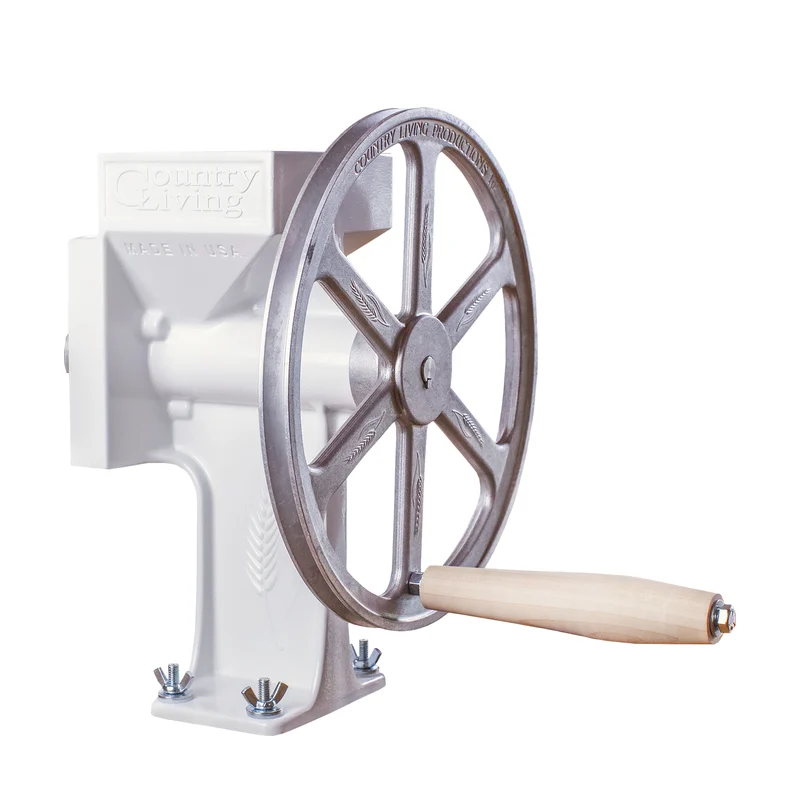
The Country Living Grain Mill mills with a hand crank and no motor. Its manufacturer’s homepage states that “The Country Living Mill is without a doubt the most rugged manual grinder on the market today. Built with two heavy-duty ball bearings, it’s the only grinder like it. Built smart for tough times.” The owner’s manual treats electric drive as something the buyer adds afterward rather than something the mill arrives with: “Your grain mill is designed to be easily motorized.” Nowhere in the manual is a wattage, a voltage or an amperage stated, because as supplied the mill has no electrical input at all.
Grain in the Country Living mill travels through a stainless steel spring auger into an opposed pair of grinding plates. The manufacturer’s own parts breakdown names them in order: “A. The Fixed Burr or Plate. Held into position by three screws … B. The Rotating Burr or Plate … C. The Adjustment Knob … D. The Grain Auger … E. The Short Key … F. Four Washers”. A burr, here, is a grinding surface that reduces grain in a set gap against a second surface; the product page states those plates are “High-carbon steel grinding plates”. The rotating plate turns on a shaft driven from a flywheel that the product page describes as a “12-inch Custom American-Made aircraft aluminum flywheel compatible with 1/2″ v-belt for motorization or pedal power”, and the owner’s manual instructs owners to remove the wooden handle from that flywheel before motorizing the mill.
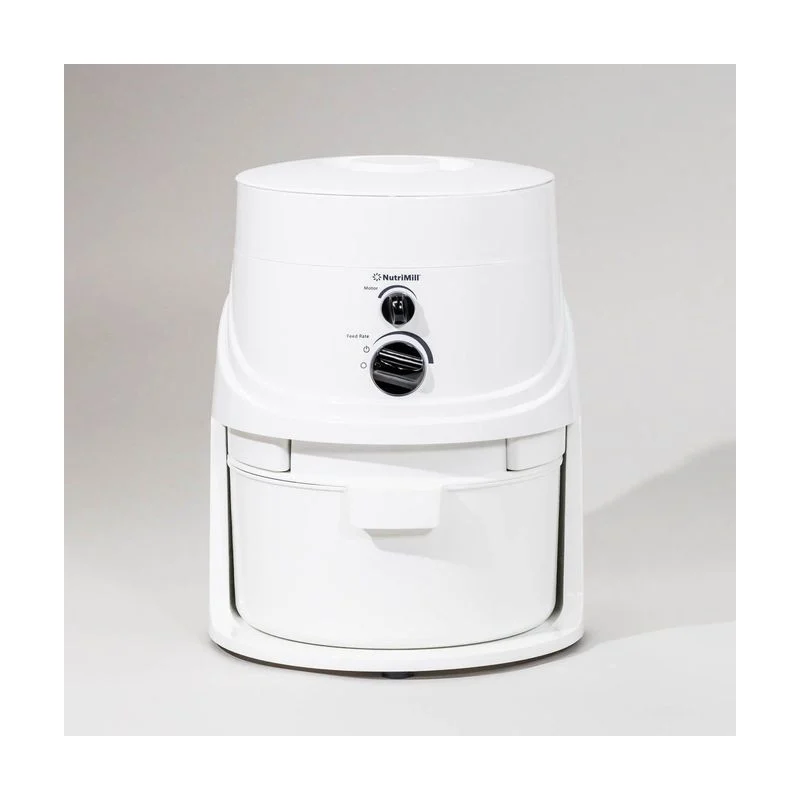
The NutriMill Classic mills on mains power. Its owner manual’s technical block states “Motor: 10 Amps; 1200 W”, and the product page states that “A 10-amp, 1¾ horsepower motor powers the Classic’s high-speed impact chamber (micronizer), using stainless steel milling heads to produce up to 20 cups of flour at a time.” That 1¾ horsepower figure appears only in the marketing prose; the manual’s technical block does not state it, and the two numbers are not the same kind of number. Impact, in this context, names a chamber that shatters grain against high-speed heads rather than reducing it in a gap between two surfaces. The manual records the mechanism in two words, “Milling Heads: Stainless Steel”, and the product page trademarks them as “Stainless Steel Microburst™ Milling Heads”. The mechanism argument in its own right is set out at Impact vs stone burr grain mills; this page is about the drive, not the grinding surface.
So the two mills differ before any question of speed, texture or price arises. One converts arm motion into plate rotation at whatever rate the operator sustains, for as long as the operator sustains it. The other converts a 10-amp draw into head speed at a rate the operator selects on a knob but does not supply. Almost every practical difference below follows from that.
| Published attribute | Country Living Grain Mill | NutriMill Classic |
|---|---|---|
| Drive | Hand crank on a 12-inch aircraft aluminium flywheel; no motor supplied (product page and homepage) | 10 Amps; 1200 W mains motor (owner manual technical block) |
| Grinding mechanism | Opposed high-carbon steel burr plates, fed by a stainless steel spring auger (product page and mechanism page) | High-speed impact chamber with stainless steel milling heads (owner manual and product page) |
| Grain hopper, as supplied | 4 1/2 cups (stated on the hopper-extension accessory page) | 12 cups on the product page, 13 cups in the owner manual |
| Flour container | None stated among the mill’s inclusions; an 8-cup polymer bin is a separate accessory (bin product page) | 20-cup flour bowl on the product page and in the owner manual’s parts diagram, against 21 to 22 cups in the manual’s grain-to-flour section |
| Stated size | 13 1/2 in high, 5 5/8 in wide, 9 1/2 in deep with the flywheel on the manufacturer’s labelled dimension drawing, against 10 × 13 × 15 in in the product page’s store listing table | 12 in W x 12 in D x 13 in H (product page and owner manual) |
| Stated weight | 16 lbs, an unqualified store-listing field, and the only weight the manufacturer publishes (product page) | 14 lbs (owner manual) |
| Texture control | Continuously threaded adjustment knob (owner’s manual), its face marked COARSE and FINE in the manufacturer’s dimension photograph | Two knobs: motor speed and grain feed rate (owner manual and product page) |
| Warranty | Lifetime of the original owner on all parts except the finish; grinding plates one year (warranty page) | 5 years on parts and plastics, limited lifetime on the motor and milling heads (owner manual) |
| Country of manufacture | MADE IN THE USA (product page, and cast into the housing in the dimension photograph) | Not stated on the product page, in the owner manual or in the quick start guide |
Neither manufacturer publishes a throughput rate, a decibel rating or a particle size, so this table carries no row for speed, noise or fineness. Each cell names the document it was read from; where a manufacturer’s own two documents disagree, both figures are printed rather than reconciled.
What the Country Living manual grain mill asks of the operator
What this section establishes
- Country Living publishes no cranking force, no torque figure and no minutes-per-batch anywhere in its documentation; the closest published proxy is its advised drive speed of under 75 rpm, with 120 rpm stated as the absolute maximum.
- The Country Living Grain Mill has to be bolted or lagged to a solid base with 5/16 inch bolts, or clamped, before it is operated at all — the manual states that requirement ahead of any operating instruction.
- The standard hopper holds 4 1/2 cups, so any larger batch is refilled by hand mid-crank, and the manual forbids running the mill empty at any point on pain of the warranty.
Country Living does not state a cranking force, a torque figure, a turns-per-cup count or a time per batch anywhere in the documentation reviewed here. What the manufacturer does state is the speed the mill is meant to turn at, and that is the closest published proxy for the cadence a hand has to hold. The motorization support page states: “120 is the absolute maximum RPM for the Country Living Grain Mill. Through long experience, we have discovered that our mill performs optimally at revolutions of less than 75 per minute.” The owner’s manual gives the same target from the other direction, advising “a gear-reduced motor that will drive the mill at 75 rpm’s or less.” Seventy-five revolutions a minute is a turn and a quarter every second, so the advised pace sits just under that — a steady rhythm rather than a sprint, held for as long as the hopper takes to empty.
The mill requires a fixed base before it turns at all. The owner’s manual states: “The mill must be securely mounted to a solid base before attempting to operate. For best results the mounting surface should be attached to either the wall or floor. The mill base is pre-drilled to be easily bolted or lagged to a surface permanently with 5/16" bolts.” The same page offers clamping to a solid work surface with the Country Living Counter Clamp as the alternative. Neither arrangement is a set-it-on-the-counter one. The manufacturer’s labelled dimension drawing states a base of 5 5/8 inches wide by 3 3/4 inches deep, and the 12-inch flywheel needs room to swing beyond that.
The mill also requires the operator’s attention on the hopper, not only on the handle. The owner’s manual states “DO NOT operate the mill without grain in the hopper” and, in capitals, “NEVER ALLOW THE MILL TO OPERATE WITHOUT GRAIN BEING PROCESSED.” The warranty page turns that instruction into a condition of coverage: the warranty is voided if the mill is “run without grain in the hopper”. The standard hopper holds 4 1/2 cups, a figure the manufacturer states only on its hopper-extension accessory page, so refilling is part of the operating rhythm on any batch larger than that.
Texture adjustment is manual work as well. The knob on the front of the mill is continuously threaded rather than indexed, and its face is marked COARSE and FINE in the manufacturer’s own dimension photograph. The owner’s manual describes the loop: “If the flour produced from this setting is not the consistency desired, it can be varied by the adjustment knob on the front of the mill. Tightening the knob will produce a finer grind. Loosening it will produce a coarse grind or “cracked” grain for cereals. Most adjustments should require only a slight turn of the knob. After each small adjustment, turn the flywheel 2 to 3 times and check the product for desired consistency.” The manufacturer’s own calibration method starts at the tight end: “We begin by tightening the adjustment knob until the plates are rubbing all the way around, then we pour in the grain and grind. It is much easier to begin at a finer setting and adjust out to a coarser setting.” No numbered detents, micron scale or count of settings is stated on any source, so the operator turns, inspects and adjusts by eye.
What the Country Living owner’s manual requires before and during a batch
- Mount the mill before anything elseThe manual states the mill “must be securely mounted to a solid base before attempting to operate”, that “For best results the mounting surface should be attached to either the wall or floor”, and that “The mill base is pre-drilled to be easily bolted or lagged to a surface permanently with 5/16" bolts.” Clamping to a solid work surface with the Country Living Counter Clamp is the manual’s stated alternative.
- Set the plates at the fine end firstThe manufacturer’s own calibration method begins tight: “We begin by tightening the adjustment knob until the plates are rubbing all the way around, then we pour in the grain and grind. It is much easier to begin at a finer setting and adjust out to a coarser setting.”
- Fill the hopper, and keep it fedThe manual states “DO NOT operate the mill without grain in the hopper.” and, in capitals, “NEVER ALLOW THE MILL TO OPERATE WITHOUT GRAIN BEING PROCESSED.”
- Adjust by a slight turn, then check“Tightening the knob will produce a finer grind. Loosening it will produce a coarse grind or “cracked” grain for cereals. Most adjustments should require only a slight turn of the knob. After each small adjustment, turn the flywheel 2 to 3 times and check the product for desired consistency.” No numbered detents, micron scale or setting count is stated on any source.
What the NutriMill Classic's 1200-watt motor asks of the kitchen
The NutriMill Classic draws 10 amps and 1200 watts, stated in the owner manual’s technical block as “Motor: 10 Amps; 1200 W”. No voltage and no frequency is stated on the product page, in the twelve-page owner manual or in the two-page quick start guide, which means a buyer outside North America cannot confirm compatibility from the manufacturer’s own documents and has to ask the seller. A 10-amp draw is also the practical outlet requirement: the Classic asks for a circuit and a permanent enough position that the cord reaches it.
The Classic is rated for domestic use only. Its manual carries the standalone heading “HOUSEHOLD USE ONLY” directly beneath the technical block, and the warranty paragraph limits coverage to “the original noncommercial purchaser”. The Country Living warranty makes the same exclusion in different words, voiding coverage if the mill is “used commercially”. Neither mill is documented as a small-bakery machine, whatever its drive method.
What the operator supplies on the Classic is knob position rather than arm work. The product page lists “Motor Speed & Texture Control Knobs” among the specifications, and the manual splits their jobs. The upper knob is the Variable Motor Speed Control Knob: “For finer flour, upper knob should remain to the left (high speed). • For very coarse flour and medium fine corn meal, knob should be set to the far right, which slows the motor speed. • For heavy flour & dense textured breads, select a middle setting.” The lower knob is the grain feed rate control and doubles as the switch: “This is the ON-OFF switch and controls grain flow into the mill. This affects the fineness of the grind.” The manual sets its positions by the clock — “For finer flour, set the knob toward 11:00 – 12:00 (most grains will not flow at less than a 10:00 position on the knob). • For bread flour, set the knob toward the 12:00 – 1:00 position. • For coarser flour turn the knob toward the right.” — and cautions that the point where grain begins to flow varies with the size of the grain or bean.
The Classic is also designed to run closed. Its operating instructions state that “The NutriMill is designed to operate with the lid on for quieter milling”, and the parts diagram repeats the point on the hopper lid callout. That is a small operational requirement with no equivalent on the hand mill, whose hopper is open to the operator throughout the batch because the operator is the one refilling it.
Hopper capacity, and the flour bowl only the NutriMill Classic includes
What this section establishes
- The Country Living Grain Mill’s standard hopper is stated at 4 1/2 cups, against 12 cups on the NutriMill Classic’s product page and 13 cups in its owner manual.
- No flour container is stated among the Country Living mill’s inclusions: the manufacturer’s 8-cup polymer bin is a separate accessory, while the NutriMill Classic’s 20-cup flour bowl is stated as part of the machine.
- Country Living’s hopper extension is stated to raise the standard 4 1/2 cups to nearly 11 cups, and the manufacturer describes it as “designed especially for those of you with motorized mills”.
Batch capacity is the difference between these two mills that the manufacturers actually quantify, and it runs in the electric mill’s favor at both ends of the machine. The Classic holds more grain above the mechanism and captures more flour below it, and it ships with the container that does the capturing. The Country Living mill holds 4 1/2 cups above the plates as supplied and publishes no included flour container at all — the bin that fits beneath its hopper is a separate accessory.
The published capacity figures, with the documents they come from, are these:
- Country Living hopper, standard: 4 1/2 cups. The figure is stated only on the manufacturer’s hopper-extension accessory page — “It more than doubles the capacity of the existing hopper from 4 1/2 cups to nearly 11 cups” — and never on the mill’s own product page.
- Country Living hopper, with the separately sold extension: “nearly 11 cups”, the manufacturer’s own hedge, on an accessory it describes as “designed especially for those of you with motorized mills”.
- Country Living flour capture: no container appears in the mill’s stated inclusions. The optional High Impact Polymer Bin is “designed to fit snugly underneath your Country Living Grain Mill hopper” and the manufacturer states it “has an 8-cup capacity”.
- NutriMill Classic hopper: “12 Cup Grain Hopper Capacity” on the product page, “Hopper Capacity: 13 cups” in the owner manual’s technical block.
- NutriMill Classic flour bowl: “20 Cup Flour Bowl Capacity” on the product page and “Large 20 cup capacity” in the manual’s parts diagram, against “The bowl holds 21 to 22 cups of flour” in the manual’s grain-to-flour ratio section.
- NutriMill Classic stated batch ceiling: “up to 20 cups of flour at a time”, with a conditional yield figure — “You will get about 21 cups of flour from 13 cups of hard wheat when milled at a medium texture” — that holds only for hard wheat at a medium texture setting.
What the capacity gap means for a week's baking
The Country Living mill’s standard hopper holds roughly a third of what the Classic’s holds on the product page’s own figures — 4 1/2 cups against 12. Milling an equal quantity of grain therefore means more refills as well as more cranking, and the two costs compound rather than trade off. The manufacturer’s answer is the hopper extension, which it states raises the standard 4 1/2 cups to nearly 11 cups, bringing the hand mill close to the Classic’s stated hopper figure. That accessory is sold separately and is described as aimed at motorized owners, which is a useful signal in itself: a motor empties 4 1/2 cups faster than a hand can refill it, so the manufacturer sized the extension for the case where the operator is no longer the bottleneck.
Flour capture works the same way. The Classic’s included bowl is stated to hold 20 cups on the product page and in the parts diagram, so a full hopper’s worth of flour has somewhere to land without the operator’s involvement. Country Living lists no flour container among the mill’s inclusions; its 8-cup polymer bin is a separate purchase, and 8 cups is less than the nearly 11 cups of grain the extended hopper is stated to hold, before any expansion from grain into flour is counted. Neither manufacturer states a grain-to-flour ratio for the Country Living mill, so that shortfall cannot be quantified from published material.
For a household that mills a couple of loaves’ worth at a time, neither capacity is limiting. For a household milling a week of flour in one session, the Classic’s published figures describe a single uninterrupted run and the Country Living mill’s describe two or three loads with a hand on the wheel throughout. The procedure a first batch actually follows, on either machine, is set out at How to mill your own flour.
Why neither Country Living nor NutriMill publishes a throughput rate
No cups-per-minute, grams-per-minute or pounds-per-hour figure is published for either mill. NutriMill publishes a batch ceiling — “up to 20 cups of flour at a time” — which states a quantity, not a rate, and says nothing about how long that quantity takes. Country Living publishes revolutions per minute for motorized operation, which states a shaft speed, not a rate of flour. Those are the only two numbers on offer, and neither answers the question buyers most often ask first.
Shaft speed cannot be converted into throughput without two figures neither manufacturer states: how much grain the auger displaces per revolution, and how the plate gap at a given knob position affects the flow. A mill turning at 65 rpm with the plates set for pastry flour and a mill turning at 65 rpm with the plates set for cracked cereal are not producing at the same rate, and the manufacturer’s own instruction to check the output after every small adjustment implies the setting moves freely between those cases.
The Classic has the same problem from the opposite direction. Both of its knobs change the rate at which flour appears: the lower knob controls grain flow into the chamber and the upper knob controls head speed, and the manual states that the point at which grain begins to flow “will vary depending on grain/bean size”. A single throughput number for the Classic would be meaningless without stating both knob positions, the grain and its moisture — which is presumably why the manufacturer publishes a batch ceiling instead.
Any cups-per-minute figure circulating for either mill is therefore a user report, not a manufacturer specification, and it is not repeated here. Where an honest number is needed for planning, the honest numbers are the hopper capacities and the stated batch ceiling.
Motorizing the Country Living Grain Mill, and the warranty clause that governs it
What this section establishes
- The Country Living Grain Mill is designed by its own manufacturer to be motorized: the flywheel is grooved for a standard half-inch A or V belt, and the owner’s manual advises a gear-reduced motor driving the mill at 75 rpm or less.
- Country Living sells both a complete kit — pre-drilled baseboard, gear-reduced motor with pulley, belt, belt guard and hardware, with the mill sold separately — and the 1/9 horsepower gear-reduced motor on its own.
- The warranty is void if the mill is motorized by anything other than the kit manufactured by Country Living Products, so a homemade conversion is a warranty decision as well as an engineering one.
The hand-versus-electric choice is not binary for the Country Living mill, because its manufacturer designed and sells the conversion. The owner’s manual states: “Your grain mill is designed to be easily motorized. The flywheel is grooved for use with a standard ½” A or V belt. We advise using a gear-reduced motor that will drive the mill at 75 rpm’s or less.” The product page carries the same intent in its flywheel bullet, describing the 12-inch aircraft aluminum wheel as “compatible with 1/2″ v-belt for motorization or pedal power”. The mill therefore ships ready for a belt whether or not the buyer ever fits one.
What the manufacturer publishes about that conversion, and what it does not, is worth reading as a list:
- Kit contents, as stated: “pre-drilled and threaded baseboard, gear-reduced motor with pulley, belt and belt guard, and all the necessary hardware.” The mill itself is sold separately from the kit.
- Motor sold on its own: the “1/9 Horsepower Grain Mill Reduced Gear Motor”, which the manufacturer states “is already geared down to run your Country Living Grain Mill at its recommended speed, so the do-it-yourselfer won’t have to mess with intermediate pulleys. A wired power cord with inline switch is included.”
- Motor electrical rating: not stated. No wattage, no voltage, no amperage and no motor rpm appears on the motor’s own product page, only the 1/9 horsepower figure in its title.
- Belt: a standard ½ inch A or V belt, running in the groove of the 12-inch flywheel.
- Advised drive speed: 75 rpm or less, per the owner’s manual.
- Stated running speed with the kit fitted: “a steady 65 rpm pace” on the kit product page, against “about 65 to 75 rpm” on the motorization support page. Two manufacturer pages, two answers.
- Absolute ceiling: “120 is the absolute maximum RPM for the Country Living Grain Mill.”
- Warranty position: void if the mill “is motorized by anything other than the kit manufactured by Country Living Products”.
Your grain mill is designed to be easily motorized. The flywheel is grooved for use with a standard ½” A or V belt. We advise using a gear-reduced motor that will drive the mill at 75 rpm’s or less.
What motorizing the Country Living mill does not change
A motorized Country Living mill is not the same proposition as an electric mill built as one. The mechanism is unchanged — the same steel plate pair, the same auger, the same continuously threaded adjustment knob — and so is the mounting requirement, since the manual’s instruction to bolt or lag the mill to a solid base applies before any attempt to operate it and says nothing about the drive. What changes is the source of rotation and, with it, the hopper arithmetic: the manufacturer’s own hopper extension is pitched at motorized owners for exactly that reason.
The warranty clause is the real constraint on a homemade conversion. The mill is mechanically open to it — the flywheel groove and the belt specification are published so that owners can do it — but the warranty text names the manufacturer’s own kit specifically, and the owner’s manual repeats the restriction. A buyer who intends to drive the mill from an existing motor, a shaft or a bicycle rig is making a warranty decision as well as an engineering one, and the manufacturer has not published any exception to that clause for non-electric drives.
The speed figures matter here more than they look. The manufacturer states 120 rpm as an absolute ceiling and states that the mill “performs optimally at revolutions of less than 75 per minute”, so any conversion has to be geared, not direct. The kit exists to remove that arithmetic from the buyer: the motor sold with it is stated to be geared down to the recommended speed already. A conversion built from an ungeared motor is the case the manufacturer’s advice is written against.
Documented specifications for the mill itself, including the mounting, plate and warranty details this page draws on, are laid out claim by claim at Country Living Grain Mill.
Off-grid operation, and the one sentence about pedal power
The off-grid case for the Country Living mill is not a marketing claim; it is the absence of an electrical specification. The mill as supplied has no motor, and the owner’s manual states no wattage, voltage or amperage because there is nothing to state. Its only power input is the operator. That is a stronger form of evidence than any slogan, and it is the one capability an electric mill cannot acquire later.
Pedal power appears exactly once in the manufacturer’s published material, in the product page’s flywheel bullet: the flywheel is “compatible with 1/2″ v-belt for motorization or pedal power”. No pedal drive, gearing ratio, mounting arrangement or instruction set is published to go with it. The sentence establishes only that the flywheel groove will accept a belt from something other than the kit motor. The warranty text addresses motorization by anything other than the manufacturer’s kit and does not state how a pedal drive would be treated, so a buyer planning one should read that clause as unresolved rather than as permission.
The NutriMill Classic has no documented path to running without an outlet. Its stated power input is 10 amps and 1200 watts, and no alternative power arrangement appears in the product page, the owner manual or the quick start guide. The missing voltage figure compounds the problem for anyone sizing a generator or inverter, because the manufacturer’s own documents do not give the number that calculation starts from.
The honest framing of the off-grid question is not which mill is better but whether flour has to be possible when the outlet is not. If it does, only the hand-cranked mill is documented to work. If it does not, that capability is being bought with arm work on every batch for the life of the mill, and the manufacturer’s own motorization kit exists precisely so an owner can change their mind later without changing mills.
What the NutriMill Classic and the Country Living mill are each permitted to mill
The two mills’ permitted lists diverge in a way that tracks the drive. The NutriMill Classic’s owner manual carries a page headed “THE NUTRIMILL CLASSIC WILL MILL THE FOLLOWING” listing thirty-one items, and a separate page headed “DO NOT MILL ANY OF THE FOLLOWING” that names nuts, coffee beans, sesame seeds, sunflower seeds, flax seeds, chia seeds, hemp, sugar, spices, herbs, chocolate, tapioca, goji beans, dried fruit or vegetables, oatmeal, steel cut oats, and sprouted grains or beans if not thoroughly dried. The general rule the manual gives is a moisture and oil rule: “Avoid grains and beans that have high oil or moisture content. Non-commercially dried products may cause plugging.” The quick start guide states the short form as “DO NOT MILL SEEDS, NUTS, SUGARS, OR SPICES”.
Country Living permits some of exactly what the Classic excludes, but only with parts swapped. Coffee appears on the manufacturer’s Corn & Bean Large Auger page: “Use the large auger to mill corn, beans, and coffee. To use, simply replace the standard spring auger with this larger auger. The large auger is cast from stainless steel.” Oily nuts appear on a different accessory page again: the Peanut Butter+Plus attachment “is intended for soft oily nuts such as peanuts, cashews, pecans and walnuts. It is not intended for almonds.” That attachment takes the place of the grinding plates, and the manufacturer states an owner can “convert your mill back to a grain grinder at any time, by reinstalling the grinding plates”.
The structural reason is that the hand mill’s working parts come out. Its auger is removable and a larger cast stainless auger is sold for corn, beans and coffee; its plates are removable and a nut attachment replaces them. The Classic’s published serviceable parts are an inlet grommet and an air filter, footnoted “*Inlet grommet and filter should be replaced every 2 years or as needed” — consumables, not alternative milling surfaces. Its stated fineness range, “Flour Fineness: Adjustable - Fine to Medium Coarse”, is what the one fitted mechanism does.
Both mills refuse wet material, and both say so plainly. Country Living’s product page states “This mill is not intended to grind wet, moist, or soft grain” and its manual warns that “Moist or soft beans or grains will cause clogging.” The Classic’s safety instructions state “Do not mill damp, wet or oily grains”, and its manual supplies a test for anything not on its list: “For any grains not listed above, mill only ¼ cup, then test the flour by pinching a small amount between your thumb and finger. If it holds the shape of a pinch and does not fall apart, it contains too much moisture. Do not mill this grain.” Country Living publishes one further restriction that is a warranty term rather than a performance caution: coverage is void if the mill is used to grind grain soaked with an ash or slaked lime solution.
Cleaning and consumables: rust on the Country Living plates, plastics on the NutriMill Classic
The Country Living mill strips down without tools beyond what the manufacturer supplies. Its manual states: “The mill is easily disassembled for cleaning by removing the adjustment knob and sliding the front plate off the shaft.” The same section then sets the limit: “The mill housing is not designed to be submerged during cleaning. A slightly damp cloth should suffice for cleaning the housing and its parts. If the grinding plates or bearings get wet, they should be dried immediately to prevent rusting.” That last instruction is a standing obligation on this mill specifically, and the manual states it twice: the cleaning section gives the drying rule, and the operating cautions repeat it as a prohibition in its own right — “DO NOT get excessive moisture on plates or bearings.” The plate half of that pair has a stated material, “High-carbon steel grinding plates” on the product page, which is the part of the mechanism the rust caution is legible against. The bearing half does not: no bearing material is stated on the product page, the mechanism page, the homepage or the owner’s manual. What the manufacturer states about the bearings is their number, their spacing and their sealing — “two sealed ball bearings spaced apart” on the mechanism page, “Double sealed agricultural-grade bearings” on the product page, two phrasings whose disagreement is set out below — and the drying instruction names them anyway, regardless of what they are made of. The published obligation is therefore a handling rule rather than an inference from materials: keep moisture off the plates and bearings, dry either immediately if it reaches them, and clean the housing with a slightly damp cloth rather than by submerging it.
The Classic’s published cleaning restriction concerns plastics, not rust, and its two manufacturer documents state it with different force. The quick start guide is absolute: “Hand-wash the plastic bowl and lid. DO NOT put them in the dishwasher. High-heat dishwashers can warp the plastics.” The owner manual states the same point as a preference: “We recommend hand-washing the plastic bowl and lid. High-heat dishwashers can warp the plastics.” Both documents are current manufacturer material for the same mill. The safe reading is the stronger one.
Their consumables differ in kind, which is the maintenance shape of the drive difference. The Classic’s chamber moves air as well as grain, so its manual footnotes an inlet grommet and an air filter for replacement every two years or as needed. The Country Living mill has no airflow parts and no stated replacement interval for anything; its wear item is the pair of grinding plates, and the manufacturer’s published statements about how long those last do not agree with each other. That disagreement is set out below.
Neither mill’s documentation states a cleaning frequency. Country Living gives a method and a prohibition on submerging; NutriMill gives a hand-wash instruction for the bowl and lid and a two-year interval for two parts. Anyone planning maintenance around a schedule is working from something other than the manufacturers’ published material.
Warranty terms: lifetime on the Country Living mill, five years on the NutriMill Classic
Country Living warrants the mill for as long as the buyer owns it, and hedges that in several directions. The warranty page states: “Country Living Products warrants this Country Living Grain Mill to be free from defects in material and workmanship under NORMAL USE and conditions for the lifetime of the original owner which includes all parts, excluding the finish.” The grinding plates sit outside that: “The grinding plates are warrantied for a period of one (1) year from the original date of purchase.” Coverage is “not transferable and applies only to United States and Canadian sales”, and the manufacturer requires registration on a clock — “The Warranty Registration Card must be completed online or mailed to Country Living Products … within fifteen (15) days from receipt of the mill.”
The Country Living voiding conditions read as a list of operating rules with money attached. The warranty is void if the mill “is used in any way other than recommended, is motorized by anything other than the kit manufactured by Country Living Products, run without grain in the hopper, or used commercially”, and separately “if the mill is used to grind grain soaked with an ash or slaked lime solution.” Two of those — the motorization clause and the never-run-empty clause — are directly about how a hand mill gets driven and fed, which is to say they are drive-method terms, not general boilerplate.
NutriMill warrants the Classic on a fixed term with two open-ended exceptions. The owner manual states: “L’Chef, LLC warrants the NutriMill® Classic mill to be free of manufacturing defects in materials and workmanship for a period of 5 years for parts and plastics and limited lifetime on motor and milling heads. Defective product will be repaired or replaced with a comparable model at our sole discretion upon receiving the defective product. L’Chef will not refund purchase price or provide any other remedy. This warranty applies to the original noncommercial purchaser.” The product page states the same headline: five years, with a limited lifetime warranty on the motor and milling heads.
Read side by side, the two warranties are closer than their headlines suggest. Both run to the original purchaser only. Both exclude commercial use. Both cover the part that does the grinding on different terms from the part that holds it — Country Living carving its plates down to one year, NutriMill extending its heads and motor to a limited lifetime. The clearest asymmetry is geography and registration: Country Living limits coverage to two countries and puts a fifteen-day registration deadline on it, while the NutriMill paragraph recorded here states neither a territory nor a registration window. Country of manufacture is likewise asymmetric. Country Living’s product page states “MADE IN THE USA” and the phrase is cast into the housing in the manufacturer’s own dimension photograph; no country of manufacture is stated on NutriMill’s product page, in its owner manual or in its quick start guide.
Where hand and electric are genuinely equivalent
Drive method is a smaller difference than the marketing on either side implies, and several of the attributes buyers expect to separate the two turn out identical once the published record is read rather than assumed. The list below is not a rhetorical balance; each entry is a place where the two documents say the same kind of thing, or the same amount of nothing.
- Neither publishes a decibel figure. Both offer a qualitative claim instead: NutriMill states “Whisper Quiet™ - Noise reduction is achieved with a sound level similar to that of a vacuum cleaner. This is quieter than the first generation of impact mill designs.” Country Living’s motorization support page states “It’s quiet (you can actually have a conversation standing next to it), and the grind is very cool.” The second describes the motorized kit, not hand cranking, so it is not even a hand-versus-electric comparison.
- Neither publishes a particle size in microns. Both use word scales: Country Living states “Adjustable output; from cracked wheat to pastry flour in one pass”, NutriMill states “Flour Fineness: Adjustable - Fine to Medium Coarse”.
- Neither publishes a throughput rate, and neither publishes a time per batch.
- Both use a continuous control rather than numbered settings, so neither can be set by reciting a number to another baker. Country Living’s threaded knob has no stated detents; NutriMill’s two knobs are described by clock positions and left-right ranges.
- Both refuse damp, wet or oily material, in near-identical language from two unrelated manufacturers.
- Both are warranted to the original purchaser only and both exclude commercial use.
- Both fit a domestic counter. The Country Living mill measures 13 1/2 inches high, 5 5/8 inches wide and 9 1/2 inches deep with the flywheel on the manufacturer’s labelled drawing; the Classic’s stated overall dimensions are 12 inches wide by 12 inches deep by 13 inches high.
- Both are liftable by one person. The Classic’s manual states “Weight: 14 lbs.” Country Living’s store listing field states “Weight | 16 lbs”, though the manufacturer does not state whether that is the mill’s own weight or the packed carton’s.
Where each manufacturer's documentation disagrees with itself
Country Living publishes two different motorized running speeds on two different pages. The motorization kit’s product page states “The motor kit grinds at a steady 65 rpm pace that keeps the flour cool to reduce the loss of nutritional enzymes.” The motorization support page states “With this kit, your mill turns at about 65 to 75 rpm to ensure a cool grind for all your flours.” Same kit, same manufacturer, one figure against a range whose top is at the edge of the mill’s own stated optimal band. Both are recorded here; neither is averaged away.
Country Living also publishes two incompatible accounts of the grinding plates’ life. The warranty page states a term — “The grinding plates are warrantied for a period of one (1) year from the original date of purchase” — and, in its return-policy text, an expectation that the plates “will last at least 4-5 years with regular use”. The product page states no term at all, describing the plates as a wear item expected to last several years with daily home use. A one-year warranty and a four-to-five-year expectation are not contradictory in principle, but the product page’s silence on the term means a buyer reading only that page would not learn there is one.
Country Living’s published size figures do not reconcile. The product page’s store listing table states “Dimensions | 10 × 13 × 15 in”. The manufacturer’s own labelled dimension drawing states “Mill Height 13 1/2"”, “Mill Width 5 5/8"” and “Mill Depth 9 1/2" with Flywheel”. Neither source labels the larger set as packaging or shipping dimensions, so the two cannot be reconciled from primary material. The drawing is the more specific of the two and is the set used on this page; the listing figures should not be read as the mill’s size. The listing weight of 16 lbs carries the same ambiguity.
Country Living describes its bearings with two different grades on two pages. The mechanism page states that “Many grinders use only one large bushing, but the Country Living Mill has two sealed ball bearings spaced apart* which increases the stability of the drive shaft and reduces bearing strain”, calling them industrial-grade. The product page lists “Double sealed agricultural-grade bearings”. The count and the arrangement are consistent; the grade wording is not.
NutriMill’s hopper capacity is stated two ways. The product page lists “12 Cup Grain Hopper Capacity”. The owner manual’s technical block states “Hopper Capacity: 13 cups”, and the manual’s own grain-to-flour ratio section reinforces the larger figure by describing a run from 13 cups of hard wheat. A cup of grain is not a trivial discrepancy on a 12-cup hopper.
NutriMill’s flour bowl capacity contradicts itself inside a single document. The manual’s parts diagram calls the bowl a “Large 20 cup capacity” vessel, matching the product page’s “20 Cup Flour Bowl Capacity”; the manual’s grain-to-flour ratio section states “The bowl holds 21 to 22 cups of flour.” Whether the bowl’s rated capacity is 20 or 22 cups matters precisely at the point where a full hopper is being emptied into it.
NutriMill’s dishwasher instruction differs in force between its two documents, as covered above, and its motor is rated two ways: “Motor: 10 Amps; 1200 W” in the manual’s technical block, against “10-amp, 1¾ horsepower” in the product page’s marketing prose. The horsepower figure appears in no technical block and is presented here as what the manufacturer states, not as an electrical specification. The product page’s “400% adjustment range” and “10 times more texture range” claims are likewise manufacturer statements with no stated baseline, and the two figures do not describe each other.
Why this publication covers exactly one hand mill
This site is about electric grain mills. The Country Living Grain Mill is the only hand-cranked mill in it, and it is here for a specific reason: the hand-versus-electric question cannot be answered honestly by a publication that carries no hand mill, and it cannot be answered by a hand mill whose manufacturer publishes nothing to check. Country Living publishes a great deal — an owner’s manual, a warranty text with named voiding conditions, a labelled dimension drawing, a motorization support page with speed figures, and separate pages for the large auger, the hopper extension, the flour bin and the nut attachment. That is enough for a claim-by-claim page, which is the standard every entry on this site has to meet.
One hand mill is also enough, because the comparison this page owns is between drive methods, not between hand mills. A second manual mill would produce a hand-versus-hand comparison — burr material, flywheel mass, clamp versus bolt — that this publication is not scoped to make and could not make well without buying and turning both. The electric field is where the rest of the coverage sits, and every mill in it is compared on the same published attributes: mechanism, motor, hopper capacity, flour container capacity, texture control, ingredient scope and warranty.
The bounding rule, stated plainly, is that a mill enters this site when its manufacturer publishes enough to be held to: a manual or a specification block, not a retail listing. The Country Living mill meets that with a hand crank, and it earns its place because it is also the one mill here whose manufacturer sells the bridge between the two categories. The NutriMill Classic meets the same standard with a 1200-watt motor and a twelve-page manual. Their full documented profiles are at Country Living Grain Mill and NutriMill Classic Grain Mill.
What this page will not do is treat the hand mill as a lifestyle position or the electric mill as the obvious default. Both are documented machines with published limits, and the limits are what this page compares.
What this guide cannot settle
Effort is not quantified by anyone. No cranking force, torque figure, turns-per-cup count or minutes-per-batch appears in the Country Living material reviewed here. The 75 rpm target and the 120 rpm ceiling describe how fast the shaft should turn, not how hard it is to turn, and how hard depends on the plate gap the operator has selected, the grain, and the operator. A page that offered a number for this would be inventing it.
Throughput is not published for either mill, so the most common reason for choosing an electric mill cannot be verified against the machine that would replace it. The Classic’s “up to 20 cups of flour at a time” is a ceiling on batch size, not a rate. Country Living’s rpm figures describe a shaft, not flour.
Flour temperature cannot be compared. NutriMill states its airflow design “keeps flour temperatures around 118°F”, with the hedge in the prose and no hedge in the specification bullet, and no grain, ambient temperature or run length attached. Country Living publishes no temperature figure at all; the nearest statements are that the motorization kit “grinds at a steady 65 rpm pace that keeps the flour cool” and that “the grind is very cool”, both about motorized operation and both qualitative. Two adjectives and one hedged figure do not make a comparison, and the manufacturer superlative “the coolest-running impact mill in the world” has no stated test behind it.
Noise cannot be compared either. Neither manufacturer publishes a decibel rating, and the only comparative statement available — a vacuum cleaner analogy on one side, a conversation-volume claim about the motorized kit on the other — puts a hand mill’s motorized configuration against an electric mill’s normal one.
Durability is not measured, only warranted. Country Living warrants the mill for the lifetime of the original owner and its grinding plates for one year; NutriMill warrants five years on parts and plastics with a limited lifetime on the motor and milling heads. Warranty terms are commercial commitments, and neither manufacturer publishes hours of operation, cycles or a plate-life measurement. The four-to-five-year plate expectation on Country Living’s warranty page is an expectation, stated as such.
Nothing on this page has been handled, cranked or plugged in. Every figure here was read from a manufacturer product page, an owner’s manual, a quick start guide, a support page or a labelled dimension drawing, and each is cited to the document it appears in. Where the manufacturers disagree with themselves, both values are printed above rather than reconciled.
How long does it take to hand-crank a batch of flour?
Country Living does not state a time per batch, a throughput rate or a turns-per-cup figure. The two published numbers that bound the question are the standard hopper’s 4 1/2 cup capacity and the manufacturer’s advised speed of less than 75 revolutions a minute, with 120 rpm stated as the absolute maximum. Those describe how much grain sits in front of the operator and the pace the mill is designed to run at; they do not multiply into minutes, because the grain-to-flour rate per revolution is not published.
Any minutes-per-cup figure quoted for this mill is a user report rather than a manufacturer specification, and it will move with the adjustment knob in any case — the manufacturer’s own instruction is to change the setting in small increments and check the output after two or three turns of the flywheel, which means the same mill produces at different rates at different settings.
Can a manual grain mill be motorized?
This one can, and its manufacturer sells the parts. The owner’s manual states that the mill “is designed to be easily motorized”, publishes the belt specification — a standard ½ inch A or V belt running in the flywheel groove — and advises “a gear-reduced motor that will drive the mill at 75 rpm’s or less”. The manufacturer sells a complete kit containing a pre-drilled and threaded baseboard, a gear-reduced motor with pulley, a belt, a belt guard and hardware, with the mill itself sold separately, and it sells the 1/9 horsepower gear-reduced motor on its own for owners building their own arrangement.
The binding constraint is the warranty rather than the engineering. Coverage is void if the mill “is motorized by anything other than the kit manufactured by Country Living Products”, and the owner’s manual repeats the restriction. Whether any other hand mill accepts a motor is a question for that manufacturer’s own documentation; nothing on this page generalizes beyond the Country Living mill.
Does an electric grain mill work in a power cut?
The NutriMill Classic publishes no path to running without an outlet. Its only stated power input is 10 amps and 1200 watts, and no alternative arrangement appears in its product page, owner manual or quick start guide. The absence of a stated voltage compounds the problem for anyone sizing a generator or an inverter, because the manufacturer’s documents do not supply the figure that calculation begins from.
The Country Living mill is the opposite case by construction: it ships with no motor, so its documented mode of operation does not involve an outlet at all. An owner who wants both can start with the hand crank and add the manufacturer’s own motorization kit later without voiding the warranty, which is the one configuration on this page that covers both conditions.
Is hand-milled flour cooler than electrically milled flour?
Not established from published sources. NutriMill states that the Classic’s “newly improved airflow design also keeps flour temperatures around 118°F, protecting nutrients during milling”, a hedged manufacturer figure with no stated grain, ambient temperature or run length, and the specification bullet drops the hedge and the unit entirely by listing “Grain Nutrient Protection 118° Flour Temperature”.
Country Living publishes no flour temperature for its mill at all. Its two nearest statements — that the motorization kit “grinds at a steady 65 rpm pace that keeps the flour cool to reduce the loss of nutritional enzymes” and that “the grind is very cool” — are qualitative, are manufacturer statements rather than measurements, and both describe the mill running on the kit motor rather than on a hand crank. There is no published figure on the hand-cranked side to place against 118°F, so the comparison cannot be made honestly in either direction.
Does a grain mill have to be bolted down?
The Country Living mill does, by its manufacturer’s own instruction. The owner’s manual states: “The mill must be securely mounted to a solid base before attempting to operate. For best results the mounting surface should be attached to either the wall or floor. The mill base is pre-drilled to be easily bolted or lagged to a surface permanently with 5/16" bolts.” The manual offers clamping to a solid work surface with the Country Living Counter Clamp as the alternative. It states the requirement without stating a reason, and it applies before any attempt to operate the mill.
No comparable mounting instruction appears in the NutriMill Classic material recorded here. The Classic’s stated overall dimensions are 12 inches wide by 12 inches deep by 13 inches high and its manual states a weight of 14 lbs, and it is documented as a machine that stands on a work surface and runs with its lid on. That is a real difference in what the two mills ask of a kitchen: one needs a permanent fixing or a clamp, the other needs a spot near an outlet.
Manual or electric: which should a first-time miller choose?
What this section establishes
- The Country Living Grain Mill is stated at 4 1/2 cups of grain, publishes no included flour container, requires a base bolted or lagged with 5/16 inch bolts, and is warranted for the lifetime of the original owner in the United States and Canada.
- The NutriMill Classic is stated at 12 cups of grain on its product page and 13 cups in its owner manual, captures flour in an included 20-cup bowl, and is warranted five years on parts and plastics with a limited lifetime on the motor and milling heads.
- Neither record carries a rate: no cups-per-minute figure is published for either mill, and NutriMill’s “up to 20 cups of flour at a time” states a batch size rather than a speed.
The decision the published evidence supports is about what the buyer is willing to supply. The NutriMill Classic supplies its own rotation and asks for a 10-amp outlet, a counter position and two knob settings; it holds 12 or 13 cups of grain depending on which manufacturer document is read, and it captures flour in an included bowl stated at 20 cups. Its warranty runs five years on parts and plastics with a limited lifetime on the motor and milling heads, to the original noncommercial purchaser.
The Country Living Grain Mill asks for a mounted or clamped base, arm work at under 75 revolutions a minute, refills every 4 1/2 cups and a separately bought bin if the flour is to land in anything. In return it runs with no outlet, carries a warranty for the lifetime of the original owner in the United States and Canada, and can be motorized later with the manufacturer’s own kit without voiding that warranty.
Neither published record contains a throughput figure, a decibel rating or a particle size, so the choice cannot be settled on speed, noise or fineness from manufacturer material. It can be settled on capacity, on power requirement, on mounting, on what each mill is permitted to accept, and on warranty terms — all of which are stated, and all of which are set out above.
Both mills' published specifications, side by side
| Attribute | Country Living | NutriMill Classic |
|---|---|---|
| Milling mechanism Wording differs | Opposed burr plates — one fixed plate held by three screws, one rotating plate on the drive shaft, fed by an auger countrylivinggrainmills.com product page | High-speed impact chamber with stainless steel Microburst milling heads nutrimill.com product page |
| Motor Figures differ | None supplied — hand-cranked; no wattage, voltage or amperage is stated countrylivinggrainmills.com product page | 1200 W, 10 amps Owner manual (PDF) |
| Optional motor | 1/9 horsepower gear-reduced motor, sold separately; wattage and voltage not stated countrylivinggrainmills.com product page | —No row for this attribute appears in the documents read for this mill. |
| Hopper capacity Figures differ | 4 1/2 cups standard; nearly 11 cups with the optional hopper extension countrylivinggrainmills.com product page | 12 cups (owner manual states 13 cups) — the manufacturer’s own documents disagree on this figure. nutrimill.com product page |
| Flour container capacity Figures differ | Not included; optional 8-cup polymer bin sold separately countrylivinggrainmills.com product page | 20 cups (owner manual's grain-to-flour section states the bowl holds 21 to 22 cups) — the manufacturer’s own documents disagree on this figure. nutrimill.com product page |
| Texture adjustment Wording differs | Threaded knob setting the burr gap, knob face marked COARSE and FINE; no detents or micron scale stated countrylivinggrainmills.com product page | Two knobs: variable motor speed and variable grain feed rate Owner manual (PDF) |
| Dimensions Figures differ | 13 1/2 in high, 5 5/8 in wide, 9 1/2 in deep with flywheel on the manufacturer's labeled drawing; the store listing field instead gives 10 x 13 x 15 in countrylivinggrainmills.com product page | 12 in W x 12 in D x 13 in H nutrimill.com product page |
| Weight Figures differ | 16 lbs in the store's weight field; whether that is net or packaged is not stated countrylivinggrainmills.com product page | 14 lbs Owner manual (PDF) |
| Burr material | High-carbon steel grinding plates countrylivinggrainmills.com product page | —No row for this attribute appears in the documents read for this mill. |
| Housing Wording differs | Solid I-beam construction from cast aircraft aluminum with FDA-approved food-grade powder coating countrylivinggrainmills.com product page | ABS plastic Owner manual (PDF) |
| Warranty Figures differ | Lifetime of the original owner on all parts excluding the finish; grinding plates one year countrylivinggrainmills.com product page | 5 years parts and plastics; limited lifetime on motor and milling heads; original noncommercial purchaser only Owner manual (PDF) |
| Country of manufacture | United States countrylivinggrainmills.com product page | —No row for this attribute appears in the documents read for this mill. |
| Flour fineness | —No row for this attribute appears in the documents read for this mill. | Adjustable, fine to medium coarse Owner manual (PDF) |
| Intended use | —No row for this attribute appears in the documents read for this mill. | Household use only Owner manual (PDF) |

The documents this page was read from
- Country Living Grain Mill — manufacturer product page
- Country Living Grain Mill — owner's instruction manual
- Country Living — warranty and returns policy
- Country Living — Motorizing Your Grain Mill support page
- Country Living — Motorization Kit product page
- Country Living — 1/9 Horsepower Grain Mill Reduced Gear Motor product page
- Country Living — Hopper Extension product page (states standard hopper capacity)
- Country Living — High Impact Polymer Bin with Storage Lid product page
- Country Living — Corn & Bean Large Auger product page
- Country Living — Peanut Butter+Plus Accessory product page
- Country Living — A Look Inside: grinding mechanism parts
- Country Living Grain Mills — manufacturer homepage
- Country Living — manufacturer labelled dimension drawing (product gallery image)
- NutriMill Classic Grain Mill — manufacturer product page
- NutriMill Classic — full user manual (PDF, manufacturer-hosted)
- NutriMill Classic — quick start guide (PDF, manufacturer-hosted)
Decide between two of these mills
This guide works from published documents rather than choosing for you. Each comparison below settles one named pair on the rows both makers print.
- Impact vs stone burr grain millsThe NutriMill Classic's impact chamber and the Mockmill 100's ceramic stones, compared on what each mechanism permits, adjusts, excludes and requires.
- NutriMill Classic vs WonderMillBoth mills shatter grain by impact, so the mechanism decides nothing. Ingredient scope, texture control, container capacity and documentation quality do.
- NutriMill Classic vs NutriMill HarvestNutriMill Classic vs Harvest: the Classic's 12- or 13-cup hopper and 20-cup bowl (21 to 22 in its manual) against the Harvest's 5-cup hopper and spout.
Where to buy the mills this guide works from, and the documents behind these figures
Prices and availability are on the seller’s site. Amazon links are affiliate links; we may earn a commission at no extra cost to you. Other seller links are unpaid.
- Publication
- By Millwright
- Source
- Manufacturer documentation
- Updated