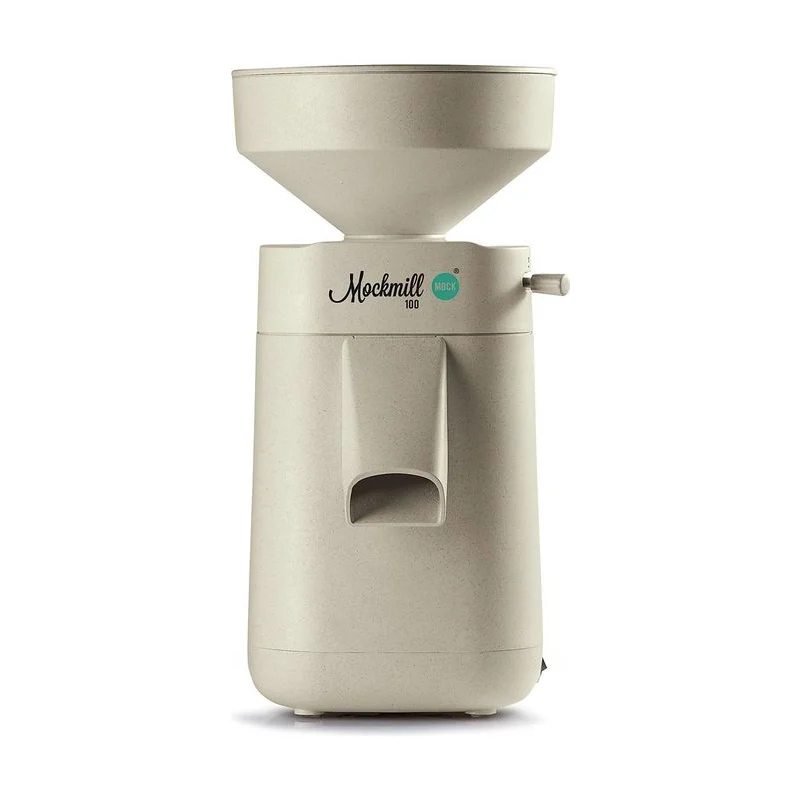
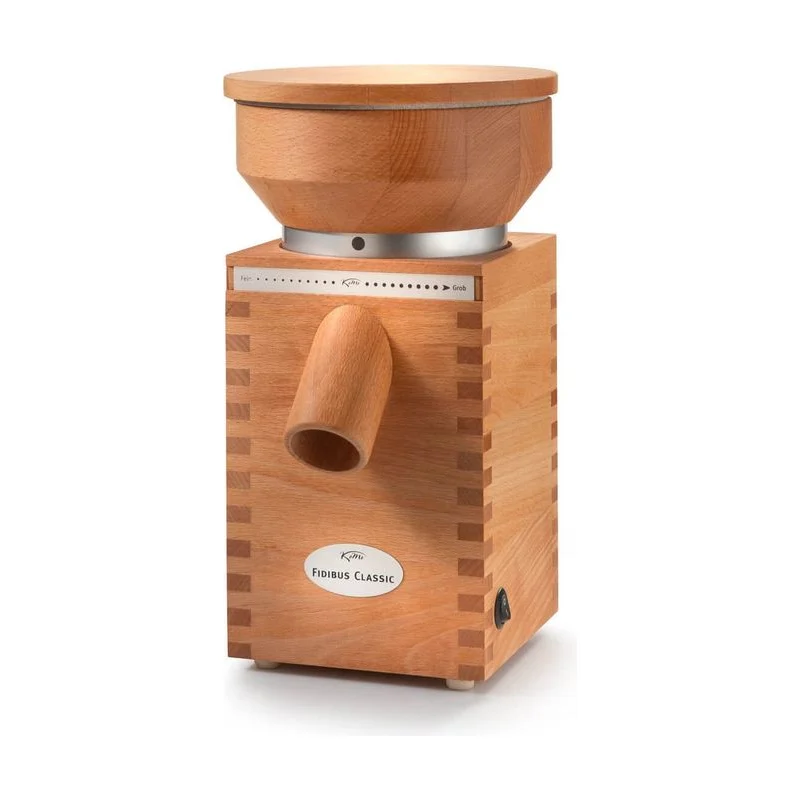
Every specification, side by side
| Attribute | Mockmill 100 | KoMo Fidibus Classic |
|---|---|---|
| Milling mechanism Wording differs | Corundum ceramic grinding stones mockmill.us product page | Stone burr; infinitely adjustable, self-sharpening, made of premium corundum ceramic komo.bio product page |
| Texture adjustment Wording differs | Stepless, variable from very fine to coarse mockmill.us product page | Stepless, set by turning the hopper komo.bio product page |
| Motor | 360 W mockmill.us product page | 360 watts komo.bio product page |
| Voltage | 110 V (US listing) mockmill.us product page | —No row for this attribute appears in the documents read for this mill. |
| Hopper capacity Figures differ | 1,100 g | 2 lbs 7 oz (wheat) mockmill.us product page | Approx. 1,000 g of wheat komo.bio product page |
| Flour container capacity | No container supplied; stated contents are the mill with hopper cover and the owner's manual mockmill.us product page | None supplied; scope of delivery is the mill with lid komo.bio product page |
| Milling speed | Approx. 1,100 RPM (owner manual states approx. 1,300 rpm at 110 V, 60 Hz) — the manufacturer’s own documents disagree on this figure. mockmill.us product page | —No row for this attribute appears in the documents read for this mill. |
| Milling rate | Approx. 100 g/min | approx. 3.5 oz/min (soft wheat) mockmill.us product page | —No row for this attribute appears in the documents read for this mill. |
| Dimensions Figures differ | 380 x 220 x 190 mm | 15 x 8.7 x 7.5 in mockmill.us product page | 33 × 16 × 21.3 cm (H × W × D) komo.bio product page |
| Weight Figures differ | 6 kg | 13 lbs 3.5 oz mockmill.us product page | 8 kg komo.bio product page |
| Housing Figures differ | Terluran GP-35 mockmill.us product page | Solid beech wood, treated with high-quality plant oils komo.bio product page |
| Warranty Figures differ | 6 years, non-commercial use mockmill.us product page | 12 years on household grain mills komo.bio product page |
| Country of manufacture Wording differs | Germany mockmill.us product page | Austria pleasanthillgrain.com product page |
| Millstone diameter | —No row for this attribute appears in the documents read for this mill. | Ø 85 mm komo.bio product page |
What a warranty term is, once it is printed in years

Mockmill vs KoMo: both mill on corundum ceramic stones at 360 watts
What this section establishes
- The Mockmill 100 and the KoMo Fidibus Classic both grind between corundum ceramic stones driven by a 360-watt motor, and the published milling rates read approx. 100 g/min for soft wheat from Mockmill against 100 g/min for wheat from KoMo.
- The housings are the split: Terluran GP-35 on the Mockmill 100, solid beech wood treated with high-quality plant oils on the Fidibus Classic.
- Mockmill’s household warranty runs 6 years from the date of purchase; KoMo’s runs 12 years from the invoice date.
Both mills grind between corundum ceramic stones. Mockmill’s grinding-mechanism row states corundum ceramic grinding stones, and the Mockmill 100/200 manual gives the same material as corundum ceramic milling stones. KoMo’s grinder row states infinitely adjustable, self-sharpening, made of premium corundum ceramic, and Pleasant Hill Grain’s specification tab lists the burr material as ceramic-corundum. Stone here means an abrasive burr surface that grinds grain in the gap between two discs, as distinct from an impact chamber that shatters grain against spinning heads. Neither of these mills is an impact mill, so the usual first fork in a grain mill decision is already closed before this comparison starts.
Motor power is identical as published. Mockmill states 360 W on the US listing, 360W on the manufacturer’s own shop table, and 360 W in the manual’s technical details block for the smaller of the two models that manual covers. KoMo states 360 watts under performance, describes a powerful 360-watt industrial motor in its product copy, and Pleasant Hill Grain restates it as 360W, half a horsepower. Mockmill’s equivalent description is the bullet sturdy industrial motor. Both phrases are manufacturer characterizations rather than motor classifications; neither company states a motor type, an amperage or a duty cycle behind them.
What is left to decide, then, is the case around the stones, the control an owner turns, the warranty each company grants and the amount of servicing detail each is prepared to publish. On those four the two mills separate sharply, and the separation is documented rather than inferred. The full published specification for each is set out at Mockmill 100 Stone Grain Mill and at KoMo Fidibus Classic Grain Mill.
| Specification | Mill | As its own document states it | Read from |
|---|---|---|---|
| Milling mechanism | Mockmill 100 | Corundum ceramic grinding stones | mockmill.us product page |
| Milling mechanism | KoMo Fidibus Classic | Infinitely adjustable, self-sharpening, made of premium corundum ceramic | komo.bio product page |
| Motor power | Mockmill 100 | 360 W | mockmill.us product page |
| Motor power | KoMo Fidibus Classic | 360 watts | komo.bio product page |
| Milling rate | Mockmill 100 | Approx. 100 g/min (soft wheat) | mockmill.us product page |
| Milling rate | KoMo Fidibus Classic | 100 g/min (wheat) | komo.bio product page |
| Hopper capacity | Mockmill 100 | 1,100 g (wheat) | mockmill.us product page |
| Hopper capacity | KoMo Fidibus Classic | Approx. 1,000 g (wheat) | komo.bio product page |
| Housing | Mockmill 100 | Terluran GP-35 | mockmill.us product page |
| Housing | KoMo Fidibus Classic | Solid beech wood, treated with high-quality plant oils | komo.bio product page |
| Millstone diameter | Mockmill 100 | No diameter published | Not stated in any document read for this page. |
| Millstone diameter | KoMo Fidibus Classic | 85 mm | komo.bio product page |
| Dimensions | Mockmill 100 | 380 x 220 x 190 mm (15 in x 8.7 in x 7.5 in) | mockmill.us product page |
| Dimensions | KoMo Fidibus Classic | 33 x 16 x 21.3 cm, height by width by depth | komo.bio product page |
| Cable length | Mockmill 100 | Approx. 150 cm | mockmill.us product page |
| Cable length | KoMo Fidibus Classic | 1.5 m | komo.bio product page |
| Warranty, household use | Mockmill 100 | 6 years from the date of purchase | Owner manual (PDF) |
| Warranty, household use | KoMo Fidibus Classic | 12 years, calculated from the invoice date | komo.bio product page |
| Country of manufacture | Mockmill 100 | Germany | mockmill.us product page |
| Country of manufacture | KoMo Fidibus Classic | Made in Austria | komo.bio product page |
| Flour container | Mockmill 100 | None supplied; the stated contents are the mill with its hopper cover and the owner’s manual | mockmill.us product page |
| Flour container | KoMo Fidibus Classic | None supplied; KoMo states the bowl shown in its photography is not included | komo.bio product page |
Rows are paired so the two mills can be read against each other, and a figure published on one side only says so on the other. Published weight is not tabulated here because each maker’s own figures conflict; those figures are set out with their documents in the housing section that follows. No row exists for noise, stone service life or flour temperature, because no document read publishes those for either mill.
Beech and Terluran GP-35: what each housing is made of
What this section establishes
- KoMo states solid beech wood treated with high-quality plant oils, with wooden mortise and tenon joints for maximum stability; Mockmill states Terluran GP-35 and publishes no joinery description at all.
- Published weight disagrees inside each maker’s own documentation: 6 kg on Mockmill’s US listing against 6.6 kg in its current manual and its shop, and 8 kg from KoMo against 16.5 lbs and 15 lbs 4 oz from its US importer on one page.
- Every pairing of the published weights puts the beech mill heavier than the plastic one, including the narrowest available, KoMo’s lightest 15 lbs 4 oz against Mockmill’s heaviest 14 lbs 9 oz.
- Housing thickness, impact resistance, finish maintenance and expected housing life are not stated by either manufacturer on any document read.
KoMo’s housing material row states solid beech wood, treated with high-quality plant oils. A second row in the same table states high-quality wooden mortise and tenon joints for maximum stability, a joint in which a projecting tongue seats into a matching cavity cut in the mating piece. Under its advantages list KoMo states solid local beech wood from sustainable forestry, oiled with natural plant oils, which is marketing copy rather than a certification claim. The certification sits on the importer’s side only: Pleasant Hill Grain’s specification tab lists PEFC under certifications and marks the mill BPA free. Neither of those entries states which component of the mill it applies to.
The Mockmill 100 casing row states Terluran GP-35 on the US listing, and the manufacturer’s own shop table repeats it as Terluran GP-35 under housing. The current owner’s manual shortens it to Terluran. Mockmill publishes no joinery description, no second structural material and no surface treatment; the housing is identified by trade name and nothing else. The compare table on mockmill.us carries the same Terluran GP-35 entry in its casing column, so three current Mockmill sources agree on the material even though none of them describes how the case is assembled.
Published weight is the only structural proxy either company offers, and both sets of figures are internally inconsistent. Mockmill’s US listing states 6 kg, 13 lbs 3.5 oz, while the current manual and the manufacturer’s shop both state 6.6 kg, 14 lbs 9 oz. KoMo states 8 kg; the US importer states 16.5 lbs on its specification tab and 15 lbs 4 oz in the table further up the same page. Taken at their heaviest published figures, 8 kg against 6.6 kg, the beech mill is roughly a fifth heavier than the plastic one. Taken at their lightest, 15 lbs 4 oz from the importer’s in-page table against 13 lbs 3.5 oz on the Mockmill US listing, the two sit about two pounds apart. No pairing is like for like: the 8 kg is KoMo’s own figure while both pound figures belong to the importer, and on the Mockmill side 6 kg comes from the US listing while 6.6 kg comes from the manufacturer’s own manual and its own shop. No source read states whether any of these are net or packaged weights, so the size of the gap is only approximately known. Its direction is not in doubt, though. Every combination of the published figures puts the beech mill heavier than the plastic one, including the narrowest pairing available, the KoMo’s lightest published weight against the Mockmill’s heaviest.
- Mockmill 100 housing: Terluran GP-35, stated on the US listing, on the manufacturer’s shop table and in the compare table; shortened to Terluran in the current manual.
- KoMo Fidibus Classic housing: solid beech wood treated with high-quality plant oils, with wooden mortise and tenon joints stated for maximum stability.
- Mockmill 100 published weight: 6 kg, 13 lbs 3.5 oz on the US listing; 6.6 kg, 14 lbs 9 oz in the current manual and on the manufacturer’s shop.
- KoMo Fidibus Classic published weight: 8 kg from KoMo; 16.5 lbs and 15 lbs 4 oz from the US importer, both on one page.
- Housing thickness, impact resistance, finish maintenance and expected housing life: not stated by either manufacturer on any source read.
The Mockmill casing description that changed, and the claim still standing beside it
Two Mockmill manuals describe the same casing differently. The 2019 English edition hosted on mockmill.us, which is the file the live US product page still links as the owner’s manual, states the casing as Arboblend made from renewable raw materials. The current edition hosted by the manufacturer states Terluran. Every specification table in circulation today states Terluran GP-35. No source read states when the material changed, whether it changed, or whether one of the two descriptions is simply stale.
The contradiction is also live inside a single page. On the manufacturer’s own shop listing, the bullet list states an innovative casing made from renewable materials directly above a specification row reading Housing: Terluran GP-35. A reader who takes the bullets at face value and a reader who takes the table at face value come away with two different materials, from the same page, on the same day.
This matters more on a build-material comparison than it would anywhere else, because the renewable-materials wording is the single published line that would have put the Mockmill housing on comparable ground with KoMo’s beech. The specification tables do not support it. On the evidence read, the Mockmill 100 housing should be treated as Terluran GP-35, with the renewable-materials phrasing recorded as an unretracted older claim rather than a current specification.
KoMo carries no equivalent divergence on housing material. Beech is stated in the specification table, restated in the advantages list, and echoed by the importer. That is the one part of the KoMo documentation where three sources agree without qualification, and it is worth noting precisely because so much of the rest of the KoMo record does not.
KoMo publishes an 85 mm millstone diameter; Mockmill publishes none
What this section establishes
- Only one of these two mills has a published stone size: 85 mm from KoMo, against no diameter on the Mockmill US listing, the manufacturer’s shop, either edition of the manual or the compare table.
- The importer’s own two figures for that same KoMo stone differ: 3.35 in in its in-page table against 3.3 in on its specification tab.
- Grinding surface area cannot be compared and stone longevity is unpublished on both sides: no service life, no replacement interval and no replacement part appears in any document read.
KoMo publishes a stone diameter. Its specification table states millstones at 85 mm, and Pleasant Hill Grain’s in-page table states 3.35 inches for the diameter of the corundum-ceramic mill stones, which is the same figure converted. The same dealer’s specification tab states 3.3 inches, a rounding difference the page does not reconcile against its own table. Either way, a buyer comparing KoMo against another mill has a number to work with.
Mockmill publishes no stone diameter on any source read: not on the US listing, not on the manufacturer’s shop table, not in either edition of the manual, and not on the compare table. What Mockmill does publish is the arrangement. The manual’s disassembly sequence describes lifting off the top stone, the stator, after which the bottom stone, the rotor, is visible attached to the motor shaft, and a separate warning tells the owner not to lose the two small springs that support the upper stone. That is a sprung stator riding against a shaft-mounted rotor, described step by step, with no dimension attached to any part of it.
KoMo states that its stones are self-sharpening. Mockmill makes no such claim about its stones in any source read. Neither manufacturer publishes stone service life, a replacement interval, a replacement part or a procedure for changing stones. Self-sharpening is KoMo’s own word for its own product and is reported here as a manufacturer statement; it is not a measured durability figure and should not be read as one.
The practical consequence for anyone deciding on long-term serviceability is that grinding surface area cannot be compared between these two mills. KoMo’s 85 mm is a published number; Mockmill’s stones are a published description. Any claim that one mill has larger or smaller stones than the other rests on nothing either manufacturer has put in writing.
Mockmill's numbered 1-to-10 lever against KoMo's turning hopper
The Mockmill 100 adjusts steplessly by a screw-in lever travelling across a numbered scale from 1 to 10. The manual states that the setting is pre-adjusted so a quiet sound of the stones touching is audible at lever position 1 when the mill idles without grain, that this is the finest setting, and that higher settings give coarser results. The lever can also be loosened and re-indexed at the ends of its travel, which shifts the whole 1 to 10 range coarser or finer without changing the scale itself. Milling grades are stated as variable from very fine to coarse on the US listing and variable from very fine to very coarse in the manual.
The KoMo Fidibus Classic adjusts by turning the hopper itself. KoMo’s operating sequence for its electric mills gives adjust the desired fineness by turning the hopper as step 4, and permits readjusting fineness at step 6 either while the grinder is empty or while grinding. Turning counter-clockwise moves toward coarse, and turning far enough counter-clockwise lifts the hopper off entirely; the product page states tool-free opening among its practical advantages. The manual’s calibration tip is to run the mill empty, turn toward fine until the stones are audibly grinding on one another, then back off toward coarse until the noise stops, which it identifies as the finest usable setting.
The two controls differ most in what they leave an owner with afterwards. Mockmill’s scale is numbered, and its manual tabulates a lever setting against each food it permits, with wheat at 1, oats at 3, chickpeas at 4 to 5, star anise at 2 to 3 and tonka beans at 9 to 10, so repeating a texture is a number that can be written down. KoMo’s front-of-mill coarse and fine markings are referenced only by the US importer, in an instruction to turn the hopper counterclockwise one half hopper turn past the coarsest indicated setting on the front of the mill for cracking dent corn. KoMo itself publishes no numbered scale and no per-ingredient setting table.
Operating rules differ as well. Mockmill’s manual states in bold that the mill is always switched on before the hopper is loaded, and that it is not switched off while it is milling. KoMo’s electric-mill sequence carries no equivalent order-of-operations rule, and explicitly permits adjustment mid-grind, which the Mockmill manual does not grant. Neither manufacturer states how many discrete settings exist; both describe the adjustment as stepless, and no source read gives a count.
Opening a Mockmill 100 and a KoMo Fidibus Classic: what each manual permits
Disassembly on the Fidibus Classic starts with the same control used for texture. KoMo’s manual states that the hopper is turned toward coarse, counter-clockwise, until it can be removed, and the product page states tool-free opening as a practical advantage. That gives access to the grinding chamber without a screwdriver, and the same access route is repeated in the manual’s chapters on the flour sifter and on the interchangeable milling unit. KoMo also sells an optional 360-watt interchangeable grinding mechanism, which it states will transform the mill into a spice or coffee mill; it is a paid accessory rather than part of the delivery.
The Mockmill 100 opens by lifting the stator off, after which the rotor is visible on the motor shaft. The manual’s handling instructions are unusually specific about the housing: the spout cover, which the manual calls the mill’s nose, is never used as a handle because it is not made to resist the unit’s weight and may break off, and the mill is lifted by the base or by cradling the hopper instead. The manual’s transport-lock removal step is marked as applying only to the Mockmill 200, so an owner of the 100 has no lock to remove before first use.
Set out side by side, the documented owner-serviceable actions look like this.
- Mockmill 100: lifting the stator off, the rotor visible on the motor shaft, and the two small springs supporting the upper stone.
- Mockmill 100: how the mill is lifted and carried, with an explicit warning against using the spout cover as a handle.
- Mockmill 100: the order of operations, switch on first and load the hopper second, stated in bold and repeated in the quick guide.
- KoMo Fidibus Classic: hopper removal by turning counter-clockwise toward coarse, stated as tool-free.
- KoMo Fidibus Classic: a calibration procedure for finding the finest usable setting by ear, run with the mill empty.
- KoMo Fidibus Classic: the troubleshooting note that switching off due to overheating only takes place in case of overload, after which the device is disconnected and left to cool at least twice as long as the preceding grinding run.
- Neither mill: stone replacement, spare-part availability, or any repair procedure beyond cleaning and reassembly.
Cleaning: Mockmill bars water from the stones, KoMo publishes no water rule
What this section establishes
- Mockmill’s manual forbids water on the millstones and submersion of the mill outright, while no KoMo document read states a water restriction of any kind.
- Mockmill’s manual orders an immediate cleaning run after any milling that has included oilseeds; the only cleaning medium on the KoMo side, rice, is the US importer’s instruction attached to dehulled oats rather than KoMo’s own.
- Coffee is the one ingredient the two makers answer in opposite directions: permitted on KoMo’s device chart for the Fidibus Classic, excluded by Mockmill’s manual on the stated ground of oil content.
Mockmill’s cleaning restriction is absolute on water. The manual states that the mill is never submerged in water or any other liquid, that the casing is wiped with a slightly damp cloth, that no water should enter the mill, and that the millstones should never be cleaned with water or a wet cloth. Its stated reason for excluding oily foods concerns the same surface: nuts and oily foods such as sesame, flax or poppy seeds, and coffee beans, leave a film on the milling stones that renders them incapable of processing grain properly. The manual instructs an immediate cleaning run after any milling that has included oilseeds.
KoMo’s stone-preservation rules are different in kind. Its manual states that flour is ground only once, because re-milling already-ground flour would cause the millstones to smear. It warns that non-purified raw food often contains small stones that might damage the device. Its general rule for what may be milled is that anything not oily or fatty and not moist is suitable, and it names nuts and oily seeds such as flaxseed, oats and poppy seeds as not belonging in a grain mill. Damp grain, KoMo states, could clog the grinding stones.
Coffee is the sharpest split between the two mills, and it falls squarely on the stones. KoMo’s device chart marks coffee as permitted for the Fidibus Classic, and the product page states the mill grinds soft and hard grains, corn, legumes or coffee beans; the US importer narrows that to roasted beans only, avoiding oily and dark roasts. Mockmill excludes coffee beans outright, on the stated ground that they contain a great deal of oil. Two mills with nominally the same stone material, and two manufacturers giving opposite instructions about the same bean.
Each documentation set also contradicts itself on an ingredient that bears directly on stone fouling. KoMo names oats among the oily seeds that do not belong in a grain mill, while KoMo’s own manual lists oat under what may be ground and the US importer lists dehulled oats as permitted with caution, in small quantities, cleaning the stones afterwards with rice. Mockmill’s permitted table gives chia seeds a lever setting of 6 to 7 despite the same manual’s general instruction to avoid oilseeds, and the manual does not reconcile the two. Neither of these is a reason to prefer one mill over the other; both are reasons to read the manufacturer’s own list before the first run rather than after it.
The two maintenance regimes are documented at very different depths, and that difference is itself the finding. Mockmill’s manual writes its water rule out in full: the mill is never submerged in water or any other liquid, the casing is wiped with a slightly damp cloth, no water should enter the mill, and the millstones should never be cleaned with water or a wet cloth. KoMo publishes no cleaning-with-water restriction at all on any source read. Its stone-preservation instructions govern what enters the mill rather than what touches the stones afterwards: flour is ground only once because re-milling would smear the millstones, damp grain is kept out because it could clog them, and grain is purified first because non-purified raw food often contains small stones that might damage the device. A KoMo owner looking for the Mockmill’s water prohibition will not find it published, and an instruction that is absent from the documentation is a gap in the documentation rather than a permission.
Rice as a cleaning medium appears once across both documentation sets, and narrowly. Pleasant Hill Grain attaches it to dehulled oats on its caution list for the 360 and 600-watt KoMo mills, the Classic among them, as the condition small quantities, clean the stones with rice. No source read states it as a general step after oily foods, and it is the importer’s instruction rather than KoMo’s own. Mockmill’s post-oilseed step, noted above, is itself a cross-reference: the manual directs the owner to clean the mill as described on its own cleaning page rather than restating a procedure at that point. The overlap between the two mills is therefore smaller than a single maintenance rule would suggest. Both manufacturers require dry grain and both warn that uncleaned grain can carry small stones into the milling chamber; past that point each manual states restrictions the other does not, so the cleaning routine to follow is the one in the manual belonging to the mill actually owned. The routine that stone mills generally require is set out at Cleaning and maintaining a grain mill.
Never submerge the Mockmill in water or any other liquid. Wipe the casing clean with a slightly damp cloth. It is important that no water enter the mill. The millstones should never be cleaned with water or a wet cloth!
Mockmill's six-year warranty against KoMo's twelve, and whose word governs a claim
What this section establishes
- Six years against twelve, on clocks that start from different published events: the date of purchase for Mockmill, the invoice date for KoMo.
- Mockmill’s permitted-ingredient table doubles as a warranty document: the manual states that milling anything outside its pages 14 to 16 can damage the mill and void the warranty.
- KoMo’s own grinding guidance is not what governs a US claim. Pleasant Hill Grain states that its claims of what each mill can and cannot grind are the only relevant claims with respect to the warranty on all US customers’ mills.
Mockmill states a 6-year warranty for non-commercial use on the US listing. The manual gives the fuller wording: the mill is guaranteed by Wolfgang Mock GmbH for home use against material and manufacturing defects for a period of 6 years from the date of purchase, with fragile parts excluded, and the owner is asked to register the device online at the manufacturer’s shop to ensure that the warranty is valid. That registration line is phrased as a request rather than as a stated condition, but it is the only registration step either manufacturer mentions anywhere. The manufacturer’s shop table then adds a term neither the US listing nor either manual carries: a 2-year warranty for commercial use, listed alongside the 6 years.
KoMo states 12 years, in three places. The site-wide footer block states a 12-year warranty; the US importer states 12 years on both its specification tab and its in-page table; and the warranty page carries the granting sentence itself. That sentence is served in German even on the English version of the page, and it is narrower than the headline: twelve years on household grain mills with the hand mill excluded, three years on flakers, the hand mill and the KoMoMix+, and two years on professional devices. The same page states that the period for calculating the warranty duration begins on the invoice date.
The two clocks therefore start from different events as published, date of purchase for Mockmill and invoice date for KoMo, and both terms are tied to what enters the hopper. Mockmill’s manual states that milling foods or substances other than those listed on its pages 14 to 16 can damage the mill and void the warranty, which makes its permitted table a warranty document as much as a recipe guide. On the KoMo side the authority sits with the importer: Pleasant Hill Grain states that its claims of what each mill can and cannot grind are the only relevant claims with respect to the warranty on all US customers’ mills, which means a US buyer is governed by the dealer’s list rather than by KoMo’s.
Who an owner would actually contact is not perfectly settled in either case. Mockmill’s current manual gives Wolfgang Mock GmbH, Marie-Curie-Str. 5, 64823 Groß-Umstadt, Germany on its back cover, while the 2019 edition still linked from the US product page gives a different German address and additionally names a US entity in Delaware. KoMo’s warranty page gives KoMo GmbH & CO. Kg, Mühltal 4, 6305 Itter, while the English owner’s manual dated February 2021 gives Penningdörfl 6, 6361 Hopfgarten. Both KoMo addresses are in Austria, and no source read explains the difference between them.
The manuals also differ in how closely each addresses the actual model. Mockmill’s manual is written for the 100 and the 200 together, gives a single set of dimensions for both, and splits paired figures such as 360 W / 600 W and 6.6 kg / 8 kg without labelling which belongs to which model. KoMo’s manual is written for all its mills and flakers and never names the Fidibus Classic at all, so every procedure in it is generic to the range. Country of manufacture is stated as Germany for the Mockmill 100 on both its US listing and the manufacturer’s shop; for the Fidibus Classic it is stated as Austria on the importer’s specification tab, while KoMo’s own site carries a Made in Austria link rather than a product-page specification row.
Der Hersteller (KoMo GmbH & CO. Kg) gewährt 12 Jahre Garantie auf Haushaltsgetreidemühlen (Handmühle ausgeschlossen), 3 Jahre auf Flocker, Handmühle, KoMoMix+ und 2 Jahre auf Profigeräte.
Where the Mockmill and KoMo documents disagree with themselves and with the US importer
Both documentation sets carry unresolved internal contradictions, and each is worth listing because it is a specification a buyer would otherwise treat as settled. None of the following is a disagreement between this page and a manufacturer. Each is a disagreement between two manufacturer or authorised-dealer sources describing the same mill.
Mockmill’s contradictions are mostly chronological. An older manual and a newer one describe the same part differently, and the older file is still the one served from the live US listing, so both versions reach a buyer at once. The casing is the clearest case, the paired 100/200 figures in the technical details block are the subtlest, and the rpm disagreement runs across three sources including the manufacturer’s own shop contradicting the manufacturer’s own manual.
KoMo’s contradictions are mostly cross-party. The manufacturer and the exclusive US importer publish different numbers for the same mill, on weight, width, cord length and throughput, and the importer disagrees with itself on stone diameter and weight within one page. The one genuinely self-contained KoMo conflict is household size, where the same product page states 1 to 2 people in one position and 3 to 5 in the specification table.
Neither pattern can be resolved from outside the two companies, and neither is offered here as an error on anyone’s part. What both patterns do establish is a practical point for a buyer weighing serviceability: the document that will govern a warranty claim is not always the document a buyer read before purchase, and on the KoMo side the importer has stated in writing that its version is the one that counts for US customers.
The itemized conflicts, mill by mill and source by source, are these.
- Mockmill weight: the US listing states 6 kg, 13 lbs 3.5 oz; the current manual, the 2019 manual and the manufacturer’s shop all state 6.6 kg.
- Mockmill milling speed, three ways: the US listing pairs 110 V with approximately 1,100 rpm; both manuals pair 110 V at 60 Hz with approximately 1,300 rpm and 230 V at 50 Hz with approximately 1,100 rpm; the manufacturer’s shop states approximately 1,300 rpm at 50 Hz, contradicting its own manual.
- Mockmill casing: Terluran GP-35 in every current specification table, Arboblend made from renewable raw materials in the 2019 manual still linked from the US product page, and an innovative casing made from renewable materials in the shop’s own bullet list directly above the Terluran row.
- Mockmill milling grades: variable from very fine to coarse on the US listing, variable from very fine to very coarse in the manual.
- Mockmill commercial use: the US listing and the manual state the mill is intended for home use and is not designed for commercial use, while the manufacturer’s shop simultaneously advertises a 2-year warranty for commercial use.
- KoMo weight, three ways: 8 kg from KoMo, 16.5 lbs on the importer’s specification tab, 15 lbs 4 oz in the importer’s in-page table.
- KoMo width: 16 cm from KoMo against 7.8 inches from the importer, a gap of about an inch and a half, while height and depth agree to within half an inch.
- KoMo milling capacity: 100 g per minute for wheat from KoMo against 8 to 9 oz per minute for a bread flour texture from the importer, roughly two and a half times higher, with neither source stating the fineness setting it measured at.
- KoMo cable: 1.5 m from KoMo against a 47-inch cord from the importer for the US unit.
- KoMo stone diameter: 3.35 inches in the importer’s in-page table against 3.3 inches on the same page’s specification tab.
- KoMo household size: 1 to 2 people stated near the product title against households with 3 to 5 people in the specification table on the same page.
- KoMo clearance beneath the spout: 12.3 cm from KoMo against a maximum bowl height at the spout of 5.5 inches, about 14 cm, from the importer.
- KoMo manufacturer address: Mühltal 4, 6305 Itter on the warranty page against Penningdörfl 6, 6361 Hopfgarten in the February 2021 manual.
- KoMo oats: named among oily seeds that do not belong in a grain mill on KoMo’s own overview page, listed under what may be ground in KoMo’s manual, and permitted with conditions by the importer.
Where the Mockmill 100 and the Fidibus Classic are genuinely equivalent
Motor power is the same published figure on every source read for both mills: 360 watts. Both manufacturers describe that motor as industrial, and neither states a motor type, an amperage, a class or a duty cycle behind the word. Grinding surface material is nominally the same as well, corundum ceramic in both, stated by both manufacturers and confirmed by the US importer on the KoMo side.
Hopper capacity for wheat lands within roughly a tenth of each other. Mockmill states 1,100 g, 2 lbs 7 oz, with its compare table rounding the same figure to 2.4 lbs; KoMo states approximately 1,000 g and the importer measures it as 2 lb 1 oz level with the lid on. Neither mill ships a flour container. Mockmill’s stated contents are the mill with its hopper cover and the owner’s manual, KoMo’s scope of delivery is the mill with lid, and KoMo adds explicitly that the bowl shown in its photography is not included. A catch bowl or container is a separate purchase either way.
Published wheat throughput from each manufacturer matches exactly: approximately 100 g per minute, approximately 3.5 oz per minute, stated by Mockmill for soft wheat and by KoMo for wheat. The importer’s much higher 8 to 9 oz per minute figure for a bread flour texture is the only number that breaks that tie, and it is stated without a fineness setting, so it cannot be lined up against Mockmill’s figure on equal terms.
Both mills adjust steplessly rather than in fixed steps. Both exclude oily and fatty foods as a category, though only one of them publishes a reason for it. Mockmill’s manual states the rationale on the stones: nuts and oily foods such as sesame, flax or poppy seeds, and coffee beans, leave a film on the milling stones that renders them incapable of processing grain properly. KoMo states the exclusion and not the reason, as the general rule that anything not oily or fatty and not moist is suitable, with nuts and oily seeds such as flaxseed, oats and poppy seeds named as not belonging in a grain mill and oilseeds marked with a cross against the Fidibus Classic on its device chart. The only stone rationales KoMo publishes anywhere are smearing from re-milling already-ground flour and clogging from damp grain. The exclusion is shared; the published reasoning behind it is not. Both manufacturers state that their mill is not intended for commercial use, KoMo with an exception carved out for its own professional devices. Both cables are stated at approximately 1.5 m by their manufacturers, though the KoMo importer publishes a shorter cord for the US unit. Both mills come from German-speaking Europe, Germany for the Mockmill and Austria for the KoMo. And neither publishes a noise rating: no decibel figure appears for either mill on any source read.
What the Mockmill and KoMo documents cannot settle
Nothing here is a durability test. No source read publishes a service life for the stones, the motor or the housing of either mill, so the six-year and twelve-year warranty terms are the only published proxy for expected longevity, and a warranty is a commercial commitment rather than a measurement. Twelve years is twice six years; that is a fact about two documents, not a fact about two machines.
Beech against Terluran GP-35 cannot be ranked from the published evidence. Neither manufacturer states housing thickness, impact resistance, moisture tolerance, or how either surface behaves after a decade in a working kitchen. KoMo publishes a plant-oil finish without stating whether or at what interval it needs re-treating. Mockmill publishes a trade name and nothing else about its case at all.
Serviceability beyond cleaning is undocumented on both sides. No source read gives a spare-part list, a stone replacement procedure, a repair-service address distinct from the warranty contact, or even a statement that the stones are replaceable. Both manuals stop at disassembly for cleaning and reassembly afterwards, and KoMo’s manual is generic to its whole range rather than specific to this model.
Several performance figures are missing or unusable for comparison. Neither manufacturer publishes flour temperature or nutrient retention. KoMo publishes a grind fineness of finer than 0.3 mm with its own hedge attached, that depending on the measuring method up to 90% falls below this size, while Mockmill publishes no particle-size figure at all, so fineness cannot be compared between them. Motor speed exists only on the Mockmill side and its three published figures contradict each other; KoMo publishes no rpm for the Fidibus Classic. Neither publishes a maximum continuous run time, and KoMo’s only thermal statement is a troubleshooting exclusion rather than an advertised protection feature.
Neither mill has been handled. Every statement above comes from manufacturer product pages, manufacturer owner’s manuals and authorised-dealer specification sheets, and where those sources disagree the disagreement is reported rather than resolved. Where a figure is absent it is absent because no source read publishes it, not because it was judged unimportant.
Does the KoMo Fidibus Classic last longer than the Mockmill 100?
Neither manufacturer publishes a service life, so the question cannot be answered from evidence. What can be stated is what each company commits to in writing. Wolfgang Mock GmbH guarantees the Mockmill 100 for home use against material and manufacturing defects for six years from the date of purchase, with fragile parts excluded and online registration requested. KoMo grants twelve years on household grain mills, calculated from the invoice date, in a sentence published in German on the English warranty page. Both terms are limited to household use. A buyer comparing longevity should treat those two numbers as the extent of the published evidence, and should ask either seller in writing whether the millstones count as wear parts, because neither warranty text read says either way.
Can the Mockmill 100 or the KoMo Fidibus Classic grind coffee beans?
KoMo permits coffee on the Fidibus Classic and Mockmill excludes it. KoMo’s device chart marks coffee as permitted for this model, and its product page states that the mill grinds soft and hard grains, corn, legumes or coffee beans; the US importer narrows that to roasted beans only, avoiding oily and dark roasts, and on the importer’s own statement that narrower guidance is what governs warranty service for US customers. Mockmill’s manual excludes coffee beans on the stated ground that they contain a great deal of oil, which leaves a film on the milling stones. The mills use nominally the same stone material and receive opposite instructions, so follow the manual belonging to the mill actually owned: Mockmill states that milling foods other than those it lists can damage the mill and void the warranty.
Do the corundum ceramic stones ever need replacing?
No source read says. KoMo states that its stones are self-sharpening, which is the manufacturer’s characterization of its own product rather than a lifespan figure, and Mockmill makes no equivalent statement about its stones. Neither company publishes a replacement interval, a replacement part, or a stone-changing procedure. The Mockmill manual describes lifting the stator off for cleaning and the KoMo manual describes turning the hopper off for the same purpose, and both stop there. What both do publish is what shortens stone life: oil films from nuts, oilseeds and coffee on the Mockmill side, and smearing from re-milling already-ground flour on the KoMo side, plus damage from uncleaned grain containing small stones, which both warn about.
Is the beech housing more durable than the Mockmill plastic?
Not established by anything either company publishes. KoMo states solid beech treated with plant oils, with mortise and tenon joints specified for maximum stability; Mockmill states Terluran GP-35 and gives no structural description at all. Neither states thickness, impact resistance or expected housing life, so the two cannot be ranked on published evidence. One related point is settled, though: for the Mockmill, the current specification tables all state Terluran GP-35, while the renewable-materials wording survives in an older manual still linked from the US listing; a bullet on the manufacturer’s own shop page carried it too until Mockmill revised that bullet between 12 September and 22 October 2026. Treat the specification tables as current and the renewable-materials phrasing as an unretracted older claim.
When does each warranty start, and what can void it?
Mockmill’s term runs six years from the date of purchase and KoMo’s runs twelve years from the invoice date. Mockmill’s manual excludes fragile parts, asks the owner to register the device online so that the warranty is valid, and states that milling foods or substances other than those on its permitted pages can damage the mill and void the warranty. KoMo’s granting sentence, published in German on the English warranty page, restricts the twelve-year term to household grain mills and gives shorter terms for flakers, the hand mill and professional devices. For a US KoMo buyer the operative ingredient list is the importer’s rather than KoMo’s, because Pleasant Hill Grain states that its claims of what each mill can and cannot grind are the only relevant claims with respect to the warranty on all US customers’ mills.
The documents this page was read from
- Mockmill 100 Stone Grain Mill — product page, mockmill.us (Wolfgang Mock GmbH's listed USA Partner; reproduces the manufacturer specification table)
- Mockmill 100 — product page on the manufacturer's own webshop, grainlovers.shop (Wolfgang Mock GmbH)
- Operating Instructions Mockmill 100 / Mockmill 200 (English) — current owner's manual, hosted by Wolfgang Mock GmbH
- Operating Instructions Mockmill 100 / Mockmill 200 (English) — 2019 edition hosted on mockmill.us and linked from the product page as the Owner's Manual
- Compare Mockmills — model comparison table, mockmill.us
- KoMo Fidibus Classic grain mill — official product page (English), komo.bio
- KoMo warranty terms page, komo.bio (granting sentence served in German)
- KoMo Overview of milled product — which KoMo devices process which materials
- KoMo Operating Instructions for Mills and Flakers (English owner's manual, KoMo GmbH & Co. KG, February 2021)
- Pleasant Hill Grain — KoMo Classic product page and Specs tab (exclusive US importer of KoMo mills)
- Pleasant Hill Grain — What Can You Grind in Your KoMo Grain Mill (authorised-dealer grinding list PDF)
Where to buy either mill, and the documents behind these figures
Prices and availability are on the seller’s site. Amazon links are affiliate links; we may earn a commission at no extra cost to you. Other seller links are unpaid.
- Publication
- By Millwright
- Source
- Manufacturer documentation
- Updated